Key Applications of Artificial Intelligence in Management
Benefits of AI in Management
Key Insights
AI supports better decision-making: AI in management helps leaders analyze large volumes of data, identify trends, forecast outcomes, and make faster, more informed decisions.
AI supports better decision-making: AI in management helps leaders analyze large volumes of data, identify trends, forecast outcomes, and make faster, more informed decisions.
AI offers multiple business benefits: It can improve productivity, reduce operational costs, strengthen risk management, enhance customer and employee experiences, and support business scalability.
Responsible AI adoption is essential: Organizations need to address challenges such as algorithmic bias, data privacy, poor data quality, and employee resistance through human oversight, ethical guidelines, and proper training.
In this blog, you'll learn what AI in management means, its key applications and benefits, how it is changing managerial roles, future trends in AI-powered business leadership, and the steps organizations can take to adopt AI effectively.
Business leaders have always relied on information to make decisions. What has changed in recent years is the speed, scale, and sophistication with which that information can now be collected, analyzed, and acted upon. Artificial intelligenceis at the center of this shift. From forecasting demand to screening job candidates, AI tools are becoming part of the everyday toolkit of managers across industries.
Understanding AI in management is no longer optional for professionals who want to lead effectively. This blog explains what AI means for managers, where it is being applied, what benefits it offers, what challenges it brings, and how it may shape the future of business
AI in management refers to the use of intelligent software systems, such asmachine learning models, natural language processing tools, and predictive analytics, to support or automate managerial tasks. These systems learn from data, identify patterns, and generate insights or recommendations that help leaders make better decisions.
It is important to note that AI does not replace the manager’s role. Instead, it handles repetitive, data-heavy work so that leaders can focus on strategy, creativity, relationships, and judgment, the areas where human capabilities remain essential.
Organizations today operate in an environment of constant change. Customer expectations shift quickly, supply chains are complex, and competitors can launch new products overnight. Traditional methods of planning and reporting often struggle to keep up.
AI in business management helps address this gap in several ways:
It processes large volumes of data far faster than any human team.
It detects trends and risks that are easy to miss in spreadsheets.
It provides real-time insights, allowing quicker responses to market changes.
It reduces the time spent on routine administrative work.
As a result, companies that adopt AI thoughtfully often gain a meaningful competitive advantage in efficiency, customer experience, and decision quality.
Free Courses
Free Python Course with Certificate – Python for Data Analysis
Key Applications of Artificial Intelligence in Management
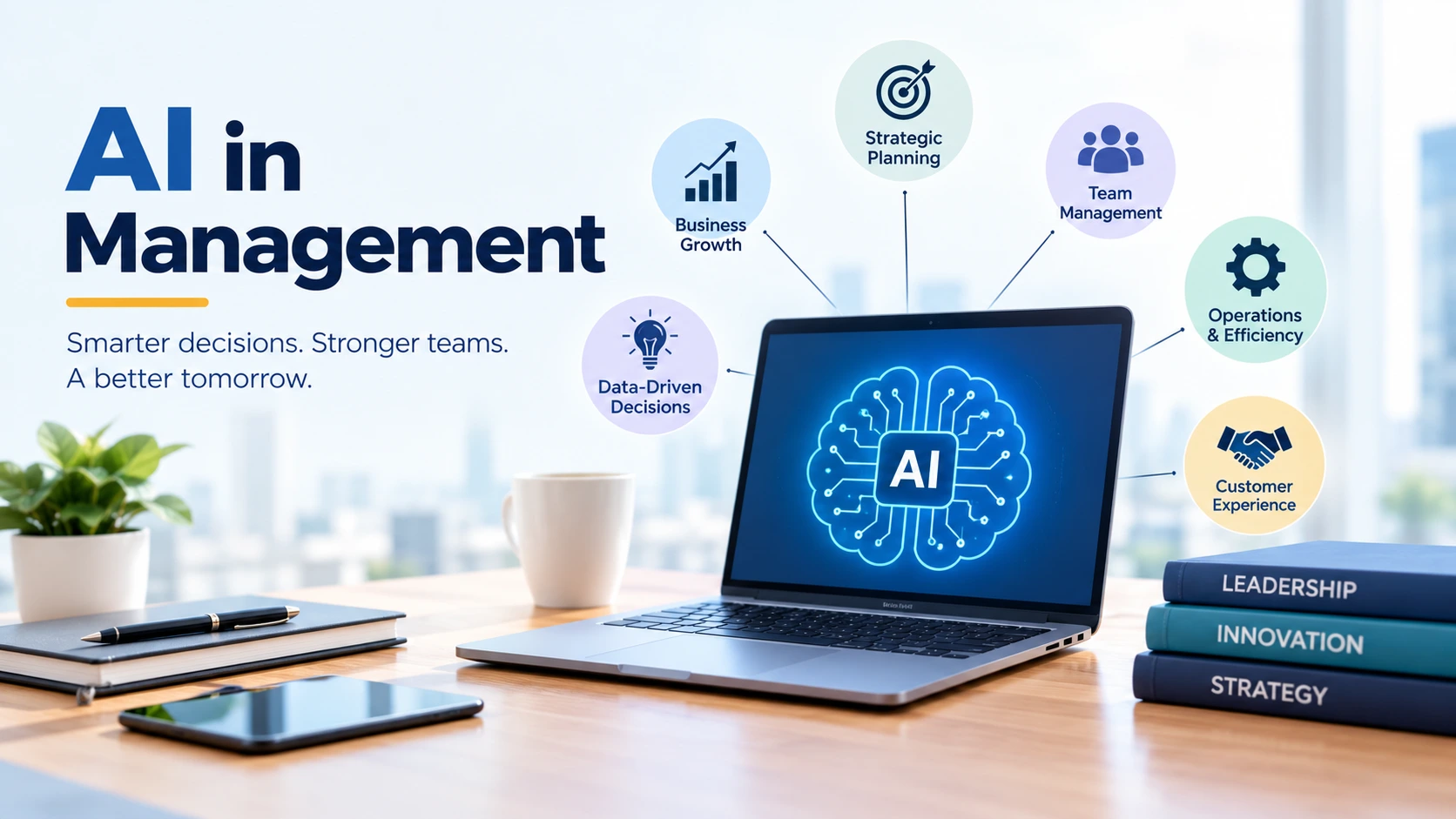
Artificial intelligence in management is not limited to one department. It supports nearly every functional area of a modern organization. The table below summarizes some of the most common applications.
Management Area
How AI Is Applied
Example Use Case
Strategic planning
Market analysis and scenario modeling
Forecasting industry trends and testing growth strategies
Leaders often face decisions with incomplete information. AI-powered analytics can combine internal data with external signals such as economic indicators, competitor activity, and customer sentiment. Managers can then test different scenarios and understand the likely outcomes before committing resources.
Human Resource Management
HR teams use AI to speed up recruitment, match candidates to roles, and personalize learning programs. Analytics can also highlight patterns in employee engagement, helping managers address concerns before they lead to resignations. However, organizations must ensure that these tools are monitored carefully so that they do not introduce bias into hiring or promotion decisions.
Financial Management
In finance, AI supports budgeting, cash flow forecasting, risk assessment, and fraud detection. Automated systems can reconcile accounts and generate reports in minutes, freeing finance professionals to focus on analysis and advisory work.
Marketing and Customer Experience
AI enables marketers to understand individual customer preferences and deliver tailored messages and offers. Chatbots and virtual assistants respond to common questions instantly, while sentiment analysis tools help companies understand how customers feel about their brand.
Operations and Supply Chain
Predictive models can anticipate when machinery needs maintenance, reducing costly breakdowns. In supply chains, AI helps forecast demand, optimize delivery routes, and balance inventory, which lowers costs and improves service levels.
Benefits of AI in Management
When implemented well, AI in management offers a range of benefits for both organizations and the people who lead them.
1. Faster and Better-Informed Decisions
AI can analyze complex datasets in seconds and present clear insights. This allows managers to base decisions on evidence rather than intuition alone, while still applying their own experience and judgment.
2. Improved Productivity and Efficiency
Automating routine tasks such as scheduling, data entry, report generation, and basic customer queries saves significant time. Teams can then devote more attention to high-value work that requires creativity and critical thinking.
3. Cost Reduction
By reducing errors, preventing equipment failures and optimizing resource use, AI can lower operational costs over time. Although the initial investment may be considerable, many organizations see a positive return as systems mature.
4. Better Risk Management
AI tools can monitor transactions, contracts, and market conditions continuously, alerting managers to potential risks early. This proactive approach supports stronger compliance and more resilient operations.
5. Enhanced Customer and Employee Experience
Personalized services, quicker responses, and tailored development opportunities improve satisfaction for customers and employees alike.
6. Scalability
AI systems can handle growing volumes of work without a proportional increase in staff, which helps businesses scale smoothly.
How the Role of Managers Is Changing
As AI takes over routine analysis and administration, the manager’s role is shifting toward areas where human strengths matter most. Future-ready leaders are expected to:
Interpret AI insights and ask the right questions
Make ethical decisions in situations that data alone cannot resolve
Build trust, motivate teams and manage change
Encourage continuous learning and experimentation
Collaborate across technical and non-technical teams
In other words, technical knowledge alone is not enough. Emotional intelligence, communication, and strategic thinking become even more valuable when machines handle much of the number crunching.
The Future of AI in Business Management
The future of AI in business management looks promising, and several trends are already taking shape.
Generative AI as a daily assistant: Tools that draft reports, summarize meetings, and suggest ideas are becoming common in the workplace.
Predictive and prescriptive analytics: Systems will not only forecast what may happen but also recommend what action to take.
AI-assisted leadership: Dashboards will give leaders a real-time view of performance, risks, and opportunities.
Responsible AI governance: Companies will increasingly adopt clear policies on transparency, fairness, and accountability.
Human-AI collaboration: Organizations will design workflows in which people and intelligent systems complement one another.
New career paths: Roles such as AI strategist, data translator, and AI ethics officer are gaining importance.
Professionals who understand both business fundamentals and AI capabilities will be well positioned to lead in this environment.
For companies beginning this journey, a gradual and structured approach works best:
Identify clear business problems: Start with specific goals, such as reducing processing time or improving forecast accuracy.
Prepare your data: Ensure that data is accurate, accessible, and secure.
Start small: Run pilot projects and measure results before scaling.
Train your people: Build AI literacy across teams, especially among managers.
Set ethical guidelines: Define how AI will be used and monitored.Review and improve: Continue refining systems based on feedback and outcomes.
Advance Your Leadership Journey with the IIM Mumbai MBA-BPGP Programme
The Blended Post Graduate Programme in Management (MBA-BPGP) by IIM Mumbai, offered in collaboration with Jaro Education, is designed for working professionals who want to strengthen their management expertise and prepare for leadership roles without putting their careers on hold. This two-year programme combines live online classes with mandatory campus immersions and covers key areas such as operations, supply chain management, marketing, finance, data science, environment, and human resources, with opportunities to specialize in the second year. Through case studies, group projects, interactive learning, and a capstone project, participants can develop strategic thinking,data-driven decision-making, and leadership skills. The programme also offers peer networking opportunities and IIM Mumbai alumni status for eligible graduates.
Want to know more about the IIM Mumbai MBA-BPGP programme? Call us for expert guidance on programme details, eligibility, and admission.
AI in management is reshaping how organizations plan, operate, and lead. It enables faster decisions, greater efficiency, and deeper insights, while also demanding responsible use, strong data practices, and continuous learning. The most successful leaders will not be those who rely entirely on technology, but those who combine intelligent tools with sound judgment, empathy, and vision. For professionals and businesses alike, building a solid understanding of artificial intelligence in management today is one of the best investments for tomorrow’s leadership.
Frequently Asked Questions
AI is used in management for forecasting, decision support, recruitment, financial analysis, customer service, supply chain planning, and project tracking. It helps managers process large amounts of data and act on insights more quickly.
It is unlikely that AI will fully replace managers. While it can automate routine tasks and provide recommendations, leadership, ethical judgment, creativity, and relationship building still require human involvement. The role is evolving rather than disappearing.
Managers benefit from data literacy, a basic understanding of how AI tools work, critical thinking, adaptability, and strong communication skills. Knowledge of ethics and data privacy is also increasingly important.
The main risks include biased algorithms, data privacy concerns, poor data quality, overreliance on automated outputs, and employee resistance to change. These can be reduced through clear governance, human oversight, and proper training.
Nuthana Reddy
Nuthana Reddy is a Senior Manager at Procter & Gamble, specializing in operations, digitization, and cross-functional leadership. She has driven multimillion-dollar impact through innovation, process optimization, and strategic execution across global markets.
Get Free Upskilling Guidance
Fill in the details for a free consultation
Related Courses
Explore our programs
Blended Post Graduate Program in Management MBA (MBA - BPGP)
 HOME > BLOG > Business Management > AI in Management: Applications, Benefits & Future of Business Leadership
 October 27, 2026
 6 min read




 Key Insights
 ChatGPT
 Perplexity
 Claude
 Grok









 ROI Calculator