Advantages and Disadvantages of Artificial Intelligence: A Complete Guide
J
By Dr. Sanjay Kulkarni
August 2, 20247 min read
Last updated on September 23, 2026
SHARE THIS ARTICLE
Table Of Content
What Is Artificial Intelligence, in Simple Terms?
Advantages of AI: Where the Technology Genuinely Helps
Disadvantages of AI: The Downsides You Should Not Ignore
Advantages and Disadvantages of Artificial Intelligence at a Glance
Key Insights
AI improves efficiency by automating repetitive tasks and helping people complete work faster.
AI supports better decisions by analysing large amounts of data, identifying patterns, and generating useful insights.
AI has certain limitations, including privacy risks, biased results, high implementation costs, and potential job displacement.
Responsible use matters because combining AI with human judgment and regular monitoring can help reduce errors and improve outcomes.
The advantages and disadvantages of AI vary by how the technology is used, making it important to consider both its benefits and potential risks before implementation.
Artificial intelligence has moved from research labs into everyday life faster than almost any technology before it. From the recommendations you see while shopping online to the chatbots that answer your support queries, AI is quietly running in the background of most digital experiences. But like every powerful tool, it comes with trade-offs. Understanding the advantages and disadvantages of artificial intelligence helps students, professionals, and business leaders make smarter decisions about where and how to use it.
This guide breaks down the real pros and cons of AI, looks closely at the disadvantages of AI in business and answers the questions people most often ask about this technology.
Artificial intelligence(AI) refers to computer systems that perform tasks requiring human-like intelligence, such as recognizing speech, identifying patterns, making predictions, and solving problems. Unlike traditional software, AI can learn from data and improve over time. This makes AI powerful and useful, but it can also be unpredictable, costly, and difficult to manage.
Common Examples of AI in Everyday Life
AI is already part of many everyday activities, often working quietly in the background. Common examples include:
Voice assistants: Recognise speech and respond to requests.
Spam filters: Detect and block unwanted emails.
GPS apps: Analyse traffic and suggest faster routes.
Streaming platforms: Recommend content based on your interests.
Banking: Detect unusual transactions and potential fraud.
Online shopping: Suggest products based on browsing and purchase history.
Understanding these everyday uses makes it easier to explore the advantages and disadvantages of AI in practical terms.
Credit: viitorcloud.com
Advantages of AI: Where the Technology Genuinely Helps
The advantages of AI go beyond simply automating tasks, with applications that can improve efficiency, accuracy, and customer experiences. Here are some of the key ways AI is helping businesses and individuals work smarter.
1. Automation of Repetitive Work
One of the clearest pros and cons of AI comparisons starts with automation. Routine, repetitive tasks such as data entry, invoice processing, and basic customer queries can be handed over to AI systems, freeing employees to focus on judgment-based work.
A manufacturing plant, for example, can use AI-powered robotic arms on an assembly line to work with more consistency and speed than a manual process, cutting down errors and production time.
2. Better, Faster Decision-Making
AI can process massive datasets in seconds and surface patterns a human team would take weeks to find. In healthcare, AI-assisted imaging tools help radiologists flag potential problems earlier, supporting faster and more evidence-based diagnoses.
In finance, machine learning models scan millions of transactions in real time to catch fraud before it causes damage. This is one of the strongest advantages of artificial intelligence in high-stakes fields where speed and accuracy both matter.
3. Personalization at Scale
Streaming platforms, e-commerce sites, and social media apps rely on AI to study browsing history and preferences, then tailor recommendations to each individual.
Netflix’s recommendation engine and Amazon’s “customers also bought” feature are everyday examples of this. For businesses, this kind of personalization improves engagement and customer loyalty without requiring a human to manually review every profile.
4. Round-the-Clock Efficiency
Unlike people, AI systems do not need breaks, shifts, or sleep. Logistics companies use AI to plan delivery routes that save fuel and time, while customer support bots handle basic questions any hour of the day.
This continuous availability is a major advantage of artificial intelligence for businesses trying to serve a global, always-online audience.
5. Driving Innovation
AI-generated insights are pushing companies to build new products and services that would have been difficult to spot manually. Fintech firms use AI to design smarter investment portfolios, while consumer brands use market data to shape product developmentaround what customers actually want.
This is one of the more overlooked advantages of artificial intelligence, since it affects long-term growth rather than day-to-day operations.
Disadvantages of AI: The Downsides You Should Not Ignore
Every conversation about the advantages and disadvantages of artificial intelligence needs an honest look at the downside of AI as well. These are not reasons to avoid the technology altogether, but they are real risks worth planning around.
1. Job Displacement
The biggest downside of AI is also tied to its biggest strength: automation. When machines take over tasks once done by people, roles in manufacturing, data entry, and basic customer service are the first to shrink.
This is one of the most talked-about disadvantages of AI in business, since companies must weigh short-term efficiency gains against long-term workforce and reskilling costs.
2. Lack of Human Judgment and Empathy
AI can process information, but it cannot feel empathy or read emotional context the way a person can. In healthcare and counseling, patients often need reassurance and compassion that no chatbot can genuinely offer.
This is a real limitation among the disadvantages of AI in business settings that depend on trust, such as customer support and client relationships.
3. High Cost and Technical Complexity
Building, training, and maintaining AI systems is expensive. Smaller companies often cannot afford enterprise-grade AI tools, which puts them at a disadvantage compared to larger competitors.
Poorly trained chatbots and half-built AI tools frustrate customers instead of helping them, which is one more downside of AI when it is implemented without enough planning or data.
4. Bias, Errors, and Trust Issues
AI systems learn from historical data, and if that data contains bias, the system can repeat or even amplify it. Self-driving vehicles, hiring algorithms, and facial recognition tools have all faced public scrutiny over fairness and accuracy.
This trust gap is a serious disadvantage of AI in business, especially in regulated industries such as finance and healthcare, where an unexplainable decision can create legal or ethical problems.
5. Data Privacy and Security Risks
AI tools need large volumes of data to work well, and that data often includes sensitive personal or financial information. Poorly secured AI systems widen the attack surface for hackers and increase the risk of data leaks.
Any organization exploring the advantages and disadvantages of artificial intelligence has to build strong data governance alongside its AI strategy.
Advantages and Disadvantages of Artificial Intelligence at a Glance
The table below summarizes the pros and cons of AI covered in this guide.
Advantages of AI
Disadvantages of AI
Automates repetitive and mundane tasks
Leads to job displacement in routine roles
Improves speed and accuracy of decisions
Can reflect bias from training data
Delivers personalized customer experiences
Lacks empathy and human judgment
Works around the clock without breaks
Expensive to build, train, and maintain
Drives innovation and new business ideas
Raises data privacy and security concerns
How Businesses Can Balance the Pros and Cons of AI
Rather than adopting AI everywhere at once, most successful organizations start with a narrow, well-defined use case, measure the results, and expand gradually. Pairing AI systems with human oversight helps catch errors and bias before they reach customers.
Training existing staff to work alongside AI tools, instead of replacing them outright, also softens the impact of job displacement while still capturing efficiency gains. A useful rule of thumb is to let AI handle volume and speed, while leaving judgment calls, sensitive conversations, and final decisions to people.
Regular audits of AI outputs, clear escalation paths for customers who need a human, and transparent communication about where AI is being used all help build trust over time. This balanced approach is the most practical way to manage the advantages and disadvantages of artificial intelligence inside a real organization, rather than treating it as an all-or-nothing decision.
There are many advantages and disadvantages of Artificial Intelligence, but AI’s role in these industries is to try and enhance their operations efficiently and accurately. They were introduced to save time and effort on redundant tasks so that people can focus on actionable insights and produce far more precise outcomes.
AI is not inherently good or bad; the outcome depends almost entirely on how thoughtfully it is designed, trained, and supervised. Small pilot projects tend to succeed more often than company-wide rollouts done in a rush, simply because they give teams room to spot problems early. Human oversight is not a sign that AI has failed; it is usually what makes AI safe to scale in the first place.
Cost, bias, and job impact are not reasons to avoid the technology altogether, but they are reasons to plan carefully, involve the right stakeholders, and set realistic expectations before implementation begins. Keeping these points in mind makes it far easier to have a grounded, useful conversation about where this technology genuinely belongs in your business or career.
Frequently Asked Questions
The main advantages of artificial intelligence include automation of repetitive tasks, faster data-driven decisions, personalized customer experiences, round-the-clock efficiency, and support for innovation. The main disadvantages include job displacement, high implementation costs, lack of human empathy, algorithmic bias, and data privacy risks.
For most companies, the biggest downside of AI is the combination of high setup cost and job displacement, since automating tasks can require significant investment while also affecting existing roles and workflows.
In a business context, the disadvantages of AI include expensive implementation, dependence on large volumes of clean data, potential bias in automated decisions, reduced personal touch in customer service, and the risk of job losses in roles built around repetitive work.
For most organizations, the pros of AI outweigh the cons when it is used thoughtfully, with human oversight and clear goals. Used carelessly, the same technology can amplify errors, bias, and costs, which is why weighing both sides matters before adoption.
ChatGPT’s pros include speed, availability, and strong language understanding for everyday writing and research tasks. Its cons include occasional factual errors, limited real-time knowledge, and the risk of over-reliance for decisions that need expert human judgment.
AI can be safe and highly useful in healthcare and finance when it is paired with human review, transparent data practices, and regular audits for bias, but using it without oversight in these high-stakes fields increases risk.
Dr. Sanjay Kulkarni
Data & AI Transformation Leader
Dr. Sanjay Kulkarni is a Data & AI Transformation Leader with over 25 years of industry experience. He helps organizations adopt data-driven and responsible AI practices through strategic guidance and education. With experience across startups and global enterprises, he bridges the gap between theory and real-world application. His work empowers teams to innovate and thrive in AI-driven environments.
Get Free Upskilling Guidance
Fill in the details for a free consultation
Related Courses
Explore our programs
Advanced Certificate Programme in Machine Learning, Gen AI & LLMs for Business Applications
 HOME > BLOG > AI and Machine Learning > Advantages and Disadvantages of Artificial Intelligence: A Complete Guide
 August 2, 2024
 7 min read




 Key Insights
 ChatGPT
 Perplexity
 Claude
 Grok
Grok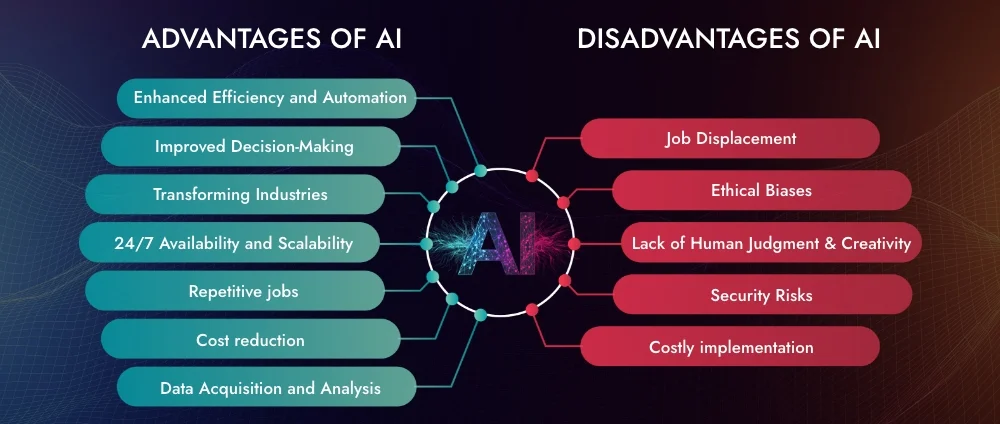









 ROI Calculator