HomeHOME > BLOG > Digital Marketing > What Is an SEO Audit? Complete SEO Audit Checklist for 2026
Digital Marketing

What Is an SEO Audit? Complete SEO Audit Checklist for 2026

J
By Priya Sahu
UpdatedApril 6, 2026Read time4 min read
Published on April 6, 2026
SHARE THIS ARTICLE
Jaro Education Facebook PageJaro Education Instagram PageJaro Education Twitter PageJaro Education Whatsapp Page Jaro Education Linkedin PageJaro Education Youtube Page
What-Is-an-SEO-Audit-Complete-SEO-Audit-Checklist-for-2026
Table of Contents

Table Of Content

  • What Is an SEO Audit?
  • Why SEO Audits Are Important in 2026
  • Types of SEO Audits
  • Complete SEO Audit Checklist for 2026

If your website is not ranking on Google in 2026, chances are it needs an SEO audit.

Search engines today use AI-driven ranking systems, user behaviour signals, semantic search, and entity-based indexing. This means traditional SEO methods alone are no longer enough.

An SEO audit helps identify technical errors, content gaps, UX issues, and optimisation opportunities that may be preventing your website from ranking higher.

Whether you run a blog, an e-commerce website, a corporate portal, or a landing page, a structured SEO audit checklist can help improve:

  • Organic traffic
  • Search visibility
  • Website performance
  • Lead generation
  • User engagement
  • Conversion rates

In this guide, you will learn:

  • What is an SEO audit
  • Why SEO audits matter in 2026
  • Step-by-step SEO audit checklist
  • Best free SEO audit tools
  • How to create an SEO audit report
  • Practical examples and use cases

What Is an SEO Audit?

An SEO audit is a complete analysis of a website’s ability to rank in search engines like Google, Bing, and AI-powered search tools.

It evaluates how well your website performs in terms of:

  • Technical SEO
  • On-page SEO
  • Content quality
  • User experience
  • Website speed
  • Backlinks
  • Mobile friendliness
  • AI search compatibility

In simple terms, an SEO audit helps answer:

“Why is my website not ranking?”

An SEO audit report highlights issues affecting rankings and provides actionable recommendations to improve performance.

Also Read:

Why SEO Audits Are Important in 2026

Search engine algorithms now use AI models that prioritise helpful content, experience-based insights, and fast-loading websites.

An SEO audit ensures your website aligns with modern ranking signals, such as:

Key Benefits of SEO Audits

BenefitImpact
Improved rankingsHelps the website appear higher on Google
Better user experienceFaster and mobile-friendly website
Higher trafficAttracts more organic visitors
Content optimisationIdentifies outdated or weak content
Technical improvementsFixes crawling and indexing issues
Competitive advantageHelps outperform competitors

Businesses that conduct regular SEO audits can adapt quickly to algorithm changes and maintain consistent growth.

If you are exploring career opportunities in digital marketing, understanding SEO fundamentals through structured learning can be helpful.

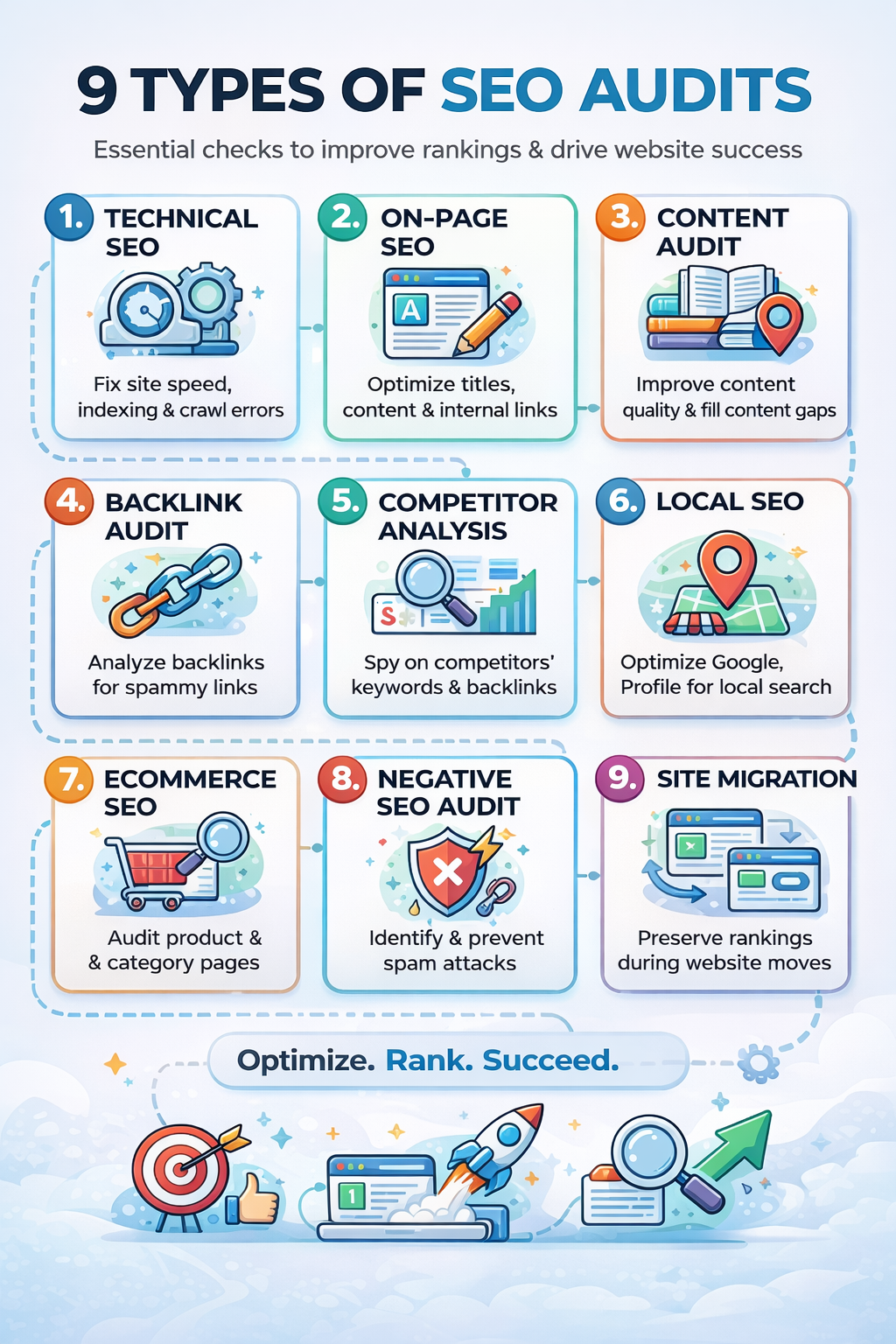
Types of SEO Audits

Different types of SEO audits focus on different performance areas.

Types of SEO Audits

1. Technical SEO Audit

Checks whether search engines can properly crawl and index your website.

Key areas:

  • Website speed
  • XML sitemap
  • Robots.txt file
  • Broken links
  • Core Web Vitals
  • Mobile usability
  • HTTPS security

2. On-Page SEO Audit

Focuses on content optimisation and keyword usage.

Key areas:

  • Title tags
  • Meta descriptions
  • Keyword placement
  • Content readability
  • Internal linking
  • Image optimisation

3. Off-Page SEO Audit

Evaluates external signals affecting website authority.

Key areas:

  • Backlink profile
  • Domain authority
  • Anchor text distribution
  • Spam score
  • Competitor backlinks

4. Content SEO Audit

Analyses content relevance and usefulness.

Key areas:

  • Content depth
  • Keyword intent match
  • Content freshness
  • Duplicate content
  • AI search visibility

Free Courses

Online MBA Degree ProgrammeOnline MBA Degree Programme
Brand Building 101
  • Duration Icon
    Duration : 2 – 3 Hours
  • Aplication Date Icon
    Application Closure Date :
Enquiry Now
Online MBA Degree ProgrammeOnline MBA Degree Programme
Finance for All – Free Finance Certification Course
  • Duration Icon
    Duration : 2 - 4 Hours
  • Aplication Date Icon
    Application Closure Date :
Enquiry Now

Complete SEO Audit Checklist for 2026

Here is a step-by-step SEO audit checklist covering all major ranking factors.

1. Technical SEO Audit Checklist

Technical SEO ensures search engines can access and understand your website.

Website Crawlability

  • Check if pages are indexed in Google
  • Ensure robots.txt is not blocking important pages
  • Submit XML sitemap
  • Fix crawl errors

Core Web Vitals (2026 Ranking Factor)

Google prioritises user experience metrics:

  • Page loading speed
  • Visual stability
  • Interaction responsiveness

Recommended tools:

  • Google PageSpeed Insights
  • Lighthouse
  • GTmetrix

Mobile Friendliness

More than 70% of users access websites through mobile devices.

Checklist:

  • Responsive design
  • Readable font size
  • Mobile navigation usability
  • Touch-friendly buttons

Website Security

Ensure HTTPS encryption is enabled.

Secure websites build trust and rank higher.

2. On-Page SEO Audit Checklist

On-page SEO helps search engines understand page content.

Title Tags Optimisation

Best practices:

  • Include primary keyword
  • Keep under 60 characters
  • Make it compelling

Example:

What Is an SEO Audit? Complete Guide for 2026

Meta Description Optimisation

  • 150–160 characters
  • Include the primary keyword naturally
  • Write a benefit-driven description

Header Tag Structure

Use structured headings:

  • H1 – Main topic
  • H2 – Main sections
  • H3 – Subtopics

This improves readability and AI search understanding.

Keyword Placement

Include keywords naturally in:

  • Title
  • Headings
  • First 100 words
  • Image alt text
  • URL

Avoid keyword stuffing.

3. Content SEO Audit Checklist

Content remains the most important ranking factor in 2026.

Content Quality Signals

Ensure content is:

  • Original
  • Helpful
  • Experience-based
  • Well structured
  • Updated for 2026 trends

Content Gap Analysis

Identify missing topics competitors are covering.

Example:

If competitors cover:

  • AI SEO tools
  • Voice search optimisation
  • Entity SEO

You should consider including these topics.

Duplicate Content Check

Avoid duplicate pages or copied content.

Use canonical tags where needed.

4. Internal Linking Audit

Internal links help search engines understand site structure.

Checklist:

  • Link related blogs naturally
  • Avoid broken internal links
  • Use descriptive anchor text
  • Maintain logical hierarchy

Example:

Blog → Category → Pillar page → Service page

Strong internal linking improves crawlability and engagement.

5. Backlink Audit Checklist

Backlinks act as trust signals.

Key checks:

  • Identify toxic backlinks
  • Analyse referring domains
  • Check anchor text variation
  • Compare competitor backlinks

High-quality backlinks improve domain authority and ranking stability.

6. UX and Engagement Audit

User experience directly affects rankings.

Key metrics:

  • Bounce rate
  • Average session duration
  • Click-through rate
  • Navigation clarity

Improve UX by:

  • Adding visuals
  • Improving readability
  • Using bullet points
  • Reducing page load time

Best Free SEO Audit Tools in 2026

Using a free SEO audit tool can simplify analysis.

Popular SEO Audit Tools

ToolFeatures
Google Search ConsoleIndexing insights
Ahrefs Webmaster ToolsBacklink audit
SEMrush Site AuditTechnical analysis
Screaming FrogWebsite crawling
UbersuggestKeyword analysis
MozDomain authority tracking

These tools help create a detailed SEO audit report quickly.

What Should an SEO Audit Report Include?

An SEO audit report summarises findings and recommendations.

Standard SEO Audit Report Structure

  1. Website overview
  2. Technical issues summary
  3. Keyword performance
  4. Content evaluation
  5. Backlink profile
  6. Competitor insights
  7. Action plan

Example recommendations:

  • Improve page speed
  • Optimise meta tags
  • Update outdated content
  • Build high-quality backlinks

SEO Audit Example: Practical Use Case

Consider an e-commerce website experiencing a traffic decline.

SEO audit findings:

IssueSolution
Slow page speedCompress images
Thin contentAdd detailed descriptions
Broken linksFix redirects
Low backlinksOutreach strategy
Poor mobile UXResponsive redesign

After implementing recommendations, traffic improved by 45% in 3 months.

How Often Should You Perform an SEO Audit?

Recommended frequency:

  • Small websites: every 6 months
  • Blogs: every 3–4 months
  • E-commerce websites: monthly
  • Enterprise websites: continuous monitoring

Regular SEO audits ensure consistent performance improvement.

Also Read:

Future of SEO Audits: AI and Automation

SEO audits are evolving with AI-powered tools.

Emerging trends in 2026:

  • AI-generated optimisation suggestions
  • Predictive SEO insights
  • Entity-based search analysis
  • Voice search compatibility checks
  • Search intent modelling

Understanding these trends helps marketers stay competitive.

If you are considering advanced learning pathways, exploring structured programmes in digital marketing or analytics can support long-term career growth.

Conclusion

An SEO audit is essential for improving website visibility, performance, and user experience.

Using a structured SEO audit checklist, businesses can identify technical issues, optimise content, and strengthen their online presence.

As AI-driven search continues to evolve, regular SEO audits will play a critical role in maintaining rankings and driving sustainable traffic growth.

Whether you are a marketer, business owner, or student, learning how to conduct an SEO audit is a valuable skill in 2026.

Frequently Asked Questions

An SEO audit is a process of analysing a website’s performance in search engines. It identifies technical issues, content gaps, keyword opportunities, and UX improvements required to improve rankings and traffic.

Popular free SEO audit tools include Google Search Console, Ubersuggest, Ahrefs Webmaster Tools, and Screaming Frog. These tools help analyse technical errors, backlinks, and keyword performance.

An SEO audit report includes technical analysis, keyword insights, backlink profile, content evaluation, and recommendations to improve rankings and website performance.

A basic SEO audit may take 2–6 hours, while a detailed audit for large websites may take several days, depending on the number of pages and technical complexity.
Priya Sahu

Priya Sahu

Sales & Digital Marketing Strategist
Sales and Marketing professional with 6+ years of experience in B2B and B2C growth, specializing in business development and digital marketing. Skilled in CRM systems, paid campaigns, and AI-driven strategies to drive revenue, optimize performance, and build lasting client relationships.

Get Free Upskilling Guidance

Fill in the details for a free consultation

*By clicking "Submit Inquiry", you authorize Jaro Education to call/email/SMS/WhatsApp you for your query.

Find a Program made just for YOU

We'll help you find the right fit for your solution. Let's get you connected with the perfect solution.

Confused which course is best for you?

Is Your Upskilling Effort worth it?

LeftAnchor ROI CalculatorRightAnchor
Confused which course is best for you?
Are Your Skills Meeting Job Demands?
LeftAnchor Try our Skill Gap toolRightAnchor
Confused which course is best for you?
Experience Lifelong Learning and Connect with Like-minded Professionals
LeftAnchor Explore Jaro ConnectRightAnchor
EllispeLeftEllispeRight
whatsapp Jaro Education