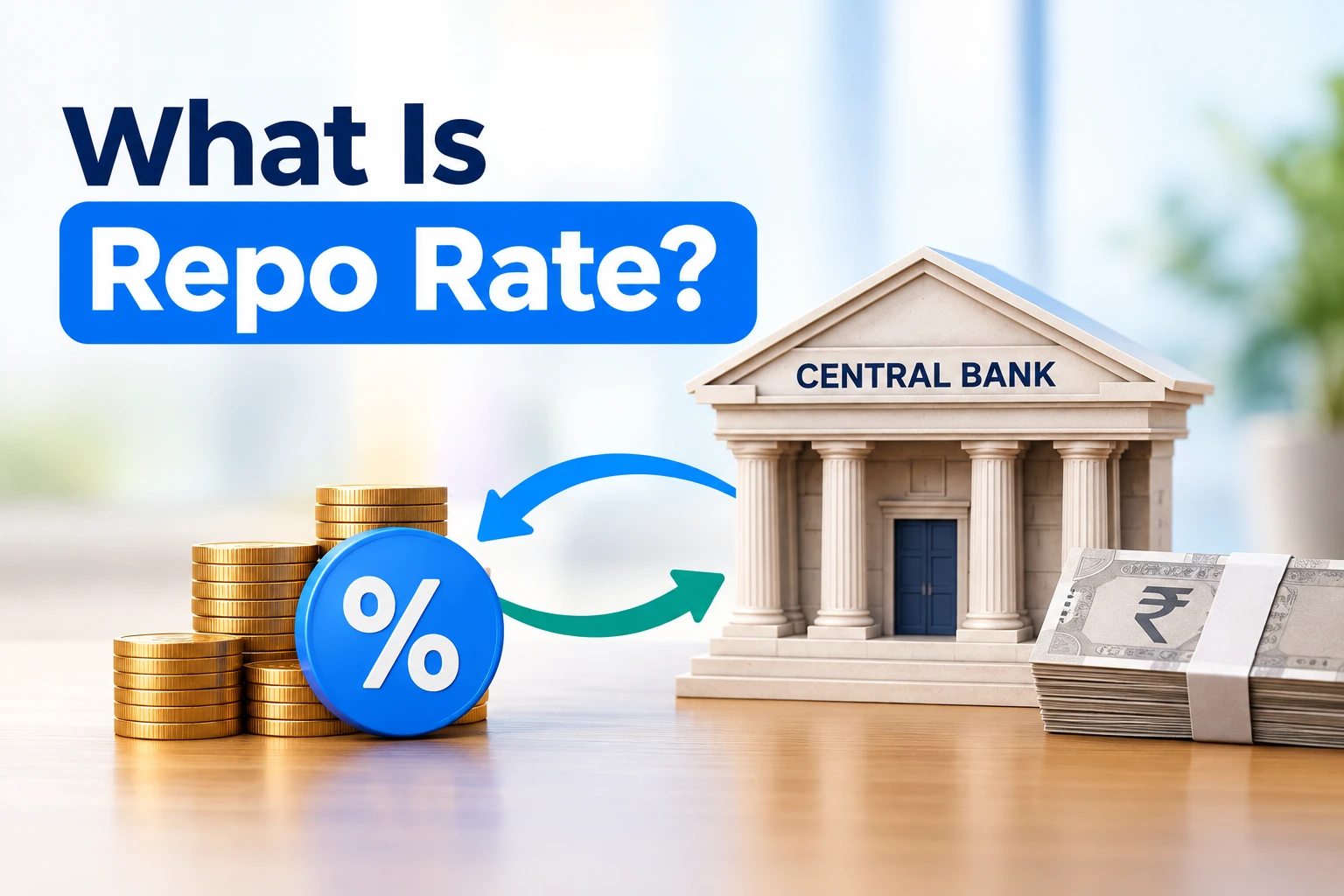
The repo rate is the interest rate at which the Reserve Bank of India lends short-term money to commercial banks against government securities, and it is the main tool of India's monetary policy.
As of 13 October 2026, the repo rate is 5.50%. The RBI's Monetary Policy Committee raised it by 25 basis points on 7 October 2026 and shifted its stance to calibrated tightening.
The repo rate is not calculated by a formula. The six-member Monetary Policy Committee votes on it after weighing inflation, growth and liquidity.
The reverse repo rate is the rate at which the RBI borrows from banks. The fixed reverse repo rate is 3.35%, but since April 2022 the standing deposit facility rate (now 5.25%) is used in practice.
A change in the repo rate flows into floating-rate loans linked to it, so a 25 basis point rise adds roughly ₹800 a month to the EMI on a ₹50 lakh, 20-year loan.
In this blog, you'll learn the repo rate meaning, the current rate, how it is decided, reverse repo, its impact on EMIs and savings, and how it connects to banking careers.
Every few weeks, news headlines announce that the RBI has "hiked", "cut" or "held" the repo rate. Whether you have a home loan, a car loan or fixed deposits, that single number can change what you pay or earn. Yet many people are unsure what the repo rate actually is or why it matters.
This guide explains the repo rate in simple language: its meaning, the current repo rate in India, how it is decided and calculated, how it differs from the reverse repo rate and what it means for your EMIs and savings.
The repo rate is the rate at which the Reserve Bank of India (RBI) lends money to commercial banks for short periods. “Repo” is short for repurchase agreement. A bank borrows from the RBI by selling government securities and agreeing to buy them back on a fixed date at a slightly higher price. The difference is, in effect, the interest, and the rate applied is the repo rate.
The RBI uses it to manage liquidity and to keep inflation in check. When the repo rate rises, borrowing becomes costlier for banks, and they generally pass this on to borrowers. When it falls, credit becomes cheaper. For the wider system behind this, see our guides on the Indian banking system and the role of banks in the financial world.
As of 13 October 2026, the repo rate is 5.50%. According to the RBI’s press release, the Monetary Policy Committee voted unanimously on 7 October 2026 to raise the policy repo rate by 25 basis points to 5.50%. It also changed the stance to “calibrated tightening”, which signals that rate cuts are off the table in the near term and that the next move can only be a hike or a pause. This was the first hike since February 2023.
RBI Policy Rates After the October 2026 Decision
Rate
Level
Meaning
Policy repo rate
5.50%
Rate at which the RBI lends to banks
Standing deposit facility (SDF)
5.25%
Rate at which banks park surplus funds with the RBI
Marginal standing facility (MSF)
5.75%
Emergency overnight borrowing rate for banks
Bank Rate
5.75%
Long-standing rate for longer-term lending, aligned with MSF
Fixed reverse repo rate
3.35%
Fixed rate, not used actively since April 2022
Recent Repo Rate History
Effective from
Repo rate
Change
October 2026
5.50%
+0.25
December 2025
5.25%
−0.25
June 2025
5.50%
−0.50
April 2025
6.00%
−0.25
February 2025
6.25%
−0.25
February 2023
6.50%
+0.25
The rate fell in 2025 to support growth as inflation eased, and the October 2026 hike partly reverses that, reflecting inflation and global uncertainty. The MPC has projected FY2026-27 GDP growth of 7.1% and CPI inflation of around 5.2%. Rates change often, so always check the RBI website for the latest figure.
Free Courses
Stakeholder Communication & Negotiation Skill Sets
Many people search for how the repo rate is “calculated”, but there is no mathematical formula that produces it. It is a policy decision made by the RBI’s Monetary Policy Committee (MPC).
Who Decides?
The MPC has six members, three from the RBI, including the Governor, and three external members appointed by the government. It meets at least four times a year, and in practice holds six scheduled meetings. Each member votes, and the decision follows the majority, with the Governor holding the casting vote in the event of a tie.
What Does the MPC Consider?
Inflation: the RBI has a target of 4% consumer price inflation with a tolerance band of plus or minus 2 percentage points.
Economic growth: cheaper credit supports growth, but too much can overheat the economy, a classic macroeconomic trade-off explained in our guide to microeconomics vs macroeconomics.
Liquidity: how much money is available in the banking system.
Global conditions: oil prices, exchange rates and decisions by other major central banks.
Fiscal position: government borrowing and spending. Our guide to fiscal policy in India explains how it works alongside monetary policy.
How Interest on a Repo Is Calculated
While the rate itself is a decision, the interest on a particular repo borrowing is a simple calculation:
For example, if a bank borrows ₹100 crore overnight at 5.50%, the interest is ₹100 crore × 5.50% × 1 ÷ 365, which is about ₹1.51 lakh. For seven days, it would be about ₹10.55 lakh. This is an illustration of the arithmetic, not an actual transaction.
How Does the Repo Rate Work?
A bank faces a shortfall of funds, perhaps because of heavy loan demand or deposit outflows.
It offers government securities to the RBI as collateral and borrows cash at the repo rate.
On the agreed date, the bank repays the money with interest and gets its securities back.
If the RBI raises the rate, borrowing from it gets costlier. Banks then tend to raise their lending rates, and credit growth slows, which helps reduce inflation.
If the RBI cuts the rate, banks can borrow more cheaply and may lower loan rates, which encourages spending and investment.
What Is the Reverse Repo Rate?
The reverse repo rate works in the opposite direction. It is the rate at which the RBI borrows money from commercial banks, and it is used to absorb excess liquidity from the system. When banks have surplus cash, they can lend it to the RBI and earn this rate.
Historically, the reverse repo rate sat below the repo rate. The fixed reverse repo rate is 3.35%, but since April 2022 the RBI has used the standing deposit facility as its effective floor for overnight rates. The SDF rate is 5.25%, which is 0.25 percentage points below the repo rate. So when people say “reverse repo rate” today, they usually mean the effective rate banks earn by depositing with the RBI.
Repo Rate vs Reverse Repo Rate
Feature
Repo rate
Reverse repo rate
Who lends
RBI lends to banks
Banks lend to the RBI
Purpose
Inject liquidity
Absorb liquidity
Collateral
Banks pledge government securities
The RBI provides securities
Relation
Higher than reverse repo
Lower than repo
Current level
5.50%
3.35% fixed; SDF 5.25% used in practice
Impact of the Repo Rate on Your Loans and EMIs
Since October 2019, the RBI has required banks to link new floating-rate retail loans, such as home loans, to an external benchmark, and many banks use the repo rate for this. When the repo rate changes, the benchmark changes, and your interest rate is reset according to your loan agreement.
Here is a simple example. Suppose you have a ₹50 lakh home loan for 20 years.
Interest rate
EMI
8.50%
About ₹43,391
8.75% (after a 0.25% rise)
About ₹44,186
That is a difference of about ₹795 a month, or roughly ₹1.9 lakh over the full term if the higher rate continued. This is an illustrative calculation, and your actual change depends on your lender’s spread and reset policy. You can run your own numbers with our guides on how to calculate EMI and the education loan EMI calculator.
What a Rate Rise or Cut Means
Area
When repo rate rises
When repo rate falls
Borrowers
Floating-rate EMIs or tenures can rise
Floating-rate EMIs or tenures can fall
Savers
Deposit rates may rise over time
Deposit rates may fall over time
Inflation
Tends to ease
May pick up
Economy
Growth can slow
Growth can speed up
Bond yields
Often rise
Often fall
Banks may adjust deposit and loan rates at different speeds, so changes are not always immediate or equal.
Why Does the RBI Change the Repo Rate?
The main reason is to keep inflation within its target while supporting growth. When prices rise too fast, the RBI tightens by raising the rate. When growth weakens and inflation is under control, it can ease. Understanding why prices change is central to this, so read our explainer on inflation and purchasing power shifts. Because the repo rate affects businesses, households and the exchange rate, it is part of the wider economic environment of business.
Borrowers: check whether your loan is linked to the repo rate, how often it resets and what spread your lender charges. Consider prepaying when rates rise.
Savers: review fixed deposit rates after policy changes, but do not chase the highest rate without checking safety.
Students and exam aspirants: repo rate, SDF, MSF and CRR questions are staples of banking exams. Our guide to the RBI Grade B exam shows how these topics are tested.
Everyone: follow policy announcements and our updates on new RBI rules.
The repo rate is the RBI’s main lever for steering inflation and growth. It currently stands at 5.50% after the October 2026 hike, it is set by the Monetary Policy Committee rather than by a formula, and it influences everything from bank borrowing costs to your home loan EMI. The reverse repo rate is its mirror image, and today the SDF rate does most of that work.
If you want to build a career in banking and finance, the IIM Trichy Post Graduate Certificate Programme in Banking and Finance is a one-year online programme for graduates with at least five years of post-qualification experience. Its curriculum includes financial markets and institutions, covering the Indian financial system and the capital market. Please check the programme page for current batch details.
Arif Siddiqui
Head of Accounting and Treasury
Arif Siddiqui is a finance leader specializing in accounting, treasury, and financial strategy. As Head of Finance at Generali Employee Benefits, he brings extensive experience in managing global financial operations. He is known for driving financial efficiency and governance across organizations. His leadership supports sustainable business growth and financial excellence.
Get Free Upskilling Guidance
Fill in the details for a free consultation
Related Courses
Explore our programs
Post Graduate Certificate Programme in Banking and Finance

 October 19, 2026
 7 min read




 Key Insights
 ChatGPT
 Perplexity
 Claude
 Grok










 ROI Calculator