HOME > BLOG > Finance > Indian Banking System: Structure, Types, Functions and Evolution
Finance
Indian Banking System: Structure, Types, Functions and Evolution
J
By Jaro Education
May 2, 202512 min read
Last updated on September 15, 2026
SHARE THIS ARTICLE
Table Of Content
What Is the Indian Banking System?
History of the Indian Banking System
Structure of the Indian Banking System
Reserve Bank of India: The Apex Banking Institution
Key Insights
The Indian banking system is a network of banks and financial institutions regulated by the Reserve Bank of India (RBI) that manages deposits, loans, payments, and other financial services.
It evolved from colonial-era banks to a modern, regulated, and digitally driven financial system.
The Indian banking system comprises RBI, commercial banks, cooperative banks, regional rural banks, small finance banks, and payments banks, serving diverse financial needs.
The Indian banking system accepts deposits, provides loans, facilitates payments, and enables fund transfers.
Career opportunities in banking include roles such as Bank PO, Probationary Officer, Credit Analyst, Relationship Manager, Loan Officer, Investment Banker, and Branch Manager.
The Indian banking system is an important part of the country's financial infrastructure. It helps individuals save money, access credit, make payments and manage their finances, while businesses rely on banks for working capital, investment and expansion. At the broader economic level, banking institutions support trade, agriculture, infrastructure, employment and economic growth.
Over the years, the Indian banking sector has moved from a largely branch-based system to a technology-enabled financial ecosystem. Today, customers can access banking services through branches, ATMs, mobile applications, internet banking and digital payment platforms.
For students and professionals interested in finance, economics, business or management, understanding the structure and functioning of the banking sector provides a useful foundation. This guide explains the history of the Indian banking system, its structure, major types of banks, functions, regulatory framework and recent developments.
The Indian banking system refers to the network of banks and banking institutions that accept deposits, provide credit, facilitate payments and offer other financial services under the regulatory framework established by the Reserve Bank of India (RBI) and applicable laws.
Banks act as financial intermediaries. They mobilise funds from individuals and organisations with surplus money and channel those funds towards borrowers who need financing.
Some of the key activities of banks include:
Accepting deposits
Providing loans and advances
Facilitating domestic and international payments
Supporting savings and investment
Providing remittance services
Creating and transmitting credit
Supporting businesses and entrepreneurs
Promoting financial inclusion
The banking system therefore connects savers, borrowers, businesses and the wider economy.
History of the Indian Banking System
The history of the Indian banking system can be understood through several stages, from indigenous banking practices and colonial-era institutions to nationalisation, economic reforms and digital banking.
Early Banking in India
Before the development of modern banks, financial activities were carried out by indigenous bankers, moneylenders, merchants and other financial intermediaries. They provided credit to traders, farmers and businesses and played an important role in local commerce.
The development of formal banking institutions gradually changed this landscape.
Presidency Banks and the Imperial Bank of India
During the colonial period, the Bank of Bengal, Bank of Bombay and Bank of Madras were established as Presidency Banks.
These three institutions were later merged in 1921 to form the Imperial Bank of India.
A significant milestone came after independence when the Imperial Bank of India was nationalised and became the State Bank of India (SBI) in 1955. The RBI notes that the establishment of SBI was part of efforts to strengthen institutional banking and expand rural credit.
Establishment of the Reserve Bank of India
The Reserve Bank of India began operations in 1935 under the Reserve Bank of India Act, 1934. It became a central institution in India’s monetary and banking framework.
The RBI’s responsibilities have expanded over time and include monetary policy, regulation and supervision of banks, management of foreign exchange and oversight of payment systems.
Banking Regulation Act, 1949
The Banking Regulation Act, 1949 established an important legal framework for regulating banking companies in India. It strengthened the regulatory role of the RBI and provided a framework for areas such as licensing, banking operations and supervision.
Nationalisation of Banks
Bank nationalisation became a major turning point in the evolution of the Indian banking system.
In 1969, 14 major commercial banks were nationalised. Six more banks were nationalised in 1980. These measures were intended to expand access to institutional credit and increase the flow of finance towards priority sectors and underserved groups.
The period following nationalisation saw significant expansion in India’s banking network. RBI research records that the number of bank branches increased substantially between 1969 and 1990 as banking expanded geographically.
Regional Rural Banks
Regional Rural Banks (RRBs) were introduced in 1975 to improve institutional credit delivery in rural areas.
RRBs were designed to combine the local knowledge and rural focus associated with cooperative institutions with the resources and banking expertise of commercial banks.
Banking Reforms After 1991
The economic reforms of the 1990s brought significant changes to India’s banking sector. The emphasis gradually shifted towards greater competition, financial sector efficiency, market-based interest rates and technological modernisation.
Private sector banks expanded, banking technology improved and the sector became increasingly competitive. RBI research describes the post-1991 period as a shift away from administered rates and towards greater market orientation and financial sector reform.
Digital Transformation
The subsequent decades brought rapid adoption of ATMs, internet banking, mobile banking and electronic payment systems.
Payment infrastructure such as NEFT and RTGS became important components of India’s electronic payments ecosystem, while UPI significantly accelerated the adoption of instant digital payments.
Today, the banking sector combines traditional banking infrastructure with digital channels, fintech partnerships, data analytics and increasingly sophisticated technology.
The structure of the Indian banking system is diverse. It includes the central bank, commercial banks, cooperative banks and specialised banking institutions.
In addition, India has several other financial institutions, including development-oriented financial institutions and NBFCs, which complement the banking sector but are not banks in the legal sense.
Reserve Bank of India: The Apex Banking Institution
The Reserve Bank of India is India’s central bank and plays a central role in maintaining monetary and financial stability.
Its responsibilities include:
Formulating and implementing monetary policy
Regulating and supervising banks
Managing currency issuance
Managing foreign exchange reserves
Acting as banker to the government
Acting as banker to banks
Overseeing payment and settlement systems
Supporting financial inclusion
RBI as Monetary Authority
The RBI uses monetary policy tools to influence liquidity, interest rates and overall financial conditions in the economy.
These tools include:
Repo rate
Cash Reserve Ratio (CRR)
Statutory Liquidity Ratio (SLR)
Open Market Operations
The RBI’s monetary policy framework focuses on maintaining price stability while keeping growth in mind.
RBI as Banker to the Government
The RBI manages banking transactions for the Central Government and certain state governments. It also manages government debt and facilitates government receipts and payments.
RBI as Banker’s Bank
The RBI maintains certain reserves of banks and provides liquidity support to the banking system when required.
This role contributes to the stability and smooth functioning of the financial system.
RBI as Banking Regulator
The RBI regulates and supervises various categories of banks and certain other financial institutions. Its regulatory responsibilities include areas such as licensing, prudential norms, governance, risk managementand depositor protection.
Types of Banks in India
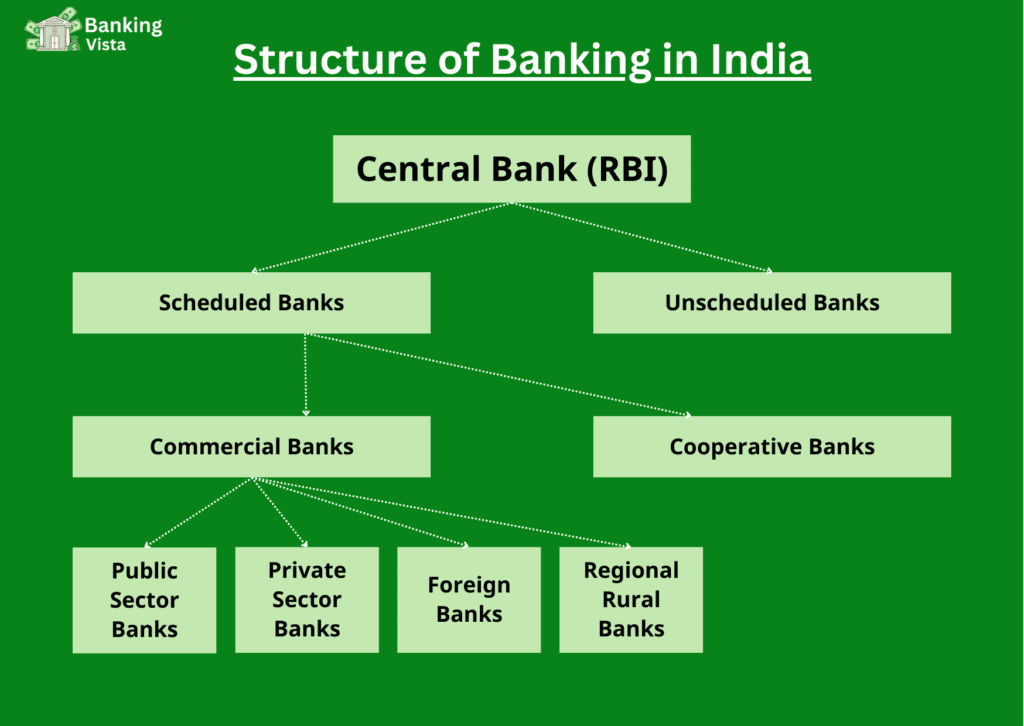
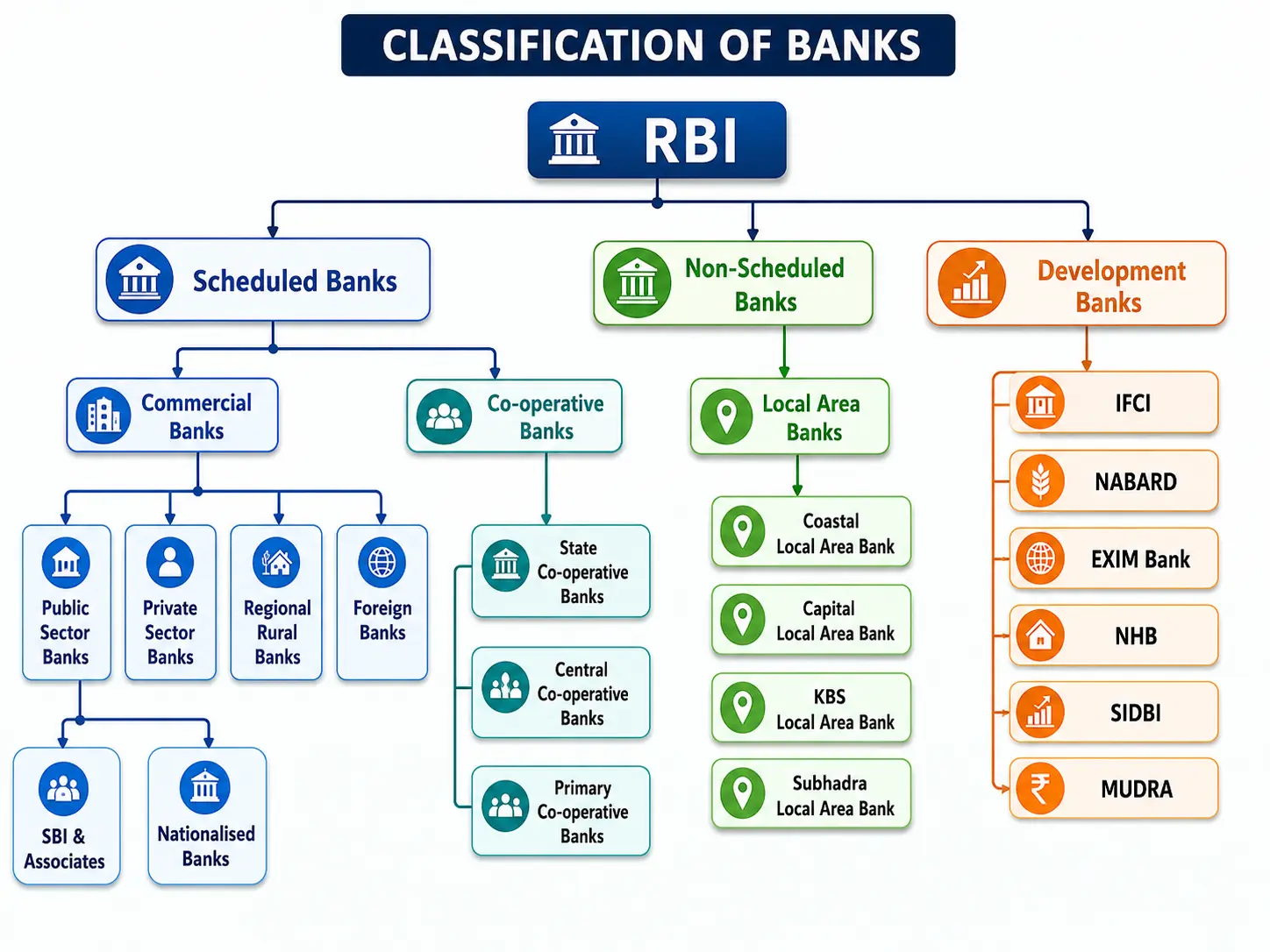
Banks in India can be classified in several ways. One important classification is based on whether they are included in the Second Schedule of the RBI Act, 1934.
Credits: kpiasacademy.com
Scheduled Banks
Scheduled banks are included in the Second Schedule of the RBI Act, 1934 and meet the conditions specified under the Act.
Scheduled banks include categories such as:
Public sector banks
Private sector banks
Foreign banks
Regional Rural Banks
Small Finance Banks
Payments Banks
Non-Scheduled Banks
Non-scheduled banks are banks that are not included in the Second Schedule of the RBI Act, 1934.
This distinction is different from the broader classification of banks by ownership or function.
Free Courses
Finance for All – Free Finance Certification Course
Commercial banks form a major part of the Indian banking sector. They accept deposits and provide loans and other banking services to individuals, businesses and institutions.
Commercial banks can be broadly grouped into public sector banks, private sector banks, foreign banks and certain specialised categories.
Public Sector Banks
Public sector banks have significant government ownership.
Examples include:
State Bank of India
Bank of Baroda
Punjab National Bank
Canara Bank
Union Bank of India
Bank of India
The public sector banking network has historically played an important role in financial inclusion, priority sector lending and government-backed financial programmes.
Private Sector Banks
Private sector banks are privately owned banking institutions operating under RBI regulation.
Examples include:
HDFC Bank
ICICI Bank
Axis Bank
Kotak Mahindra Bank
IndusInd Bank
Private sector banks have played a significant role in technology adoption, digital banking and competition within the sector.
Foreign Banks
Foreign banks are banks headquartered outside India that operate in the country through branches or other permitted structures.
They serve corporate customers, international businesses and other segments depending on their operations and regulatory permissions.
Regional Rural Banks
RRBs primarily focus on the banking and credit requirements of rural areas. They serve groups such as farmers, agricultural workers, small businesses and rural entrepreneurs.
Their role is particularly relevant to rural credit and financial inclusion.
Cooperative Banks
Cooperative banks operate on cooperative principles and are designed to serve their members and local communities.
They are broadly divided into urban and rural cooperative institutions.
Rural Cooperative Banks
The rural cooperative credit structure includes institutions such as:
State Cooperative Banks
District Central Cooperative Banks
Primary Agricultural Credit Societies
These institutions play an important role in providing credit to the agricultural and rural sectors.
Urban Cooperative Banks
Urban Cooperative Banks serve customers primarily in urban and semi-urban areas. They cater to individuals, small businesses and local communities.
Cooperative banking is subject to a regulatory framework involving both the RBI and, depending on the institution and applicable law, cooperative authorities.
Payments Banks
Payments Banks were introduced with a focus on deposits, payments, remittances and financial inclusion.
Their business model differs from that of conventional commercial banks, particularly with respect to lending activities.
Examples of payments banks have included India Post Payments Bank, Airtel Payments Bank and FINO Payments Bank. The status of individual institutions can change, so customers should verify the latest RBI information before relying on an institution’s current licence or operating status.
Banks and NBFCs: What Is the Difference?
Non-Banking Financial Companies, or NBFCs, provide several financial services that overlap with those offered by banks. However, NBFCs are not banks and operate under a different regulatory framework.
Do not function as full banking payment institutions
Banking licence
Required
Different regulatory framework
Deposit insurance
Eligible bank deposits may be covered by DICGC, subject to applicable rules
Generally not covered as bank deposits
Examples
SBI, HDFC Bank, ICICI Bank
Bajaj Finance, Shriram Finance
NBFCs complement banks by providing credit and other financial services to consumers, businesses and underserved segments of the economy.
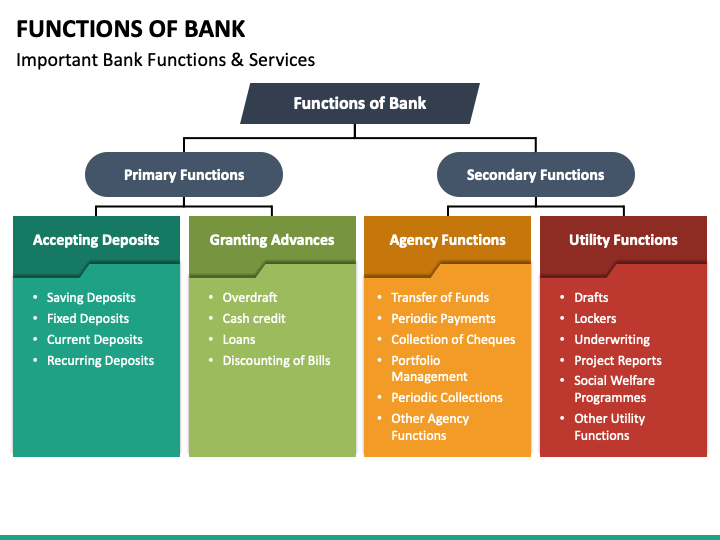
Functions of the Indian Banking System
Credits: sketchbubble.com
Mobilisation of Savings
Banks encourage individuals and organisations to deposit their surplus funds. These deposits can then be channelled into productive economic activities.
Providing Credit
Banks provide loans to individuals, businesses, farmers and other borrowers. Credit can support consumption, education, housing, business expansion and investment.
Credit Creation
Commercial banking enables the creation and transmission of credit within the financial system, subject to regulatory requirements and monetary conditions.
Facilitating Payments
Banks enable individuals and businesses to make payments through cash, cheques, cards, internet banking and digital payment systems.
India’s electronic payment infrastructure includes systems such as NEFT and RTGS, alongside retail digital payment channels.
Supporting Economic Development
Bank credit supports sectors such as agriculture, manufacturing, infrastructure, services and small businesses.
Promoting Financial Inclusion
Banks help bring individuals and communities into the formal financial system through basic accounts, credit, insurance-linked services, digital payments and other financial products.
The RBI’s financial inclusion strategy has included initiatives such as bank nationalisation, financial access programmes and digital financial services.
Priority Sector Lending
Priority Sector Lending (PSL) is an important feature of India’s banking framework.
It is designed to ensure adequate institutional credit reaches sectors whose financing needs are considered important for socio-economic development.
The RBI’s current Priority Sector Lending Directions, effective from April 1, 2025, apply to commercial banks including Regional Rural Banks and Small Finance Banks, as well as certain cooperative banks and Local Area Banks.
Priority sectors include areas such as:
Agriculture
Micro, Small and Medium Enterprises
Export credit
Education
Housing
Renewable energy
Other specified underserved segments
Financial Inclusion and the Indian Banking System
Financial inclusion aims to make appropriate financial services accessible and affordable to sections of society that may otherwise remain outside the formal financial system.
Important developments include:
Basic bank accounts
Rural banking expansion
Direct Benefit Transfers
Digital payments
Microcredit
Small Finance Banks
Financial literacy initiatives
Digital infrastructure has also made it easier for customers in different parts of the country to access payments and financial services.
Digital Transformation of Indian Banking
Technology has fundamentally changed how banking services are delivered.
Internet and Mobile Banking
Customers can now perform many routine banking activities without visiting a branch. These include checking balances, transferring funds, paying bills and managing accounts.
UPI and Digital Payments
The Unified Payments Interface has significantly changed retail payments in India by enabling interoperable, real-time account-to-account transactions through participating applications and banks.
Artificial Intelligence
Banks are increasingly exploring AI and machine learning for applications such as:
Fraud detection
Customer support
Risk assessment
Personalisation
Process automation
Data analysis
Cybersecurity
As banking becomes increasingly digital, cybersecurity has become a critical priority. Banks need systems and processes to protect customer information, transactions and digital infrastructure from evolving threats.
Domestic Systemically Important Banks
Some banks are considered particularly important to India’s financial system because their failure could have a significant impact on the wider economy.
These are classified as Domestic Systemically Important Banks, or D-SIBs, under the RBI framework.
In the RBI’s 2024 list, State Bank of India, HDFC Bank and ICICI Bank continued to be identified as D-SIBs.
Such banks are subject to additional capital requirements based on their systemic importance.
Basel Norms and Banking Stability
Basel norms are international standards designed to strengthen banks’ capital, liquidity and risk-management frameworks.
Basel I
Basel I primarily focused on credit risk and capital adequacy.
Basel II
Basel II expanded the framework to cover:
Capital adequacy
Supervisory review
Market discipline
It also incorporated credit, market and operational risks.
Basel III
Basel III was developed following the global financial crisis and introduced stronger requirements for capital, liquidity and risk resilience.
These standards are intended to make banks better equipped to withstand financial shocks.
Capital Adequacy Ratio
The Capital to Risk-Weighted Assets Ratio, or CRAR, indicates a bank’s capital position relative to the risks associated with its assets.
A simplified representation is:
CRAR = (Eligible Bank Capital / Risk-Weighted Assets) × 100
Regulators use capital adequacy requirements as part of the broader prudential framework for maintaining banking stability.
Emerging Trends in the Indian Banking Sector
The evolution of the Indian banking system continues as technology, regulation and customer expectations change.
Some important trends include:
Greater Digital Adoption
Customers increasingly use mobile applications and digital channels for routine banking and payments.
Fintech and Bank Partnerships
Banks and fintech companies increasingly collaborate to improve payments, lending, customer experience and financial technology infrastructure.
AI and Automation
Artificial intelligenceand automation are being explored to improve operational efficiency, fraud monitoring, customer service and decision-making.
Greater Focus on Cybersecurity
As digital transactions increase, banks need stronger cybersecurity, fraud prevention and data protection mechanisms.
Financial Inclusion
Expanding access to formal financial services remains an important objective, particularly for rural communities, low-income households and small businesses.
Why Should Students Understand the Indian Banking System?
Knowledge of the Indian banking system is useful for students pursuing finance, economics, commerce, management and related disciplines.
It can help learners understand:
How banks support economic activity
How monetary policy affects banking
How credit moves through the economy
How financial institutions are regulated
How digital banking is changing financial services
How banking careers are evolving
For professionals, understanding banking fundamentals can also provide context for roles in banking, financial services, investment, risk management, fintech and business management.
Career Opportunities in Banking and Financial Services
The transformation of India’s financial sector has created opportunities across traditional banking as well as technology-driven financial services.
Depending on their qualifications and skills, professionals can explore roles such as:
How Jaro Education Can Help You Build Relevant Skills
The banking sector is evolving alongside technology, analytics and changing business models. Professionals looking to move into management or strengthen their business knowledge can consider postgraduate and executive education programmes aligned with their career goals.
Jaro Education offers higher education and upskilling programmes from partner institutions, covering areas such as management, finance, analytics, technology and other professional disciplines.
When selecting a programme, consider factors such as curriculum, university recognition, programme format, faculty, industry exposure, career support and how well the course aligns with your intended career path.
Conclusion
The Indian banking system has evolved from traditional banking institutions into a diverse and technology-enabled financial ecosystem. Its journey includes the establishment of the RBI, nationalisation, rural banking expansion, financial sector reforms, private sector growth and rapid digital transformation.
Today, banks do more than accept deposits and provide loans. They facilitate digital payments, support businesses and households, promote financial inclusion and contribute to economic development.
Understanding the history of the Indian banking system and its current structure can help students and professionals build a stronger foundation for careers in banking, finance, management and financial technology.
Frequently Asked Questions
The Indian banking system is the network of banks and banking institutions that provide services such as deposits, loans, payments, remittances and other financial services under India’s regulatory framework.
The history of the Indian banking system includes the development of indigenous banking, the Presidency Banks, formation of the Imperial Bank of India, establishment of the RBI, nationalisation of major banks, creation of Regional Rural Banks, post-1991 banking reforms and the growth of digital banking.
The main categories include public sector banks, private sector banks, foreign banks, Regional Rural Banks, Small Finance Banks, Payments Banks and cooperative banks.
The RBI acts as India’s central bank and performs functions related to monetary policy, banking regulation and supervision, currency management, foreign exchange management, government banking and payment systems.
Commercial banks operate primarily as banking institutions serving individuals, businesses and other customers, while cooperative banks operate on cooperative principles and have traditionally focused strongly on members, local communities, agriculture and small borrowers.
Regional Rural Banks are banking institutions established to improve access to formal banking and credit in rural and semi-urban areas, particularly for farmers, small businesses and other rural customers.
Small Finance Banks are specialised banks established to improve access to banking services and credit for underserved groups, including small businesses, small farmers, micro enterprises and low-income households.
Banks support financial inclusion by providing access to savings accounts, credit, payment services and other financial products to people who may have limited access to formal financial institutions.
Technology has enabled internet banking, mobile banking, digital payments, automated services, data analytics and AI-based applications. It has also increased the importance of cybersecurity and digital risk management.
The banking and financial services sector offers career opportunities across banking operations, credit, risk, compliance, analytics, digital banking, fintech and management. The most suitable path depends on an individual’s education, skills and career interests.
Get Free Upskilling Guidance
Fill in the details for a free consultation
Related Courses
Explore our programs
Advanced Programme in Financial Technologies and Financial Analytics

 May 2, 2025
 12 min read




 Key Insights
 ChatGPT
 Perplexity
 Claude
 Grok










 ROI Calculator