 HOME > BLOG > Career Information > What is Production Engineering? Jobs, Salary & Career Scope in 2026
What is Production Engineering? Jobs, Salary & Career Scope in 2026
 May 4, 2026
 11 min read




Table Of Content
- What is Production Engineering?
- Types of Production Engineer Jobs in 2026
- Top Industries Hiring Production Engineers in 2026
- Production Engineer Salary in India & Globally
Not everything in manufacturing goes as planned. Machines slow down, timelines shift, and small inefficiencies quietly add up. This is where production engineering becomes important. It focuses on fixing what does not work smoothly and improving what already does.
For anyone trying to figure out what is production engineering, it is less about theory and more about making real systems perform better. It deals with practical decisions that affect cost, speed, and quality every single day. As the world becomes more competitive, the need for individuals who can manage this process continues to grow.
 ChatGPT
 Perplexity
 Claude
 Grok
GrokWhat is Production Engineering?
Production engineering is all about how the manufacturing process actually happens and making it manageable. This might involve making any changes to the process or simply making sure that the process doesn’t come to a halt due to any kind of waste in the process. The process might be continuous, as there can always be scope for making things faster.
However, the key thing that differentiates this field from others is the aspect of practicality. The decisions are made based on what works, not on what looks good on paper. Production engineers now also have a greater role in terms of improving things, especially with the introduction of better technologies in industries.
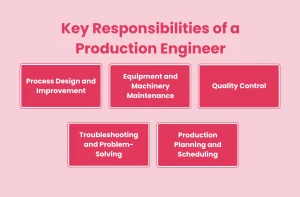
Key Responsibilities of a Production Engineer
*iscalepro.com
- Plan production on a daily and weekly basis according to actual demand
- Keep track of running activities and step in when problems occur
- Identify delays in the process and work towards reducing them
- Ensure that production meets expected standards of quality
- Help in avoiding sudden breakdowns with the maintenance team
- Help coordinate activities with other departments to keep production running smoothly
- Reduce waste in terms of resources, time, and effort
- Help in bringing in better tools/methods if needed
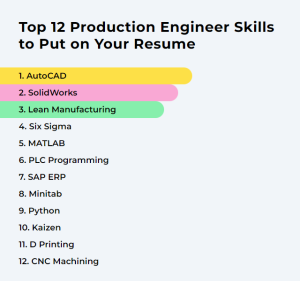
Skills Required to Become a Successful Production Engineer
*resumecat.com
- Knowledge of basic production tools and systems
- Knowledge of methods used to improve production efficiency
- Communication skills to work with various teams on the production floor
- Flexibility to accommodate changing production processes and technologies
- Ability to manage time and work on multiple tasks
- Focus on details that make a big difference in final output
Types of Production Engineer Jobs in 2026
If you look at production engineering closely, you will notice that it is not limited to one fixed role. The title may sound the same, but the actual work can look very different depending on the industry, company size, and level of responsibility. Some roles are more focused on processes, some on quality, and some on managing entire operations.
What makes production engineer jobs interesting in 2026 is how much they have expanded. With automation, data tracking, and smarter systems coming into play, companies are no longer hiring people just to “manage production”. They are hiring people who can improve it continuously.
Here are the most common roles you will come across.
1. Manufacturing Engineer
This is one of the most common entry points. A manufacturing engineer focuses on how products are actually made on the shop floor. The work involves setting up production lines, choosing the right machines, and making sure everything runs without unnecessary delays.
In many companies, this role is very hands-on. You are expected to understand how machines behave, how materials move, and where time is being lost. Small improvements here can make a big difference in output.
Over time, this role can grow into more senior positions where you start handling larger sections of production or even entire plants.
2. Process Engineer
A process engineer spends more time thinking about “how things can be done better”. Instead of just running operations, the focus here is on improving them.
This could mean reducing production time, cutting down waste, or making workflows smoother. You will often work with data, observe patterns, and suggest changes that improve efficiency.
In 2026, this role has become more important because companies are under constant pressure to do more with fewer resources. Even small process improvements are taken seriously.
3. Quality Control Engineer
No matter how fast production runs, quality cannot be ignored. That is where this role comes in. A quality control engineer ensures that products meet certain standards before they reach the customer. This involves checking materials, monitoring production stages, and identifying defects early.
The work requires patience and attention to detail. You are often the person who spots problems others might miss. In industries like automotive, pharma, and electronics, this role carries a lot of responsibility.
4. Industrial Engineer
This role is slightly broader. An industrial engineer looks at the entire system rather than just one part of it. The focus is on improving overall efficiency. This includes people, processes, machines, and even workplace layout. For example, changing the way a production floor is arranged can reduce movement and save time.
In many ways, this role connects production with business goals. It is not just about making things faster, but also making them smarter and more cost-effective.
5. Operations Manager
This is usually a step up after gaining some experience. An operations manager handles a larger part of the production system and is responsible for the results.
The role involves planning, coordination, and decision-making. You are not just solving small issues anymore, but making sure everything works together smoothly. You also deal with targets, deadlines, and sometimes even budgeting. It requires both technical understanding and the ability to manage people.
6. Maintenance Engineer
Production cannot run if machines keep breaking down. A maintenance engineer focuses on keeping equipment in working condition.
This includes regular checks, preventive maintenance, and quick fixes when something goes wrong. The goal is to avoid downtime as much as possible. In industries with heavy machinery, this role becomes critical. Even a short delay can lead to significant losses.
7. Automation Engineer
This is one of the fastest-growing production engineer jobs today. An automation engineer works on reducing manual effort by introducing automated systems. This could involve robotics, sensors, or software that controls machines.
In 2026, many companies are moving towards smart factories. This means automation engineers are no longer optional. They are becoming a core part of production teams.
8. Supply Chain and Production Planner
This role connects production with supply chain activities. It focuses on making sure the right materials are available at the right time so that production does not stop.
Planning becomes very important here. You need to balance demand, inventory, and production capacity. This role suits people who are comfortable with coordination and planning rather than purely technical work.
Top Industries Hiring Production Engineers in 2026
Not every industry uses production engineers in the same way, but the demand is steady across sectors that rely on scale, speed, and consistency. What changes is the kind of problems you solve. In some industries, it is about handling volume. In others, it is about precision or compliance.
Here’s where most opportunities are currently concentrated:
- FMCG: Focus on high-volume output where even small delays can affect large supply chains. Speed and consistency matter the most here.
- Automotive: Structured production lines with strict quality checks. Work often revolves around improving cycle time and reducing defects.
- Pharmaceuticals: Highly controlled environments where accuracy and compliance are non-negotiable. Documentation plays a big role.
- Electronics & Semiconductors: Sensitive production processes that require precision and careful handling at every stage.
- Aerospace: Low-volume but high-importance manufacturing where reliability is critical and errors are costly.
- E-commerce & Warehousing: Not traditional manufacturing, but production thinking is applied to packaging, sorting, and dispatch efficiency.
- Energy & Heavy Industries: Large-scale operations where downtime can be expensive, so process stability is key.
- Textile & Apparel: Continuous production environments driven by cost control and turnaround time.
Production Engineer Salary in India & Globally
Salary in this field does not jump overnight, but it builds steadily with experience. Early roles are more about learning how things actually work. Once that understanding sets in, growth becomes more visible.
In India, salaries can vary depending on the industry you enter. Core sectors may start lower, while electronics and newer manufacturing setups sometimes offer better packages. Globally, the pay scale is higher, mainly because of advanced systems and higher production value.
Here is the average salary overview:
| Experience Level | India (₹ per annum) | Global (USD per year) |
| Entry-Level (0–2 years) | ₹3 – ₹6 LPA | $50,000 – $70,000 |
| Mid-Level (3–7 years) | ₹6 – ₹12 LPA | $70,000 – $95,000 |
| Senior-Level (8+ years) | ₹12 – ₹20+ LPA | $95,000 – $130,000+ |
One thing that makes a difference here is exposure. The more hands-on experience you gain with real systems, the better your growth tends to be over time.
Career Scope of Production Engineering in 2026 and Beyond
If you try to map where production engineering is heading, it does not move in a straight line. It spreads out. Instead of one fixed path, you start with a base and then branch out depending on what you get comfortable with.
Where Most Careers Usually Begin
- Shop floor roles
- Basic process handling
- Understanding machines, materials, and workflow
This stage is less about titles and more about exposure.
What Changes After a Few Years
You stop just “running” processes and start improving them.
- Identifying delays and fixing them
- Reducing waste and improving output
- Taking ownership of small sections of production
This is where real learning happens.
Directions You Can Move Into
Instead of a single ladder, think of multiple paths:
- Process Improvement: Focus on making systems faster and smoother
- Quality: Move deeper into standards, testing, and compliance
- Operations: Handle planning, targets, and team coordination
- Automation: Work with systems that reduce manual effort
- Supply Chain: Shift towards planning and resource management
What Is Changing in 2026
- More reliance on data rather than guesswork
- Increased use of automation across industries
- Higher expectations from engineers to improve systems, not just maintain them
Note: No matter how much things change, one thing does not: Production still needs to happen, and it needs to happen efficiently. That is where this field stays relevant.
Tools & Technologies Used in Production Engineering (2026 Edition)
The tools used in production engineering have changed a lot over the years. Earlier, most things were handled manually or through basic systems. Now, almost every part of production is supported by some form of software or automation. The expectation is not that you master everything, but that you understand how these tools actually help on the ground.
Here are some of the commonly used ones:
- ERP systems: These are used to keep track of production, materials, and orders in one place. Instead of chasing updates from different teams, you can see what is happening across the process more clearly.
- CAD and CAM tools: These come from the design side, but they still matter. They help you understand how a product is supposed to be made and where issues might come up during production.
- Automation setups: This includes machines that can run with limited manual effort. In some places, it is simple conveyor systems. In others, it can be fully automated lines. Your role is usually to make sure they keep running without issues.
- Monitoring systems: These are used to track production while it is happening. You can see if output is dropping or if something is slowing things down, instead of finding out later.
- Basic data tools: A lot of decisions now come from numbers. Even simple reports can show where time is being wasted or where improvements are possible.
- Quality checking tools: These help in catching defects early. It can be as simple as inspection setups or more advanced testing systems, depending on the industry.
- Connected machines (IoT): In some setups, machines are linked and share information automatically. This helps in spotting issues faster and avoiding sudden stops in production.
What matters is not the tool itself, but how it is used. Two people can work with the same system and get very different results. Over time, you start understanding which tool helps in which situation, and that is where the real learning happens.





Build a Future-Ready Career in Production Engineering with Jaro Education
For professionals looking to move beyond theoretical knowledge and gain real industry relevance, structured upskilling becomes essential. This is where Jaro Education positions itself as a strategic career partner. Through collaborations with reputed institutions and universities, we offer programs that are designed to match current industry demands. Whether it is understanding modern manufacturing systems, learning process optimization techniques, or gaining exposure to emerging technologies, these programs are built to enhance both technical and managerial capabilities.
Relevant Courses for Production Engineering
- Executive Programme in Operations Management and Analytics – CEP, IIT Delhi
Focuses on operations strategy, demand forecasting, and decision-making tools that directly apply to production systems and process improvement. - Advanced Certificate Programme in Smart Supply Chain Management & Transformation – IIM Kozhikode
Focuses on modern supply chain systems, digital transformation, and operational integration across industries. - Post Graduate Certificate Programme in Supply Chain Operations & Analytics – IIM Nagpur
Strong emphasis on analytics-driven supply chain decisions and operational planning, which are key extensions of production roles.
In a field where growth depends heavily on how well you understand processes, investing in the right learning pathway can make a noticeable difference.
Conclusion
Production engineering is not the kind of field that gets attention quickly, but it builds value over time. It sits quietly behind how things are made, improved, and delivered at scale. From understanding what is production engineering to exploring production engineer jobs and salary growth, the path is practical and grounded in real work.
As industries continue to focus on efficiency and consistency, the need for people who can manage and improve production will not fade. For anyone looking for a stable career with room to grow, this field offers a solid and dependable direction.
Frequently Asked Questions
Production engineer jobs include roles like manufacturing engineer, process engineer, and quality engineer. Each focuses on improving different parts of the production system.

Related Courses
Explore our programs




Find a Program made just for YOU
We'll help you find the right fit for your solution. Let's get you connected with the perfect solution.
Is Your Upskilling Effort worth it?
 ROI Calculator

Are Your Skills Meeting Job Demands?
Try our Skill Gap tool
Experience Lifelong Learning and Connect with Like-minded Professionals
Explore Jaro Connect

