HOME > BLOG > Online MBA > Online MBA vs Blended MBA vs Executive MBA: Which One Should You Actually Do in 2026?
Online MBA
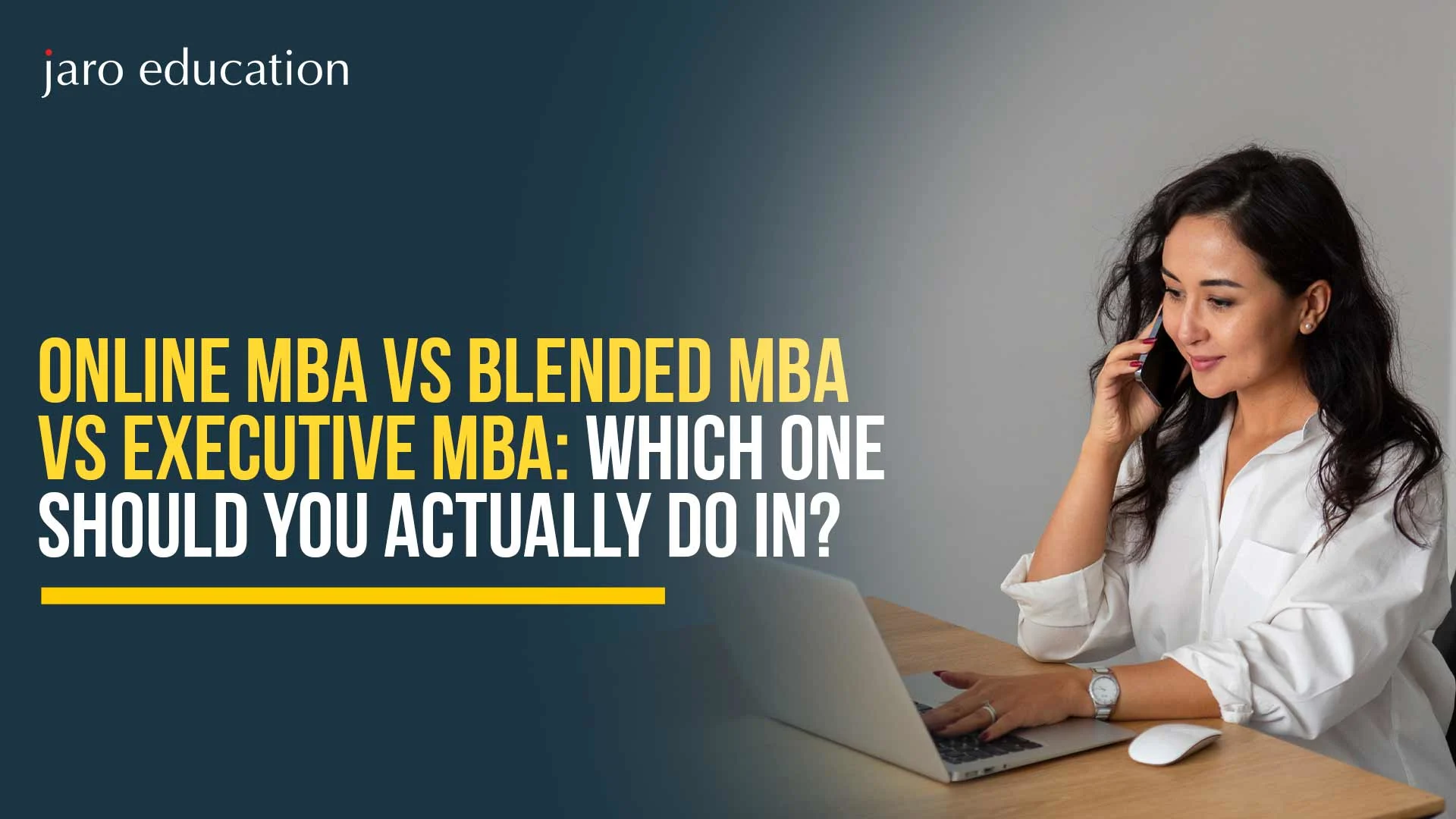
Online MBA vs Blended MBA vs Executive MBA: Which One Should You Actually Do in 2026?
J
By Manya Tohani
June 8, 20265 min read
Last updated on July 10, 2026
SHARE THIS ARTICLE
Table Of Content
The Three Formats: What They Actually Mean
Head-to-Head Comparison: All Three Formats
Decision Framework: Which One Is Right for You?
The 2026 Context: Why Format Choice Has Career Consequences
Three management education formats. Three very different outcomes. If you pick the wrong one for your career stage, you spend two years and significant money on a qualification that does not move the needle in the way you expected.
This guide is built for the professional who is past the ‘is an online MBA valid?’ question and is now asking, given where I am in my career right now, which of these three formats is the right investment?. We compare them honestly — including which specific programmes are available through Jaro Education and what each is actually built for.
The Three Formats: What They Actually Mean
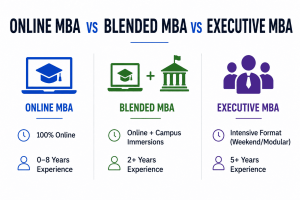
Online MBA — 100% Digital, Maximum Flexibility
A fully digital programme delivered through live video sessions, recorded content, and online assessments. No campus. No travel. You can be in Mumbai or Mangalore and the experience is the same.
Best for: Professionals at any experience level (0–8 years) who need maximum scheduling flexibility, are location-constrained, and want a cost-effective, fully recognised management degree.
Blended MBA — Online Core + Campus Immersions
A hybrid format where the majority of learning happens online, but includes mandatory in-person campus residencies at defined intervals. Not optional — the campus component is part of the programme’s academic structure.
In India, the most prominent blended MBA at this quality level is the IIM Nagpur Blended MBA for Working Professionals — a full PG degree from a government-established IIM, combining online delivery with campus immersions at IIM Nagpur.
Best for: Working professionals with 2+ years of experience who want IIM-level credibility and peer networking alongside scheduling flexibility.
Executive MBA — Senior Cohort, Intensive Format
Designed for senior professionals — typically 5–15 years of work experience. Delivered as intensive weekend blocks, modular sessions, or residential weeks. The peer cohort is a key part of the value — you are in the room with professionals at a similar level.
Best for: Senior managers, directors, and VP-level professionals who want a leadership upgrade — not a career pivot, but a step up in strategic thinking and peer network.
The 2026 Context: Why Format Choice Has Career Consequences
In 2026, format choice is not just about logistics — it has direct career implications:
Employer perception: The IIM Nagpur Blended MBA credential reads differently to a hiring manager than an online MBA from a UGC entitled university. Both are valid degrees — but IIM carries a specific brand premium in India’s job market, particularly in consulting, BFSI, and strategy roles.
Peer network quality: The professionals you study alongside in a blended or executive programme — who you have case discussions with, who you do group projects with — often shape your career opportunities more than the curriculum itself. The IIM Nagpur cohort is a door opener.
Time-to-ROI: Online MBAs typically show salary impact in 1–3 years post-completion. The IIM Nagpur Blended MBA’s ROI starts earlier — during the programme, through cohort connections and case-based learning that is immediately applicable.
Specialisation depth: Online MBAs offer broad specialisations. IIM/IIT certificates offer domain depth. The blended MBA sits between — broad general management and IIM methodology. Know which you need.
Distance MBA is a separate, older category — correspondence-based, physical study materials, in-person examination centres. It is not the same as an online MBA. All programmes available through Jaro Education are online (not distance) unless specifically noted. Online and distance education are separate frameworks under UGC’s regulatory structure.
Conclusion
Choosing between an Online MBA, Blended MBA, and Executive MBA in 2026 depends entirely on your career stage, professional goals, budget, and preferred learning style. An Online MBA is ideal for professionals seeking maximum flexibility, affordability, and recognised qualifications while balancing work and personal commitments. A Blended MBA offers the advantage of combining online learning with valuable campus immersion and networking opportunities, making it suitable for professionals aiming for stronger industry exposure and institutional credibility. Meanwhile, an Executive MBA is designed for experienced managers and senior leaders looking to strengthen strategic thinking, leadership capabilities, and executive-level peer networks.
There is no universally “best” MBA format — only the format that aligns best with your current position and future ambitions. Before making a decision, evaluate factors such as work experience, time availability, ROI expectations, and long-term career objectives to choose the programme that delivers the most value for your professional growth.
Frequently Asked Questions
Yes, blended MBA programmes are generally priced higher than online MBA programmes because they include additional benefits such as campus immersion, networking opportunities, and industry exposure. However, the value depends on your career goals, learning preferences, and long-term professional growth.
Both online and blended MBA programmes are valuable when pursued from recognised institutions. Online MBAs are widely accepted for career advancement and skill enhancement, while blended MBAs may offer added advantages through in-person networking and immersive learning experiences.
No, online MBA and blended MBA programmes are usually offered separately, and transfers between them are generally not allowed after enrolment. It is important to evaluate your career goals and learning preferences before choosing a programme format.
Most Executive MBA programmes require candidates to have prior work experience, typically ranging from 2 to 5 years or more depending on the institution and programme structure.
You can compare MBA formats by reviewing factors such as curriculum, fees, learning mode, specialisations, accreditation, placement support, and career outcomes on official university or education platform websites before making a decision.
Manya Tohani
Personal Growth Mentor
Manya Tohani is a Personal Growth Mentor and content strategist, helping individuals build strong personal brands and accelerate career growth. With 8M+ impressions and experience mentoring students, she empowers others through actionable guidance, resilience, and real-world insights.
 HOME > BLOG > Online MBA > Online MBA vs Blended MBA vs Executive MBA: Which One Should You Actually Do in 2026?
 June 8, 2026
 5 min read








 Admission Open
 Admission Open
 Admission Open
 Admission Open

 ROI Calculator




