HOME > BLOG > Online MBA > MBA vs Executive MBA in 2026: Which One Should Mid-Career Professionals Actually Choose?
Online MBA
MBA vs Executive MBA in 2026: Which One Should Mid-Career Professionals Actually Choose?
J
By Nuthana Reddy
June 22, 20268 min read
Last updated on August 17, 2026
SHARE THIS ARTICLE
Table Of Content
Why Mid-Career Professionals Are Returning to Education in 2026
What Is an MBA?
What Is an Executive MBA?
MBA vs Executive MBA: Understanding the Core Difference
The professional world is changing faster than ever before. Artificial Intelligence, digital transformation, automation, global competition, and evolving leadership expectations are forcing professionals to continuously upgrade their skills.
For many mid-career professionals, this often leads to an important question:
Should I pursue an MBA or an Executive MBA?
While both qualifications aim to develop leadership, strategic thinking, and business management capabilities, they serve different audiences and career goals. In 2026, the decision has become even more complex because professionals now have access to Online MBA programs, Executive MBA programs, and specialised executive education offerings from leading institutions.
The traditional belief that an MBA is the only pathway to career advancement is gradually evolving. Today, experienced professionals often seek targeted leadership and management education that aligns with their career stage rather than pursuing a full-time degree.
The right choice depends on several factors, including:
Years of work experience
Career aspirations
Current job responsibilities
Industry requirements
Leadership goals
Time and financial investment
This guide explores MBA vs Executive MBA India 2026 from a practical perspective, helping working professionals understand which option delivers the most value at different stages of their careers.
A Master of Business Administration (MBA) is a postgraduate management qualification designed to develop business, leadership, and managerial capabilities.
MBA programs typically cover:
Marketing Management
Finance
Operations
Human Resource Management
Business Strategy
Organisational Behaviour
Entrepreneurship
Traditionally, MBA programs were primarily targeted at:
Fresh graduates
Early-career professionals
Career switchers
However, Online MBA programs have made management education more accessible to working professionals as well.
An Executive MBA (EMBA) is a management program specifically designed for experienced working professionals.
Unlike traditional MBA programs, Executive MBA programs assume that participants already possess substantial professional experience and industry knowledge.
As a result, the curriculum often focuses more heavily on:
Strategic Leadership
Organisational Transformation
Business Growth
Executive Decision-Making
Change Management
Participants learn alongside experienced peers, creating valuable opportunities for networking and knowledge exchange.
Benefits of an Executive MBA
Leadership-focused curriculum
Peer learning from experienced professionals
Immediate workplace application
Strong executive networking opportunities
Career advancement support
Ideal Candidate Profile
Executive MBA programs are generally suitable for:
5+ years of work experience
Mid-career professionals
Functional managers
Senior executives
Entrepreneurs
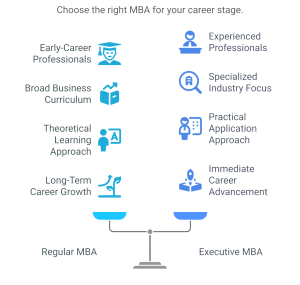
MBA vs Executive MBA: Understanding the Core Difference
*prestigeuniversity
Many professionals assume that an Executive MBA is simply a more advanced version of a traditional MBA.
In reality, the primary difference lies in the audience and learning approach.
An MBA typically focuses on building management foundations, while an Executive MBA focuses on enhancing leadership and strategic decision-making capabilities among experienced professionals.
The question is not:
“Which one is better?”
The real question is:
“Which one is more appropriate for your current career stage?”
MBA vs Executive MBA: Detailed Comparison
Parameter
MBA
Executive MBA
Target Audience
Freshers & Early Career Professionals
Experienced Professionals
Work Experience
Not always required
Usually 5+ Years
Learning Focus
Business Fundamentals
Leadership & Strategy
Career Goal
Career Launch or Transition
Career Acceleration
Peer Group
Mixed Experience Levels
Experienced Managers & Leaders
Networking Value
Moderate
High
Immediate Application
Moderate
High
Leadership Development
Strong
Very Strong
Program Format
Full-Time, Online, Hybrid
Weekend, Modular, Executive Format
Cost
Moderate to High
Generally Higher
MBA vs Executive MBA Salary Comparison
Salary outcomes depend on several variables, including:
Industry
Experience
Institution
Functional expertise
Geographic location
However, professionals often pursue management education with compensation growth in mind.
Both programs can accelerate careers, but they do so in different ways.
MBA Career Impact
MBA programs help professionals:
Build management foundations
Enter new industries
Develop broad business knowledge
Improve employability
Executive MBA Career Impact
Executive MBA programs help professionals:
Strengthen leadership capabilities
Transition into senior management
Develop strategic thinking skills
Expand executive networks
Enhance organisational influence
For many mid-career professionals, the choice depends on whether they need foundational management knowledge or leadership-focused development.
When an MBA Makes More Sense
An MBA may be the better option if:
You Have Limited Work Experience
Professionals with fewer than 5 years of experience often benefit more from foundational management education.
You Want to Switch Careers
MBA programs provide broad exposure to different business functions.
You Need Comprehensive Business Knowledge
An MBA offers structured learning across multiple management disciplines.
You Are Seeking Entry Into Management
The degree can help professionals move into managerial positions earlier in their careers.
When an Executive MBA Makes More Sense
While an MBA is an excellent choice for early-career professionals, many mid-career managers discover that they need a different kind of learning experience.
Executive MBA programs are specifically designed for professionals who already possess business experience and are looking to enhance their leadership capabilities.
An Executive MBA may be the better choice if:
You Have Significant Work Experience
Professionals with 5–15 years of experience often gain greater value from executive-level learning environments where participants bring real-world business challenges into the classroom.
You Are Moving Into Leadership Roles
If you are transitioning from functional management to strategic leadership, an Executive MBA can help develop:
Executive Learning Opportunities for Mid-Career Professionals
Many professionals discover that they do not necessarily need another degree. Instead, they need focused learning aligned with their leadership responsibilities.
For Finance Professionals
Professionals seeking deeper expertise in corporate finance and strategic decision-making may benefit from specialised finance-focused executive education.
Technology managers aiming for CIO, CTO, and digital leadership roles increasingly require a blend of technology expertise and business leadership skills.
Professionals seeking stronger capabilities in business strategy and organisational leadership may benefit from specialised strategic management education.
If you’re still unsure whether to pursue an MBA or an Executive MBA, ask yourself the following questions.
Question 1
Do I need foundational business knowledge?
Yes → MBA
No → Continue to Question 2
Question 2
Do I already have 5+ years of experience?
Yes → Executive MBA or Executive Program
No → MBA
Question 3
Am I trying to switch careers?
Yes → MBA
No → Continue to Question 4
Question 4
Do I want to move into senior leadership roles?
Yes → Executive MBA or Leadership Program
No → MBA may still be sufficient
Question 5
Do I need specialised expertise rather than a broad management curriculum?
Yes → Executive Certificate Program
No → Executive MBA
This framework helps professionals align educational investments with actual career objectives rather than following trends.
MBA vs Executive MBA in 2026: The Final Verdict
The debate between MBA and Executive MBA is no longer about which qualification is better.
Instead, it is about choosing the option that best fits your career stage and professional goals.
Choose an MBA If:
You have less than 5 years of experience
You want comprehensive business knowledge
You are considering a career switch
You need a strong management foundation
You are building your professional network
Choose an Executive MBA If:
You have 5+ years of experience
You already understand business fundamentals
You want to move into leadership roles
You seek strategic and executive-level thinking
You want immediate workplace application
Consider Executive Certificate Programs If:
You already possess substantial experience
You need specialised expertise
You want targeted leadership development
You prefer shorter, focused learning journeys
You are preparing for specific leadership responsibilities
The most successful professionals in 2026 are not simply collecting qualifications—they are strategically selecting learning experiences that align with their career aspirations.
Final Thoughts
Management education continues to evolve as professionals seek more flexible, relevant, and career-focused learning opportunities.
For early-career professionals, an MBA remains one of the strongest pathways to develop business knowledge and leadership potential. For mid-career managers, an Executive MBA can provide the strategic perspective and executive-level capabilities needed to advance into senior leadership positions.
However, the growing popularity of executive certificate programs highlights an important trend: professionals increasingly value focused learning that addresses specific business challenges and career objectives.
Whether you choose an MBA, Executive MBA, or specialised executive program, the key is to align your investment with your current experience, future goals, and the skills required to succeed in an increasingly competitive business environment.
Frequently Asked Questions
An MBA focuses on building business fundamentals and is generally suitable for early-career professionals, while an Executive MBA is designed for experienced professionals seeking leadership and strategic management skills.
Neither is universally better. The right choice depends on your work experience, career goals, and professional development needs.
Most Executive MBA programs require 3–5 years of professional experience, while some premium programs may prefer candidates with 5–10 years or more of managerial experience.
Yes. Online MBA and flexible learning formats have made it easier for working professionals to pursue management education while continuing their careers.
For experienced professionals seeking leadership roles, strategic responsibilities, and executive-level career growth, an Executive MBA can provide significant value.
For professionals seeking specialised expertise and shorter learning formats, executive certificate programs can be an effective alternative.
Professionals with substantial experience often benefit more from Executive MBA programs or specialised executive education focused on leadership, strategy, technology, or finance.
Nuthana Reddy
Nuthana Reddy is a Senior Manager at Procter & Gamble, specializing in operations, digitization, and cross-functional leadership. She has driven multimillion-dollar impact through innovation, process optimization, and strategic execution across global markets.
Get Free Upskilling Guidance
Fill in the details for a free consultation
Related Courses
Explore our programs
Admission Closed
Executive Certificate Programme in Corporate & Strategic Finance
 HOME > BLOG > Online MBA > MBA vs Executive MBA in 2026: Which One Should Mid-Career Professionals Actually Choose?
 June 22, 2026
 8 min read





 ChatGPT
 Perplexity
 Claude
 Grok
Grok




 Admission Closed
 Admission Open
 Admission Open
 ROI Calculator