HOME > BLOG > Online MBA > MBA After 30 in India: Is It Too Late, Which Programme, and What to Expect (2026)
Online MBA
MBA After 30 in India: Is It Too Late, Which Programme, and What to Expect (2026)
J
By Manya Tohani
August 7, 20267 min read
Published on August 7, 2026
SHARE THIS ARTICLE
Table Of Content
Why More Professionals Are Choosing an MBA After 30
Is 30 Too Late for an MBA?
Why Experience Makes an MBA More Valuable
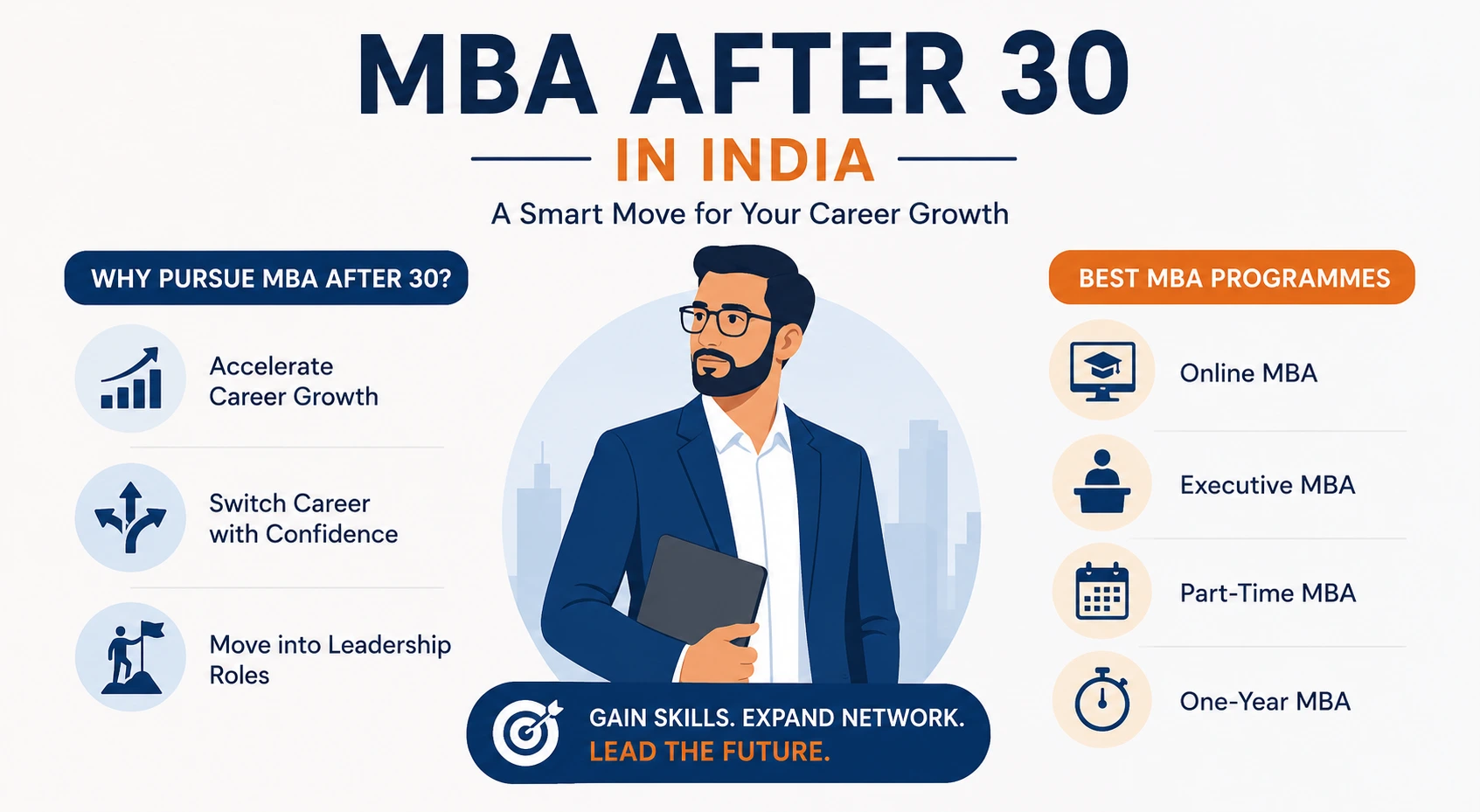
Common Reasons Professionals Pursue an MBA After 30
In today's rapidly evolving job market, professionals are no longer following a single career path. Many individuals spend their twenties gaining industry experience and then begin thinking about advancing into leadership, management, consulting, or entrepreneurial roles. This shift has made one question increasingly common: Is pursuing an MBA after the age of 30 worth it?
The answer in 2026 is far more encouraging than it was a decade ago. Companies today value professionals who combine practical experience with strategic business knowledge. Whether you're an IT professional aiming for a managerial role, an engineer looking to move into product management, a healthcare professional planning to lead hospital operations, or a finance executive aspiring to become a business leader, an MBA after 30 can significantly reshape your career.
The key, however, is selecting the right programme that aligns with your work schedule, career goals, and financial expectations.
This guide explains whether an MBA after 30 makes sense in India, which programmes are best suited for experienced professionals, and what you can realistically expect after graduation.
Why More Professionals Are Choosing an MBA After 30
Ten years ago, many believed that an MBA should be completed immediately after graduation or within the first few years of employment. That mindset has changed dramatically.
Employers today prefer managers who have already faced real business challenges. Professionals with 8–15 years of experience bring industry understanding, people management skills, and practical decision-making abilities into MBA classrooms.
Several factors are driving this trend:
Career progression has become slower without management qualifications.
Digital transformation demands cross-functional leadership.
Companies increasingly promote professionals who understand both business strategy and technology.
Professionals are switching industries more frequently than ever before.
In fact, for many professionals, 30 to 40 years may be the ideal age to pursue an MBA.
At this stage, professionals typically have:
Clear career goals
Better understanding of business challenges
Leadership responsibilities
Financial stability
Strong motivation to learn
Unlike fresh graduates who often pursue an MBA to explore career options, experienced professionals generally pursue one with a specific objective such as:
One major advantage of pursuing an MBA after 30 is the ability to connect academic concepts with real workplace situations.
Topics like strategic management, marketing, operations, finance, organisational behaviour, and leadership become much easier to understand because professionals have already encountered these challenges in their careers.
For example, aproject manager studying operations management can directly relate classroom discussions to resource allocation, timelines, and stakeholder management. Similarly, an HR professional studying organisational behaviour already understands workplace dynamics, making learning more practical and impactful.
This real-world perspective often leads to richer classroom discussions and more meaningful networking opportunities.
Common Reasons Professionals Pursue an MBA After 30
Career aspirations evolve over time. By the age of 30, many professionals begin looking beyond technical expertise and focus on long-term leadership.
Some of the most common motivations include:
Career Acceleration
Many organisations require management qualifications for senior leadership positions. An MBA helps professionals prepare for responsibilities involving business strategy, budgeting, cross-functional leadership, and organisational growth.
Career Switch
Software developers may want to become product managers.
Sales executives may aspire to transition into marketing leadership.
Mechanical engineers may want to move into consulting or operations management.
An MBA provides structured business knowledge that supports such career transitions.
Salary Growth
Experienced professionals often pursue an MBA to improve earning potential. While salary growth depends on industry, experience, employer, and role, professionals who successfully transition into managerial positions often see significant compensation improvements over time.
Entrepreneurship
Many aspiring entrepreneurs pursue an MBA after gaining industry experience. Subjects like finance, marketing, business strategy, and innovation help reduce business risks while improving decision-making.
Which MBA Programme Is Best After 30?
The ideal programme depends on your career stage, work commitments, and future goals.
Online MBA
TheOnline MBA has become one of the most popular options for working professionals.
It allows learners to continue full-time employment while studying through live classes, recorded lectures, digital learning platforms, and online assessments.
This format is particularly suitable for professionals who cannot leave their jobs but want to upgrade their qualifications.
Ideal for:
Working professionals
Mid-level managers
IT employees
Entrepreneurs
Professionals with family responsibilities
Executive MBA
Executive MBAprogrammes are specifically designed for professionals with significant work experience.
The curriculum focuses on leadership, strategic thinking, organisational transformation, innovation, and executive decision-making.
Participants also benefit from peer learning, networking with senior professionals, and industry-focused case studies.
Best suited for professionals aiming for senior leadership positions.
Part-Time MBA
Part-time MBA programmes are offered through weekend or evening classes, enabling professionals to balance work and study.
Although they require greater time commitment than online programmes, they provide classroom interaction while allowing learners to remain employed.
One-Year MBA
One-year MBA programmes have become increasingly popular among experienced professionals.
These programmes are intensive and focus on fast-paced learning.
They are ideal for professionals who can afford to take a career break for a year in exchange for accelerated career growth.
Choosing the Right MBA Specialisation
Selecting the right specialisation is often more important than selecting the programme format.
Professionals should align their MBA with future career goals rather than past experience.
These capabilities become increasingly valuable as professionals move toward director, vice president, and CXO roles.
Balancing Work, Family, and an MBA
One concern professionals over 30 frequently have is managing multiple responsibilities.
Many are balancing demanding jobs, family commitments, financial obligations, and personal goals.
The good news is that today’s MBA programmes are far more flexible than traditional full-time options.
Online learning platforms offer recorded lectures, weekend sessions, digital assignments, and mobile access, allowing professionals to learn at their own pace.
Setting weekly study schedules, involving family members in planning, and maintaining consistency can make the journey manageable without compromising work performance.
What Salary Growth Can You Expect?
Salary outcomes vary depending on several factors:
Years of experience
Industry
Company
MBA institution
Skills acquired
Role after graduation
Location
Instead of expecting immediate salary jumps solely because of the degree, professionals should view an MBA as a long-term investment in career progression.
Many professionals move from technical or operational roles into leadership positions after completing an MBA. These transitions often bring greater responsibilities, larger teams, improved compensation, and stronger long-term career prospects.
The combination of experience and management education usually creates better opportunities than either qualification alone.
Networking Matters More Than Ever
Networking becomes increasingly valuable after 30.
MBA programmes bring together professionals from technology,healthcare, banking, consulting, manufacturing, retail, startups, government, and multinational companies.
These interactions create opportunities for:
Career referrals
Business partnerships
Industry insights
Mentorship
Entrepreneurial collaboration
Many professionals find that the relationships built during an MBA continue to benefit their careers long after graduation.
While pursuing an MBA after 30 offers significant benefits, professionals should also prepare for certain challenges.
Balancing work deadlines with academic assignments can be demanding, especially during examination periods. Maintaining discipline becomes essential, particularly in online programmes where self-motivation plays a major role.
Financial planning is another important consideration. Tuition fees should be evaluated alongside expected career outcomes, and professionals should choose programmes that deliver long-term value rather than simply opting for the most prestigious name.
Finally, adapting to new technologies, digital learning platforms, and collaborative assignments may require some adjustment, but these experiences also enhance workplace readiness.
How to Choose the Right MBA in 2026
Before enrolling, evaluate every programme carefully.
Look beyond rankings and consider whether the curriculum matches your career goals.
Check factors such as accreditation, faculty expertise, flexibility, industry relevance, alumni network, placement support (where applicable), learning platform, peer profile, and overall return on investment.
Speaking with alumni, attending information sessions, and reviewing programme outcomes can help you make an informed decision.
The best MBA is one that complements your experience and supports your long-term ambitions.
Final Thoughts
Pursuing an MBA after 30 in India is no longer considered unconventional—it has become a strategic career move for experienced professionals seeking leadership roles, career transitions, or entrepreneurial success. With flexible learning formats, specialised curricula, and growing employer acceptance of online and executive programmes, there are more opportunities than ever to upgrade your business skills without pausing your career.
The key is to define your goals clearly, choose a programme that fits your lifestyle and aspirations, and stay committed throughout the journey. An MBA is not simply about adding another qualification to your résumé; it is about broadening your perspective, strengthening your leadership capabilities, and preparing for the next phase of your professional life. For many professionals in their thirties and beyond, it can be the catalyst that transforms years of experience into lasting career growth.
Manya Tohani
Personal Growth Mentor
Manya Tohani is a Personal Growth Mentor and content strategist, helping individuals build strong personal brands and accelerate career growth. With 8M+ impressions and experience mentoring students, she empowers others through actionable guidance, resilience, and real-world insights.
 HOME > BLOG > Online MBA > MBA After 30 in India: Is It Too Late, Which Programme, and What to Expect (2026)
 August 7, 2026
 7 min read





 ChatGPT
 Perplexity
 Claude
 Grok
Grok








 ROI Calculator