Scrum organises work into fixed-length sprints with defined roles, scheduled meetings, and regular reviews, making it suitable for planned, goal-driven projects.
Kanban focuses on continuous workflow, visual task tracking, work-in-progress (WIP) limits, and continuous improvement, making it useful for teams handling changing priorities.
The key differences between Scrum and Kanban include work cycles, roles, planning, flexibility, performance metrics, and how teams manage changes during work.
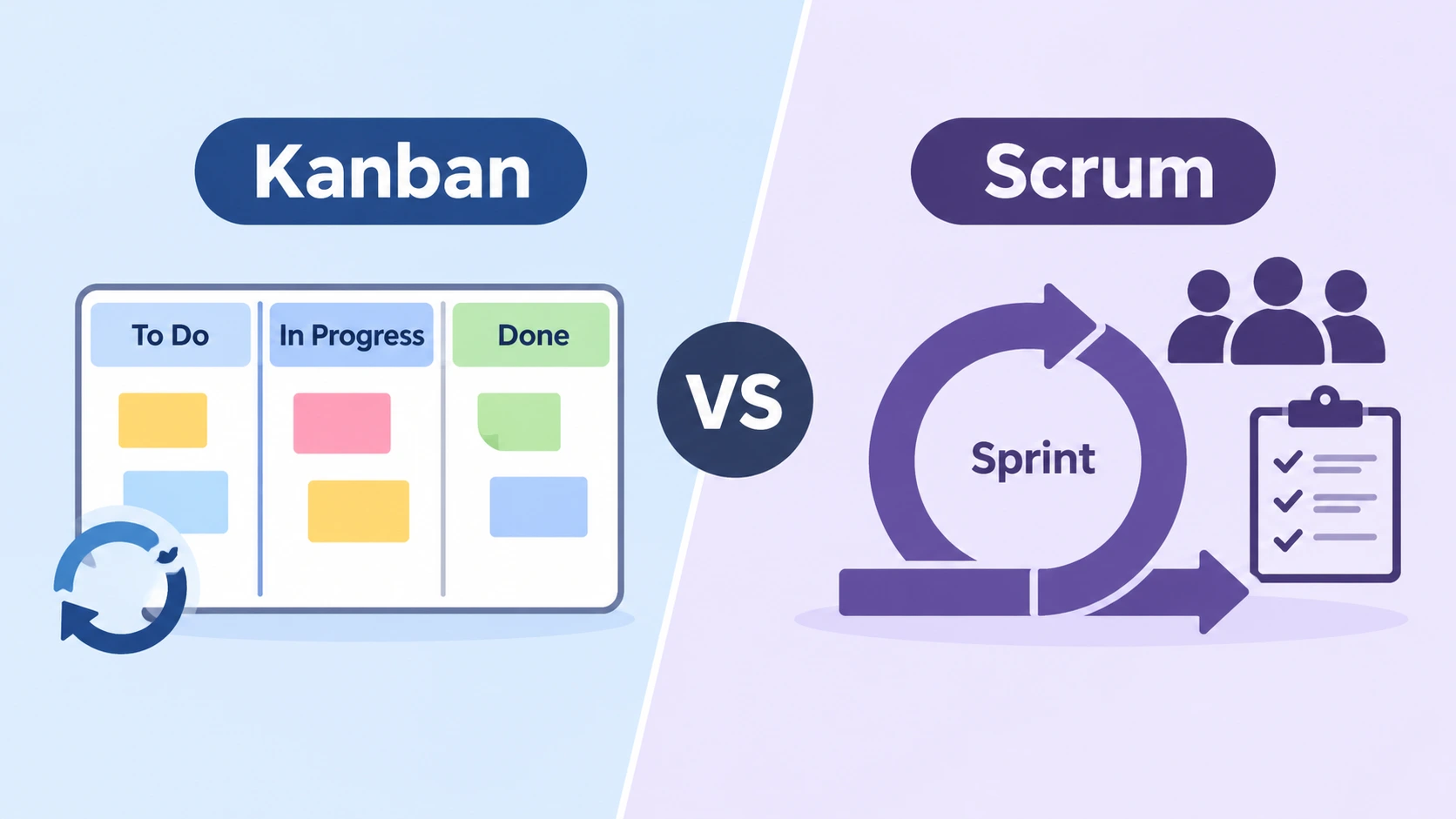
Scrum boards track tasks within a specific sprint, while Kanban boards provide a continuous view of workflow stages and use WIP limits to prevent bottlenecks.
In this blog, you'll learn the differences between Kanban and Scrum, their benefits and limitations, how Scrum and Kanban boards work, when to choose each framework, and how Scrumban combines both approaches.
Every team wants to deliver good work faster, with fewer surprises. That is why Agile methods have become so popular across software, marketing, manufacturing, and operations. Yet once a team decides to "go Agile," a practical question follows: should we use Scrum or Kanban? The debate around kanban vs scrum is common, and the honest answer is that neither is better in every situation. Each suits a certain kind of work. Professionals who manage processes, workflows, and data-driven decisions, including those pursuing structured learning such as thePG Certificate Programme in Operations Management and Analytics from IIM Visakhapatnam, meet both frameworks early in their careers. This blog explains each approach in plain language, compares them side by side, and helps you choose the one that fits your team.
Agile is a way of working that focuses on delivering value in small steps, collecting feedback, and adjusting quickly. Instead of planning everything upfront and hoping it works, Agile teams plan a little, build a little, learn a lot, and repeat.
Scrum and Kanban are the two most widely used Agile frameworks. Both aim to reduce waste, improve teamwork, and make progress visible. But they go about it differently. Choosing the wrong one does not ruin a project, yet it can create friction. A team that needs flexibility may feel trapped by fixed deadlines, while a team that needs structure may feel lost without clear roles.
Understanding how each framework works is the first step toward a good decision.
Scrum is a framework that organizes work into short, fixed-length periods called sprints. A sprint usually lasts one to four weeks, and most teams choose two. At the start of each sprint, the team agrees on a set of tasks it can complete within that time. At the end, the team delivers a usable piece of work and reviews how things went.
Scrum is built around a few clear elements.
Roles – Scrum defines three roles. The product owner decides what the team should build and in what order. The Scrum Masterhelps the team follow the process and removes obstacles. The developers, meaning the people doing the work, decide how to complete it.
Events – Scrum has regular meetings, each with a purpose. Sprint Planning decides what will be done. The Daily Scrum is a short check-in, usually fifteen minutes. The sprint review shows completed work to stakeholders. The Sprint Retrospective helps the team talk about what went well and what to improve.
Artifacts – The Product Backlog is a prioritized list of everything that might be needed. The Sprint Backlog is the smaller list chosen for the current sprint. The increment is the finished, usable result.
The strength of Scrum lies in its rhythm. Because everyone knows when planning, review, and delivery happen, the team builds a steady pace. Scrum works especially well for projects with a clear goal, such as launching a new product feature or building a software application step by step.
What Is Kanban?
Kanban began in Japan in the late 1940s, when Toyota developed it as a scheduling system for manufacturing. The word means “visual signal” or “card.” Today, Kanban is used well beyond factories, in IT support, healthcare, content creation, and customer service.
Kanban is simpler than Scrum in structure. It does not require sprints, fixed roles, or scheduled meetings. Instead, it asks the team to visualize its work, limit how much is in progress at once, and keep work flowing smoothly from start to finish.
The core practices of Kanban include:
Visualize the workflow. Every task appears on a board so anyone can see its status at a glance.
Limit work in progress (WIP). The team sets a cap on how many tasks can be in each stage. This prevents overload and exposes bottlenecks.
Manage flow. The team watches how quickly tasks move and works to remove delays.
Make policies explicit. Rules such as “what counts as done” are written down so everyone shares the same understanding.
Improve continuously. The team makes small, steady changes based on what the data shows.
Because Kanban allows new work to enter at any time, it suits teams that face unpredictable requests. A support desk, for example, cannot know on Monday what will arrive on Wednesday. Kanban handles that reality gracefully.
The difference between scrum and kanban comes down to structure, timing, and flexibility. Let us look at the main areas where they diverge.
1. Cadence and Timing
Scrum works in time boxes. Work is planned, built, and delivered inside each sprint, and the cycle repeats. Kanban has no such boxes. Work flows continuously, and teams can release whenever a task is ready. If you like predictable rhythms, Scrum feels natural. If you prefer to deliver the moment something is finished, Kanban feels more comfortable.
2. Roles and Responsibilities
Scrum assigns formal roles, which brings clarity about who decides what. Kanban does not prescribe roles. Teams keep their existing structure, and managers orteam leads continue in their current positions. This makes Kanban easier to adopt in organizations that do not want to reshape their teams.
3. Handling Change
In Scrum, the sprint scope is protected. Once the team commits to a set of tasks, new requests generally wait for the next sprint. This protection helps the team stay focused. In Kanban, a new task can be added at any time, provided the WIP limit allows it. That makes Kanban a better fit when priorities shift frequently.
4. Planning and Estimation
Scrum teams estimate the effort of tasks, often using story points, and track velocity to forecast how much they can finish in future sprints. Kanban teams usually skip detailed estimation. Instead, they measure cycle time, which is how long a task takes from start to finish, and use it to predict delivery.
5. Measuring Performance
Scrum relies on velocity and burndown charts to show progress toward the sprint goal. Kanban relies on cycle time, lead time, and throughput. Kanban also uses cumulative flow diagrams to reveal where work gets stuck. Both approaches are data-friendly, which is why professionals with an analytics background often find them easy to apply.
6. Speed of Adoption
Kanban is generally easier to start. You can draw a board, add your current tasks, set limits, and begin the same day. Scrum requires training, role definitions, and a shared understanding of events, so it takes more time to set up. The upside is that this investment gives teams a strong, repeatable structure.
Scrum Board vs Kanban Board
Both frameworks use boards, so people often assume they are identical. They are similar in appearance, but they behave differently. Understanding the scrum board vs kanban board distinction helps you see the frameworks in action.
The Scrum Board
A Scrum board shows the work of a single sprint. It typically has columns such as To Do, In Progress, and Done. Once the sprint ends, the board is cleared or reset, and a new one begins with the next sprint’s tasks. The board is temporary and tied to the sprint goal. It often includes a burndown chart to track remaining work.
Because the sprint backlog is fixed, the number of tasks on the board stays mostly the same during the sprint. Items move from left to right until they are done, and the team’s aim is to clear the board by the sprint’s end.
The Kanban Board
A Kanban board is permanent and continuous. It stays in use as long as the team does. Columns often reflect more detailed stages of the workflow, such as Backlog, Analysis, Development, Testing, Review, and Released. The most important feature is the WIP limit shown on each column. If the Testing column has a limit of three and already holds three tasks, the team cannot pull in more until one moves forward.
New tasks can be added whenever capacity opens up. The board never resets, so it offers a running view of the entire workflow.
Key Differences at a Glance
Lifespan: A Scrum board is reset every sprint. A Kanban board is ongoing.
Limits: A Scrum board is limited by sprint scope. A Kanban board is limited by WIP caps on each column.
Flexibility: A Scrum board does not welcome new items mid-sprint. A Kanban board does.
Ownership: A Scrum board belongs to a specific team and sprint. A Kanban board can be shared across a wider workflow.
In short, the Scrum board answers the question, “What will we finish in this sprint?” The Kanban board answers, “How smoothly is our work flowing right now?”
When to Choose Scrum
Scrum is a strong choice when your project has a defined goal and benefits from regular checkpoints. Consider Scrum if:
You are building a product in stages and need frequent feedback from customers or stakeholders.
Your requirements are fairly clear, or can be refined in short cycles.
Your team is cross-functional and can complete a piece of work without depending heavily on others.
You want clear accountability through defined roles.
You value a steady, predictable rhythm and regular reflection through retrospectives.
For example, a software company developing a mobile app can plan features sprint by sprint, demonstrate progress every two weeks, and adjust the next sprint based on user feedback. The fixed cycle keeps the team focused and gives stakeholders confidence.
Scrum can feel heavy, however, when the work is unpredictable. If urgent requests keep interrupting the sprint, the team may struggle to meet its commitments and may become frustrated.
When to Choose Kanban
Kanban shines when work arrives continuously and priorities change often. Consider Kanban if:
Your team handles ongoing requests, such as support tickets, maintenance tasks, or operational issues.
Priorities shift regularly, and you need the freedom to respond immediately.
You want to improve an existing process without changing team roles or structure.
Your main challenge is bottlenecks, delays, or too many tasks happening at once.
You prefer a lightweight method that is easy to start and easy to adjust.
For example, an operations team managing vendor requests, order issues, and process improvements can place every item on a Kanban board, limit work in progress, and watch where delays occur. Over time, the data reveals which stage slows things down, and the team can fix it.
Kanban has its own limitations. Without time boxes, some teams drift and lose urgency. Without regular events, discussions about improvement may not happen unless the team makes a point of scheduling them. Discipline matters here, especially in honoring WIP limits.
Many teams discover that the choice between kanban vs scrum is not strictly either-or. Scrumban is a hybrid that blends elements of both. A team might keep Scrum’s sprints and retrospectives while adopting Kanban’s WIP limits and flow metrics. Or a Kanban team might add a weekly planning session and a regular review to bring more rhythm.
Scrumban is useful when a team starts with Scrum but finds that interruptions are frequent, or when a Kanban team wants more structure. It is also a practical bridge for organizations moving from one method to the other. Still, it works best when the team already understands the basics of both frameworks. Start with one, learn it well, and then adapt.
How to Pick the Best Agile System: A Simple Checklist
If you are still unsure, walk through these questions with your team.
What kind of work do we do? If it is project-based with clear goals, lean toward Scrum. If it is ongoing and unpredictable, lean toward Kanban.
How often do priorities change? Frequent changes favor Kanban. Stable priorities within a few weeks favor Scrum.
Do we need defined roles? If your team lacks clarity about who decides what, Scrum’s roles can help. If roles already work well, Kanban will fit without disruption.
How much change can our organization absorb? Kanban asks for little upfront change. Scrum asks for more.
What problem are we trying to solve? If the issue is delivering a product in steady increments, Scrum is a good match. If the issue is bottlenecks and slow turnaround, Kanban is a good match.
How comfortable is the team with structure? Teams that like routines tend to thrive with Scrum. Teams that value autonomy and flexibility often prefer Kanban.
If most of your answers point in one direction, you have your answer. If they are mixed, begin with the simpler option, usually Kanban, and add elements of Scrum as your needs grow.
A Few Practical Tips for Getting Started
Start small. Pilot the framework with one team before rolling it out widely.
Train the team. A shared understanding prevents confusion. Even a short workshop helps.
Review regularly. Whichever framework you pick, hold a regular conversation about what is working and what is not.
Use data. Track cycle time, velocity, or throughput, and let the numbers guide improvements rather than guesswork.
Stay flexible. Frameworks are tools. If something is not helping, adjust it.
Final Thoughts
The kanban vs scrum conversation is less about finding a winner and more about finding a fit. Scrum offers structure, rhythm, and clear roles, which suit teams building products in planned cycles. Kanban offers flexibility, visibility, and continuous flow, which suit teams handling variable and ongoing work. Knowing the difference between scrum and kanban, and understanding how a scrum board vs kanban board behaves in daily practice, gives you the confidence to choose wisely.
Remember that no framework is permanent. Teams grow, projects change, and what works today may need adjusting tomorrow. Begin with the approach that matches your current needs, measure the results honestly, and keep improving. That mindset, more than any specific method, is what makes a team truly Agile.
Frequently Asked Questions
The main difference is how work is organized. Scrum divides work into fixed-length sprints with defined roles and scheduled meetings. Kanban uses a continuous flow with no required roles or time boxes, and it controls workload through work-in-progress limits.
enerally, yes. Kanban can be started quickly with a simple board and a few rules, and it does not require changes to team roles. Scrum needs more training because it introduces specific roles, events, and artifacts. That said, Scrum’s structure helps many teams stay disciplined once they learn it.
Yes. This hybrid approach is known as Scrumban. Teams combine Scrum’s sprints and retrospectives with Kanban’s visual boards and WIP limits. It is a popular option for teams that want structure without losing flexibility.
Both work well with digital tools such as online boards and video calls. Scrum’s regular meetings keep distributed teams aligned, while Kanban’s visual board gives everyone a clear view of progress at any time. The better choice depends on whether your work is planned in cycles or arrives continuously.
Arif Siddiqui
Head of Accounting and Treasury
Arif Siddiqui is a finance leader specializing in accounting, treasury, and financial strategy. As Head of Finance at Generali Employee Benefits, he brings extensive experience in managing global financial operations. He is known for driving financial efficiency and governance across organizations. His leadership supports sustainable business growth and financial excellence.
Get Free Upskilling Guidance
Fill in the details for a free consultation
Related Courses
Explore our programs
Post Graduate Certificate Programme in Operations Management & Analytics

 November 17, 2026
 11 min read





 Key Insights
 ChatGPT
 Perplexity
 Claude
 Grok










 ROI Calculator