Step-by-Step: How to Build a Professional Portfolio
Key Insights
A professional portfolio showcases your skills, achievements, and work samples, helping employers evaluate your abilities beyond what your resume communicates.
A strong career portfolio should include a professional introduction, resume, relevant work samples, project descriptions, testimonials, certifications, and contact information.
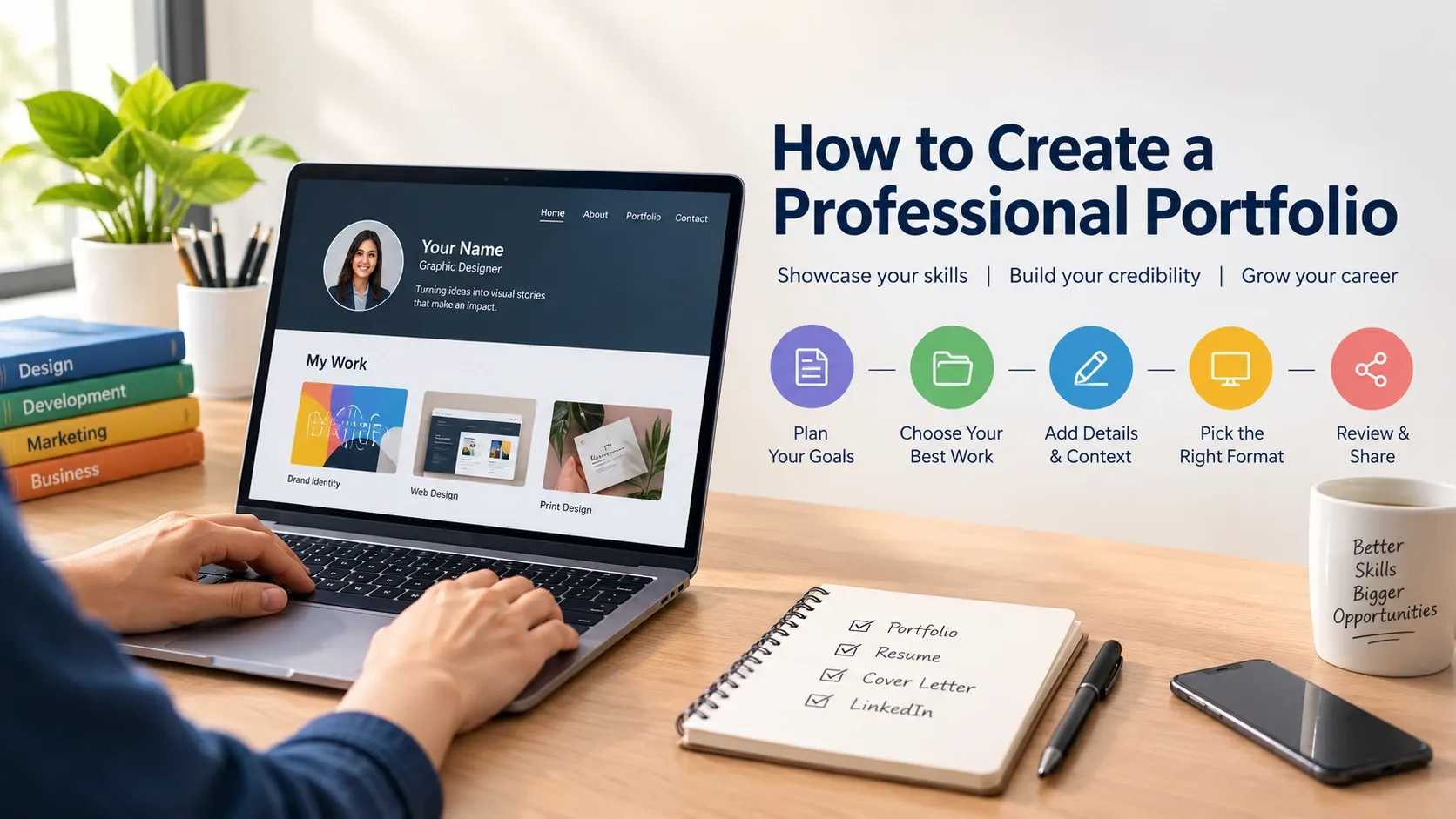
Building an effective job portfolio involves defining your goals, selecting five to ten relevant work samples, explaining your contributions, choosing the right format, and reviewing the final presentation.
Portfolio formats and content vary by profession. Designers can showcase visual projects, developers can share code repositories, finance professionals can present reports and dashboards, and fresh graduates can include academic projects and internships.
In this blog, you'll learn how to create a professional portfolio step by step, choose the right format for different careers, explore profession-specific examples, and keep your portfolio updated.
A resume tells an employer what you have done. A professional portfolio shows them. In a job market where hiring managers review dozens of applications for a single role, proof of your skills can set you apart quickly. Whether you are a designer, a teacher, a software developer, or a finance professional, a well-built career portfolio gives your experience context, evidence, and credibility.
This blog explains what a professional portfolio is, what it should include, and how to build a job portfolio that fits your own field. You will also find career-specific advice, and answers to frequently asked questions.
A professional portfolio is a curated collection of work samples, achievements, and documents that demonstrates your skills, experience, and growth. It can be a website, a PDF, a printed binder, or a mix of formats. Its purpose is simple: to give proof behind the claims you make on your resume and in interviews.
Many people think portfolios are only for artists and designers. That is no longer true. Teachers share lesson plans, analysts share dashboards, project managers share case studies, and nurses share certifications and continuing education records. Any professional can benefit from organizing their best work in one place.
A career portfolio does more than decorate your application. It serves several practical purposes:
It proves your skills. Employers can see the quality of your work instead of relying only on your description of it.
It tells your story. A portfolio shows how your skills developed over time and what makes your approach unique.
It helps you stand out. Many candidates submit similar resumes. A strong portfolio gives you a clear advantage.
It supports interviews. You can walk interviewers through real examples, which makes your answers more concrete and memorable.
It tracks your growth. Keeping your achievements organized helps with promotions, salary discussions, and career changes.
A career portfolio is also useful when you are not job hunting. Clients, collaborators, and recruiters may find you through it, which opens doors you did not plan for.
Key Elements Every Job Portfolio Should Include
The content of your job portfolio will vary by profession, but most strong portfolios share a common structure. Consider including the following:
A professional introduction. A short bio that explains who you are, what you do, and what you are looking for. Keep it clear and free of jargon.
Your resume. Make it easy to view or download.
Work samples. Select your best examples, not every project you have ever completed. Quality matters more than quantity.
Project descriptions. For each sample, explain the problem, your role, the actions you took, and the results.
Testimonials and recommendations. Short quotes from managers, clients, or colleagues add trust.
Certifications, awards, and education. These show formal training and recognition.
Contact information. Provide a professional email address and links to relevant profiles such as LinkedIn.
When possible, support your work with numbers. For example, “increased website traffic by 40% in six months” is far more convincing than “improved website performance.”
Step-by-Step: How to Build a Professional Portfolio
Step 1: Define Your Goal and Audience
Start by asking who will view your portfolio and what you want them to do. A hiring manager at a tech company will look for different things than a client who wants to hire you for freelance work. Write down your target roles or industries, and let that goal guide every decision you make.
Step 2: Gather Your Best Work
Collect everything you might use: projects, reports, presentations, designs, code, articles, lesson plans, case studies, and performance reviews. Then select the pieces that best match the roles you want. Aim for five to ten strong samples rather than a long list of average ones.
Step 3: Tell the Story Behind Each Piece
A work sample without context is only half useful. For each item, briefly describe the challenge, your specific contribution, the tools or methods you used, and the outcome. If the work was a team effort, be honest about your role. This approach shows your thinking process, which employers value highly.
Step 4: Choose the Right Format
Pick a format that suits your field and audience. We cover this in more detail in the next section.
Step 5: Organize and Design with Care
Use a clean layout, consistent fonts, and a logical order. Place your strongest work first. Make navigation simple so that a visitor can find what they need within seconds. Avoid clutter, heavy animation, and low-quality images.
Step 6: Review, Test, and Share
Proofread everything carefully. Ask a trusted colleague or mentor for feedback. If your portfolio is online, test it on both desktop and mobile devices. Once it is ready, include the link in your resume, cover letter, email signature, and LinkedIn profile.
Choosing the Right Format for Your Career Portfolio
The best format depends on your profession and where your audience will view your work.
Website or online portfolio. Ideal for designers, developers, writers, photographers, and marketers. It is easy to update and share, and it allows you to present multimedia work.
PDF portfolio. A good choice for consultants, analysts, and executives who want a polished, printable document that can be attached to an email.
Printed or physical portfolio. Useful for in-person interviews, especially in fields such as architecture, fashion, and education.
Platform-based portfolio. Sites such as LinkedIn, Behance, GitHub, or Medium can serve as part of your professional portfolio, particularly when employers in your field already use them.
Many professionals use two formats: a live online version and a downloadable PDF for applications that require attachments.
Professional Portfolio Examples for Different Careers
Here is how the contents of a job portfolio change across professions.
Portfolio for Designers and Creative Professionals
Graphic designers, illustrators, photographers, and video editors rely heavily on visuals. Show high-quality images of your best projects, along with short notes about the brief, your process, and the result. Include sketches, drafts, or before-and-after versions to show how your ideas developed. Platforms such as Behance or a personal website work well here.
Portfolio for Writers, Marketers, and Communications Professionals
Include published articles, blog posts, campaign summaries, social media examples, email sequences, and press releases. For marketers, add measurable outcomes such as conversion rates, engagement growth, or lead numbers. If your work is under a non-disclosure agreement, describe it generally or create a sample project that reflects your skills.
Portfolio for Software Developers and IT Professionals
A developer’s career portfolio often centers on code repositories, live applications, and technical case studies. Share links to GitHub projects with clear documentation. Explain the problem each project solves, the technologies you used, and any challenges you overcame. Contributions to open-source projects also strengthen your profile.
Portfolio for Business, Finance, and Management Professionals
Professionals in these fields can feature case studies, project summaries, reports, dashboards, process improvements, and presentations. Focus on results: revenue growth, cost savings, efficiency gains, or successful team leadership. Remove confidential details, and replace sensitive figures with percentages or ranges when needed.
Portfolio for Teachers and Education Professionals
A teaching portfolio may include a teaching philosophy, sample lesson plans, student feedback, assessment tools, classroom management strategies, and evidence of student progress. Add professional development certificates and any curriculum design work. Photos or short video clips of classroom activities can also help, provided you follow privacy rules.
Portfolio for Healthcare Professionals
Nurses, therapists, and allied health professionals can include licenses, certifications, continuing education records, quality improvement projects, patient education materials, and letters of recommendation. Always protect patient privacy by removing any identifying information.
Portfolio for Students and Fresh Graduates
If you have limited work experience, use academic projects, internships, volunteer work, research papers, and group assignments. Include any leadership roles or competitions. A student’s professional portfolio proves initiative and potential, even without a long job history.
Tips to Make Your Job Portfolio Stand Out
Tailor it to the role. Adjust the order and selection of your samples to match each job application.
Show results. Use data, outcomes, and client feedback wherever possible.
Keep it concise. A focused portfolio is easier to review than a lengthy one.
Use plain language. Explain your work so that someone outside your field can follow it.
Maintain a professional tone. Your writing, images, and design should all reflect the standards of your industry.
Add a clear call to action. Tell visitors how to contact you or what step to take next.
Make it accessible. Use readable fonts, good color contrast, and descriptive text for images
How to Keep Your Professional Portfolio Updated
Your portfolio should grow as you do. Set a reminder to review it every three to six months. Add new projects, remove weaker items, update your bio, and refresh your contact details. After each major accomplishment, such as finishing a project or earning a certification, add it while the details are still fresh. A regularly updated job portfolio is always ready when an opportunity appears.
A professional portfolio is one of the most effective tools for presenting your skills with confidence. It turns claims into evidence and helps employers understand the value you can bring. No matter your field, the process is similar: define your goal, choose your best work, explain the story behind it, pick the right format, and keep it current.
Start small if you need to. Even a simple career portfolio with three or four strong samples can make a meaningful difference. Over time, you can expand and refine it as your career develops.
Frequently Asked Questions
Yes. A professional portfolio is useful in almost every profession. Analysts, managers, teachers, engineers, and healthcare workers can all use one to present projects, results, certifications, and recommendations that a resume alone cannot fully show.
Most professionals do well with five to ten strong samples. Choose work that is relevant to the roles you want, and explain your contribution and the results for each one.
It depends on your field. An online portfolio is best for creative and technical roles and is easy to update. A PDF is helpful for formal applications and email attachments. Many professionals keep both.
Use academic projects, internships, volunteer work, personal projects, online course assignments, and research. You can also create sample projects that reflect the kind of work you want to do. Focus on showing your skills, effort, and potential.
Bhargavi R
HR Professional
Bhargavi Reddy is an HR professional with over 6 years of experience in IT recruitment and talent acquisition. She specializes in hiring across technologies like Java, DevOps, Python, and Data Engineering. With strong expertise in full-cycle recruitment and stakeholder management, she focuses on building high-performing teams. Currently, she works as an HR Manager driving strategic hiring initiatives.

 November 1, 2026
 7 min read





 Key Insights
 ChatGPT
 Perplexity
 Claude
 Grok











 ROI Calculator