How to Become a General Manager: A Step-by-Step Path
General Manager Qualifications Employers Look For
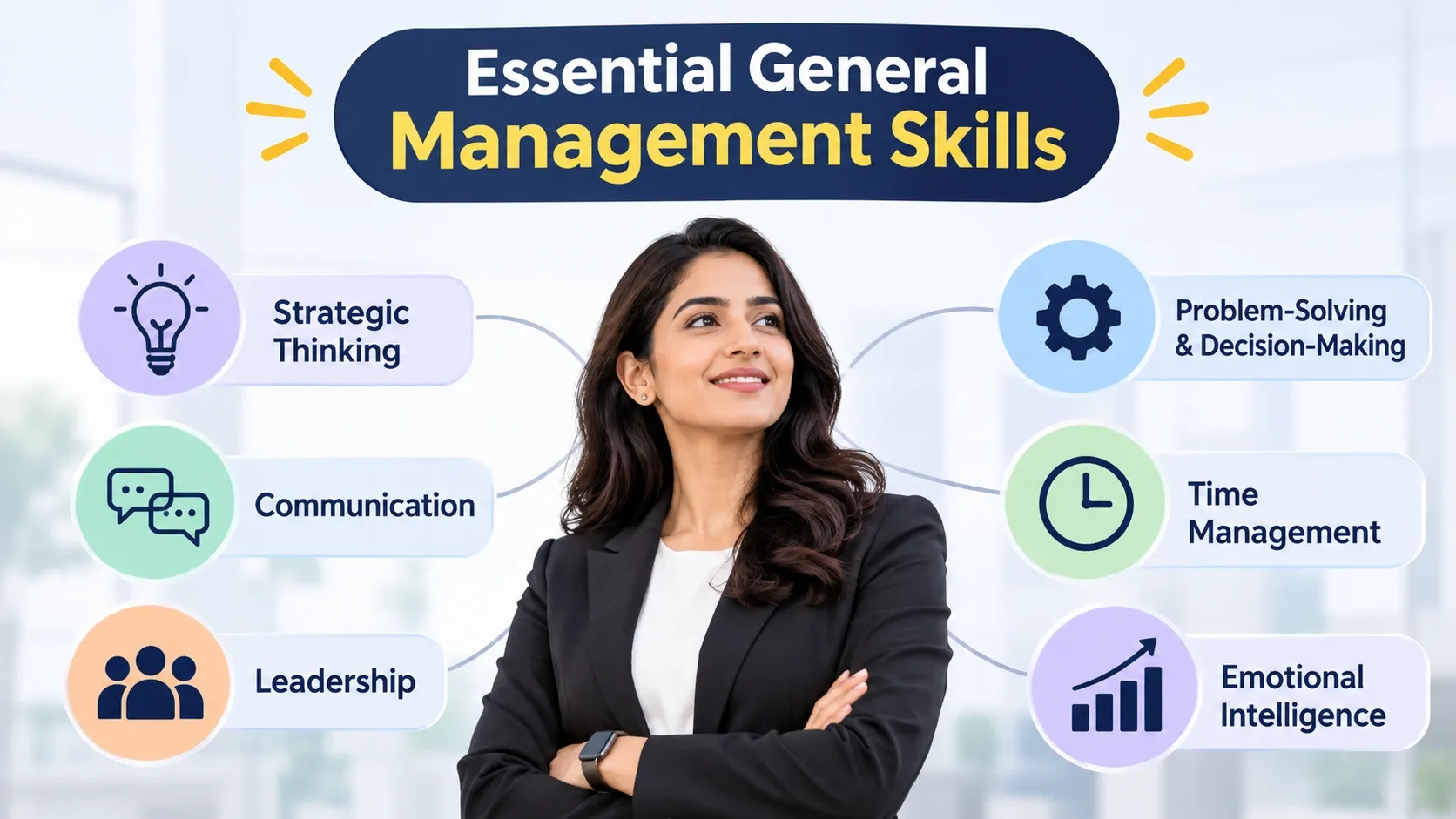
Essential General Management Skills
Key Insights
A General Manager oversees multiple business functions, manages budgets and operations, leads teams, and ensures that business goals align with the organisation's long-term strategy.
The journey to becoming a General Manager involves building a strong educational foundation, gaining functional experience, moving into leadership roles, and developing cross-functional business knowledge.
Employers generally look for a bachelor's degree, relevant postgraduate qualifications, 8 to 15 years of professional experience, and at least 3 to 5 years in a managerial or leadership position.
Essential general management skills include strategic thinking, leadership, financial acumen, decision-making, communication, operational excellence, adaptability, and digital awareness.
In this blog, you'll learn how to become a General Manager in India, the qualifications and skills required, the career path to follow, industry-wise job opportunities, and how general management courses can support your professional growth.
Every organization needs someone who can see the complete picture. A General Manager is that person. They connect strategy with operations, guide multiple teams, and take responsibility for the overall performance of a business unit, branch, or department. With India's economy growing across sectors such as manufacturing, retail, healthcare, hospitality, banking, and technology, the demand for capable business leaders continues to rise.
If you are an ambitious professional wondering how to become a General Manager in India, this guide will help. We explain what the role involves, the General Manager qualifications employers expect, the general management skillsyou must build, the career path you can follow, and the options available for learning and growth.
A General Manager, often called a GM, holds overall responsibility for the business results of a unit or division. Unlike a functional manager who focuses on one area, such as finance or marketing, a General Manager oversees several functions together and ensures they work toward the same goals.
Typical responsibilities include:
Setting business goals and aligning them with the company’s long-term strategy
Managing budgets, profit and loss, and resource allocation
Leading department heads and building high-performing teams
Overseeing operations, sales, customer service, and quality standards
Monitoring performance reports and making data-informed decisions
Managing relationships with clients, vendors, regulators, and senior leadership
In smaller companies, a General Manager may run the entire business. In larger organizations, the role may cover a plant, a region, or a business vertical. In both cases, the position demands a mix of leadership, business understanding, and sound judgment.
How to Become a General Manager: A Step-by-Step Path
There is no single route to this position, but most successful professionals follow a similar pattern. Here is a practical approach to how to become a General Manager.
Step 1: Build a strong educational base. Start with a bachelor’s degree in business, commerce, engineering, or a related field. Your undergraduate subject matters less than the way you build on it later with business knowledge and leadership experience.
Step 2: Gain hands-on experience in a core function. Begin your career in a function such as sales, operations, finance, marketing, or human resources. Deep experience in at least one area earns you credibility and teaches you how businesses actually work.
Step 3: Move into team leadership. Take opportunities to lead people early. Becoming a team leader or supervisor gives you practice in delegation, coaching, and handling performance issues.
Step 4: Progress to a managerial role. As a manager, you will handle budgets, targets, and larger teams. This stage is where you learn to balance short-term results with long-term planning.
Step 5: Broaden your exposure beyond one function. General Managers must understand how different departments connect. Volunteer for cross-functional projects, job rotations, or special assignments that expose you to finance,operations, marketing, and strategy.
Step 6: Strengthen your qualifications. At this point, many professionals pursue advanced learning to fill knowledge gaps and prepare for broader responsibility.
Step 7: Build a professional network and find mentors. Experienced leaders can share lessons that books and courses cannot. Industry events, alumni networks, and professional communities also help you learn about opportunities early.
Step 8: Demonstrate results and leadership potential. Promotions to senior roles depend on measurable outcomes, such as revenue growth, cost savings, improved customer satisfaction, or successful turnarounds. Keep a record of your achievements and share them clearly during performance reviews.
In India, the journey from entry-level to General Manager typically takes between ten and fifteen years, though this varies by industry, company size, and individual performance.
General Manager Qualifications Employers Look For
When companies hire for General Manager jobs, they usually evaluate three things together: formal education, professional experience, and leadership ability.
Educational qualifications: A bachelor’s degree is the minimum requirement for most roles. Many employers prefer candidates who also hold a postgraduate qualification, such as an MBA, a PGDM, or a postgraduate certificate in general management. These programs cover finance, marketing, operations, strategy, and people management, which together form the core knowledge base of a General Manager.
Professional experience: Most organizations expect between eight and fifteen years of work experience, with at least three to five years in a managerial or leadership role. Experience in handling budgets, managing teams, and delivering business targets carries significant weight.
Certifications and specialized learning: Certifications in project management, data analytics, supply chain, or leadership can strengthen your profile. They show that you keep your knowledge current and are willing to learn new approaches.
Industry knowledge: A General Manager in healthcare needs different domain awareness than one in retail or manufacturing. Strong understanding of your industry’s regulations, customers, and competitive landscape is an important part of General Manager qualifications.
Essential General Management Skills
Qualifications open the door, but general management skills determine how well you perform once you are inside. Here are the most important ones.
Strategic thinking: General Managers must look beyond daily operations. This means understanding market trends, identifying opportunities, and creating plans that keep the business competitive.
Leadership and people management: You will lead department heads and large teams. The ability to motivate people, resolve conflict, and build a positive culture is central to the role.
Financial acumen: Understanding profit and loss statements, budgeting, cost control, and return on investment is essential. Even if you come from a non-finance background, you must be comfortable with numbers.
Decision-making and problem-solving: General Managers often make decisions with incomplete information. Good judgment, supported by data and experience, helps you act with confidence.
Communication and negotiation: You will present to senior leadership, negotiate with clients and vendors, and communicate goals to your teams. Clear and respectful communication builds trust at every level.
Operational excellence: A strong grasp of processes, quality standards, and efficiency helps you keep the business running smoothly while improving results.
Adaptability and change management: Markets, technology, and customer expectations change quickly. Leaders who manage change calmly and guide their teams through it are highly valued.
Digital and analytical awareness: Modern businesses rely on data, automation, and digital tools. A General Manager need not be a technical expert, but should understand how technology can improve performance.
General Management Courses to Consider
Formal learning plays a major role in preparing for senior leadership. The right General Management courses give you a broad view of business, structured frameworks for decision-making, and exposure to peers from different industries.
When choosing a program, look for these features:
A curriculum that covers finance, marketing, operations, strategy, and leadership
Faculty and institutional credibility
A format that suits working professionals, such as online or blended learning
Case studies and projects based on real business situations
Networking opportunities with fellow professionals and alumni
Options include full-time MBA programs, executive MBAs, and postgraduate certificate programs. For working professionals who cannot take a career break, flexible programs are often the most practical choice. One such course is thePGCP in General Management by IIM Nagpur, offered through Jaro Education, which is designed to help experienced professionals build leadership and business skills while continuing to work.
Whichever program you choose, remember that learning delivers the best results when you apply it. Try to use new concepts in your current role, discuss them with your team, and track the impact on your performance.
General Manager Jobs in India: Where the Opportunities Are
General Manager jobs exist in almost every sector, and the scope of the role varies by industry. Some of the most active areas include:
Manufacturing: Plant General Managers oversee production, quality, safety, and supply chains.
Hospitality and tourism: Hotel General Managers manage guest experience, revenue, and operations.
Retail and e-commerce: GMs lead store networks, regional sales, and customer experience.
Banking and financial services: Branch or regional General Managers handle business growth, compliance, and teams.
Healthcare: Hospital General Managers coordinate clinical support, administration, and finance.
Information technology and services: GMs lead business units, delivery centers, or service lines.
Real estate and infrastructure: GMs manage project execution, budgets, and stakeholder relationships.
Besides corporate roles, many professionals also move into entrepreneurship, consulting, or advisory positions after gaining general management experience. The broad skill set of a General Manager is highly transferable.
Free Courses
Free Product Management Course – Roadmap,Vision, and Strategy
The career path toward senior leadership usually follows these stages:
Executive or Associate: You build functional expertise and learn how the organization operates.
Team Leader or Senior Executive: You begin guiding people and managing small projects.
Manager: You own targets, budgets, and team performance.
Senior Manager or Assistant General Manager: You manage multiple teams and contribute to planning.
General Manager: You take charge of an entire unit, branch, or division.
Senior General Manager, Vice President, or Director: You shape strategy across larger parts of the business.
CEO or Managing Director: You lead the entire organization.
Progress is not always linear. Some professionals change companies or industries to move up faster, while others grow steadily within one organization. What matters most is a consistent record of results, continuous learning, and the ability to lead people with fairness and clarity.
Tips to Accelerate Your Growth
Think like an owner. Take responsibility for outcomes, not only tasks.
Becoming a General Manager is a long-term goal that rewards patience, discipline, and continuous growth. By gaining solid experience, meeting the right General Manager qualifications, developing strong general management skills, and investing in suitable learning, you can prepare yourself for broader leadership. Start where you are, set clear milestones, and keep moving forward one step at a time.
Frequently Asked Questions
Most professionals take around ten to fifteen years, depending on their industry, performance, and learning path. Strong results and cross-functional experience can speed up the process.
An MBA is not compulsory, but it is common and valued. Many professionals also choose postgraduate certificate programs in general management, which offer similar business knowledge in a flexible format.
Employers often look for strategic thinking, leadership, financial understanding, communication, adaptability, and digital awareness, especially the ability to make decisions using data.
Yes. Many General Managers begin in engineering, technology, medicine, or other fields. They then build business knowledge through experience, mentoring, and General Management courses.
Manya Tohani
Personal Growth Mentor
Manya Tohani is a Personal Growth Mentor and content strategist, helping individuals build strong personal brands and accelerate career growth. With 8M+ impressions and experience mentoring students, she empowers others through actionable guidance, resilience, and real-world insights.
Get Free Upskilling Guidance
Fill in the details for a free consultation
Related Courses
Explore our programs
Post Graduate Certificate Programme in General Management (PGCPGM)
 HOME > BLOG > Career Guidance > How to Become a General Manager in India: Skills, Experience & Career Path
 November 26, 2026
 8 min read




 Key Insights
 ChatGPT
 Perplexity
 Claude
 Grok








 ROI Calculator