
How to Become a Brand Manager in India: Skills, Salary, and the Right Certification Path
 July 22, 2026
 7 min read





Table Of Content
- What a Brand Manager Actually Does
- The Typical Entry Points Into the Role
- Skills That Actually Matter
- What You Can Realistically Expect to Earn
Brand management sounds glamorous from the outside — sitting in campaigns, shaping how a company is perceived, deciding what a brand stands for. The reality is more operational: budgets, cross-functional meetings, data reviews, and a lot of quiet persuasion to get sales, product, and creative agencies aligned on one direction. If you're weighing whether to move into this role, here's what the job actually involves, what it pays, and how to build toward it without wasting a year or a lakh of rupees on the wrong first step.
 ChatGPT
 Perplexity
 Claude
 Grok
GrokWhat a Brand Manager Actually Does
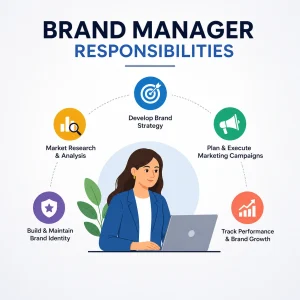
Strip away the job-posting language and the role breaks down into a handful of recurring responsibilities:
- Owning brand positioning and strategy — deciding what the brand stands for and making sure every campaign, product decision, and piece of communication reinforces that, rather than drifting.
- Coordinating across functions — briefing creative agencies, aligning with sales on how the brand story translates into pitches, and working with product teams on how new launches fit the existing brand.
- Tracking brand health and consumer perception — not just sales numbers, but brand equity, awareness, and sentiment over time.
- Managing budgets — brand managers typically own a marketing spend line and are expected to justify it against measurable outcomes.
- Running the day-to-day of campaigns — timelines, approvals, vendor coordination, and the unglamorous project management that makes a campaign actually ship on schedule.
It’s a strategy role wrapped around a lot of execution management — which is exactly why certification programmes spend as much time on frameworks (positioning, brand equity, portfolio strategy) as they do on the practical mechanics of running a brand day to day.
The Typical Entry Points Into the Role
Very few people start their career as a brand manager directly. The common paths in are: starting in digital marketing execution and moving into brand-focused work once you’ve shown strategic thinking, not just campaign execution; coming through a marketing or sales trainee programme at an FMCG or consumer goods company, where brand management is often a defined career track; or working agency-side in account management or planning and moving client-side into a brand role. A smaller but real fourth path is founders and small-business operators who end up doing brand management by necessity and later formalise it with a credential to open doors at larger companies.
Skills That Actually Matter
Beyond the obvious “creativity and communication” that every job description lists, the skills that separate people who get promoted from people who plateau at Assistant Brand Manager are more specific:
- Structured brand strategy frameworks — positioning maps, brand equity models, and portfolio thinking, rather than intuition alone.
- Consumer behaviour and segmentation — the ability to read research and translate it into a decision, not just describe a target audience in a slide.
- Data and analytics literacy — brand ROI, customer lifetime value, and increasingly, comfort using AI tools for content ideation, monitoring, and campaign analysis.
- Cross-functional influence — getting sales, product, and external agencies to actually execute your strategy, without formal authority over most of them.
- Budget ownership — building and defending a marketing budget against real business outcomes, not just spend.
That AI-and-analytics layer is the one shifting fastest. Brand teams are increasingly expected to use generative AI for content and monitoring work that used to take a full team, and hiring managers are starting to ask about it directly in interviews.
What You Can Realistically Expect to Earn
Salary data for brand managers in India varies a lot depending on the source and methodology, but a reasonable consensus across multiple 2026 salary surveys looks roughly like this: entry-level professionals (under a year or two of experience) typically start in the ₹5–8 lakh range annually; mid-career brand managers with three to nine years of experience tend to land between ₹10–16 lakh; and senior brand leaders at large FMCG or multinational companies can cross ₹20–30 lakh, with select tech-sector roles going higher still. FMCG and e-commerce companies generally pay the most at the top end, because branding has a more direct, visible link to revenue in categories where products themselves are harder to differentiate.
Worth being honest about: entry-level marketing hiring has tightened industry-wide, and some 2026 industry surveys report companies pulling back on junior marketing headcount specifically. That doesn’t mean the role is disappearing — brand strategy is still a real, valued function — but it does mean walking in with just a degree and no differentiated skill set is a harder path than it was a few years ago. A certification that demonstrates structured strategic thinking, not just familiarity with marketing terminology, is one of the more reliable ways to stand out in a tighter hiring market.



Do You Need a Certification, or Can You Learn on the Job?
Plenty of successful brand managers never did a formal certification — they learned through agency experience, mentorship, and trial and error inside a company with a strong brand function. That path still works, particularly if you’re already inside an organisation with senior marketers willing to mentor you.
Where a certification earns its cost is in three specific situations: you’re switching into brand management from an unrelated field and need a credible signal to get past resume screening; you’re already in a marketing-adjacent role (digital marketing, sales) and want to formalise strategic frameworks you’ve only picked up piecemeal; or you’re a founder who needs the frameworks fast because you’re already doing the job without the structured training. If none of those apply — you’re already doing strategic brand work inside a company that’s actively developing you — the calculus is less clear-cut, and the money might be better spent elsewhere.
How to Choose the Right Certification If You Go That Route
Not all brand management certifications are built the same way, and the differences matter more than the institute’s name on the certificate. Some are fully live and cohort-based; others are recorded-lecture-heavy with occasional live sessions. Fees range from roughly ₹60,000 to over ₹1,30,000. Some fold AI/GenAI training into the core curriculum; others sell it as a paid add-on or don’t cover it meaningfully at all.
This comparison of IIT Delhi’s programme against IIM and MICA options breaks down exactly those differences. If you want a wider scan of the market before narrowing down, this roundup of the best brand management certifications in India covers ten programmes side by side.
What a Strong Brand Manager Resume Actually Shows
Recruiters and hiring managers screening for brand roles are looking for a specific pattern, whether they say so explicitly or not. First, evidence of ownership — not “assisted with campaigns” but “owned positioning for X product line” or “managed a ₹Y budget across Z campaigns.” Second, a measurable outcome tied to that ownership, even an imperfect one — brand awareness lift, campaign performance, or a launch that hit its numbers. Third, some sign of structured thinking rather than just activity: a framework you applied, a segmentation approach you built, a repositioning decision you can explain and defend, not just a list of channels you ran.
This is exactly why a capstone project from a certification programme carries more weight than the certificate itself. A finished capstone — a real brand strategy built end-to-end, defensible in an interview — gives you concrete material for that third point, especially if your current job hasn’t given you a chance to demonstrate strategic ownership yet. Treat the capstone as the actual deliverable of a certification programme, not a formality to get through for the credential.
Red Flags Worth Watching For
A few patterns are worth being wary of when evaluating either certification programmes or early brand-management job offers. On the certification side: vague syllabi that list buzzwords (“digital,” “AI,” “strategy”) without naming actual frameworks or deliverables, and programmes that won’t clearly state whether sessions are live or recorded until after you’ve paid. On the job side: brand-manager titles that are really just campaign–execution roles with no budget ownership or strategic input — common enough at smaller companies that it’s worth asking directly in interviews what decisions the role actually owns, rather than assuming the title tells you.
A Realistic 12-Month Plan
If you’re starting from outside the field entirely, a workable timeline looks like this: spend the first month researching and choosing a certification that matches your schedule and budget rather than picking based on brand name alone; enroll and treat the next four to six months as your primary skill-building phase, actively applying what you learn to any brand-adjacent work at your current job, even informally; use months seven through nine to build a portfolio piece — ideally your capstone project, reframed as a case study — and start networking with brand professionals through alumni groups or industry events; and spend the final stretch actively applying for brand-focused roles, using the certification and capstone as concrete proof points rather than just a line on your resume.
Twelve months is a realistic runway, not a guarantee — how fast this moves depends heavily on your starting point and the hiring market when you’re job-searching.
Frequently Asked Questions
No, though an MBA — particularly in marketing — does help at larger FMCG companies with structured management-trainee tracks. A focused brand management certification is a faster, cheaper alternative if a full MBA isn’t the right move for your situation.
Coming from an unrelated field, expect twelve to eighteen months realistically — time to build the skill base, gain some practical exposure, and land the role. Coming from an adjacent marketing role, it can be faster, sometimes six to nine months.
Yes. Client-side marketing roles, sales, and even operations roles with strong cross-functional exposure can lead into brand management. Agency experience helps with campaign fluency but isn’t a hard requirement.
Probably not the best fit. Brand strategy rewards long-horizon thinking, and results take months or quarters to show up. If you want rapid, visible feedback loops, performance marketing or growth roles tend to suit that preference better.





Find a Program made just for YOU
We'll help you find the right fit for your solution. Let's get you connected with the perfect solution.
Is Your Upskilling Effort worth it?
 ROI Calculator

Are Your Skills Meeting Job Demands?
Try our Skill Gap tool
Experience Lifelong Learning and Connect with Like-minded Professionals
Explore Jaro Connect

