HOME > BLOG > Finance > FinTech Careers in India 2026: Top Roles, Salaries and Which Courses Actually Prepare You
Finance
FinTech Careers in India 2026: Top Roles, Salaries and Which Courses Actually Prepare You
J
By Arif Siddiqui
July 31, 20268 min read
Published on July 31, 2026
SHARE THIS ARTICLE
Table Of Content
Why FinTech Is One of India's Fastest-Growing Industries
Why FinTech Careers Are Attractive in 2026
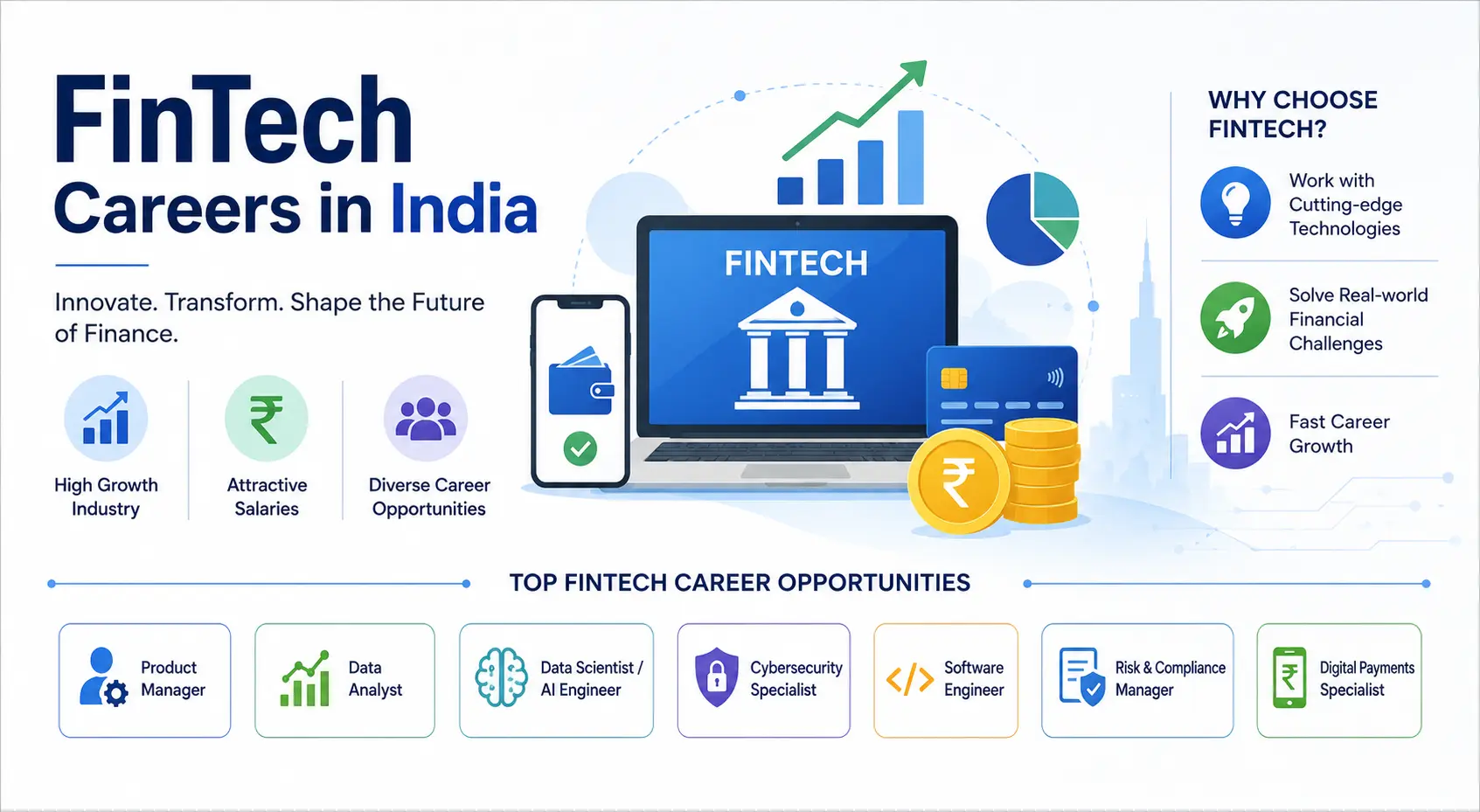
Top FinTech Career Roles in India
Salary Trends for FinTech Careers in India (2026)
Discover the fastest-growing FinTech careers in India for 2026, along with expected salary ranges and emerging job opportunities. Learn about the skills employers value most and explore the courses that can help you build a successful career in the rapidly evolving financial technology sector.
India's financial services industry is undergoing one of its biggest transformations. Digital payments, embedded finance,artificial intelligence (AI), blockchain, open banking, digital lending, wealth technology, and regulatory technology are reshaping how businesses and consumers interact with financial products. As a result, FinTech (Financial Technology) has become one of the fastest-growing sectors in the country, creating thousands of new career opportunities across technology, finance, analytics, cybersecurity, compliance, and product management.
In 2026, India's FinTech ecosystem is expected to continue expanding, driven by increasing internet penetration, digital banking adoption, UPI transactions, government initiatives, and investor confidence. This growth has created strong demand for professionals who can combine financial knowledge with technology skills.
However, many aspiring professionals still wonder: Which FinTech careers offer the best salary? What skills are companies hiring for? Which courses genuinely prepare candidates for these roles?
This guide explores the top FinTech careers in India in 2026, expected salary ranges, required skills, and the educational pathways that can help professionals build successful careers in this rapidly evolving industry.
Why FinTech Is One of India's Fastest-Growing Industries
India has emerged as one of the world’s leading digital finance markets. Millions of consumers now use digital wallets, UPI applications, online investment platforms, Buy Now Pay Later (BNPL) services, digital insurance products, and AI-powered financial tools every day.
Financial institutions are investing heavily in digital transformation to improve customer experience, reduce operational costs, strengthen cybersecurity, and comply with evolving regulations. At the same time, FinTech startups continue introducing innovative products in lending, payments, wealth management, and financial inclusion.
This rapid innovation has significantly increased demand for professionals who understand both technology and finance. Organizations are no longer looking only for software engineers or finance specialists—they increasingly prefer professionals who can bridge the gap between the two domains.
Why FinTech Careers Are Attractive in 2026
FinTech offers a combination of high growth, competitive salaries, continuous innovation, and diverse career opportunities. Professionals can work in startups, global technology companies, banks, insurance firms, investment organizations, consulting firms, and payment companies.
Unlike traditional finance careers that often follow structured career paths, FinTech provides opportunities to work on cutting-edge technologies such as AI-driven fraud detection, blockchain-based payments, algorithmic trading, digital identity verification, cloud banking, and predictive financial analytics.
The sector also offers faster career progression for professionals who continuously upgrade their technical and business skills.
The FinTech industry requires professionals from multiple disciplines. While software development remains important, there are equally rewarding opportunities in analytics, compliance, cybersecurity, product management, and digital strategy.
1. FinTech Product Manager
Product Managers play a critical role in developing digital financial products that meet customer needs while aligning with business goals. They work closely with engineering, design, compliance, marketing, and business teams to define product strategy and manage product lifecycles.
Successful Product Managers combine business understanding, customer insights, and technology knowledge to build scalable digital solutions.
2. Data Scientist
Data Scientists help financial organizations extract meaningful insights from vast amounts of customer and transaction data. Their work supports fraud detection, customer segmentation, credit risk assessment, personalized recommendations, and predictive analytics.
As AI adoption continues to grow, Data Scientists remain among the most sought-after professionals in the FinTech sector.
3. Business Analyst
Business Analysts serve as a bridge between technical teams and business stakeholders. They identify business problems, gather requirements, evaluate processes, and recommend technology-driven improvements.
Professionals with strong analytical thinking and communication skills often find excellent opportunities in this role.
4. Financial Data Analyst
Financial Data Analysts analyze financial trends, customer behavior, investment data, and business performance metrics to support strategic decision-making.
This role combines financial analysis with data visualization and statistical tools, making it ideal for professionals interested in both finance and analytics.
5. Blockchain Developer
Blockchain technology continues to gain relevance in digital identity, payments, smart contracts, cross-border transactions, and decentralized finance.
Blockchain Developers design secure decentralized applications and distributed ledger systems that improve transparency and transaction security.
Although this remains a specialized career path, demand continues to grow in selected FinTech segments.
6. Cybersecurity Specialist
As digital transactions increase, cybersecurity has become one of the most critical areas within financial technology.
Cybersecurity professionals protect financial systems from cyberattacks, fraud, ransomware, phishing attempts, and data breaches. They ensure regulatory compliance while maintaining customer trust.
Professionals with expertise in cloud security, ethical hacking, and security operations are increasingly valuable.
7. Risk and Compliance Manager
Financial regulations continue evolving rapidly. Organizations therefore require professionals who understand regulatory frameworks, governance, risk management, and compliance requirements.
Risk Managers assess operational, financial, technological, and cybersecurity risks while ensuring organizations remain compliant with regulatory standards.
8. AI and Machine Learning Engineer
Artificial Intelligence is transforming almost every FinTech function, including loan approvals, fraud detection, chatbot services, customer support, investment advisory, and credit scoring.
Machine Learning Engineers build intelligent systems capable of automating complex financial decision-making processes using predictive algorithms.
9. Digital Payments Specialist
India’s digital payment ecosystem continues expanding through UPI, payment gateways, merchant solutions, QR payments, and embedded finance.
Digital Payments Specialists focus on payment infrastructure, transaction security, merchant integration, customer experience, and payment innovation.
10. FinTech Consultant
Consultants help financial organizations implement digital transformation strategies, adopt emerging technologies, optimize business processes, and improve operational efficiency.
They often work with banks, insurance companies, consulting firms, and technology service providers.
Free Courses
Finance for All – Free Finance Certification Course
Actual compensation varies depending on experience, location, company size, qualifications, and technical expertise. However, the following table provides indicative annual salary ranges for professionals in India.
While technical expertise remains important, employers increasingly seek professionals who can combine analytical thinking with business acumen and regulatory awareness.
Professionals who continuously update their skills are often better positioned for leadership opportunities as the industry evolves.
Which Courses Actually Prepare You for FinTech Careers?
One of the biggest misconceptions is that a single degree is enough to build a FinTech career. In reality, employers value a combination of academic qualifications, technical skills, and practical experience.
MBA in Finance
An MBA in Finance provides a strong foundation in corporate finance, investment management, financial markets, accounting, and business strategy. It is well suited for professionals aiming for leadership roles in digital banking, financial consulting, or FinTech product management.
MBA in Business Analytics
As data-driven decision-making becomes central to financial services, anMBA in Business Analytics equips learners with skills in statistics, predictive modeling, business intelligence, and data visualization.
Graduates often pursue careers in analytics, product management, and strategic decision-making.
PG Programmes in FinTech
Specialized postgraduate programmes in FinTech are designed to combine financial concepts with emerging technologies. Typical subjects include:
Topics usually include Python, machine learning, SQL, data visualization, predictive analytics, and statistical modeling.
Cybersecurity Certifications
With financial institutions facing increasing cyber threats, cybersecurity certifications help professionals develop expertise in network security, cloud security, ethical hacking, and security governance.
These qualifications are especially useful for professionals targeting information security roles within banks and FinTech firms.
Product Management Courses
Digital financial products require professionals who understand user needs, technology, business strategy, and market dynamics.
Product management programmes typically cover product lifecycle management, customer research, Agile frameworks, roadmap planning, and business metrics.
Who Should Consider a Career in FinTech?
The FinTech industry welcomes professionals from diverse educational and professional backgrounds. It is not limited to engineers or finance graduates.
A FinTech career can be suitable for:
Finance professionals looking to work with digital technologies
Software developers interested in financial applications
Data analysts seeking industry specialization
Banking professionals aiming to transition into digital roles
MBA graduates pursuing product or strategy positions
Entrepreneurs building financial technology startups
Recent graduates interested in innovation-driven careers
Professionals who enjoy solving business problems using technology often find FinTech both intellectually rewarding and financially attractive.
Challenges Professionals Should Be Prepared For
Although FinTech offers exciting opportunities, it is also a fast-moving industry that demands continuous learning.
Technologies evolve rapidly, regulatory requirements frequently change, and customer expectations continue to rise. Professionals must therefore stay updated on new tools, compliance standards, cybersecurity practices, and digital innovations.
The ability to adapt quickly, learn continuously, and collaborate across multiple disciplines is often more valuable than mastering a single technical skill.
Future Outlook for FinTech Careers in India
The future of India’s FinTech sector looks highly promising. AI-powered banking, embedded finance, digital lending, blockchain applications, wealth technology, insurance technology, and open finance are expected to create new job categories over the coming years.
Organizations will increasingly seek professionals who can integrate financial expertise with technology, customer experience, and strategic thinking. Roles involving AI governance, digital risk management, financial data engineering, and intelligent automation are also expected to gain importance.
As businesses continue investing in digital transformation, FinTech professionals with interdisciplinary skills are likely to remain in high demand.
Conclusion
FinTech has evolved from a niche industry into a core driver of innovation within India’s financial ecosystem. In 2026, the sector offers diverse career opportunities spanning product management, data science, cybersecurity, analytics, compliance, blockchain, consulting, and digital payments. With competitive salaries, rapid innovation, and strong long-term demand, it presents an attractive career path for both fresh graduates and experienced professionals.
Choosing the right career, however, involves more than following salary trends. Building expertise through relevant education, practical projects, technical certifications, and continuous learning is essential for long-term success. Programmes in finance, business analytics, data science, cybersecurity, product management, and specialized FinTech studies can provide the knowledge and skills employers seek.
As technology continues to reshape financial services, professionals who combine business understanding with digital capabilities will be well positioned to thrive in one of India’s most dynamic and future-ready industries.
Frequently Asked Questions
Yes. FinTech continues to be one of the fastest-growing sectors in India, driven by digital payments, AI, blockchain, embedded finance, and regulatory technology. Professionals with skills in finance and technology are expected to see strong job demand and competitive salaries.
Some of the highest-paying FinTech roles include Product Manager, Data Scientist, Blockchain Developer, AI/ML Engineer, Risk & Compliance Manager, Quantitative Analyst, Cybersecurity Specialist, and FinTech Solutions Architect. Salaries typically increase with experience and specialized expertise.
A degree in finance, engineering, business, or computer science is a common starting point. Additionally, certifications or postgraduate programmes in FinTech, Data Analytics, Artificial Intelligence, Blockchain, Financial Risk Management, or Digital Banking can significantly improve career prospects.
Entry-level FinTech professionals typically earn between ₹5–8 LPA, while mid-level professionals can earn ₹10–20 LPA. Experienced specialists and leadership roles in areas like AI, product management, and digital finance can command salaries exceeding ₹30 LPA, depending on the company and skill set.
Employers are increasingly looking for professionals with expertise in digital payments, financial analytics, blockchain, AI and machine learning, cloud computing, cybersecurity, SQL, Python, regulatory compliance, and product management. Strong problem-solving and business strategy skills are also highly valued.
Arif Siddiqui
Head of Accounting and Treasury
Arif Siddiqui is a finance leader specializing in accounting, treasury, and financial strategy. As Head of Finance at Generali Employee Benefits, he brings extensive experience in managing global financial operations. He is known for driving financial efficiency and governance across organizations. His leadership supports sustainable business growth and financial excellence.

 July 31, 2026
 8 min read





 ChatGPT
 Perplexity
 Claude
 Grok
Grok










 ROI Calculator