Why Choose a Cyber Security Manager Career in India?
Cyber Security Manager Career Path
Cyber Security Manager Skills Required
Key Insights
Cyber Security Managers combine technical security expertise with risk management, leadership, governance, compliance, and business decision-making.
The cyber security manager career path can progress from education and IT fundamentals to cybersecurity roles, specialization, project ownership, leadership experience, and management positions.
The cyber security manager skills required include cybersecurity fundamentals, risk management, governance and compliance, incident management, cloud security, communication, leadership, and analytical thinking.
Certifications such as CISM and CISSP can complement professional experience, while practical exposure, project responsibility, and demonstrated leadership remain important for management roles.
In this blog, you'll learn how to become a cyber security manager in India, including the career path, required skills, certifications, salary considerations, career roadmap, and ways to prepare for cybersecurity management roles.
As organizations increasingly depend on cloud platforms, digital payments, connected devices, AI applications and data-driven operations, cybersecurity has become a business priority rather than only an IT function. This shift has created demand for professionals who can combine technical security knowledge with risk management, leadership and business decision-making.
For professionals interested in moving into cybersecurity leadership, the role of a Cyber Security Manager can offer a strong career progression path. However, becoming a manager typically requires more than knowledge of security tools. It involves developing technical expertise, gaining relevant work experience, understanding governance and compliance, and learning how to lead security teams and communicate cyber risks to business stakeholders.
If you are wondering how to become a cyber security manager in India, this guide explains the career path, essential skills, certifications, salary considerations and a practical cyber security career roadmap in India that professionals can follow.
A Cyber Security Manager is responsible for helping an organization protect its systems, networks, applications and data fromcyber threats. The role combines cybersecurity operations with management responsibilities.
Depending on the organization, responsibilities may include developing security policies, managing security teams, monitoring vulnerabilities, coordinating incident response, assessing cyber risks, supporting compliance requirements and working with senior leadershipon security strategy.
A manager may also coordinate with IT, data, cloud, legal, compliance and business teams. This makes communication and stakeholder management just as important as technical knowledge.
Modern cybersecurity work increasingly requires professionals to combine technical and workplace skills. The NIST NICE Framework, for example, describes cybersecurity work through tasks, knowledge and skills and also highlights workplace capabilities such as teamwork, time management and problem-solving. (NIST)
Why Choose a Cyber Security Manager Career in India?
Cybersecurity has become an important consideration across industries such as banking, financial services, healthcare, e-commerce, telecommunications, manufacturing, consulting and technology.
The expansion of cloud infrastructure, connected technologies, digital transactions and AI-based systems has also increased the complexity of protecting business environments. Consequently, organizations require professionals who can understand both technical security requirements and business risks.
For experienced IT and cybersecurity professionals, management can therefore be a natural next step. Instead of focusing exclusively on individual security tasks, managers are expected to coordinate people, processes and technology to strengthen the organization’s overall security posture.
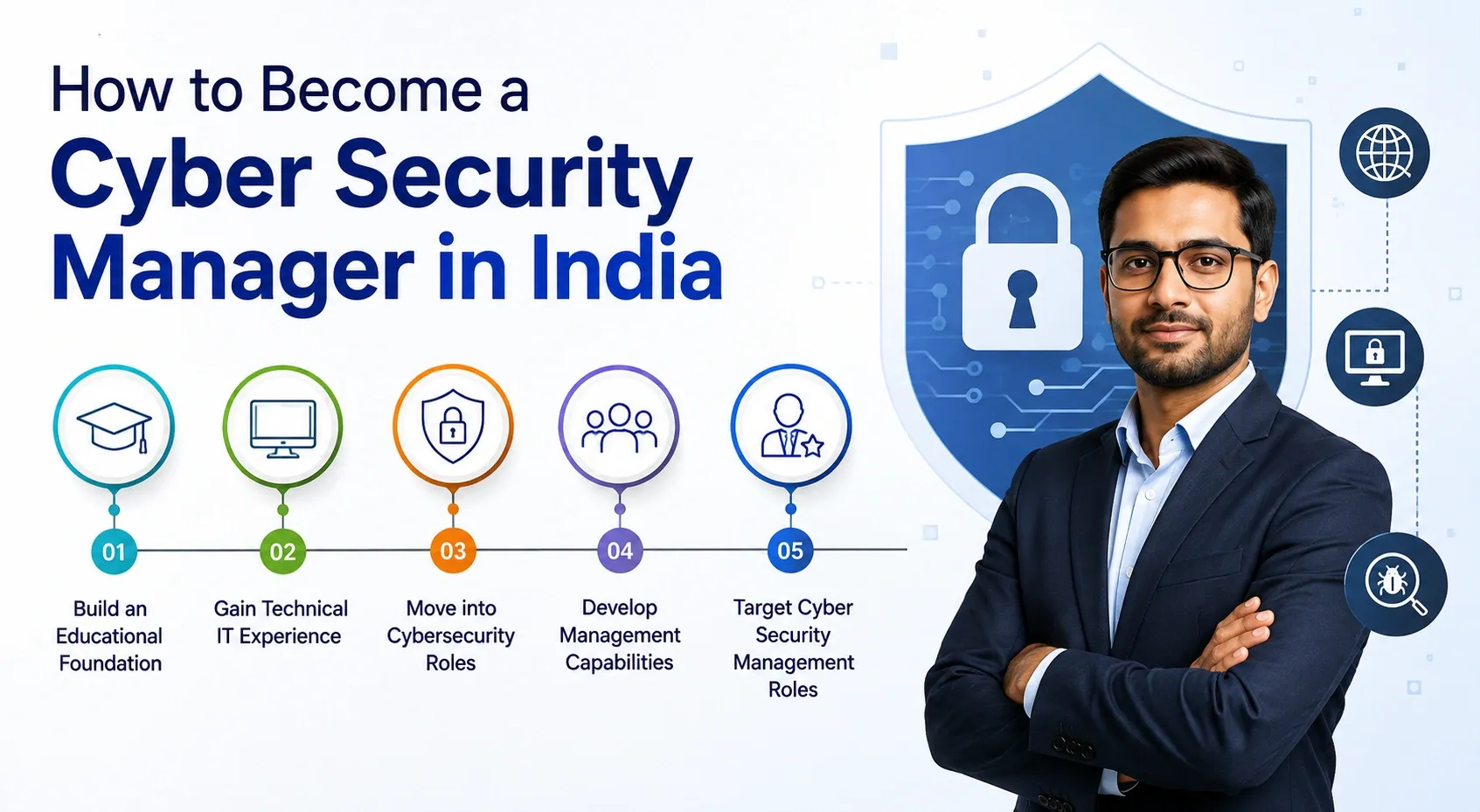
The cyber security manager career path generally develops through a combination of education, technical experience, specialized cybersecurity exposure and leadership responsibilities. There is no single route, but the following progression can provide a practical direction.
Step 1: Build an Educational Foundation
A bachelor’s degree in computer science, information technology, cybersecurity or a related field can provide a foundation in computing and technology.
Students from other academic backgrounds can also transition into cybersecurity by developing relevant technical knowledge through structured learning, certifications, projects and work experience.
The objective at this stage should be to understand fundamentals such as computer networks, operating systems, databases, programming concepts and information security.
Step 2: Gain Technical IT Experience
Before moving into management, professionals generally benefit from experience in technical IT roles. Possible starting points include network administration, system administration, IT support, security operations or infrastructure roles.
This stage helps professionals understand how enterprise technology environments operate and how security controls are implemented in real-world situations.
Step 3: Move into Cybersecurity Roles
The next step is to gain dedicated cybersecurity experience. Professionals may work as security analysts, SOC analysts, penetration testers, vulnerability analysts, incident response professionals or security engineers.
Working in these roles helps develop practical exposure to threat detection, vulnerability management, security monitoring, incident handling and security architecture.
Step 4: Develop Management Capabilities
Technical expertise alone is not enough for a managerial position. Professionals should gradually take ownership of projects, security initiatives, audits, incident response exercises and cross-functional activities.
Managing small teams, coordinating vendors and communicating with business stakeholders can provide valuable leadership experience.
Step 5: Target Cybersecurity Management Roles
With relevant experience and management exposure, professionals can target roles such as Cyber Security Manager, Information Security Manager, Security Operations Manager, Cyber Risk Manager or GRC Manager.
Further career progressioncan lead towards senior security leadership positions, including security director and CISO-level responsibilities, depending on experience and organizational structure.
Cyber Security Manager Skills Required
The cyber security manager skills required can broadly be divided into technical, managerial and business-oriented capabilities.
1. Cybersecurity Fundamentals
Managers should understand core concepts such as network security, endpoint protection, identity and access management, vulnerability management, threat intelligence and incident response.
They do not necessarily need to perform every technical task themselves, but they should be capable of evaluating technical recommendations and making informed decisions.
2. Risk Management
Security managers need to identify potential risks, assess their business impact and prioritize mitigation strategies. Risk management is particularly important when security investments, technology decisions and business priorities need to be balanced.
3. Security Governance and Compliance
Knowledge of security policies, governance frameworks, audits, regulatory requirements and data privacy is increasingly important. Managers may be responsible for ensuring that security processes align with organizational policies and applicable requirements.
4. Incident Management
When a security incident occurs, managers may coordinate different teams, establish priorities, communicate with stakeholders and oversee recovery activities. Strong decision-making under pressure is therefore essential.
5. Cloud and Emerging Technology Security
Cloud computing, IoT, AI and other emerging technologies introduce new security considerations. Managers should understand how security requirements change across modern technology environments.
6. Communication and Leadership
Cybersecurity managers frequently need to explain technical risks to non-technical stakeholders. They must communicate clearly with executives, employees, vendors and technical teams.
Leadership, teamwork and problem-solving are important workplace skills for cybersecurity professionals. (NIST)
7. Data and Analytical Thinking
Security teams generate large amounts of information through logs, alerts, threat intelligence and security monitoring systems. Data analysiscan help managers identify patterns, evaluate risks and support security decisions.
Cyber Security Certification for Managers in India
Certifications can complement professional experience and demonstrate knowledge in specific areas of cybersecurity. The right certification depends on your experience, career goals and current responsibilities.
CISM is particularly relevant for professionals interested in information security management. ISACA’s certification framework covers areas including information security governance, risk management, information security programmes and incident management.
ISACA currently requires candidates seeking CISM certification to pass the examination and demonstrate five or more years of professional information security management experience across at least three of the four CISM domains.
Certified Information Systems Security Professional (CISSP)
CISSP is another widely recognised option for experienced cybersecurity professionals and managers. Its examination covers eight domains, including security and risk management, asset security, security architecture, IAM, security operations and software development security.
ISC2 currently requires five years of cumulative full-time experience in at least two CISSP domains, with certain qualifications allowing up to one year of experience to be waived.
Other Certifications
Depending on your career direction, certifications in areas such as cloud security, security operations, penetration testing, governance, risk and compliance can also complement your profile.
The important point is not to collect certifications without practical experience. A strong cybersecurity profile combines recognised credentials with hands-on exposure and demonstrated responsibility.
Cyber Security Career Roadmap India
A practical cyber security career roadmap in India that professionals can follow is:
Education → IT Fundamentals → Cybersecurity Role → Specialization → Project Ownership → Leadership Experience → Management Role → Senior Security Leadership
At the beginning, focus on computing and networking fundamentals. Next, build practical cybersecurity experience through security operations, vulnerability management, incident response or related roles.
After gaining experience, choose a specialization that aligns with your interests. You could focus on cloud security, security operations, GRC, application security, threat intelligence or cyber risk.
As your technical experience grows, take ownership of projects and begin developing leadership capabilities. Certifications can then strengthen your professional profile and support career progression.
Finally, target managerial positions where you can combine technical knowledge with strategic decision-making, team leadership and business communication.
The cyber security manager salary in India varies based on experience, location, organization, technical specialization, and managerial responsibilities. Current salary data indicates that experienced professionals can earn substantially higher compensation as they move into management and senior security roles.
Experience / Career Stage
Typical Annual Salary in India
Approx. Monthly Salary
Key Factors
Early Career (1–4 years)
₹18 lakh*
₹1.50 lakh/month*
Technical skills, certifications and entry into managerial responsibilities
Mid Career (5–9 years)
₹22.96 lakh*
₹1.91 lakh/month*
Security specialization, project ownership and management experience
Cyber Security Manager – India
₹17.8–₹32 lakh base salary
₹1.48–₹2.67 lakh/month
Experience, organization, location and technical expertise
Cyber Security Manager – Mumbai
₹12.5–₹41.5 lakh
₹1.04–₹3.46 lakh/month
Experience, employer and role scope
Information Security Manager – India
₹8.7–₹43 lakh
₹72,500–₹3.58 lakh/month
Industry, experience, location and specialization
Senior-Level Cyber Security Manager
₹30 lakh+ in some reported roles
₹2.5 lakh+/month
Leadership responsibilities, specialized expertise, and employer
Note: These figures are indicative salary-market data, not guaranteed compensation. Actual packages can differ considerably based on employer, location, experience, certifications, technical specialization, variable pay and leadership scope.
How to Prepare for a Cyber Security Manager Role
If your goal is to transition into cybersecurity management, focus on four areas simultaneously.
Build business understanding: Learn how cybersecurity affects business continuity, risk, compliance, data protection and organizational objectives.
Develop leadership skills: Take responsibility for projects, coordinate teams and learn to communicate effectively with senior stakeholders.
Keep learning: Cyber threats and technologies continuously evolve. Regular learning, industry certifications, practical projects and exposure to emerging technologies can help professionals stay relevant.
Build Future-Ready Cybersecurity and Data Skills with IIM Nagpur
The programme covers cybersecurity fundamentals, network security, cryptography, ethical hacking basics, vulnerability and incident management, security analytics, AI and machine learning for cybersecurity, enterprise security architecture, cyber strategy, governance, risk and compliance, cloud security, IoT/OT security, data privacy and leadership.
Its curriculum also includes hands-on exposure to cybersecurity tools, case studies, simulation exercises and projects. The programme is designed to develop knowledge across both cybersecurity management and data science, making it relevant for professionals seeking broader technology-management capabilities.
The programme awards an IIM Nagpur certification to eligible participants who successfully complete the programme and meet the prerequisites. Participants are also accorded IIM Nagpur’s Executive alumni status.
Conclusion
Becoming a Cyber Security Manager in India requires a strong combination of technical expertise, leadership abilities, industry knowledge, and continuous learning. Building experience in cybersecurity roles, developing essential skills, and earning relevant certifications can help professionals progress toward managerial positions. As organizations increasingly prioritize data protection and cyber resilience, skilled cybersecurity managers can play an important role in strengthening security strategies and managing cyber risks. With the right career path, practical exposure, and commitment to upskilling, aspiring professionals can prepare themselves for rewarding opportunities in cybersecurity management and take on greater responsibilities in India’s evolving digital security landscape.
Frequently Asked Questions
There is no fixed timeline because the role generally requires a combination of technical cybersecurity experience, project ownership and management capabilities. The timeline depends on your educational background, previous IT experience, specialization, and opportunities to take on leadership responsibilities.
CISM and CISSP are prominent options for experienced cybersecurity professionals. CISM has a strong management orientation, while CISSP covers a broad range of technical and managerial security domains. Eligibility and experience requirements should be checked before selecting a certification.
Yes, a technical degree is not the only possible route. However, professionals from non-technical backgrounds should develop strong cybersecurity and IT fundamentals through relevant learning, practical experience and certifications before targeting management roles.
A combination of cybersecurity knowledge, risk management, governance, incident management, leadership, communication, problem-solving and business understanding is important. Managers should be able to connect technical security decisions with organizational objectives.
Cybersecurity management can be a strong career option for professionals who enjoy technology, risk management and leadership. As organizations continue to depend on digital infrastructure and data, professionals who can combine cybersecurity expertise with strategic and managerial capabilities can pursue opportunities across multiple industries.
Shubham Lal
Lead Software Developer
Shubham Lal joined Microsoft in 2017 and brings 8 years of experience across Windows, Office 365, and Teams. He has mentored 5,000+ students, supported 15+ ed-techs, delivered 60+ keynotes including TEDx, and founded AI Linc, transforming learning in colleges and companies.
Get Free Upskilling Guidance
Fill in the details for a free consultation
Related Courses
Explore our programs
PG Certificate Programme in Cyber Security Management and Data Science
 HOME > BLOG > Cloud Computing and Cyber Security > How to Become a Cyber Security Manager in India: Career Path, Skills & Certification Guide
 August 21, 2026
 8 min read




 Key Insights
 ChatGPT
 Perplexity
 Claude
 Grok
Grok










 ROI Calculator



