A content calendar is one of the most powerful tools a marketer, blogger, or brand can use — yet it’s frequently underestimated. Whether you’re managing a solo blog or coordinating campaigns across multiple channels, having a structured publishing schedule transforms scattered ideas into a coherent, results-driven strategy.
So, what is a content calendar, exactly? At its core, it’s a planning system — visual or digital — that maps out what content you’ll publish, when you’ll publish it, and where it will appear. Think of it as the editorial backbone of your entire content operation. It brings order to the creative chaos that inevitably comes with consistent publishing.
A common pattern in high-performing content teams is deliberate, calendar-driven planning. According to Smartsheet’s content calendar resource, organized teams consistently outpace those relying on ad-hoc publishing because they can align content with business goals, seasonal trends, and audience behavior in advance.
Content calendars typically include:
Publishing dates and deadlines
Content topics and formats (blogs, videos, social posts)
A well-built content calendar doesn’t just organize — it gives your entire team a single source of truth, eliminating guesswork and last-minute scrambles. Understanding this foundation is the first step toward building a strategy that delivers consistently.
Why a Content Calendar is Essential for Your Strategy
A well-structured content calendar isn’t just a scheduling tool — it’s the backbone of any sustainable content strategy. Without one, even the most talented teams find themselves scrambling to meet deadlines, publishing inconsistently, or missing key opportunities tied to seasonal trends and industry events.
Consistency Drives Results
Research consistently shows that brands publishing content on a regular schedule build stronger audience trust and generate more organic traffic over time. In practice, consistency signals reliability — both to your audience and to search engine algorithms. A content calendar template helps enforce that regularity by giving every piece of content a defined publish date, owner, and purpose long before the deadline arrives.
Strategic Alignment Across Channels
One of the most underappreciated benefits of a content calendar is its ability to align multiple digital marketing channels under a single, cohesive plan. When blog posts, social media updates, and email campaigns work in coordination, the cumulative impact on brand awareness grows significantly.
Better Time and Resource Management
Planning content weeks or even months in advance reduces last-minute production pressure. According to Draft.dev’s Content Calendar Setup Guide, teams that plan ahead consistently report fewer bottlenecks and better cross-functional collaboration. Effective planning and time management becomes far easier when your content pipeline is visible at a glance.
A content calendar transforms reactive publishing into a proactive, intentional strategy — one where every post has a purpose.
Once you understand why a content calendar matters, the logical next step is building one that actually works — which starts with knowing the key components every effective calendar must include.
Now that we’ve established why a content calendar matters, it’s worth examining what actually makes one work. Not all calendars are created equal — a simple spreadsheet and a fully structured social media content calendar can look worlds apart in terms of detail and function.
Core Fields Every Calendar Should Include
At a minimum, an effective content calendar captures these essential elements:
Publish date and time — when the content goes live
Content type — blog post, video, infographic, social post, email
Assigned owner — who’s responsible for creation and approval
Optional but High-Impact Fields
Beyond the basics, high-performing teams typically add layers of strategic context. Fields like target audience segment, funnel stage (awareness, consideration, conversion), primary keyword, and campaign tag transform a calendar from a simple schedule into a strategic map. According to Emplifi’s complete guide, structuring your calendar around campaigns rather than isolated posts significantly improves content cohesion.
Aligning your calendar with a broader social media marketing approach ensures every piece of content serves a measurable purpose — not just a publish date.
A content calendar without strategic context is just a to-do list.
With these components clearly defined, you’re ready to build your own. The next step is putting the structure into practice – and that’s exactly where a step-by-step process becomes invaluable.
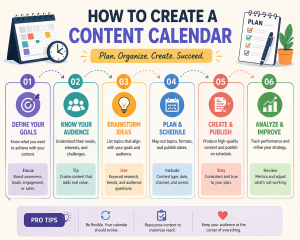
How to Create a Content Calendar: A Step-by-Step Guide
With a clear picture of what a content calendar contains, the natural next question is: how do you actually build one? The good news is that the process is more straightforward than most teams expect — as long as you follow a structured approach.
Step 1: Audit Your Existing Content
Before creating anything new, take stock of what’s already published. Identify top-performing pieces, content gaps, and topics that need updating. This foundation prevents duplication and reveals real opportunities.
Step 2: Define Your Goals and Audience
Every piece of content should map to a specific objective — brand awareness, lead generation, or audience education. Knowing your audience’s preferences shapes both format and frequency decisions.
Step 3: Choose Your Channels and Cadence
Not every channel demands the same output. A common pattern is to prioritize two or three platforms and publish consistently rather than spreading thin across many. Keeping a consistent posting rhythm for Facebook and other channels is far more effective than sporadic bursts.
Step 4: Build Your SEO Content Calendar Framework
This is where strategy meets execution. Map keywords to topics, assign publication dates, and flag seasonal opportunities. A well-built SEO content calendar aligns your publishing schedule with search demand, ensuring content reaches audiences when interest peaks. According to Semrush’s content calendar guide, aligning content themes with keyword research is one of the most impactful steps teams can take.
Step 5: Assign Roles and Set Deadlines
Accountability matters. Clearly assign writers, editors, and approvers to each content item. Use status labels – ‘Draft’, ‘In Review’, ‘Scheduled’, and ‘Published’ – to keep everyone aligned.
A well-executed content calendar transforms scattered publishing into a repeatable, strategic system that compounds results over time.
With these foundational steps in place, it’s worth exploring how social media — with its unique pace and formats — demands its own dedicated planning approach.
Managing content across multiple platforms without a system is a recipe for inconsistency. A dedicated social media content calendar brings structure to what can otherwise feel like a never-ending scramble — ensuring every post has purpose, timing, and alignment with broader goals.
Plan Platform-Specific Content
Different platforms demand different content formats, tones, and posting frequencies. What performs on LinkedIn rarely translates directly to Instagram or X (formerly Twitter). In practice, the most effective approach is to map content types to each platform’s native behavior before scheduling anything. Short-form video, carousel posts, and static images each belong in distinct columns of your calendar, tagged by channel.
A well-maintained editorial calendar goes beyond just tracking publish dates — it captures the why behind each piece, connecting individual posts to campaign goals and audience segments. Free editorial calendar templates from HubSpot offer a practical starting point for teams building this layer of strategy.
Maintain a Consistent Posting Rhythm
Consistency matters more than volume. Research consistently shows that brands posting on a predictable schedule build stronger audience trust than those who post in bursts. Aim for a sustainable cadence that your team can realistically maintain.
Building a solid content strategy doesn’t require starting from scratch. The right template can compress hours of setup into minutes, giving your team a ready-made framework that only needs customization to fit your brand’s goals.
Notion-based templates (like those featured in this walkthrough) work well for teams that prefer a flexible, visual workspace
Choosing the Right Format
A template’s value lies not in its design, but in how consistently your team commits to filling it out. Spreadsheet-based templates suit smaller teams with minimal tools; project management platforms work better for larger operations requiring task assignments and approvals.
For startups, especially, pairing a template with a clearcontent marketing roadmap helps ensure every piece of content maps back to a measurable business objective. Similarly, teams producing video should consider a format that accounts for production timelines – something outlined inplanning video content effectively.
With the right content calendar template in hand, the next step is seeing how these frameworks look in real-world application, which is exactly what the following examples illustrate.
Example Scenarios: Implementing Content Calendars
Seeing a content calendar in action makes the concept click faster than any abstract explanation. The scenarios below illustrate how different teams put these tools to practical use — and what separates a well-executed plan from a disorganized one.
Scenario 1: The Solo Content Creator
A freelance blogger targeting a niche audience builds a monthly content calendar template in a spreadsheet. Before filling in topics, they conduct keyword research to identify what their audience is actively searching for, then map those topics to specific publish dates. The result? A consistent posting rhythm with zero last-minute scrambling.
Scenario 2: The Growing E-Commerce Brand
A small product team managing both a blog and a social media content calendar uses a shared planning tool to coordinate promotional campaigns. Product launches, seasonal sales, and educational posts are all plotted weeks in advance. Understandingdigital marketing fundamentals helps the team align every content piece with a specific business goal rather than publishing at random.
Scenario 3: The Marketing Agency
An agency managing multiple client accounts separates each brand into individual calendar tabs with color-coded content types. Deadlines, approval stages, and distribution channels are tracked in one view — dramatically reducing miscommunication.
In practice, the common thread across all three scenarios is intentionality. A content calendar forces teams to think strategically rather than reactively. With those patterns in mind, the key takeaways ahead will help you distill these lessons into immediate, actionable steps.
Key Takeaways
Content planning is the backbone of every successful content operation, and a well-structured content calendar is the tool that makes it repeatable. After covering templates, real-world scenarios, and implementation strategies throughout this guide, a few core principles stand out as universally applicable.
What every content team should remember:
A content calendar is more than a schedule — it’s a strategic document that aligns publishing with business goals
Consistency beats volume; publishing fewer pieces on a reliable cadence outperforms sporadic bursts of output
Repurposing content across channels multiplies your return on every piece created
Regular audits keep your calendar relevant as audience behavior and platform algorithms shift
According to the eLearning Industry content calendar guide, teams that document their content strategy are measurably more effective than those operating without structure.
A strong content calendar transforms reactive publishing into proactive storytelling — giving every post, article, and campaign a clear purpose within a larger narrative.
Whether you’re a solo creator or managing a cross-functional team, the fundamentals remain the same: plan ahead, stay flexible, and review often. Even small adjustments to your process compound over time into meaningful results.
Still have questions about applying these principles? The next section addresses the most common queries teams encounter when building their content calendar workflow.
Frequently Asked Questions
A content calendar is a planning tool that maps out what content you’ll publish, on which platform, and when. It serves as the single source of truth for your entire content operation — keeping writers, designers, and marketers aligned. Without one, content production tends to be reactive and inconsistent. With one, it becomes a repeatable, strategic process that supports SEO goals, audience growth, and brand authority simultaneously.
A solid content calendar template should include publish dates, content titles, target keywords, assigned authors, platform or channel, content format (blog, video, infographic), status (draft, review, scheduled), and distribution notes. Optional but valuable fields include campaign tags, buyer persona targets, and performance tracking columns. The more context each row captures, the fewer follow-up questions your team will need to ask.
A social media content calendar focuses specifically on posts, stories, reels, and platform-specific scheduling — often at a higher publishing frequency than blog or long-form content. An editorial calendar typically governs broader content assets like articles, whitepapers, and email newsletters. Many teams maintain both, with the editorial calendar driving themes that the social calendar amplifies across channels. Understanding content repurposing strategies can help bridge the two seamlessly.
A common pattern is planning one quarter ahead at the strategic level — locking in campaigns, themes, and key dates — while filling in specific content details on a rolling monthly or bi-weekly basis. This balance gives teams enough structure to stay proactive without sacrificing the flexibility needed to respond to trending topics or industry news. Revisiting your digital marketing planning approach periodically ensures your calendar stays aligned with evolving business goals.
Manya Tohani
Personal Growth Mentor
Manya Tohani is a Personal Growth Mentor and content strategist, helping individuals build strong personal brands and accelerate career growth. With 8M+ impressions and experience mentoring students, she empowers others through actionable guidance, resilience, and real-world insights.
Get Free Upskilling Guidance
Fill in the details for a free consultation
Related Courses
Explore our programs
Admission Closed
Digital Marketing: Business Models, Processes and Technologies
 HOME > BLOG > Digital Marketing > A Complete Guide to Content Calendars (+ Free Templates to Get Started)
 April 13, 2026
 10 min read




 ChatGPT
 Perplexity
 Claude
 Grok
Grok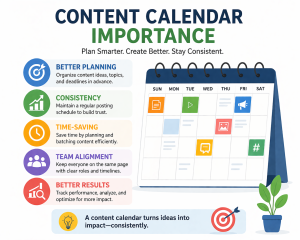




 Admission Closed

 Admission Open
 Admission Open

 ROI Calculator



