
Top Certified Public Accountant (CPA) Courses in 2026
 October 2, 2026
 7 min read





Table Of Content
- What Is a Certified Public Accountant Course?
- CPA Course Subjects: What the Exam Covers
- Top CPA Courses and CPA Classes to Consider in 2026
- CPA Eligibility for Indian Candidates
 Key Insights
- A certified public accountant course is not a single degree. It is a preparation route for the US CPA licence, which combines education, the Uniform CPA Exam and work experience.
- The CPA course subjects follow the exam structure: three Core sections (AUD, FAR, REG) plus one Discipline section (BAR, ISC or TCP).
- Indian candidates usually need to convert their degrees into US credit hours through an evaluation agency, and requirements differ by state board.
- The best CPA classes are those aligned to the current AICPA blueprint, with practice questions, mock exams and eligibility guidance.
- CPA is one of several finance credentials, so it is worth comparing it with CA, CMA and CFA before committing.
- In this blog, you'll learn what a CPA course covers, the top CPA course options in 2026, eligibility, fees, how to choose, and career scope.
If you are comparing a certified public accountant course, you are probably weighing a global credential against domestic options such as CA. The US CPA is widely recognised in audit, tax and financial reporting, and Indian candidates can now sit the exam at test centres in India.
But "CPA course" can mean several things: exam review programmes, live CPA classes, or degrees that help you meet credit requirements. Choosing without understanding the difference is one of the most common and costly mistakes candidates make.
This guide explains what a CPA course covers, the top options in 2026, who is eligible, what it costs and where it can take your career. It also gives a step-by-step plan to start from India.
 ChatGPT
 Perplexity
 Claude
 Grok
GrokWhat Is a Certified Public Accountant Course?
A CPA course prepares you for the Uniform CPA Examination and, ultimately, the CPA licence. According to the AICPA, licensure requires meeting education, examination and experience criteria, and requirements other than the exam itself can differ by jurisdiction.
In practice, a CPA course is usually a review programme delivered as recorded lectures, live online sessions or classroom CPA classes. It teaches the exam content and trains you on multiple-choice questions and task-based simulations. It does not by itself award the licence. That comes from a US state board of accountancy after you satisfy its rules.
CPA Course Subjects: What the Exam Covers
CPA course subjects map directly to the exam. Since the 2024 CPA Evolution update, every candidate takes three Core sections and chooses one Discipline section. Each section is four hours long, scored from 0 to 99, and you need at least 75 to pass. That score is not a percentage of questions answered correctly, as the AICPA explains.
| Section | Type | Main focus |
|---|---|---|
| AUD: Auditing and Attestation | Core | Audit planning, evidence, reporting, ethics |
| FAR: Financial Accounting and Reporting | Core | Financial statements, US GAAP, government and not-for-profit accounting |
| REG: Taxation and Regulation | Core | Federal taxation, business law, tax ethics |
| BAR: Business Analysis and Reporting | Discipline | Financial analysis, technical accounting, data analytics |
| ISC: Information Systems and Controls | Discipline | IT audit, data security, SOC engagements |
| TCP: Tax Compliance and Planning | Discipline | Advanced individual and entity taxation |
The exact topics and weightings are published in the AICPA blueprints, which good CPA classes follow closely.
A Closer Look at the Core Sections
AUD covers ethics and professional responsibilities, risk assessment and planning, gathering audit evidence and forming conclusions and reports. FAR is the broadest section: it tests financial statement preparation, specific balance sheet accounts and transactions, and governmental and not-for-profit accounting. REG combines ethics in tax practice, business law and the federal taxation of individuals, entities and property transactions.
Each section has five testlets: two of multiple-choice questions followed by three task-based simulations. That is why good CPA classes spend as much time on simulations as on theory.
Which Discipline Should You Choose?
Choose BAR if you lean towards corporate finance and analysis, ISC for IT audit and risk, and TCP for tax careers. Since BAR includes data analytics, our guide to finance analytics certification courses is a useful companion, and TCP candidates can start with our guide to taxation in India for tax fundamentals. If you are still deciding, brush up on financial accounting vs managerial accounting, the types of accounting and financial statement analysis.
Top CPA Courses and CPA Classes to Consider in 2026
There is no official ranking, so the “top” CPA course is the one that fits your eligibility, budget and learning style. Most options fall into three groups.
1. CPA Review Courses
Global review providers such as Becker, UWorld Roger CPA Review, Gleim and Surgent offer question banks, video lessons and adaptive practice. Many Indian institutes, including Simandhar Education, Miles Education and EduMont, deliver live or hybrid CPA classes built around such materials and add support with evaluation and state selection. Treat these names as examples, not endorsements, and compare demo classes before paying.
2. Degrees That Bridge the Credit Gap
If your degree falls short of the credit requirement, a postgraduate qualification can help. Options include an M.Com or MBA, and our guide to career options after M.Com shows how such a degree fits your plan. Graduates still in the B.Com stage can review B.Com accounting and finance subjects and career options after B.Com.
3. Alternatives to Compare
CPA is not the only route. Read about the CMA course, how to become a CA and CFA vs MBA in finance to see which credential matches your goals. For a wider view, see the best finance courses in India.
CPA Eligibility for Indian Candidates
Eligibility is set by individual state boards, not one national body, and this is where most Indian candidates need planning.
Credit hours. Most boards traditionally expect 120 semester credits to sit the exam and 150 for licensure. Provider evaluations commonly report that a three-year Indian B.Com converts to roughly 90 credits, so an M.Com, MBA or CA qualification is often needed to close the gap. Your actual figure depends on the evaluation agency and the board.
Evaluation. You submit transcripts to a recognised credential evaluation agency, which converts your Indian degrees into US credits. Some boards are more accessible to international candidates because of documentation rules, so compare states carefully.
New pathways. NASBA notes that the model law now offers three routes: a graduate degree plus one year of experience, the traditional 150-hour route plus one year, and a 120-hour bachelor’s pathway with two years of experience. States decide whether to adopt each route, so check your chosen board before enrolling.
Testing location. Prometric centres in major Indian cities host the exam, though the centre list can change.
How to Start Your CPA Journey from India: Step by Step
1. Check Your Credit Position
Gather your mark sheets and degree certificates, and get an evaluation report so you know how many US credits you hold.
2. Shortlist State Boards
Compare boards on education rules, experience requirements, documentation and fees. Verify each rule on the board’s own website, because requirements change.
3. Enrol in a CPA Course
Pick a review programme or CPA classes that match your schedule. If you are early in your career, build fundamentals first with our list of top accounting skills.
4. Apply, Get Your Notice to Schedule and Test
After your state board approves your application, you receive a Notice to Schedule, which lets you book each section at a test centre.
5. Complete Experience and Licensing
Once you pass all four sections, complete the ethics and experience requirements your board sets, then apply for the licence.
How Much Does a CPA Course Cost in India?
Costs are quoted in dollars and converted to rupees, so totals move with exchange rates. Published estimates from Indian providers range widely, from under ₹3 lakh to about ₹5 lakh in total, depending on state board, review course and the number of attempts.
The main components are the credential evaluation, the state application, the exam fee for each section plus an international testing fee, the review course and licensing. Retaking a failed section means paying the exam fees again, so it is worth budgeting for at least one retake. Timelines of 12 to 18 months are commonly quoted for completing all four sections.
How to Choose the Right CPA Course
- Blueprint alignment: the syllabus should match the current AICPA blueprint, updated each year.
- Practice volume: look for large question banks, task-based simulations and full mock exams.
- Faculty and support: ask about instructor credentials, doubt-clearing and mentoring.
- Eligibility guidance: the provider should help with evaluation and state board choice, not only lectures.
- Flexibility: live, recorded and hybrid CPA classes suit different schedules.
- Total cost: compare access duration, retake support and hidden fees.
Because FAR and AUD pass rates usually sit below 50%, prioritise quality of practice over the lowest price. Ask for a demo class, read recent candidate feedback and confirm what happens if the exam blueprint changes during your access period. A cheaper course that you have to repurchase is rarely the better deal.
Career Scope After a CPA Course
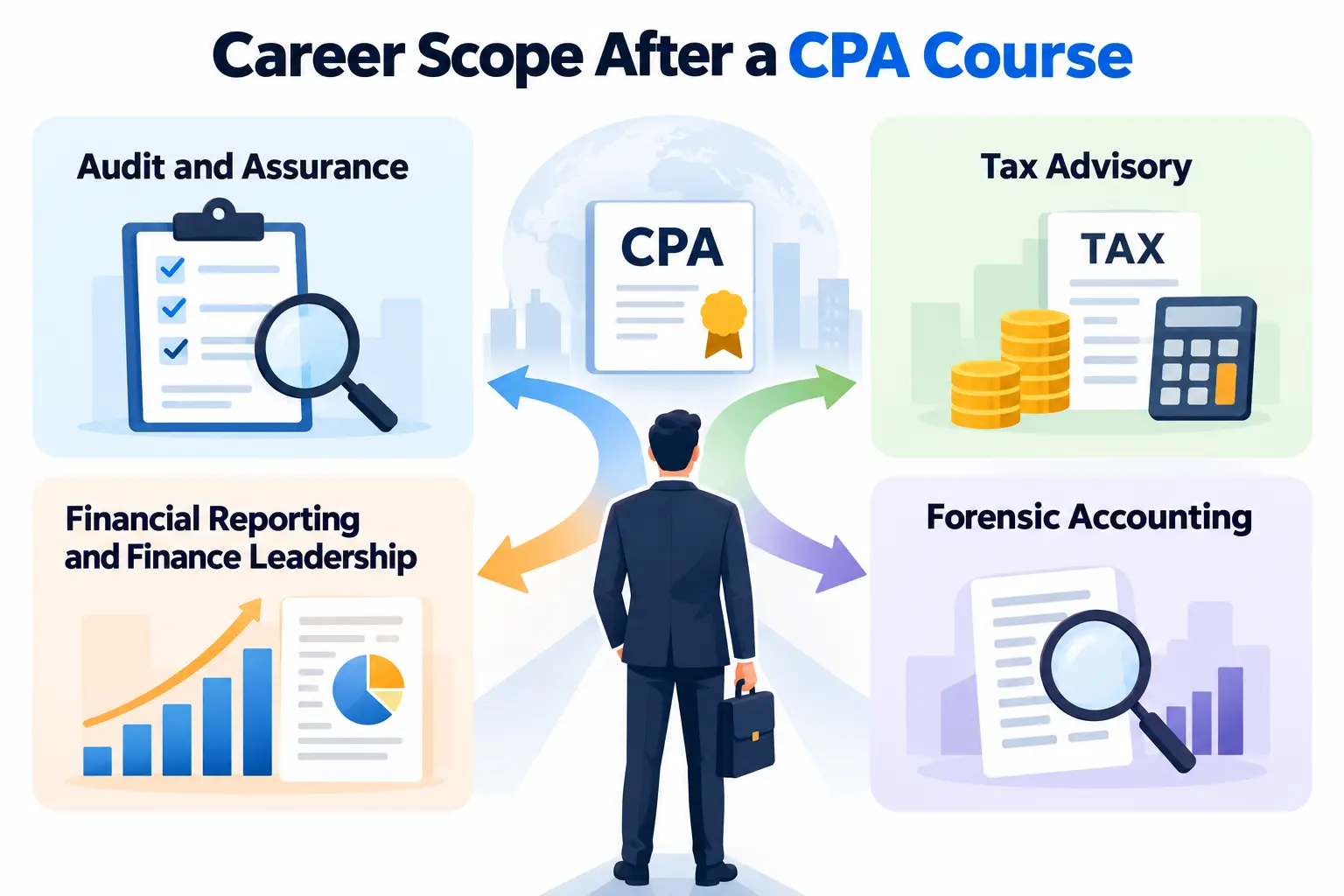
CPA-qualified professionals work in audit, tax, financial reporting, consulting and corporate finance, often with multinational firms and global capability centres. Common paths include:
- Audit and assurance, where our guide to how to become an auditor and the difference between internal and external audit are useful.
- Tax advisory, with pay covered in our tax consultant salary guide.
- Financial reporting and finance leadership, including finance manager salary benchmarks.
- Forensic work, explained in forensic accounting careers.
Since global roles involve IFRS and US GAAP, read Ind AS vs IFRS. To compare pay with a domestic credential, see CA salary in India. Pay varies by experience, employer and role.
Conclusion
A certified public accountant course works best when it matches your eligibility, your target discipline and your budget. Confirm your credit position with an evaluation agency, check your chosen state board’s rules, and compare CPA classes on blueprint alignment and practice quality.
If you are still deciding, compare CPA with CA, CMA and CFA, and read our roadmap for a career change to finance or the top finance courses.
Frequently Asked Questions
It is a programme that prepares you for the US Uniform CPA Examination. It covers the exam’s Core and Discipline sections but does not award the licence itself, which is issued by a state board.
The CPA course subjects are AUD, FAR and REG as Core sections, plus one Discipline section: BAR, ISC or TCP. Together they cover auditing, financial reporting, taxation, analysis, IT controls and tax planning.
Yes. Indian candidates can attempt the exam if their credentials satisfy a state board after evaluation. Most need additional qualifications beyond a three-year B.Com to meet the credit requirement.
Providers commonly quote 12 to 18 months to clear all four sections, though it depends on your study hours, exam scheduling and how many attempts you need.
Yes. Many review providers and Indian institutes offer live online, recorded and hybrid CPA classes, so you can study alongside a job.
Neither is better overall. CPA is oriented to US accounting standards and global roles, while CA is centred on Indian regulation. Compare both against your target work.
Pick BAR for finance analysis, ISC for IT audit and controls, or TCP for tax. All three lead to the same CPA licence, so choose by career interest.
It is demanding, with a minimum passing score of 75 on each section. FAR and AUD typically have lower pass rates, so structured preparation and plenty of practice matter.

Related Courses
Explore our programs








Find a Program made just for YOU
We'll help you find the right fit for your solution. Let's get you connected with the perfect solution.

Is Your Upskilling Effort worth it?
 ROI Calculator

Are Your Skills Meeting Job Demands?
Try our Skill Gap tool
Experience Lifelong Learning and Connect with Like-minded Professionals
Explore Jaro Connect
