
C Language: Basics, Benefits, Features, and Applications
 April 16, 2026
 8 min read




Table Of Content
- Introduction to C Programming Language
- Understanding the C Language Basics
- Key Features of C Language
- Benefits of C Programming for Developers
 ChatGPT
 Perplexity
 Claude
 Grok
GrokIntroduction to C Programming Language
C language is one of the most powerful and enduring programming languages ever created — and decades after its invention, it still forms the backbone of modern software development. From operating systems to embedded devices, C quietly powers the digital world around us.
Developed in the early 1970s by Dennis Ritchie at Bell Labs, C was originally designed to build the Unix operating system. What started as a systems programming tool quickly became a universal language for developers worldwide. According to the TIOBE Index, C consistently ranks among the top programming languages globally, a testament to its durability and relevance.
For anyone exploring C for beginners, this language offers something truly valuable — a direct window into how computers actually think. Unlike higher-level languages that abstract away the details, C teaches you memory management, data structures, and logical thinking from the ground up.
Whether you’re curious about how arithmetic works at the code level or ready to write your first program, C rewards curiosity with deep understanding.
Before diving into benefits, features, and real-world applications, let’s build a solid foundation by exploring the core C language basics— because great programming always starts with the fundamentals.
Understanding the C Language Basics
C programming starts with a surprisingly simple idea: give programmers direct, efficient control over a computer’s hardware using readable, structured code. Before diving into features and applications, it helps to build a solid foundation — because every advanced concept in C traces back to a handful of core building blocks.
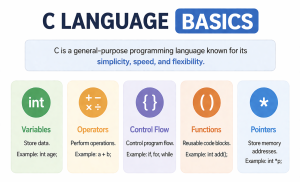
At its heart, C language basics revolve around a few essential elements:
- Variables and data types — defining what kind of data your program works with (integers, characters, floating-point numbers)
- Operators — symbols that perform calculations or comparisons
- Control flow — if, else, for, and while statements that guide program logic
- Functions — reusable blocks of code that keep programs organized
- Pointers — one of C’s most powerful tools for managing memory directly
These building blocks appear in virtually every program you’ll ever write. For beginners keeping C language notes, organizing these concepts early makes the learning curve significantly more manageable.
In practice, even a simple “Hello, World!” program teaches you how C structures a file, uses libraries, and executes instructions in sequence. If you’re curious about how these basics apply to real problems, exploring beginner-friendly C examples is a practical next step.
One important thing to understand early on: C and more advanced languages share DNA, meaning mastering C genuinely accelerates learning everything that comes after it.
With these C language basics in place, the next natural question is — what specific features make C so uniquely effective?
Key Features of C Language
Understanding C language basics goes deeper than just syntax — it’s the distinctive features of C that make it such a compelling choice for programmers at every stage of their journey.
Structured Programming
C follows a structured programming approach, breaking code into functions and modules. This makes programs easier to read, debug, and maintain. Rather than writing one long block of code, you organize logic into clean, reusable pieces.
Rich Library Support
C comes with a powerful standard library packed with built-in functions for input/output, string manipulation, and mathematical operations. These ready-made tools speed up development significantly.
Portability
One of C’s standout qualities is portability. Code written on one machine can be compiled and run on another with minimal changes — a feature that made C the foundation of cross-platform development.
Low-Level Memory Access
C gives programmers direct control over memory management through pointers. This level of access is rare in modern languages and is exactly why operating systems and embedded systems rely on it.
Speed and Efficiency
C compiles directly to machine code, making it exceptionally fast. According to GeeksforGeeks, C is considered one of the fastest programming languages available today.
C basic programs — from simple calculators to sorting algorithms — demonstrate these features in action. Want to explore hands-on projects that put these features to work? Check out some beginner-friendly project ideas to practice what you’re learning.
These features don’t just make C powerful — they deliver real, practical advantages for developers, which we’ll explore next.





Benefits of C Programming for Developers
Mastering C basics doesn’t just teach you a language — it shapes the way you think about programming altogether. The benefits of learning C extend far beyond writing code; they build a mindset that makes developers more effective in virtually every technical role.
Why C gives developers a real edge:
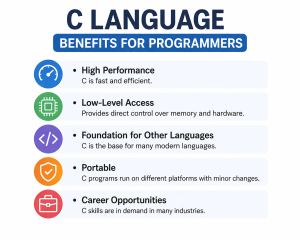
- Deep hardware understanding — C’s close-to-the-metal nature forces programmers to understand memory, pointers, and system resources. That knowledge translates directly into writing more efficient code in any language.
- Career versatility — According to Indeed, C remains widely used in systems programming, embedded development, and high-performance computing, making it a valuable skill across industries.
- Stronger problem-solving skills — Working through concepts like manual memory management and core programming fundamentals builds analytical thinking that benefits developers long-term.
- Gateway to other languages — C’s syntax influenced C++, Java, and Python. Learning C first makes picking up new languages noticeably faster.
- High performance — C programs execute with exceptional speed, which is why it’s trusted for resource-critical applications.
“C doesn’t just teach you to code — it teaches you to think like a computer, and that perspective is irreplaceable.”
Whether you’re exploring competitive programming or building system-level software, a solid C foundation consistently proves its worth. These benefits naturally set the stage for understanding where C is actually applied in the real world.
Practical Applications of C Language
The C language features we explored earlier aren’t just academic concepts — they translate directly into real-world applications that power the technology around us every day. C is genuinely everywhere, even when you can’t see it.
Where C Powers the World
Operating systems are perhaps C’s most iconic domain. The Unix operating system was built in C, and Linux runs millions of servers, smartphones, and embedded devices globally. continues to rely on C at its core. According to Simplilearn, C remains one of the most widely used languages in system-level development worldwide.
Here’s where C shows up in practice:
- Embedded systems — microcontrollers in appliances, medical devices, and automotive systems
- Compilers and interpreters — many programming language compilers are written in C
- Database engines — MySQL and PostgreSQL use C extensively
- Networking tools — routers, firewalls, and protocol implementations
- Game development — performance-critical game engines and graphics libraries
C’s influence even shaped modern programming history; understanding how C evolved over decades helps explain why it remains relevant today.
C is the silent engine behind technologies most programmers rely on daily, from operating systems to the tools they use to write code.
With such broad real-world reach, it only makes sense to see C in action — and that’s exactly what hands-on example programs deliver.
Example Programs for C Language Beginners
Seeing code in action is one of the best ways to truly appreciate the benefits of C — it transforms abstract concepts into something concrete and understandable. Let’s walk through a few beginner-friendly programs that put c language basic programs into perspective.
Hello, World!
The classic starting point for every new programmer:
int main() {
printf(“Hello, World!\n”);
return 0;
}
This simple program demonstrates how C uses header files, the main() function, and standard output — all core c language basics.
Adding Two Numbers
int main() {
int a = 5, b = 10;
printf(“Sum = %d”, a + b);
return 0;
}
This example shows variable declaration and arithmetic — perfect c language basics notes material for any beginner.
Fibonacci Sequence
C handles mathematical logic beautifully. If you want to explore how loops generate number patterns, this breakdown of number sequences explains the logic clearly.
Strong programs are built on clear fundamentals — and these examples prove that even small C programs teach big concepts.
For those interested in hardware interaction, C also powers microcontrollers. Learning how to write code for embedded boards is a natural next step once your basics of c language for beginners are solid.
These examples are just the starting line — the key takeaways ahead will help consolidate everything you’ve learned.
Conclusion
As we’ve journeyed through C’s history, core features, real-world C applications, and beginner-friendly programs, it’s worth pausing to consolidate what you’ve learned. Think of this as your quick-reference summary before diving into the most commonly asked questions.
Here’s what every beginner should walk away understanding:
- C is foundational — mastering it makes learning other languages significantly easier
- C language basics form the building blocks of operating systems, embedded systems, and game engines
- Memory management gives programmers direct control, developing skills that carry into every language you’ll ever use
- Portability and speed make C a top choice for performance-critical software
- C language basic programs — like calculators, pattern printing, and sorting algorithms — are the ideal starting point for hands-on practice
In practice, programmers who invest time in basics of C language for beginners build stronger problem-solving instincts across their entire careers. Understanding how C manages arrays, linked lists, and trees at a low level also enhances your appreciation for efficient data handling.
C doesn’t just teach you a programming language — it teaches you how computers think, making every concept you learn after it click faster.
According to Coursera, C remains one of the most recommended first languages for aspiring developers precisely because of this foundational strength.
Frequently Asked Questions
Absolutely. C teaches you how computers actually work — memory, pointers, and logic — giving you a rock-solid foundation. Mastering C language basics prepares you for virtually every other language you’ll encounter later.
With consistent practice, most beginners grasp C language basic programs and core syntax within four to eight weeks. Dedication and daily coding practice accelerate progress significantly.

Related Courses
Explore our programs



Find a Program made just for YOU
We'll help you find the right fit for your solution. Let's get you connected with the perfect solution.

Is Your Upskilling Effort worth it?
 ROI Calculator

Are Your Skills Meeting Job Demands?
Try our Skill Gap tool
Experience Lifelong Learning and Connect with Like-minded Professionals
Explore Jaro Connect

