Why Binary Trees Are Important in Coding Interviews
Binary Tree in Data Structure
Types of Binary Tree
Preparing for coding interviews often requires a strong understanding of core data structures, and one concept that consistently appears in technical assessments is the binary tree. From entry-level roles to advanced software engineering positions, interviewers frequently evaluate candidates based on their ability to understand, implement, and optimise tree-based algorithms.
But what is binary tree exactly, and why is it so important in programming? A binary tree in data structure is a hierarchical structure where each node can have at most two children. These children are typically referred to as the left child and right child. Despite this simple definition, binary trees support a wide range of algorithms and real-world applications, including searching, sorting, expression evaluation, file organisation, and decision-making systems.
In coding interviews, binary trees are often used to test problem-solving ability, recursion skills, algorithm optimisation, and understanding of time complexity. Questions related to traversal, height calculation, tree balancing, and path evaluation are common, making this topic essential for interview preparation.
This comprehensive guide explains the fundamentals of binary trees, their structure, different types of binary tree, traversal techniques, implementation methods, complexity analysis, and frequently asked interview questions.
A binary tree is a non-linear data structure consisting of nodes connected through edges. Each node contains three main components:
Data (value stored in the node)
Reference to the left child
Reference to the right child
Unlike linear data structures such as arrays or linked lists, a binary tree organises data hierarchically. The topmost node of the tree is known as the root, and nodes without children are called leaf nodes.
Basic Terminology
Understanding common terminology helps in solving interview questions efficiently.
Root – The top node of the tree
Parent node – A node that has children
Child node – Nodes connected below a parent
Leaf node – A node with no children
Subtree – A smaller tree within the main tree
Height – Number of edges in the longest path from root to leaf
Depth – Distance from the root node
Edge – Connection between nodes
*GeeksforGeeks
Example of Binary Tree Structure
10
/ \
5 15
/ \ \
2 7 20
In this example:
10 is the root node
5 and 15 are children of 10
2, 7, and 20 are leaf nodes
Why Binary Trees Are Important in Coding Interviews
Binary trees are frequently used in coding interviews because they test multiple problem-solving skills simultaneously:
Logical thinking
Recursion understanding
Algorithm efficiency
Data structure design
Memory optimisation
Companies such as Google, Microsoft, Amazon, and Meta commonly include binary tree questions in technical interviews.
Binary trees are used in:
Database indexing
Expression parsing
Artificial intelligence decision trees
Network routing algorithms
File compression systems
Syntax tree construction in compilers
Because of their widespread application, mastering binary trees significantly improves coding interview performance.
Binary Tree in Data Structure
In computer science, a binary tree in data structure is implemented using nodes linked through pointers or references. Each node typically contains:
class Node: def __init__(self, value): self.value = value self.left = None self.right = None
This structure allows efficient insertion, deletion, and traversal operations.
Binary trees can grow dynamically, unlike arrays that require fixed memory allocation. This flexibility makes them suitable for problems where the data size changes frequently.
Understanding the types of binary tree is critical for coding interviews because many questions are based on identifying the structure of the tree.
1. Full Binary Tree
A full binary tree is a tree where every node has either 0 or 2 children.
Example:
1
/ \
2 3
/ \
4 5
Each node either has two children or none.
2. Complete Binary Tree
In a complete binary tree, all levels are completely filled except possibly the last level, which is filled from left to right.
Example:
1
/ \
2 3
/ \ /
4 5 6
Complete binary trees are commonly used in heap data structures.
3. Perfect Binary Tree
A perfect binary tree has all internal nodes with exactly two children, and all leaf nodes are at the same level.
Formula:
Number of nodes = 2^h – 1
Where h = height of the tree.
4. Balanced Binary Tree
A balanced binary tree ensures that the height difference between left and right subtrees is minimal (usually not more than 1).
Balanced trees ensure efficient searching operations.
Example:
AVL Tree
Red-Black Tree
5. Degenerate Binary Tree
A degenerate tree behaves like a linked list where each node has only one child.
Example:
1
\
2
\
3
This structure reduces efficiency because search operations become linear.
6. Binary Search Tree (BST)
A Binary Search Tree (BST) follows a specific ordering rule:
All values in the left subtree are less than (or sometimes less than or equal to) the root node.
All values in the right subtree are greater than (or sometimes greater than or equal to) the root node.
The same rule applies recursively to every subtree.
Handling duplicates: BST implementations may handle duplicate values in different ways:
Store duplicates in the left subtree (≤ root)
Store duplicates in the right subtree (≥ root)
Maintain a count of duplicates in each node
Example:
8
/ \
3 10
/ \ \
1 6 14
BST is widely used because it supports efficient search, insertion, and deletion operations, typically with an average time complexity of O(log n) when the tree is balanced.
Binary Tree Traversal Methods
Traversal refers to visiting all nodes of the tree in a specific order.
Traversal questions are extremely common in coding interviews.
1. Inorder Traversal (Left → Root → Right)
Steps:
Traverse left subtree
Visit root node
Traverse right subtree
Example output:
Sorted order in BST.
Python code:
def inorder(root): if root: inorder(root.left) print(root.value) inorder(root.right)
2. Preorder Traversal (Root → Left → Right)
Steps:
Visit root
Traverse left subtree
Traverse right subtree
Used in tree copying and expression trees.
def preorder(root): if root: print(root.value) preorder(root.left) preorder(root.right)
3. Postorder Traversal (Left → Right → Root)
Steps:
Traverse left subtree
Traverse right subtree
Visit root
Used in deleting trees.
def postorder(root): if root: postorder(root.left) postorder(root.right) print(root.value)
Here are the important binary tree operations that you should know of:
Insertion
Insertion depends on the type of binary tree.
In Binary Search Tree:
Compare value with root
Insert left if smaller
Insert right if greater
Deletion
Deletion is slightly complex due to multiple cases:
Node has no children
Node has one child
Node has two children
For case 3, replace with inorder successor. The inorder predecessor is also a valid alternative.
Searching
Searching in a BST follows a divide-and-conquer approach.
Time complexity depends on tree height.
Time Complexity of Binary Tree Operations
The performance of binary tree operations depends on the height of the tree. When the tree is balanced, operations are faster. However, when the tree becomes skewed (degenerate) — meaning each node has only one child (like a linked list) — the performance degrades.
Operation
Best Case
Average Case
Worst Case
Search
O(1) (element is at root)
O(log n) (balanced tree)
O(n) (skewed tree)
Insert
O(1) (insert at root or immediate child)
O(log n) (balanced tree)
O(n) (skewed tree)
Delete
O(1) (delete root or leaf with minimal adjustment)
O(log n) (balanced tree)
O(n) (skewed tree)
Traversal
O(n)
O(n)
O(n)
Why Worst Case Becomes O(n)
The worst-case complexity of O(n) occurs when the binary tree becomes skewed (degenerate), meaning each node has only one child.
Example of a right-skewed tree:
1 \ 2 \ 3 \ 4
Here, the structure behaves like a linked list, so operations must examine every node sequentially.
Key Insight
Balanced trees (AVL Tree, Red-Black Tree, etc.) maintain height ≈ log n, ensuring faster operations.
Unbalanced or skewed trees increase height to n, reducing efficiency.
Binary Tree vs Binary Search Tree
Here’s the difference between a binary tree and a binary search tree:
Consistency is key to mastering binary tree concepts.
Conclusion
Understanding the binary tree is essential for coding interviews and real-world software development. From traversal techniques to tree balancing methods, binary trees provide efficient solutions for complex computational problems.
Knowing the types of binary tree, implementing algorithms, and practising interview questions can significantly improve problem-solving confidence. Whether preparing for technical interviews or strengthening data structure fundamentals, mastering binary trees offers long-term benefits for programming careers.
With regular practice and a strong grasp of recursion and traversal techniques, candidates can confidently solve binary tree questions in interviews.
Frequently Asked Questions
A binary tree in data structure is a hierarchical structure where each node has at most two children, called left and right child.
Binary tree questions test recursion, algorithm optimisation, and problem-solving skills, which are important for technical roles.
Common types of binary tree include full binary tree, complete binary tree, perfect binary tree, balanced binary tree, degenerate tree, and binary search tree.
A binary tree is a general structure, while a Binary Search Tree follows ordering rules where left child values are smaller than the root and right child values are greater.
‘Traversal’ refers to visiting all nodes in a tree in a specific order, such as inorder, preorder, postorder, and level order.
Dr. Sanjay Kulkarni
Data & AI Transformation Leader
Dr. Sanjay Kulkarni is a Data & AI Transformation Leader with over 25 years of industry experience. He helps organizations adopt data-driven and responsible AI practices through strategic guidance and education. With experience across startups and global enterprises, he bridges the gap between theory and real-world application. His work empowers teams to innovate and thrive in AI-driven environments.
Get Free Upskilling Guidance
Fill in the details for a free consultation
Related Courses
Explore our programs
Admission Open
Post Graduate Certification Programme in Business Analytics & Artificial Intelligence (AI) Applications

 April 9, 2026
 7 min read




 ChatGPT
 Perplexity
 Claude
 Grok
Grok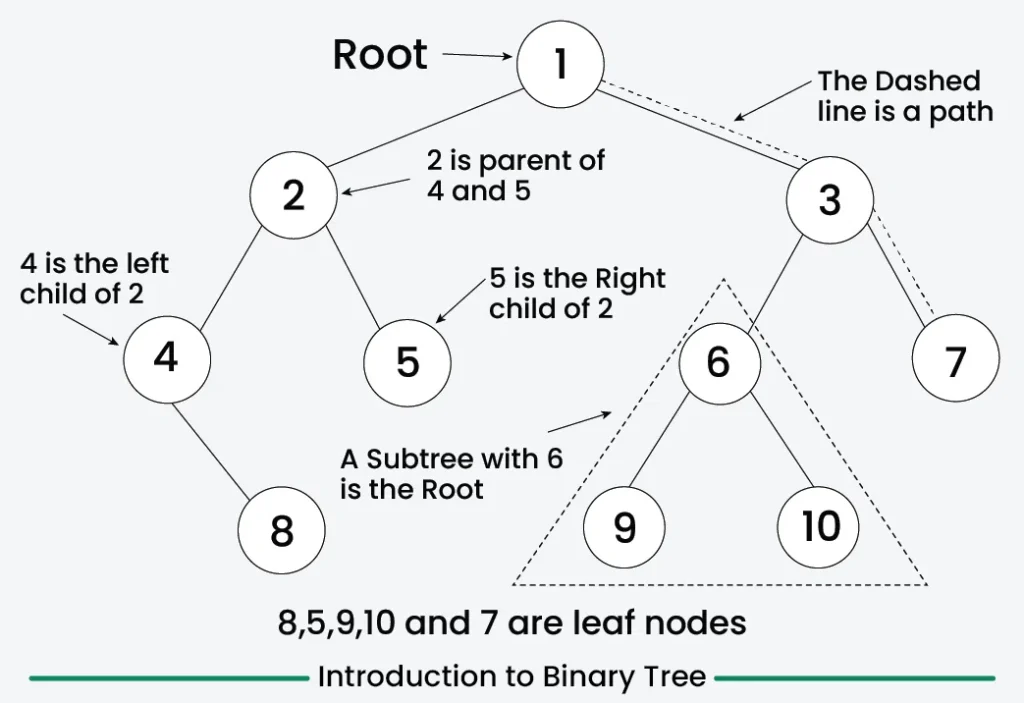




 Admission Open

 Admission Closed
 Admission Open
 Admission Open

 ROI Calculator