Overview of SAP ABAP: Getting to Know SAP's Programming Language
Why SAP ABAP is Still Relevant Today
SAP Modules Overview and Where ABAP Fits In
Architecture of SAP ABAP: How ABAP Works Internally
In enterprise software development, one of the very first questions most beginners ask is: what is SAP ABAP? SAP ABAP or Advanced Business Application Programming is the primary programming language that SAP uses for creating custom business applications in SAP environments. It plays a central role in enabling organizations to customize their SAP systems, extend business workflows, automate processes, and build scalable enterprise applications. Developers often work with several sap abap modules and heavily rely especially on functional modules in sap abap while developing modular and reusable code pieces that support business operations with efficiency.
Both technical and functional consultants can make informed decisions in designing the solution by understanding what SAP ABAP is and how it fits into the broader SAP ecosystem. In this comprehensive guide, readers will learn about the basics, architecture, modules, practical use cases, and future scope of SAP ABAP.
Overview of SAP ABAP: Getting to Know SAP's Programming Language
To begin with, the basics: what is sap abap? ABAP is a high-level programming language used to create applications for the SAP ERP system. Originally developed for managing high volumes of business data and offering extensive functionality across SAP modules, it has undergone much development in recent decades. Today, SAP ABAP supports both procedural and object-oriented programming, so it is suitable for building robust and scalable enterprise solutions with tight integrations across different SAP modules.One of the key features of ABAP is that this language can process business logic across different departments. Since companies rely on SAP for finance, HR, supply chain, manufacturing, and more, developers extend features with ABAP, create custom reports, and build transactions that align with real business needs. This is where functional modules in sap abap are very critical to assure modular, reusable, and maintainable code.
Knowing what is SAP ABAP lets organizations make informed decisions about system enhancements and assures that developers will be able to support even the most complex business processes with reliable and customized programming.
Why SAP ABAP is Still Relevant Today
Even now, with emerging technologies, most enterprises are still investing intensively in SAP systems. That also keeps the question of what is sap abap highly relevant. ABAP has smooth integration with SAP’s application server, database layers, and functional modules. As SAP deals with huge amounts of transactional data, the efficiency and robustness of ABAP become vital for custom development over sap abap modules. ABAP remains very relevant because of its stability: enterprises trust ABAP for mission-critical operations, financial accuracy, data consistency, and compliance. Developers also rely on functional modules in sap abap to ensure that business logic is reusable, uniform, and easy to audit. With the move to SAP S/4HANA, ABAP continues to evolve and stays the backbone for cloud-ready development.
Knowing what SAP ABAP is important for anyone looking to work with enterprise software or wanting to effectively customize ERP workflows.
SAP is designed to be modular, meaning that different business functions are split into key modules. Key examples include: FI – Financial Accounting
CO – Controlling
MM – Material Management
SD – Sales and Distribution
HR/HCM – Human Resources
PP – Production Planning
QM – Quality Management
While the above are functional modules, ABAP is considered one of the main technical areas supporting system customization. To understand what is SAP ABAP, you need to understand how it interacts with these modules. As developers, different sap abap modules are worked upon depending on the nature of the requirement, whether building reports, interfaces, enhancements, or workflows.
It is here that functional modules in SAP ABAP come in, which enable developers to write logic that can be reused, interacting with FI, MM, SD, or other SAP modules through structured and parameter-based functions.
Thus, ABAP acts as the technical backbone for functional modules running smoothly across departments.
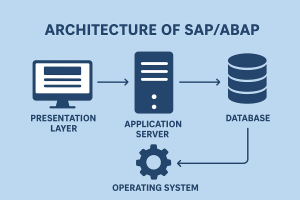
Architecture of SAP ABAP: How ABAP Works Internally
To fully answer what is SAP ABAP, let’s look at its three-tier architecture:
1. Presentation Layer
This is the layer at which users interact through SAP GUI or browser-based applications. It provides screens, forms, and UI components. It also acts as an entry point to work with various sap abap modules.
2. Application Layer
This is where ABAP programs run. The different aspects it controls and manages include business logic, transactions, code processing, and calling of functional modules in sap abap. This layer is central to SAP operations.
3. Database Layer
All data from SAP modules is housed herein. ABAP reads and updates the records using Open SQL or Native SQL. A good understanding of the working of the database layer is very crucial in developing expertise on what is sap abap.
The architecture of ABAP ensures scalability, performance, and the seamless execution of complex processes, including those involving large datasets across SAP systems.
Understanding what is SAP ABAP requires learning about its core features, which include:1. Modular Programming
Developers use modules and function groups in SAP ABAP to modularize tasks that they can reuse. This reduces redundancy and makes maintenance easier.
2. Strong Data Handling Capabilities
ABAP allows for speedy in-memory processing of huge datasets with internal tables. Along with functional modules in sap abap, this ensures efficient data workflows.
3. Integrated Database Access
Open SQL thus allows platform-independent access to SAP databases and, therefore, is very important to learn what is sap abap for enterprise operations.
4. Object-Oriented Support
ABAP Objects facilitates current-state codingstandards, enhancing structure and reusability within the SAP ABAP modules.
5. Built-In Error and Transaction Management
ABAP also supports multi-user processing with security transaction control. It is an essential requirement of enterprise applications which depend on functional modules in sap abap.
Understanding Functional Modules in SAP ABAP
In development, one of the most frequently used components in sap abap is the functional modules. These are reusable functions defined in SAP and organized into function groups.
Characteristics of Functional Modules
Reusability: They can be called from any ABAP program.
Encapsulation: They contain clearly defined logics.
Parameter-Based: Input, output, and exception handling parameters assure structure.
Consistency: They help maintain uniform behavior in the different sap abap modules.
Anyone studying what is SAP ABAP will find out rather quickly that functional modules are the cornerstone of ABAP programming and a requirement in just about every project.
Creating and Using Functional Modules in SAP ABAP
The developers create new modules using the Function Builder. These steps usually involve:
Creating a function group
Writing reusable logic
Defining import/export parameters
Exception Handling
Activation and transportation of the module
This modular approach is one of the reasons why understanding what SAP ABAP remains important. The use of functional modules helps provide clean, standardized solutions across SAP systems.
What are SAP ABAP Modules?
The term SAP ABAP modules usually refers to the technical components or reusable blocks created using ABAP. They differ from the functional modules of SAP, such as FI, MM, or SD. Rather, the ABAP modules include objects, programs, classes, and reusable code elements.In most real-world scenarios, ABAP developers work closely with functional consultants to understand business processes and build logic that integrates with them. Here again, the functional modules in SAP ABAP play an important role in making solutions stable and development efficient.
Use Cases of SAP ABAP in Modern Enterprises
Understanding what is SAP ABAP becomes easier when you see how it is used. Here are common use cases:
1. Custom Reports
Organisations often require reports that are not standard in SAP. ABAP permits their presentation with internal tables and logic taken from SAP ABAP modules.
2. Integrations and Interfaces
ABAP allows systems to interact with other platforms through IDocs, APIs, or RFCs. Most interactions between systems depend on functional modules in sap abap.
3. Improvements and Changes
Exits, BAdIs, and enhancements are common methods of extending SAP functionality.
4. Data Migration and Conversion
ABAP facilitates the import/export of enormous datasets in system upgrades or migrations.
5. Automated Workflows
The use of automated tasks, batch jobs, and scheduled tasks relies on strong ABAP logic, which further reinforces the importance of learning what is SAP ABAP.
Here are the key concepts which every ABAP developer should have:Internal Tables
Used for in-memory data handling across SAP ABAP modules.
Open SQL
platform-independent SQL used for efficient database operations.
Function Modules & Function Groups
Reusable logic blocks are called functional modules in SAP ABAP.
Object-Oriented ABAP
Modern coding style: classes, interfaces, and methods.
Table Types & Data Dictionary
It defines metadata, ensures data consistency, and supports comprehension of what SAP ABAP is in practice.
How to Start Learning SAP ABAP?
Here’s a recommended learning path:
Overview of SAP ABAP and its basics.
Learn SAP GUI and ABAP Workbench.
Practice Open SQL and internal tables.
Create small programs and reports.
Learn SAP ABAP modules and modular coding.
Build and test functional modules in Sap ABAP.
Work with actual functional SAP modules such as MM or SD.
Learn debugging and transport mechanisms.
This path ensures that you learn about the implementation, not just the theoretical aspects.
Challenges When Working with SAP ABAP
Despite the strengths, there are challenges facing ABAP:
It has a learning curve.
It requires understanding functional modules.
Performance optimization is key.
It’s inextricably linked with SAP environments.
Business process understanding is critically important.
Still, learning what is sap abap offers long-term career value to a developer.
Future of SAP ABAP
ABAP is getting more modern and powerful with SAP S/4HANA and cloud platforms. Developers can efficiently create applications ready for the cloud with ABAP RESTful Application Programming Model RAP. Companies keep relying on ABAP to support mission-critical processes.Future development will still rely heavily on SAP ABAP modules and reusable functional modules in SAP ABAP. Thus, ABAP is a future-proof skill.
Advanced Capabilities of SAP ABAP in Modern SAP Systems
Understanding what is SAP ABAP also involves researching its advanced capabilities that support digital transformation across industries. With demands for high-speed processing and real-time analytics from businesses, ABAP has grown to optimize performance on the SAP S/4HANA platform. At times, developers combine the logic of various SAP ABAP modules to guarantee accuracy in financial postings, material movements, sales processing, and analytics, thus making ABAP one of the most vital components within enterprise operations.
Introduction to the role that ABAP plays in SAP S/4HANA and in cloud development
This means ABAP has now been tuned for in-memory computing with SAP S/4HANA, which allows applications to run much faster. As this happens, developers will also need to learn about database-efficient programming, such as CDS views and other innovations. Building custom logic within functional modules in sap abap ensures that such logic remains reusable, scalable, and in line with the clean-core development principles of SAP. These modules facilitate maintaining consistent business logic across multiple applications and systems for an organization.
Future-Proofing Business Applications with ABAP
Modern ABAP frameworks, especially ABAP RESTful Application Programming Model (RAP), allow the creation of cloud-ready and API-driven solutions. As enterprises move toward hybrid and cloud-based architecture, understanding what SAP ABAP is becomes important in creating applications that seamlessly integrate into SAP Fiori, third-party tools, and mobile platforms. This continued evolution has secured ABAP’s position as one of the most future-proofed development skills within the SAP ecosystem.
Conclusion
In summary, what is SAP ABAP? It is the most important language for programming at SAP, creating, customizing, and extending applications within an enterprise. ABAP cooperates with several sap abap modules and uses functional modules within sap abap that can help create maintainable, consistent, and scalable code. Be it reports, interfaces, data processing, or enhancements, ABAP enables organizations to tailor SAP to their exact business needs.
Learning SAP ABAP opens up long-term career perspectives since companies are moving to SAP S/4HANA and continue using ABAP for core development.
Frequently Asked Questions
SAP ABAP requires quite a lot of coding since it is the primary programming language to customize SAP systems. When people ask what SAP ABAP is, it mainly means writing logic for reports, forms, and enhancements. Even though you work with sap abap modules, your role remains largely technical with continuous coding tasks.
SAP means the whole ERP, while SAP ABAP is the programming language for building and customizing its applications. When learning what is SAP ABAP you will realize that SAP is functional while ABAP is technical. The SAP ABAP developers use the so-called functional modules to extend the standard business processes.
Being business-process-oriented and structured makes SAP ABAP easier to learn than other programming languages. Beginners often search what is SAP ABAP before starting their journey, find clear syntax, and strong documentation. Understanding sap abap modules also helps simplify the learning curve.
Yes, SAP ABAP is a well-paying IT profession, particularly for experts skilled in advanced features and integrations. Companies welcome those professionals who know what SAP ABAP is and can work across SAP ABAP modules to support critical business operations. Knowledge of functional modules in the SAP ABAP increases earning potential.
Shubham Lal
Lead Software Developer
Shubham Lal joined Microsoft in 2017 and brings 8 years of experience across Windows, Office 365, and Teams. He has mentored 5,000+ students, supported 15+ ed-techs, delivered 60+ keynotes including TEDx, and founded AI Linc, transforming learning in colleges and companies.
Get Free Upskilling Guidance
Fill in the details for a free consultation
Related Courses
Explore our programs
Advanced Professional Certification Programme in Data Science & Machine Learning

 December 31, 2025
 9 min read





 ChatGPT
 Perplexity
 Claude
 Grok
Grok











 ROI Calculator