
Best Study Tips for Students: How to Study Effectively for Exams
 October 7, 2026
 8 min read





Table Of Content
- Why Most Students Study the Wrong Way
- Start With a Plan, Not a Panic
- Create a Study Space That Helps You Focus
- The Most Effective Study Tips for Exams (Backed by Science)
 Key Insights
- Effective studying is less about spending more hours and more about using active learning methods such as recall, spaced repetition, and practice.
- Creating a realistic study plan, prioritizing weak areas, and leaving time for revision can make exam preparation more organized and manageable.
- Techniques such as the Feynman Technique, past papers, interleaving, and studying mistakes can help identify knowledge gaps and strengthen understanding.
- Good study habits also include getting enough sleep, taking meaningful breaks, staying hydrated, managing stress, and maintaining a focused study environment.
- In this blog, you'll learn the best study tips for students and exams, including effective learning techniques, note-taking strategies, the Pomodoro Technique, stress management, last-minute preparation, and habits for long-term academic success.
We've all been there. The exam is in three days, your notes look like a foreign language, and you've just spent two hours "studying" while mostly rearranging your desk and checking your phone. Sound familiar?
Here's the good news: studying hard and studying smart are two very different things. Students who score well aren't always the ones who put in the most hours. They're the ones who use better methods. This blog gathers the most useful study tips you can start using today, from simple habits to science-backed techniques, so you can learn more in less time and walk into exams feeling prepared instead of panicked.
 ChatGPT
 Perplexity
 Claude
 Grok
GrokWhy Most Students Study the Wrong Way
Before we get to what works, let’s talk about what doesn’t. Most students rely on three habits:
- Re-reading notes and textbooks. It feels productive because the material starts to look familiar, but familiarity isn’t the same as understanding.
- Highlighting everything. When half the page is yellow, nothing stands out.
- Cramming the night before. It might get you through a quiz, but the information fades within days.
These methods create an illusion of learning. You feel like you know it, until the exam paper proves otherwise. The best study tips for students share one idea: make your brain work. Learning happens when you struggle a little, recall information, and connect ideas, not when you passively stare at pages.
Start With a Plan, Not a Panic
The most underrated of all study tips for exams is simply deciding what to study and when. A plan removes the stress of wondering where to begin.
Step 1: List everything. Write down every subject, chapter, and topic you need to cover. Check your syllabus and past papers.
Step 2: Rate your confidence. Mark each topic as strong, medium, or weak. Spend the most time on weak areas, but don’t ignore the strong ones entirely.
Step 3: Work backward from the exam date. Divide topics across the days available, and leave the last two or three days purely for revision.
Step 4: Build in buffer time. Life happens. Leave a free slot each week to catch up.
Keep the plan realistic. Scheduling twelve hours a day looks impressive on paper and collapses by day two. Four to six focused hours beats ten distracted ones.
Create a Study Space That Helps You Focus
Your environment quietly shapes your concentration. You don’t need a fancy desk, just a spot that signals “it’s study time.”
- Choose a consistent place. Your brain starts linking that spot with focus.
- Keep it tidy. Clutter competes for your attention.
- Use good lighting. Natural light is best; avoid studying in bed, where your brain associates the space with sleep.
- Put your phone away. Not face-down on the desk. In another room, or at least on silent in a drawer. Even a visible phone reduces concentration.
- Gather everything first. Water, notes, pens, charger. Fewer reasons to get up means fewer chances to drift.
If your home is noisy, try a library, a quiet café, or noise-cancelling headphones with instrumental or ambient sounds.
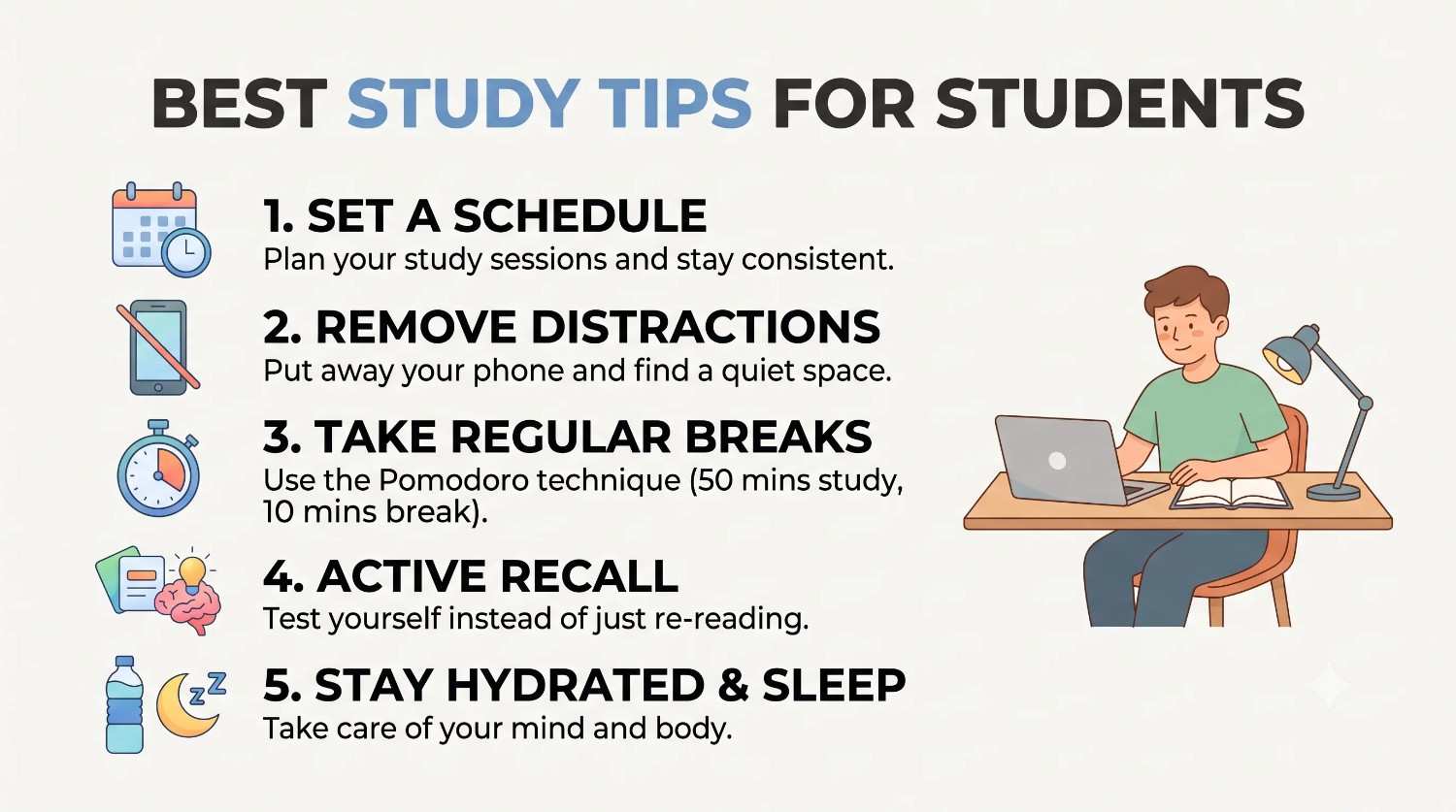





The Most Effective Study Tips for Exams (Backed by Science)
This is the heart of the guide. These techniques are supported by research in learning and memory, and they consistently outperform passive re-reading.
1. Active Recall
Instead of reading your notes again, close the book and try to remember the information. Ask yourself questions, write down what you know, or explain the topic out loud. Then check what you missed.
It feels harder than re-reading, and that’s exactly why it works. Retrieving information strengthens the memory pathways in your brain.
How to use it: Turn headings into questions, use flashcards, or attempt practice questions before looking at the answers.
2. Spaced Repetition
Your brain forgets information quickly unless you revisit it. Spaced repetition means reviewing material at increasing intervals, for example, after one day, then three days, then a week, then two weeks.
Studying a topic for one hour across five days beats studying it for five hours in one sitting. Apps like Anki can automate the schedule, but a simple calendar works too.
3. The Feynman Technique
Pick a concept and explain it in plain language, as if teaching a ten-year-old. Wherever you stumble, you’ve found a gap in your understanding. Go back, learn it, and try again.
If you can’t explain something simply, you probably don’t understand it yet.
4. Practice Past Papers
Nothing prepares you for an exam like doing exam-style questions. Past papers teach you the format, the types of questions, and how to manage time. Do some under timed, exam-like conditions, then review your mistakes carefully. Your errors are a goldmine of information about what to fix.
5. Interleaving
Rather than studying one topic for hours, mix related subjects or problem types in a single session. It feels messier, but it trains your brain to choose the right method for each question, which is exactly what exams demand.
3 Uncommon Study Tips Most Students Never Hear
Following are some uncommon strategies that top students use constantly and most others overlook.
#1: Study Your Mistakes, Not Just Your Notes
Keep a simple “error log.” Every time you get a question wrong in practice, write down what the question was, why you got it wrong, and what the correct approach is. Was it a careless slip, a knowledge gap, or a misunderstanding of the question?
Reviewing this log before the exam is far more valuable than rereading chapters you already know. It targets your specific weak spots.
#2: Start With the Hardest Task First
Your focus and energy are strongest early in a study session. Use that window for the topic you find most difficult or least enjoyable. Save the easier, more familiar material for when your energy dips. Most students do the opposite, ending up with the hardest material when they’re already tired.
#3: Sleep Is Part of Studying
This one sounds almost too simple, yet it might be the most powerful. Your brain consolidates memories during sleep, turning what you studied into long-term knowledge. Pulling an all-nighter often means you remember less, not more, and think more slowly during the exam.
Aim for 7 to 9 hours, especially the night before the exam. Studying a topic and then sleeping on it often does more for retention than an extra hour of late-night cramming.
Take Smart Notes (and Stop Copying the Textbook)
Good notes make revision faster. Bad notes just recreate the textbook in your handwriting.
- Summarize in your own words. Rewriting forces understanding.
- Try the Cornell method. Divide the page into a notes column, a cue or question column, and a summary at the bottom. It’s built for later recall.
- Use mind maps for big-picture subjects. They’re great for history, biology, and anything with lots of connected ideas.
- Add examples and diagrams. Visuals stick better than walls of text.
- Use color sparingly. Two or three colors with clear meanings beat a rainbow of confusion.
After each class, spend ten minutes cleaning up your notes while the lesson is fresh. It saves hours later.
Use the Pomodoro Technique to Beat Distraction
Long study marathons sound noble, but attention fades fast. The Pomodoro Technique solves this beautifully:
- Study for 25 minutes with full focus
- Take a 5-minute break
- Repeat four times
- Take a longer 15 to 30-minute break
The short deadline makes starting easier, and the breaks keep your mind fresh. During breaks, stand up, stretch, drink water, or look out the window. Avoid social media, because it’s hard to stop once you start scrolling.
Some students prefer longer blocks, like 50 minutes of study and a 10-minute break. Experiment and see what suits your concentration span.
Look After Your Body to Power Your Brain
Study techniques only work if your body can support them. A few basics make a surprising difference:
- Eat regular, balanced meals. Include protein, fruits, vegetables, and whole grains. Heavy, oily food can make you sluggish.
- Stay hydrated. Even mild dehydration affects concentration.
- Move daily. A 20-minute walk or light workout boosts mood and focus.
- Limit excess caffeine. A cup of tea or coffee is fine, but too much can increase anxiety and harm sleep.
- Take real breaks. Rest isn’t laziness, it’s part of the process.
Manage Exam Stress and Anxiety
A little nervousness can sharpen your focus, but too much can freeze your thinking. If stress is building:
- Break big tasks into small ones. “Study chemistry” is overwhelming. “Finish 15 questions on organic reactions” is doable.
- Practice deep breathing. Inhale for four seconds, hold for four, exhale for six. Repeat a few times.
- Talk to someone. Friends, family, teachers, or a counselor can help you feel less alone.
- Avoid comparing yourself. Other people’s progress says nothing about your ability.
- Focus on effort, not perfection. You don’t need to know everything, just enough to do your best.
If anxiety feels constant or unmanageable, reach out to a school counselor or mental health professional. Asking for support is a strength, not a weakness.
Last-Minute Study Tips for the Final Days
The final stretch matters, so use it wisely:
- Revise, don’t learn new topics. Focus on consolidating what you already know.
- Use summary sheets. One-page notes, formulas, and key definitions are perfect for quick review.
- Do a final timed practice paper. It builds confidence and sharpens timing.
- Prepare the night before. Pack your admit card, stationery, ID, and water bottle.
- Eat a proper breakfast. Don’t rely on caffeine alone.
- Reach the venue early. Arriving calm sets the tone for your performance.
During the exam, read all instructions carefully, start with questions you’re confident about, and keep an eye on the clock. If you get stuck, move on and return later.
Study Tips for Students: Quick Habits to Build Long-Term Success
Great results come from habits, not one-off efforts. Build these into your routine:
- Review notes briefly after each class
- Set small daily goals instead of vague ones
- Study at the same time each day
- Ask teachers when you don’t understand something
- Form a study group (small and focused, not social hour)
- Track your progress weekly and adjust your methods
Over time, these tiny actions compound into serious academic confidence.
Final Thoughts
There’s no single magic trick to acing exams. The best study tips are really about working with your brain instead of against it: plan ahead, recall actively, space out your revision, learn from mistakes, protect your sleep, and take care of yourself along the way.
You don’t have to apply everything at once. Pick two or three techniques from this guide, try them for a week, and see what changes. Keep what works, drop what doesn’t, and keep improving.
Studying effectively isn’t about being a genius. It’s about being consistent, curious, and a little bit kinder to yourself. You’ve got this.
Frequently Asked Questions
There’s no universal number. Quality matters more than quantity. Most students do well with 4 to 6 hours of focused study, broken into sessions with regular breaks. Around exam time, you might increase this, but only if you can stay productive. If you’re exhausted and absorbing nothing, rest is the better investment.
Combine active recall and spaced repetition. Test yourself often, use flashcards, and revisit the material over several days. Memory aids like acronyms, stories, and visual associations can also help with lists, dates, and formulas. Understanding the concept first makes memorizing far easier.
It depends on when you feel most alert. Some students concentrate best in the early morning, others in the evening. Pick the time that suits you and use it for your toughest subjects. Just avoid sacrificing sleep, since memory consolidation depends on it.

Related Courses
Explore our programs





Find a Program made just for YOU
We'll help you find the right fit for your solution. Let's get you connected with the perfect solution.

Is Your Upskilling Effort worth it?
 ROI Calculator

Are Your Skills Meeting Job Demands?
Try our Skill Gap tool
Experience Lifelong Learning and Connect with Like-minded Professionals
Explore Jaro Connect
