Have you ever thought of how it would be normal to be a bank manager? What do they actually do and how much do they earn? These thoughts usually come into the minds of most aspiring bankers or those interested in finance. Now imagine walking into a bank, where you can listen to the sound of typing, ringing phones, and customer chatter. Now, how would it feel to be a leader in that environment, to see to it that everything runs smoothly?
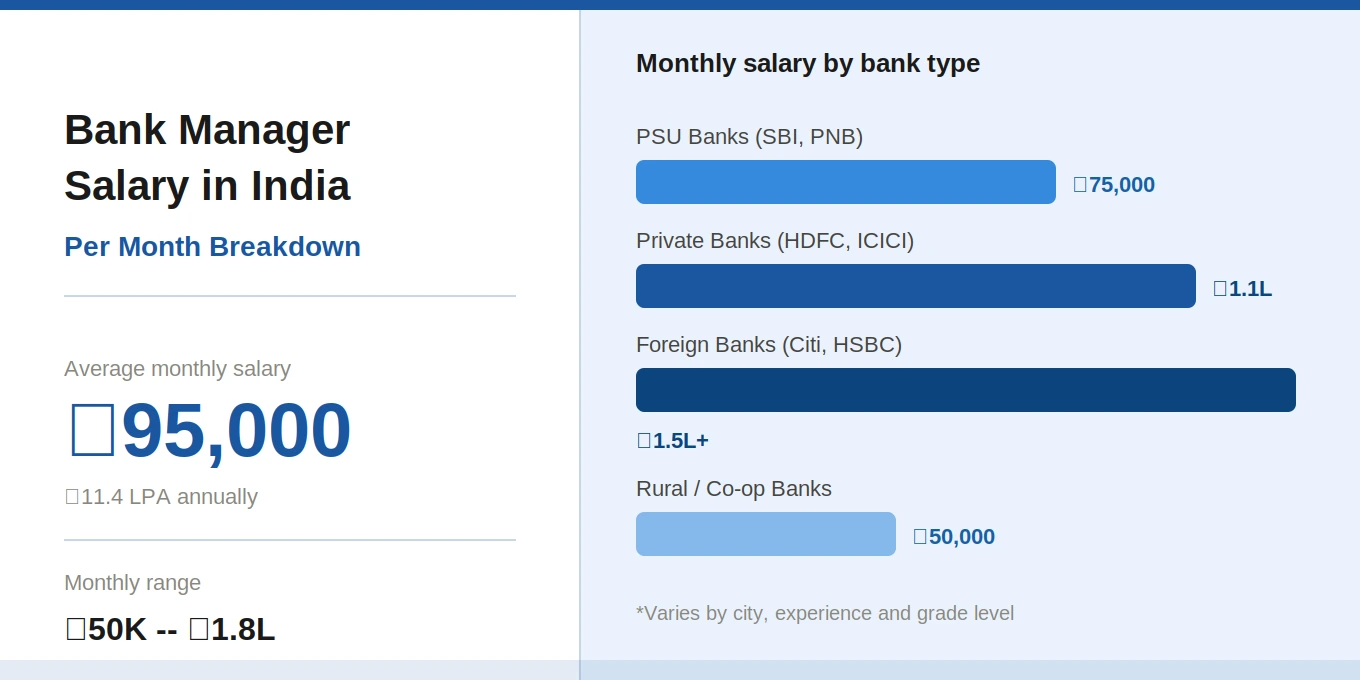
Of course, it is beyond function. One needs to make a serious decision on the finance line, client relationships, and team leadership. Now this begs the question: what does this salary look like? Do bank managers earn a decent living, or do they suffer for it? Well, the average salary of a Bank Manager varies between INR 7LPA to 8 LPA. But let’s delve deeply into the bank manager average salary working in India in detail, encompassing variable factors affecting earnings, differences in pay between public and private sectors, and skills required to become a bank manager. So, let’s get started!
Who is a Bank Manager?
A bank manager is asked to play multiple roles. The manager not only personifies the bank; quite often, they are the motivating person behind their administrative aspects. However, exactly what does a bank manager do? Essentially, like a master, they oversee the daily activities of a bank branch and ensure that it runs efficiently and profitably.
Key Responsibilities
Operations Management: The day-to-day running of the bank will involve the granting of loans, supervising cash flow, and managing records.
Customer Relations: Building and maintaining a strong customer base is of utmost importance. Customer satisfaction and loyalty should be regularly monitored by the bank manager. If any such issues crop up, it is the bank manager who intervenes.
Staff Training and Development: They train the new staff coming on board and are also responsible for educating the other staff regularly. A well-trained team is essential for the best customer service.
Budget Management: They control the branch budget in determining cost-effectiveness and profitability.
Compliance and Regulations: A banker should keep up with the banking regulations that deal with the safe and tidy conduct of banking operations. Every bank manager’s main concern should be the observance by his or her branch of all laws or guidelines put forth by the regulatory aspects of the line.
Average Bank Manager Salary Per Month in India:
Being a Bank Manager is a dynamic role, primarily focused on sales and attracting customers. Hence, to be an effective bank manager, leadership qualities and great interpersonal skills are required. These attributes help to build relations with customers and to guide the bank team in enhancing performance across the board.
In India, the average bank manager’s salary is INR 7.59 LPA, which translates to around INR 53,914 per month. Fresh graduates and entry-level managers with less than a year of experience earn approximately INR 3.60 LPA. The highest-paying bank is the State Bank of India (SBI), which offers a salary package of INR 10.17 LPA, followed closely by Punjab National Bank (PNB) with an INR 8.95 LPA package.
Factors Affecting Bank Manager Salary:
Bonuses and Incentives: Many private banks keep the salary with performance-based bonuses and incentives that create a substantial increase in the monthly take-home package of a manager.
Location: The bank manager’s salary differs from location to location. For example, a bank manager working in Mumbai might be more highly paid than in Lucknow or Haryana.
Additional Benefits: Private banks often give other perks such as health insurance retirement plans and other allowances. Such benefits contribute toward the total compensation.
Private Bank Manager Salary Per Month
Many private banks often pay competitive compensation packages to retain their skilled managers. Given below table represents the approximate range of a bank manager’s salary per month.
Specialisation
Average Annual Salary (INR)
Risk Management
7.23 LPA
Banking and Finance
6.25 LPA
Human Resource Management
5.07 LPA
Marketing
5.79 LPA
Operation Management
8.40 LPA
Retail
8.20 LPA
Information Technology
7.90 LPA
Bank Manager Salary – Company Wise
A bank manager’s salary in India varies with different banks. The average salary of bank managers according to the particular banks in which they work are noted as follows:
Bank Name
Average Annual Salary
Insight
Yes Bank
INR 8.06 Lakhs
Yes Bank, a prominent private sector bank, provides a competitive salary package for Bank Managers, reflecting the dynamism of the private banking industry.
ICICI Bank
INR 8.52 Lakhs
Provides a competitive salary, in line with its strong presence in the private sector.
UBS Bank
INR 13.42 Lakhs
UBS Bank offers a higher average annual salary for Bank Managers, showcasing the premium compensation associated with international banking institutions.
Federal Bank
INR 7.56 Lakhs
Federal Bank provides a competitive salary package for Bank Managers, aligning with its position in the private banking sector.
Canara Bank
INR 7.20 Lakhs
As a significant public sector bank, Canara Bank offers a competitive salary to its Bank Managers, reflecting its role in the banking industry.
State Bank of India
INR 15.6 Lakhs
As one of India’s largest public sector banks, SBI offers a high salary to Bank Managers, recognizing their key role.
Bank of Baroda
INR 12 Lakhs
Bank of Baroda provides a solid salary for Bank Managers, showcasing its status in the public banking sector.
Punjab National Bank
INR 10 Lakhs
Punjab National Bank offers a competitive salary, reflecting its significant role in the banking landscape.
Indian Overseas Bank
INR 14.6 Lakhs
Indian Overseas Bank provides a strong salary package for Bank Managers, indicating its commitment to attracting talent.
Note* Salaries can vary based on the bank’s reputation, size, and overall financial health. International banks such as UBS and Deutsche Bank typically offer higher compensation packages. Meanwhile, public sector banks like SBI and PNB also provide competitive salaries for bank managers.
City/Experience
Average Salary
Highest Payscale Offered
New Delhi Bank Manager 1 – 19 years exp.
INR 0.5 L/yr – INR19 L/yr
INR 9.2 Lakhs
Mumbai Bank Manager 1 – 19 years exp.
INR 1.9 L/yr – INR17 L/yr
INR 8.7 Lakhs
Kolkata Bank Manager 2 – 18 years exp.
INR 2.8 L/yr – INR22 L/yr
INR 8.8 Lakhs
Hyderabad / Secunderabad Bank Manager 1 – 19 years exp.
INR 1 L/yr – INR20 L/yr
INR 10.4 Lakhs
Pune Bank Manager 1 – 19 years exp.
INR 0.2 L/yr – INR20 L/yr
INR 9.4 Lakhs
Chennai Bank Manager 1 – 19 years exp.
INR 0.5 L/yr – INR15 L/yr
INR 8.1 Lakhs
Jaipur Bank Manager 1 – 19 years exp.
INR2.5 L/yr – INR15 L/yr
INR8.8 Lakhs
Thrissur Bank Manager 5 – 14 years exp.
INR7.5 L/yr – INR15 L/yr
INR11 Lakhs
Ahmedabad Bank Manager 2 – 9 years exp.
INR2 L/yr – INR15 L/yr
INR6.5 Lakhs
Bhopal Bank Manager 1 – 18 years exp.
INR2.1 L/yr – INR16 L/yr
INR 8.9 Lakhs
*shine.com
Skills for Future Bank Managers
A bank manager is an exciting career requiring a blend of educational knowledge and the necessary skills combined with prior experience. What are the main skills you will require to achieve success in this role? Let’s see them one by one:
1. Educational Background
There is no particular degree to pursue as a bank manager. However, a good certification can help you understand banking principles. One of them is the Professional Certificate Programme in Investment Banking – IIM Kozhikode.
With an aim to get people acquainted with the nuances of the industry, IIM Kozhikode has created a uniquely structured programme that will elaborate on the structure, management, and practices of investment banking in the Indian context. This programme aims to cover advanced corporate finance concepts such as higher mathematics, economics, corporate valuation, mergers and acquisitions, and corporate restructuring within its framework.
Programme Highlights:
Certificate of Completion from IIM Kozhikode
Gain Executive Alumni Status of IIM Kozhikode
Industry-Aligned Curriculum
Learn from Eminent IIM Faculty and Industry Experts
Assimilate and Apply Learnings via Capstone Project
3 Days Campus Immersion
2. Financial Understanding
A thorough understanding of various aspects of banking, including basic financial principles, banking operations, etc., is very helpful. Having knowledge of accounting practices, risk management, and compliance with regulations will enhance your approach to work.
3. Leadership and Management Skills
You must have strong leadership abilities that enable you to motivate the organization and set directions for your team. You should manage time and resources effectively while decision-making in the proper direction for the effective running of the bank.
4. Customer Service
Interpersonal skills and communication will help interact with the clients to meet their demands. Providing the best services will help you maintain good relations with clients.
5. Analytical Skills
To make informed business decisions, analyzing data and other market trends becomes crucial. You should be able to determine the risks and have plans to mitigate them.
6. Problem-Solving Skills
Quick and effective solutions should be found to overcome challenges arising in banking operations. It should embrace adaptation to the dynamic economic landscape.
7. Communication Skills
Effective written and oral communication skills are extremely important. You possess the ability to translate intricate financial concepts into simpler terms so other employees in the bank and clients can comprehend them in the same manner.
8. Ethical Standards
Operating within the high ethical standards with no circumvention from policy breaches and total confidentiality of the financial information of the institution together with the adherence to the set banking laws, evidenced by their overriding nature.
10. Technological Proficiency
Become more familiar with banking software and fintech tools! Make the leap and embrace technological change to keep you ahead of the game in this ever-evolving industry.
11. Sales and Marketing Insight
In understanding sales and marketing tactics is the ability to leverage the scope for promoting banking products and services. It includes identifying opportunities for expansion and customer acquisition.
12. Risk Management Knowledge
An adept understanding of risk assessment and management is essential in securing the bank. This includes identification and ensuring the implementation of sound risk mitigation measures.
Leading Recruiters for Bank Managers in India
In India, private banks play a crucial role in recruiting bank managers, proving to be one of the most rewarding segments for a professional career. Following is a list of some renowned private banks known to recruit bank managers:
ICICI Bank: ICICI Bank, one of the largest banking institutions in the private sector in India, provides a wide range of financial products and services, encompassing retail banking, corporate banking, and wealth management.
HDFC Bank: HDFC Bank is a principal entity in private banking circles, leveled with a broad range of services centered on retail banking. It offers savings accounts, loans, credit cards, and several other products.
Axis Bank: Another big private sector bank, Axis Bank, provides a clear range of financial services in the retail and corporate banking sectors.
Kotak Mahindra Bank: Kotak Mahindra Bank provides universal banking and financial services concentrating on personal banking, corporate banking, and wealth management.
IndusInd Bank: Customer-centric in its approach, IndusInd Bank caters to a variety of banking needs, including savings accounts, loans, and a host of other financial products.
Yes Bank: A major bank in private banking, Yes Bank serves both retail and corporate clients urban and semi-urban.
RBL Bank: Formerly known as Ratnakar Bank, RBL Bank has retail banking, corporate banking, and agricultural banking as its service line.
Federal Bank: With a significant presence in South India, Federal Bank extends various facilities, including savings accounts, loans, and NRI banking.
IDFC FIRST Bank: IDFC FIRST Bank aims to provide personalized banking solutions, catering to both retail and corporate clients.
Bandhan Bank: Focused on financial inclusion, Bandhan Bank provides banking services to a wide range of clients, comprising retail customers and microfinance clientele.
How Jaro Education Can Take You to the Next Level!
Jaro Education is one of the leading online higher education and upskilling companies offering academic assistance and career counseling. With over 15 years of experience in the industry, we at Jaro are here to bridge the gap between online learning and students. We have collaboration with renowned colleges and institutions to bring 150+ management, management, technology, and techno-functional programs. In fact, for most of the programmes offered by IIM and IITs, we act as marketing and technology partners. If you’re registering for the Professional Certificate Programme in Investment Banking offered by IIM Kozhikode, you have access to The Jaro Advantage which consist of:
Unparalleled career guidance and support
Dedicated student support
Immersive and lifelong learning experiences
Be a part of discussions and forums for enhanced learning
Leverage peer-to-peer learning experience
To Sum Up
Becoming a bank manager is both rewarding as well as a financially very careful profession to walk on. Not only that, banking is also changing, and therefore, the demand is high for skilled professionals. To match customer service in an ever-evolving technological world, banks are raising the demand for nice leaders who know how to lead operational management and client relations and ensure compliance.
To gain a better position within this industry, aspiring bankers should consider taking up courses associated with banking, such as the Professional Certificate Programme in Investment Banking from IIM Kozhikode. This programme ensures that learners get the necessary behind-the-scenes training required to succeed in investment banking and increases earning potential.
In sum, a bank manager offers stable pay and also satisfies the satisfaction of one to grow in such a dynamic and impactful industry.
Frequently Asked Questions
Bank Managers in India typically earn an impressive average salary of INR 18.6 lakhs per year. This figure can vary significantly, with most salaries ranging from INR 13.0 lakhs to INR 46.7 lakhs annually, based on 24 profiles. If you’re in the top 10% of earners, you can expect to make over INR 29.8 lakhs each year.
The average salary for a Bank Manager stands at INR18.6 lakhs, reflecting the competitive nature of this role within the banking sector.
These figures highlight the lucrative opportunities available for skilled professionals in the banking industry. With the right experience and expertise, a career as a Bank Manager can be both rewarding and financially beneficial.
Get Free Upskilling Guidance
Fill in the details for a free consultation
Related Courses
Explore our programs
Admission Closed
Certificate Course in Investment Strategies and Portfolio Management in the Age of AI

 April 29, 2025
 10 min read







 Admission Closed

 Admission Open
 Admission Open
 Admission Open
 ROI Calculator