HOME > BLOG > Finance > Asset Based Valuation: Methods, Pros & Cons
Finance
Asset Based Valuation: Methods, Pros & Cons
J
By Arif Siddiqui
July 2, 20234 min read
Last updated on July 20, 2026
SHARE THIS ARTICLE
Table Of Content
What is Asset-Based Valuation?
Discover the Various Asset-Based Valuation Methods
Pros & Cons of Asset-Based Valuation
Conclusion
Asset-based valuation arguably remains one of the most reliable methods for ascertaining a firm's true financial worth by pitting what a company owns against what it owes. The approach mainly focuses on both tangible and intangible assets, thus representing a suitable method for firms characterized by huge physical plants or those whose goals border on liquidation. What gives the asset-based technique a distinctive edge is that it provides quite clear and objective insight into the net value that a given firm represents to its stakeholders. Mergers, takeovers, and restructuring are two areas where this technique finds maximum application because of its relative transparency. Asset method valuation aids a firm in correctly gauging its financialfoundation on which its strategic decisions can be based. Unlike market-driven models, this minimizes speculation and attaches pure worth. The asset-based valuation technique is especially helpful for investors in asset-heavy industries to evaluate stability and long-term sustainability. This blog will elaborate on its methods, advantages, limitations, and best-use scenarios.
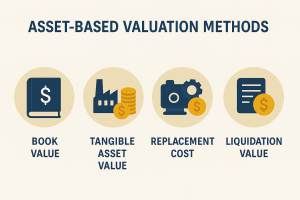
The asset based valuation model is a framework that determines the fair market value of a firm’s assets. These assets, encompassing tangible elements like property, plant, and equipment, alongside intangible components like copyrights and trademarks, play a pivotal role in generating revenue.Underlying this model is the principle that the company’s overall equity value equals the total value of its assets, both tangible and intangible, subtracted by its total liabilities, recorded or contingent. Analysts employ diverse techniques to evaluate asset value, including balance sheet values, replacement values, and fair market values.
This widely accepted valuation approach combines flexibility and complexity. Its flexibility emerges from the incorporation of off-balance-sheet items, such as contingent assets or liabilities. Determining the market value of tangible assets based on book value follows a relatively straightforward path. Assessing the worth of intangible assets introduces intricacy, demanding more extensive data, analytical effort, and associated expenses compared to alternative valuation methods.
Discover the Various Asset-Based Valuation Methods
When evaluating the worth of a business, asset-based valuation methods provide a comprehensive analysis of its net asset value and liabilities. Let’s explore two well-known approaches to valuation: the asset accumulation method and the excess earnings valuation method.
The asset accumulation valuation method
is similar to the balance sheet equation. It determines the company’s equity value or net worth by calculating the difference between its assets and liabilities. It considers all assets and liabilities, even those that are not explicitly listed on the balance sheet. For example, it considers the values of intangible assets and contingent liabilities disclosed in financial statement footnotes.
The Excess Earnings Valuation method
is a hybrid approach that takes into account both income and assets when determining the value of a company. This method is particularly useful for valuing the goodwill of a firm, as it utilizes earning as an input and applies the income method to calculate the goodwill. Due to its effectiveness in assessing firms with substantial goodwill, analysts often prefer using the Excess Earnings Valuation method.
Free Courses
Finance for All – Free Finance Certification Course
Understanding the pros and cons of asset-based valuation is essential for evaluating the strengths and limitations of this method in determining the value of a company. Below are the prominent pros and cons related to asset-based valuation.
Pros
Uncovering Liquidation Value
Asset-based valuation proves particularly advantageous when a company grapples with liquidation concerns. It provides an estimate of the value achievable through the sale of the company’s assets.
Evaluating Investments
This valuation approach finds relevance in assessing the worth of firms within the investment sector. It aids investors in evaluating a company’s asset value and making well-informed investment choices.
Flexibility in Asset Selection
Asset-based valuation grants the flexibility to choose which assets and liabilities to include in the valuation process. Moreover, it allows for various methods of measuring the value of each individual asset.
Applicability to Equity and Enterprise Value
This valuation method applies to the calculation of both equity value and enterprise value, as long as equity is not involved.
Cons
Neglecting Potential Earnings
Unlike other widely-used valuation methods, asset-based valuation disregards the prospective earnings of a firm. It solely focuses on tangible assets and liabilities, overlooking the potential for future income.
Discrepancies in Asset Value
The value derived from asset-based valuation may not accurately reflect the actual worth a business can attain when disposing of its assets. Real-world market conditions and other factors can impact the realized value of the assets.
Challenges with Off-Balance Sheet Items
Asset-based valuation may require consideration of off-balance sheet items, adding complexity to the measurement of those items. This introduces intricacies in the valuation process.
Demand for Expertise and Precision
Asset-based valuation may appear straightforward on the surface. But achieving an accurate assessment demands a high level of experience, precision, and attention to detail. Without proper data and expertise, companies may struggle to obtain a reliable valuation.
While various methods exist to value a business, asset based valuation is often preferred in situations involving liquidity challenges or in core sectors like real estate. Nonetheless, it comes with complexities, particularly for those with limited experience.
To ensure a successful career in the world of finance, enroll in Investment Banking Professional Certificate Programme with Jaro Education. The 12-month programme is meant to offer in-depth lectures by IIM experts with real-world experience, case studies of successful and unsuccessful ideas, practical exercises, modeling, simulations, and projects. Candidates will gain the desired expertise and understanding needed to confidently enter the investment banking field.
Frequently Asked Questions
The formula for asset-based valuation typically sums up a company’s total assets and subtracts total liabilities to get a firm net worth. This method corresponds with the asset method valuation, which offers a crystal clear financial picture when using the asset-based valuation approach.
A common example of asset-based valuation is the valuation of a company through assessment of its property, machinery, and inventory. In this example, the asset method valuation aids in decision-making through the asset-based valuation approach.
These include income, market, cost, and asset based valuation, each applied when the need arises in the business context. Of these, the asset method valuation continues to be important to companies relying on the asset based valuation approach.
The asset-based valuation model calculates a firm’s value based on the fair market value of its assets minus liabilities. This model is a core part of the asset method valuation and forms the basis of the asset-based valuation approach.
Arif Siddiqui
Head of Accounting and Treasury
Arif Siddiqui is a finance leader specializing in accounting, treasury, and financial strategy. As Head of Finance at Generali Employee Benefits, he brings extensive experience in managing global financial operations. He is known for driving financial efficiency and governance across organizations. His leadership supports sustainable business growth and financial excellence.
Get Free Upskilling Guidance
Fill in the details for a free consultation
Related Courses
Explore our programs
Admission Open
Online MBA in Fintech (In Collaboration with Grant Thornton)

 July 2, 2023
 4 min read





 ChatGPT
 Perplexity
 Claude
 Grok
Grok






 Admission Open
 Admission Open
 Admission Closed
 ROI Calculator