An Armstrong number is one of those beautifully elegant concepts in mathematics and programmingthat manages to be both simple and surprisingly fascinating. At its core, it’s a number that equals the sum of its own digits, each raised to the power of the total number of digits. That one sentence holds everything — and unpacking it is where the real fun begins.
Also known as a narcissistic number, this type of number essentially “describes itself” through its own digits. The term ‘narcissistic’ is fitting: the number is so self-referential that it can be reconstructed entirely from the properties of its own components.
Here’s a quick look at some well-known examples:
1, 2, 3 … 9 — All single-digit numbers are Armstrong numbers (1¹ = 1, 2¹ = 2, and so on)
According to GeeksforGeeks, there are exactly 88 Armstrong numbers that exist in the base-10 number system — a finite, well-defined set that makes them perfect for programming exercises.
Armstrong numbers are among the most popular programming challenges for beginners because they combine loops, conditionals, and arithmetic in one clean problem.
Understanding what an Armstrong number is sets the stage perfectly. Next, let’s break down exactly how the calculation works – step by step.
How Armstrong Numbers Are Calculated
Understanding the calculation behind an Armstrong number sets the foundation for writing an effective Armstrong number in C program. The math is straightforward, but knowing why each step matters makes all the difference when you sit down to code.
The process follows three clean steps:
Count the digits in the number
Raise each digit to the power equal to the total digit count
Sum the results and compare to the original number
Let’s walk through a concrete example using 153:
Number of digits: 3
1³ = 1
5³ = 125
3³ = 27
Sum: 1 + 125 + 27 = 153 ✓
Because the sum equals the original number, 153 is confirmed to be an Armstrong number. Try the same logic with 370 (3³ + 7³ + 0³ = 27 + 343 + 0 = 370) or 371 (3³ + 7³ + 1³ = 371), and the pattern holds beautifully.
A number that equals the sum of its digits raised to the power of its own digit count is, mathematically speaking, a rare and self-referential gem.
According to Programiz, there are only a handful of these numbers, making their detection a rewarding programming challenge.
In practice, the logic translates almost directly into C code — extracting digits using the modulus operator, computing powers iteratively, and comparing the final sum. That’s precisely what the next section breaks down, step by step.
Armstrong Number Program in C: A Step-by-Step Guide
Now that you understand the math behind Armstrong numbers, it’s time to put that knowledge into code. Writing an Armstrong number program in C is one of the most popular beginner exercises for a good reason — it reinforces core programming concepts like loops, modulus operations, and conditional logic all at once.
Here’s a clean, beginner-friendly implementation:
#include <stdio.h>#include <math.h>
int main() {
int num, original, remainder, n = 0;
double result = 0.0;
printf(“Enter an integer: “);
scanf(“%d”, &num);
original = num;
// Count the number of digits
while (original != 0) {
original /= 10;
++n;
}
original = num;
// Calculate sum of digits raised to power n
while (original != 0) {
remainder = original % 10;
result += pow(remainder, n);
original /= 10;
}
if ((int)result == num)
printf(“%d is an Armstrong number.\n”, num);
else
printf(“%d is not an Armstrong number.\n”, num);
return 0;
}
This approach, as detailed by HackerNoon, uses the pow() function from math.h to handle digit-power calculations dynamically – making it work for numbers beyond just three digits.
Breaking down the key steps:
Digit counting loop — determines the value of n before any power calculations begin
Extraction loop — isolates each digit using the % operator
Power summation — accumulates the result progressively
Comparison — checks if the sum equals the original number
A well-structured Armstrong number program in C teaches you to think in terms of digit manipulation – a skill that applies far beyond this single exercise.
With the logic firmly in place, the next step is seeing this code in action across real examples, confirming exactly which numbers pass the test and which don’t.
Seeing the Armstrong number check in action with real examples is one of the fastest ways to solidify your understanding. Let’s walk through several concrete cases that show exactly how the logic plays out.
Three-Digit Armstrong Numbers
The most commonly tested examples are three-digit Armstrong numbers. Consider these verified cases:
153 → 1³ + 5³ + 3³ = 1 + 125 + 27 = 153 ✓
370 → 3³ + 7³ + 0³ = 27 + 343 + 0 = 370 ✓
371 → 3³ + 7³ + 1³ = 27 + 343 + 1 = 371 ✓
407 → 4³ + 0³ + 7³ = 64 + 0 + 343 = 407 ✓
Notice that 100 fails immediately: 1³ + 0³ + 0³ = 1, not 100. This contrast is what makes the check interesting to implement.
Four-Digit Armstrong Numbers
Stepping up to four digits, the exponent shifts to 4. A well-known example is 1634: 1⁴ + 6⁴ + 3⁴ + 4⁴ = 1 + 1296 + 81 + 256 = 1634 ✓. According to the Program for Armstrong Numbers, there are exactly four Armstrong numbers between 1 and 9999.
A strong pattern emerges quickly: Armstrong numbers become increasingly rare as the digit count grows, making each discovery feel like uncovering something mathematically special.
Running your program against these values is excellent practice – each one either confirms or challenges your implementation. In practice, testing edge cases like 0, 1, and 2 (all technically Armstrong numbers) helps catch subtle bugs in digit-counting logic.
These examples naturally bridge into a broader question — beyond academic exercises, where do these programs actually matter? That’s worth exploring next.
Armstrong numbers might seem like a purely mathematical curiosity, but they carry real weight in the world of programming education and beyond. Understanding every Armstrong number example you encounter builds a mental toolkit that pays dividends far beyond this single concept.
Why Armstrong numbers matter in practice:
Algorithm thinking: Checking Armstrong numbers trains you to break a problem into discrete steps – extract digits, compute powers, compare sums. That structured thinking is the foundation of every algorithm you’ll ever write.
Loop and modulus mastery: The program relies heavily on while loops and the % operator. These two tools appear constantly across file parsing, data validation, and number-crunching tasks in real C projects.
Debugging practice: When a result comes out wrong, you learn to trace variable states step by step — a habit that experienced developers consider non-negotiable.
In practice, Armstrong number problems are a staple in coding interviewsand university assessments precisely because they test multiple concepts simultaneously: conditionals, loops, math functions, and output formatting all in one compact program.
Writing an Armstrong number program in C teaches beginners how to think algorithmically, not just how to type code.
Beyond academics, the digit-extraction pattern used here directly mirrors techniques applied inchecksum validation, cryptographic hashing foundations, and numeric data processing pipelines.
With the mechanics and applications now clear, let’s lock in the most important concepts with concise, memorable takeaways.
Key Takeaways: What Every Developer Should Remember About C Program Armstrong Logic
You’ve covered a lot of ground in this article. Before moving on, it’s worth locking in the essential concepts, so they stick.
Here’s a crisp summary of everything that matters:
Armstrong numbers are self-referential. A number qualifies as an Armstrong number when the sum of its digits, each raised to the power of the total digit count, equals the number itself. Simple rule, surprisingly powerful concept.
The digit count drives everything. Whether you’re working with a 3-digit or an n-digit number, the exponent changes accordingly. A solid C program Armstrong implementation always calculates digit length dynamically rather than hardcoding a value.
Three core operations power the algorithm: extract each digit using the modulus operator (%), raise it to the appropriate power, and accumulate the results before comparing them to the original number.
Loops are your best tool. Both while and for loops handle this logic cleanly. Recursive approaches work too, though they add complexity that’s rarely necessary for beginners.
Real-world value goes beyond math. Armstrong numbers reinforce critical programming fundamentals— digit manipulation, loop control, and modular thinking — that transfer directly to professional coding challenges.
Mastering Armstrong number logic in C builds the kind of systematic thinking that separates confident programmers from those who just copy and paste code.
For additional walkthroughs and visual explanations, resources like ‘Armstrong Number Program in C | C Language Tutorial’ offer helpful reinforcement.
Frequently Asked Questions
An Armstrong number is a number that equals the sum of its own digits, each raised to the power of the number of digits it contains. For example, 153 is an Armstrong number because 1³ + 5³ + 3³ = 153. It’s a self-referential number with a neat mathematical identity.
Start simple. Extract each digit using the modulus operator (%), raise it to the appropriate power, accumulate the sum, and compare it to the original number.
Yes! Numbers like 1634, 8208, and 9474 are four-digit Armstrong numbers.
They combine loops, conditionals, and mathematical operations — making them ideal beginner exercises. They build logic that transfers directly to real-world programming challenges.
Shubham Lal
Lead Software Developer
Shubham Lal joined Microsoft in 2017 and brings 8 years of experience across Windows, Office 365, and Teams. He has mentored 5,000+ students, supported 15+ ed-techs, delivered 60+ keynotes including TEDx, and founded AI Linc, transforming learning in colleges and companies.
Get Free Upskilling Guidance
Fill in the details for a free consultation
Related Courses
Explore our programs
Admission Open
Online BCA Course – Bachelor of Computer Applications

 April 16, 2026
 8 min read





 ChatGPT
 Perplexity
 Claude
 Grok
Grok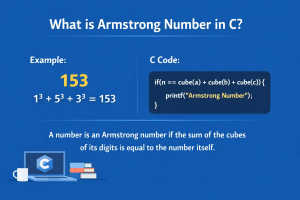




 Admission Open

 Admission Open
 Admission Open
 Admission Open

 ROI Calculator