
5 Ways to Use AI in Marketing
 October 3, 2023
 6 min read




Table Of Content
- 5 Powerful Ways To Utilise AI in Marketing
- Tips for Effective AI Utilisation in Marketing
- AI in Digital Marketing
- Conclusion
 Key Insights
- AI in marketing uses artificial intelligence to analyse data and understand customer behaviour. It helps marketers automate tasks, personalise campaigns, and improve marketing performance.
- Use AI to automate repetitive tasks, analyse customer data, and personalise marketing campaigns. Regularly review AI-generated insights and content to ensure accuracy, relevance, and brand consistency.
- AI in digital marketing uses artificial intelligence to analyse data, automate tasks, and understand audience behaviour. It helps marketers personalise content, optimise campaigns, and improve customer engagement and results.
The rise of AI in marketing is reshaping the digital landscape by enabling businesses to understand audiences, personalise interactions, and optimise campaigns with greater precision. From predictive analytics and intelligent targeting to automated content creation and real-time campaign optimisation, AI is helping marketers turn vast amounts of data into actionable insights.
As digital channels become increasingly competitive, integrating AI into marketing strategies allows brands to deliver more relevant experiences, improve operational efficiency, and make faster, data-driven decisions.
 ChatGPT
 Perplexity
 Claude
 Grok
Grok5 Powerful Ways To Utilise AI in Marketing
AI in marketing is being applied across the customer journey to automate processes, interpret complex datasets, personalise interactions, and optimise campaign performance.
From lead scoring and predictive analytics to creative testing and conversational AI, businesses can use these applications to make marketing more precise and scalable.
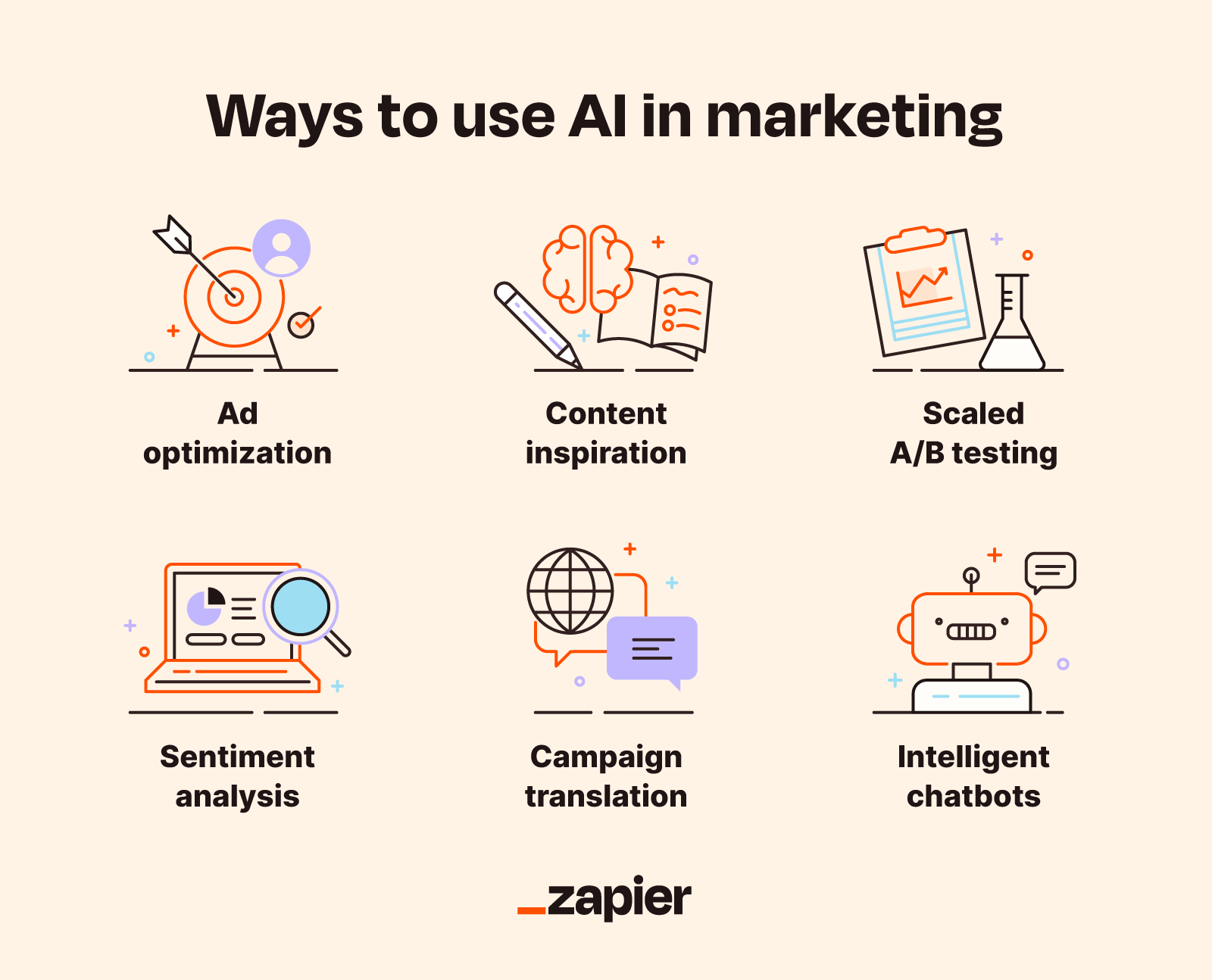
Here are five key applications of artificial intelligence in marketing that businesses can implement to improve their marketing efforts.
1. AI Strategy for Lead Management and Qualification
AI in Marketing can transform lead management by analysing customer interactions and behavioural signals to determine which prospects are most likely to convert. Instead of manually evaluating every lead, marketers can use AI to automate qualification, segmentation, prioritisation, and nurturing.
Key applications include:
- Lead scoring: Assigns scores to prospects based on engagement, demographics, website activity, and purchase intent.
- Lead qualification: Identifies high-intent prospects and prioritises them for sales teams
. - Lead segmentation: Groups prospects based on behaviour, interests, demographics, or funnel stage.
- Automated follow-ups: Triggers personalised emails and messages based on customer actions.
- Predictive lead conversion: Estimates which prospects are more likely to convert.
- Call intelligence: Transcribes sales calls and identifies customer sentiment, objections, and buying signals.
These applications allow marketing and sales teams to spend less time manually evaluating leads and more time engaging with high-potential prospects.
2. AI for A/B Testing and Campaign Experimentation
AI can make marketing experimentation more sophisticated by helping teams generate multiple variations, analyse results, identify patterns, and continuously refine campaign elements. This enables marketers to test more variables without significantly increasing manual workload.
A/B testing is an essential component of digital marketing, and AI can enhance its applications in several ways:
- Automated variation generation: Creates different versions of headlines, CTAs, ad copy, emails, and landing-page content.
- Audience-level testing: Determines how different customer segments respond to specific variations.
- Performance analysis: Evaluates CTR, conversion rate, engagement, and other campaign metrics.
- Pattern identification: Detects which messaging and creative elements consistently perform better.
- Continuous optimisation: Uses previous test results to inform subsequent experiments.
- Multivariate experimentation: Helps marketers evaluate multiple combinations of campaign elements at scale.
These uses of AI in marketing enables marketers to move from occasional A/B tests towards continuous, data-driven experimentation.
3. AI for Marketing Budget and Media Optimisation
One of the practical applications of AI and marketing is intelligent budget management. AI can process campaign data across multiple platforms and help marketers determine where their marketing investment is generating the strongest results.
Key applications include:
- Budget allocation: Recommends how marketing budgets can be distributed across campaigns and channels.
- Automated bidding: Adjusts bids based on conversion probability and campaign objectives.
- Media planning: Uses historical and real-time data to support channel and audience selection.
- Performance forecasting: Predicts potential campaign outcomes before additional budget is invested.
- Cross-channel optimisation: Compares performance across search, social, display, and other digital channels.
- Real-time optimisation: Detects performance changes and identifies opportunities for budget adjustments.
For example, an AI-powered advertising system can identify that one audience segment is producing conversions at a lower cost and recommend increasing investment in that segment.
4. AI for Ad Creative and Content Optimisation
AI is increasingly being applied to the creative side of marketing. Marketers can use AI to generate, test, analyse, and optimise creative assets based on audience behaviour and campaign performance.
Key applications include:
- Ad copy generation: Creates multiple variations of headlines, descriptions, and CTAs.
- Creative analysis: Evaluates images, messaging, layouts, and other creative components.
- Personalised creatives: Develops variations tailored to specific audience segments.
- Creative performance prediction: Identifies creative concepts with potential to generate stronger engagement.
- Content optimisation: Recommends improvements to messaging, structure, and readability.
- Creative testing: Compares different visual and textual combinations to identify stronger-performing assets.
- Content repurposing: Converts existing content into social posts, email copy, advertisements, and other formats.
This application demonstrates how AI in marketing can accelerate creative workflows while allowing marketers to focus on brand strategy, storytelling, and differentiation.
5. AI for Customer Experience and Engagement
AI in Marketing can also be applied throughout the customer journey to create more responsive and personalised interactions. By combining behavioural data with real-time intelligence, brands can understand customer needs and deliver relevant communication at different touchpoints.
Key applications include:
- AI chatbots: Answer customer queries and provide instant assistance.
- Virtual assistants: Guide users through product discovery, purchases, or service-related questions.
- Recommendation engines: Suggest products, services, or content based on individual behaviour.
- Personalised email marketing: Determines suitable content, timing, and messaging for different customers.
- Sentiment analysis: Analyses reviews, feedback, and conversations to understand customer sentiment.
- Next-best-action recommendations: Suggests the most relevant action or communication for a customer.
- Conversational commerce: Uses AI-powered conversations to assist customers during product discovery and purchasing.
- AR/VR experiences: Combines AI with VR/AR experiences to create more interactive brand and product experiences.
These AI in Marketing applications enable brands to respond to customers more intelligently while creating consistent experiences across multiple marketing channels.
Tips for Effective AI Utilisation in Marketing
Marketers can use AI to streamline workflows, strengthen data-driven decision-making, and deliver personalised customer experiences. The following practices can help businesses use AI in marketing more effectively.
1. Set Clear Goals
Define measurable objectives before implementing AI, such as improving conversion rates, strengthening personalisation, or increasing lead generation. Clear goals help marketers select relevant AI solutions and evaluate their impact.
2.Leverage Predictive Analytics
Predictive analytics can help marketers anticipate customer behaviour, identify high-potential leads, and optimise campaigns. It can also support audience segmentation and determine suitable timings for emails, advertisements, and other communications.
3.Automate Routine Tasks
AI-powered automation can handle repetitive activities such as email campaigns, social media scheduling, customer responses, and data analysis. This reduces manual effort and allows marketing teams to focus on strategy, creativity, and customer engagement.




AI in Digital Marketing
- Personalised Marketing: AI in Digital Marketing analyses customer behaviour, preferences, and purchase history to deliver personalised content, product recommendations, offers, and advertisements.
- AI-Powered Content Creation: Generative AI helps marketers develop blog ideas, ad copy, social media posts, email content, and creative variations while reducing content production time.
- Predictive Analytics: AI uses historical and real-time data to forecast customer behaviour, identify conversion opportunities, predict demand, and improve campaign planning.
- Intelligent Advertising Optimisation: AI can optimise audience targeting, bidding, budgets, placements, and ad creatives based on campaign performance and conversion signals.
- AI-Powered Customer Engagement: Chatbots and virtual assistants provide instant responses, answer queries, recommend products, and guide customers throughout their digital journey.
Conclusion
The applications of artificial intelligence in marketing extend across nearly every stage of the marketing funnel. Businesses can use AI to qualify leads, automate experimentation, optimise advertising budgets, develop stronger creatives, and personalise customer interactions.
The key is to treat AI as a strategic marketing capability rather than simply an automation tool. When AI-driven insights are combined with human creativity, critical thinking, and marketing expertise, businesses can build more adaptive and high-performing marketing strategies.
Frequently Asked Questions
AI marketing uses customer data and behavioural signals to deliver personalised content, product recommendations, offers, advertisements, and communications based on individual preferences and journey stages.
The combination of AI and marketing enables marketers to generate content ideas, ad variations, headlines, email copy, and social media content while also analysing performance and identifying opportunities for optimisation.
Yes. AI in marketing can help small businesses automate repetitive activities, analyse customer data, create content, manage campaigns, and deliver personalised experiences without requiring extensive marketing resources.
Marketers increasingly need skills in data interpretation, AI tools, prompt engineering, analytics, experimentation, strategic thinking, and ethical AI use, alongside core capabilities such as creativity and communication.





Find a Program made just for YOU
We'll help you find the right fit for your solution. Let's get you connected with the perfect solution.
Is Your Upskilling Effort worth it?
 ROI Calculator

Are Your Skills Meeting Job Demands?
Try our Skill Gap tool
Experience Lifelong Learning and Connect with Like-minded Professionals
Explore Jaro Connect

