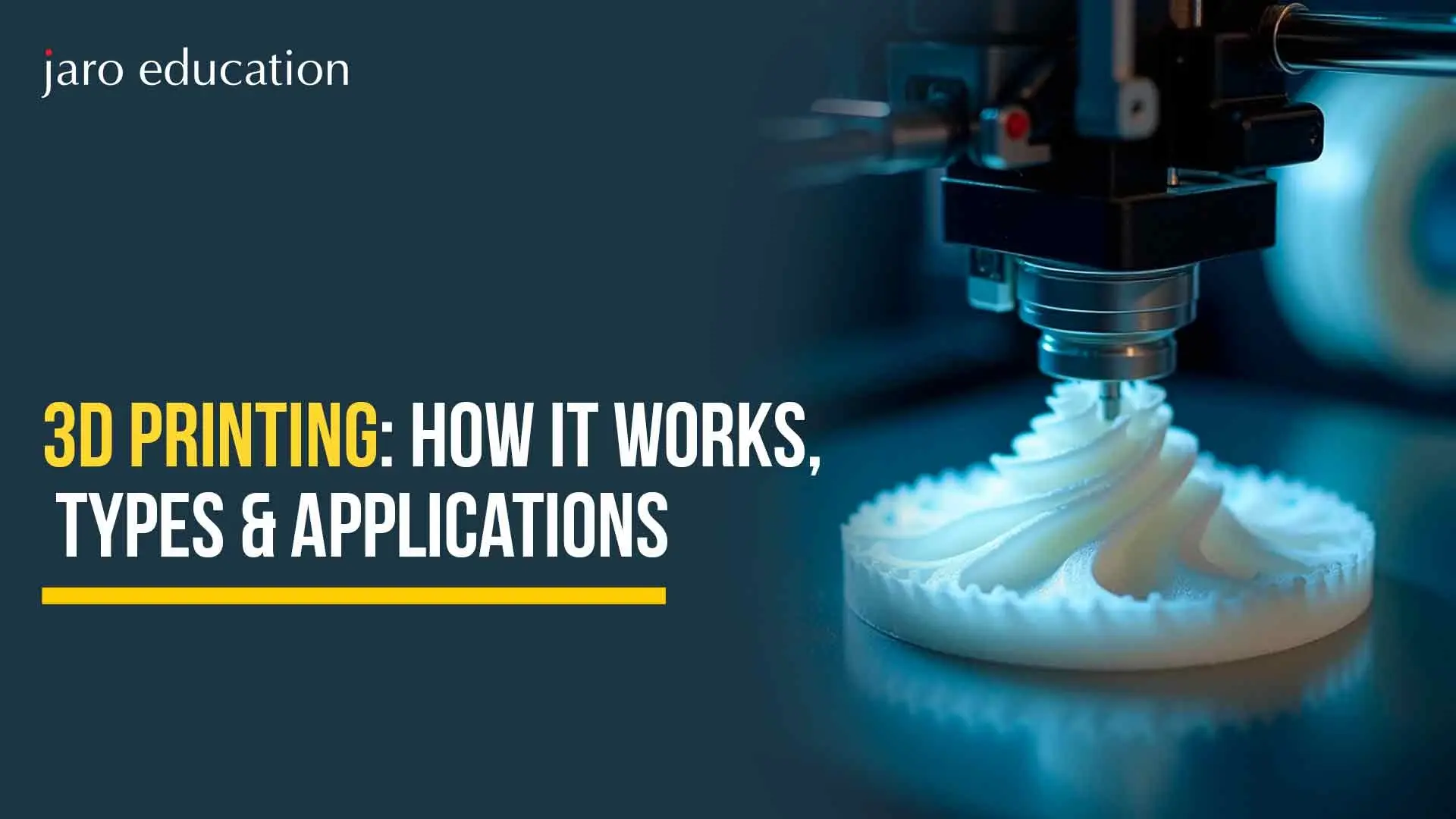
3D printing, also called additive manufacturing, builds objects layer by layer from a digital model instead of cutting material away.
Chuck Hull filed the patent for stereolithography in 1984 and is widely credited as the inventor of 3D printing, though Hideo Kodama described a layered photopolymer method in 1981 and French engineers filed a similar patent weeks earlier.
Every 3D print follows the same workflow: design a 3D model, slice it into layers, print and post-process.
The seven standard process categories include material extrusion (FDM), vat photopolymerisation (SLA), powder bed fusion (SLS and metal printing), material jetting, binder jetting, directed energy deposition and sheet lamination.
Applications range from prosthetics and dental products to aerospace parts and construction. India's first 3D-printed post office opened in Bengaluru in 2023.
In this blog, you'll learn what 3D printing is, who invented it, how it works, the types and materials, applications, limitations and career paths.
Imagine designing an object on a computer in the morning and holding it in your hand by evening, without a mould, a factory line or a single cutting tool. That is the promise of 3D printing, and it is already used to make everything from dental aligners and prosthetic limbs to aircraft components and houses.
This guide explains what 3D printing is, who invented it, how 3D printing works step by step, the main types, materials and applications, and what the technology means for careers and for India.
3D printing is a manufacturing process that creates three-dimensional objects by adding material layer by layer, guided by a digital model. Industry standards call the broader field additive manufacturing, and the two terms are often used interchangeably.
This is the opposite of traditional subtractive manufacturing, such as milling or turning, in which you start with a block and cut material away. Because material is added only where needed, 3D printing can produce complex shapes, internal channels and custom parts that are difficult or impossible to make by conventional methods. Our overview of emerging technology and its impact on business places it in the wider landscape of new technologies.
The question has more than one answer, depending on whether you mean the idea, the first patent or the first commercial machine.
1981: Hideo Kodama of the Nagoya Municipal Industrial Research Institute published a rapid prototyping method that built a plastic model by hardening photosensitive resin layer by layer. He did not complete a patent.
16 July 1984: French engineers Alain Le Méhauté, Olivier de Witte and Jean Claude André filed a patent for a stereolithography process, but it was later abandoned.
8 August 1984: American engineer Chuck Hull filed his patent application for stereolithography. It was granted as US patent 4,575,330 on 11 March 1986, and Hull coined the term.
1986: Hull co-founded 3D Systems.
1987: 3D Systems produced the SLA-1, widely described as the first commercial 3D printer.
Because of his patent, his company and the commercial machine, Chuck Hull is most commonly credited as the inventor of 3D printing. Other technologies followed in the late 1980s, including selective laser sintering and fused deposition modelling. In 2006, the open-source RepRap project aimed to create a self-replicating 3D printer, and as key patents expired and costs fell, desktop machines became affordable for hobbyists and schools.
How Does 3D Printing Work?
Although technologies differ, nearly every 3D print follows five steps.
Step 1: Create a 3D Model
You design the object in computer-aided design (CAD) software, scan a real object with a 3D scanner or download a ready-made model. Good design takes the printing process into account, for example avoiding unsupported overhangs.
Step 2: Export the File
The model is saved in a printable format such as STL or 3MF, which describes the surface of the object.
Step 3: Slice the Model
Slicing software cuts the model into thin horizontal layers and generates instructions for the printer, such as layer height, speed, temperature and support structures. Thinner layers mean finer detail but longer print times.
Step 4: Print Layer by Layer
The printer deposits, cures or fuses material one layer at a time. Depending on the technology, this might be melted plastic from a nozzle, a laser hardening liquid resin or a laser fusing metal powder.
Step 5: Post-Process
Parts often need support removal, cleaning, curing, sanding, polishing, heat treatment or painting before use. Post-processing is a significant part of the time and cost, especially for metal parts. Prototyping with 3D printing fits naturally with design methods, as our guide to prototyping in design thinking explains.
Free Courses
Free Microsoft Excel course: : Beginner to Advanced
The international standard for additive manufacturing groups processes into seven categories.
Category
Common names
How it works
Typical uses
Material extrusion
FDM, FFF
Melted filament is pushed through a nozzle
Prototypes, hobby parts, jigs
Vat photopolymerisation
SLA, DLP
Light cures liquid resin layer by layer
Detailed models, dental, jewellery
Powder bed fusion
SLS, MJF, SLM, DMLS
A laser or energy source fuses powder
Functional plastic and metal parts
Material jetting
PolyJet
Droplets of material are jetted and cured
Multi-colour, realistic models
Binder jetting
Binder jet
A liquid binder glues powder
Sand moulds, full-colour parts
Directed energy deposition
DED, laser cladding
Material is melted as it is deposited
Repairs, large metal parts
Sheet lamination
LOM
Sheets are bonded and cut
Low-cost models, paper-based parts
Fused Deposition Modelling (FDM)
The most common and affordable type. A heated nozzle melts plastic filament and draws each layer. It is widely used in schools, hobby projects and prototyping, though surface finish is rougher than resin printing.
Stereolithography (SLA)
The original 3D printing process. A UV light source cures liquid resin layer by layer, producing smooth, detailed parts.
Selective Laser Sintering (SLS)
A laser fuses powdered nylon or other materials. Because the surrounding powder supports the part, SLS can create complex shapes without separate support structures.
Metal 3D Printing
Selective laser melting and similar processes fuse metal powder such as titanium, stainless steel and aluminium alloys. They produce strong, lightweight parts for aerospace, medical implants and tooling.
3D Printing Materials
Plastics: PLA, ABS, PETG and nylon for general and functional parts.
Resins: photopolymers for detailed, smooth objects, including dental and jewellery applications.
Metals: titanium, stainless steel, aluminium and nickel alloys for industrial parts.
Ceramics and composites: for heat-resistant or reinforced components.
Concrete and construction mixes: for printing buildings.
Biomaterials: research materials used to print tissue-like structures.
Applications of 3D Printing
Healthcare
Custom prosthetics, dental aligners and crowns, surgical guides, anatomical models for surgical planning and implants are among the best-known uses. See how technology is reshaping the sector in our article on healthcare technology.
Aerospace and Automotive
Lightweight, complex components, tooling and rapid prototyping reduce weight and development time. Engineers also print spare parts on demand.
Construction
Large concrete printers can print walls and entire structures. In August 2023, India’s first 3D-printed post office was inaugurated in Bengaluru, built by L&T Construction in collaboration with IIT Madras, which a policy review reported was completed in 43 days at a cost of under ₹25 lakh.
Students and designers print models and prototypes, and consumers buy custom jewellery, footwear and accessories.
3D Printing in India
India’s Ministry of Electronics and Information Technology released the National Strategy on Additive Manufacturing in February 2022, aiming to build a domestic ecosystem and capture 5% of the global additive manufacturing market. According to a recent DD News report, the strategy has trained more than 1.54 lakh people, supported 56 start-ups and helped develop 65 indigenous technologies, and a second phase, NSAM 2.0, is planned. The sectors using the technology include healthcare, construction, automotive, jewellery and defence.
Advantages of 3D Printing
Design freedom: complex geometries and internal structures.
Speed for prototypes: designs go from file to part in hours or days.
Customisation: each part can be different at no extra tooling cost.
Less waste: material is added only where needed in many processes.
Low-volume economics: no moulds for small batches.
Distributed production: parts can be printed near where they are needed.
Speed and cost at scale: conventional methods like injection moulding are usually cheaper for mass production.
Material limits: fewer materials and properties than traditional manufacturing.
Strength and finish: parts can be weaker between layers and may need post-processing.
Equipment and training: industrial machines are expensive and require skilled operators.
Quality control: consistency and certification are demanding, especially in medicine and aerospace.
Safety: resins, powders and fumes need proper handling and ventilation.
Intellectual property: copying designs is easy, which raises legal questions.
3D Printing vs Traditional Manufacturing
Factor
3D printing
CNC machining
Injection moulding
Method
Adds material
Removes material
Injects into a mould
Best volume
One to a few hundred
Low to medium
Thousands and above
Setup cost
Low
Moderate
High (moulds)
Complexity
Very high
Moderate
Moderate to high
Cost per part at scale
Higher
Moderate
Lowest
The Future of 3D Printing
Expect faster printers, more materials, AI-assisted design and print monitoring, and tighter links with digital models. Our guide to digital twin technology shows how virtual replicas help design, test and monitor products, and printers connected to sensors are part of the wider Internet of Things.
Robotics also plays a role in automated finishing and handling, as seen in the applications of robotics.
Skills and Careers in 3D Printing
Additive manufacturing is a growing field for engineers, designers and operations professionals.
Skills: CAD modelling, slicing and print settings, materials knowledge, design for additive manufacturing, quality inspection and post-processing.
Roles: additive manufacturing engineer, design engineer, process engineer, application engineer and operations or production manager.
Start with a beginner FDM printer or use a local makerspace or college lab.
Print simple, useful objects and learn how settings affect results.
Study materials and design rules such as wall thickness and overhangs.
Join online communities and share your designs.
Build a portfolio that shows design, printing and finishing work.
Conclusion
3D printing has moved from a laboratory curiosity of the 1980s to a practical tool across healthcare, aerospace, construction and consumer products. It builds objects layer by layer from digital files, and its strengths are design freedom, customisation and speed for prototypes, while mass production, material limits and finishing remain challenges.
If you are curious about the field, start with a simple model and a basic printer, or explore CAD and the careers around additive manufacturing. As technology develops and India’s national strategy matures, skills in design, materials and digital manufacturing are likely to be in growing demand.
Frequently Asked Questions
3D printing, or additive manufacturing, is a process that builds three-dimensional objects layer by layer from a digital model, adding material only where it is needed.
Chuck Hull is widely credited. He filed the stereolithography patent on 8 August 1984, received it in 1986 and co-founded 3D Systems. Hideo Kodama had described a similar layered method in 1981.
You create a 3D model, export it, slice it into layers, print it layer by layer using a method such as melting plastic or curing resin, and then post-process the part.
The seven standard categories are material extrusion, vat photopolymerisation, powder bed fusion, material jetting, binder jetting, directed energy deposition and sheet lamination.
Plastics such as PLA and ABS, resins, metals like titanium and aluminium, ceramics, composites, concrete and some biomaterials.
Prototyping, custom prosthetics and dental products, aerospace and automotive parts, tooling, construction, education and consumer products.
For prototypes and small, complex or custom batches, often yes. For large production runs, conventional methods such as injection moulding are usually cheaper per part.
India’s National Strategy on Additive Manufacturing aims to build local capability, start-ups and technologies, with a second phase planned. Applications are growing in healthcare, construction, automotive and defence.
Shubham Lal
Lead Software Developer
Shubham Lal joined Microsoft in 2017 and brings 8 years of experience across Windows, Office 365, and Teams. He has mentored 5,000+ students, supported 15+ ed-techs, delivered 60+ keynotes including TEDx, and founded AI Linc, transforming learning in colleges and companies.
Get Free Upskilling Guidance
Fill in the details for a free consultation
Related Courses
Explore our programs
Executive Programme in Operations Management and Analytics

 October 25, 2026
 8 min read




 Key Insights
 ChatGPT
 Perplexity
 Claude
 Grok








 ROI Calculator