PESTLE analysis is a strategic planning tool that helps businesses understand external factors, identify opportunities, manage risks, and make informed decisions.
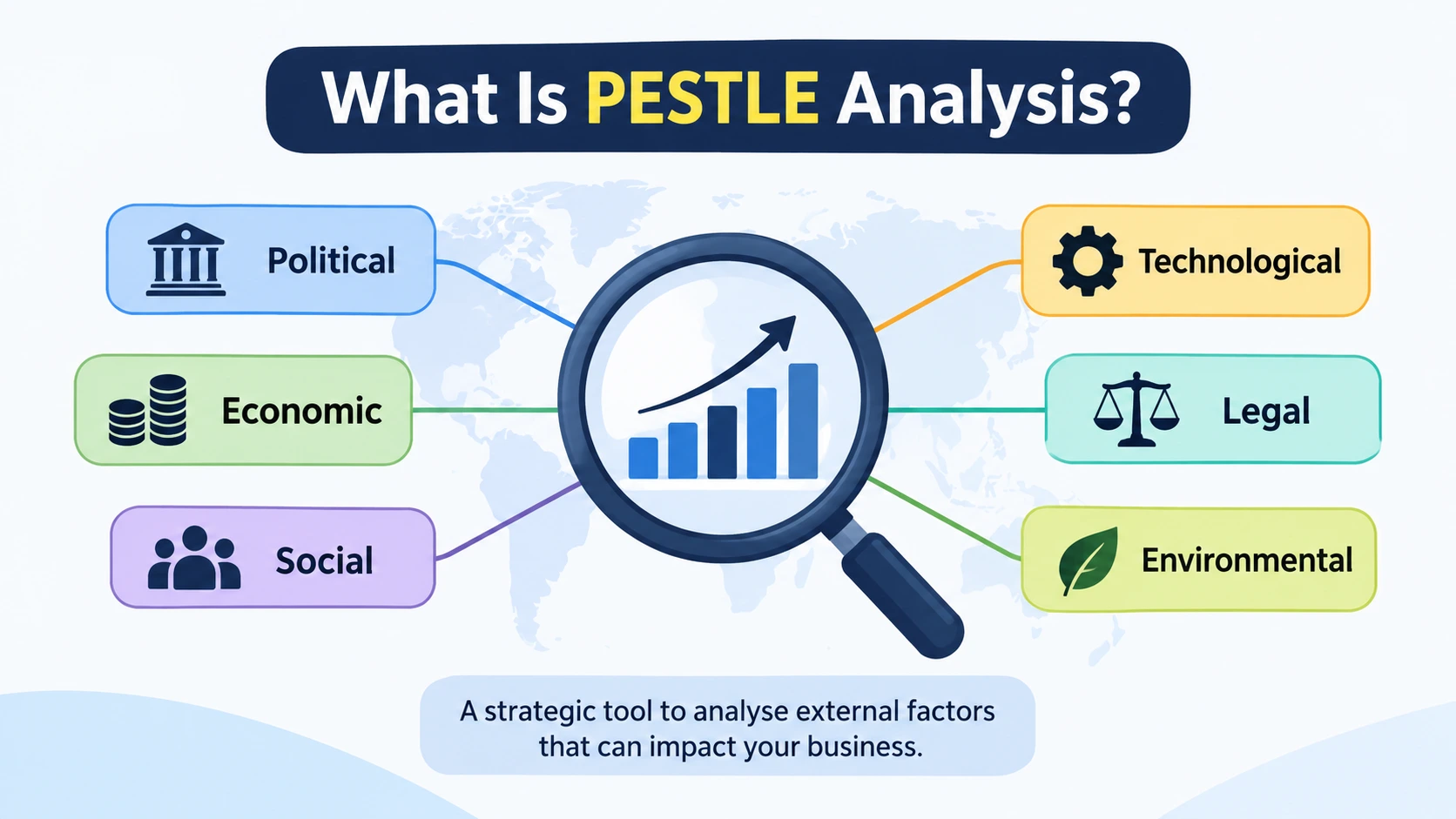
The PESTLE full form includes six factors: Political, Economic, Social, Technological, Legal, and Environmental.
Businesses can conduct PESTLE analysis by defining their goals, gathering reliable information, evaluating each factor, rating its impact, and turning findings into actionable plans
While PESTLE analysis is simple and cost-effective, its effectiveness depends on reliable research, clear priorities, and regular updates.
In this blog, you'll learn the meaning and full form of PESTLE analysis, its six factors, importance, step-by-step process, practical EV company example, benefits, limitations, and differences between PESTLE and SWOT analysis.
Every business, big or small, operates in a world it cannot fully control. Governments change rules, economies rise and fall, customer habits shift, and new technology appears almost overnight. So how do smart managers stay ahead of all this? One of the simplest tools they use is PESTLE analysis. If you are exploring a career in management and want to learn frameworks like this in depth, a program such as theOnline MBA Programme from Manipal University can help you build strong strategic thinking skills while you continue working. In this blog, we will explain PESTLE analysis in plain language, cover the PESTLE meaning and PESTLE full form, and walk through a real-world PESTLE analysis example.
PESTLE analysis is a strategic planning tool that helps a business understand the outside factors that can affect its performance. These are factors the company does not control, but it must still deal with them. Think of it as a checklist for scanning the environment around your business before you make a big decision.
For example, imagine a company wants to launch a new product in a new country. Before spending money, the team would want to know: Is the government stable? Is the economy growing? Do people in that country need this product? Are there any laws that might block it? PESTLE analysis gives the team a clear structure to answer all these questions in an organized way.
The tool is widely used in business planning, marketing, project management, consulting, and even in school and college case studies. It is simple, flexible, and does not need any special software. A pen, paper, and some good research are enough to get started.
Let’s look at the PESTLE meaning in simple terms. PESTLE is a framework that groups outside influences into six categories. Each category looks at a different part of the world your business operates in. By going through them one by one, you can spot opportunities you might otherwise miss and risks you might not see coming.
In short, the PESTLE meaning can be put this way: it is a method to study the big-picture forces around a business so that leaders can plan better, reduce surprises, and make smarter choices. It is called a “macro-environmental” tool because it looks at large-scale factors, not just what is happening inside the company or among direct competitors.
You may also see it written as PEST analysis (which has only four factors) or PESTEL analysis (which just changes the order of the last two letters). They all mean almost the same thing. PESTLE simply adds legal and environmental to the original PEST model, because in today’s world these two areas have become very important.
PESTLE Full Form: Breaking Down the Six Factors
Now let’s get to the PESTLE full form. The word PESTLE stands for:
P – Political
E – Economic
S – Social
T – Technological
L – Legal
E – Environmental
Let’s understand each one in detail.
Political Factors
Political factors cover how government actions and policies can affect a business. This includes political stability, tax policies, trade rules, import and export restrictions, government subsidies, and labor policies. For example, if a government increases import duties, a company that relies on foreign raw materials will face higher costs. On the other hand, if a government offers tax benefits to manufacturers, it may encourage new businesses to set up factories.
When studying political factors, ask questions like: Is the country politically stable? How often do policies change? Does the government support our industry? What are the rules around foreign investment?
Economic Factors
Economic factors look at the financial health of the market. These includeinflation, interest rates, exchange rates, economic growth, unemployment, and consumer spending power. If interest rates rise, loans become costlier, and customers may spend less on big purchases like homes or cars. If the local currency weakens, imported goods become more expensive.
Businesses use this part of the analysis to understand demand, pricing, and profit potential. A luxury brand, for example, would look closely at the average income level of a country before opening stores there.
Social Factors
Social factors, sometimes called socio-cultural factors, deal with people and society. They include population size, age groups, lifestyle trends, cultural values, education levels, health awareness, and buying habits. A growing young population may mean more demand for digital services and fast fashion. An aging population may increase the need for healthcare and wellness products.
Understanding social trends helps companies create products that people actually want. It also helps with marketing, because messages that work in one culture may not work in another.
Technological Factors
Technological factors cover innovation, automation, research and development, digital tools, and the pace of technology change. Think about how artificial intelligence, cloud computing, and mobile payments have changed the way companies work and how customers shop. A business that ignores technology risks falling behind, while one that adopts it early can gain a strong advantage.
Here, you would look at what new technologies are emerging, how quickly competitors are adopting them, what it would cost to upgrade, and whether the technology could make your current product outdated.
Legal Factors
Legal factors involve the laws and regulations a business must follow. These include employment laws, consumer protection rules, health and safety standards, data privacy laws, advertising guidelines, and intellectual property rights. Breaking these rules can lead to heavy fines, lawsuits, or damage to a brand’s reputation.
It may sound similar to political factors, but there is a difference. Political factors are about government policy and direction, while legal factors are about the actual rules and laws that are already in place and must be followed.
Environmental Factors
Environmental factors relate to the natural environment and how businesses affect it. They include climate change, weather patterns, pollution, waste management, sustainability expectations, and the availability of natural resources. Today, customers and investors care more about green practices than ever before. Companies that reduce carbon emissions or use eco-friendly packaging often build stronger trust with their audience.
For industries like agriculture, tourism, energy, and manufacturing, environmental factors can directly affect daily operations and long-term planning.
Free Courses
Stakeholder Communication & Negotiation Skill Sets
Now that you know the PESTLE full form and what each letter means, let’s see why this tool is so useful.
It helps you spot opportunities early. A change in law or a new consumer trend can open the door to a new market. Businesses that notice these shifts first often win.
It helps you manage risks. By looking at outside threats in advance, you can prepare backup plans instead of reacting in panic.
It supports better decision-making. Instead of relying on guesswork, leaders can base choices on researched facts about the market environment.
It improves long-term planning. Strategy is not just about today. PESTLE analysis encourages teams to think about where the world is heading over the next few years.
It is easy to use. You do not need advanced training to try it. Students, startup founders, and senior executives can all use the same framework.
How to Do a PESTLE Analysis: Step-by-Step
Doing a PESTLE analysis is not complicated. Here is a simple process you can follow.
Define your goal. Decide what you are analyzing. It could be a whole company, a new product, a project, or entry into a new market.
Gather information. Use reliable sources such as government websites, industry reports, news articles, and market research.
List factors under each category. Write down every relevant point under Political, Economic, Social, Technological, Legal, and Environmental.
Rate the impact. Not every factor matters equally. Mark each one as high, medium, or low impact, and note whether it is an opportunity or a threat.
Analyze and connect the dots. Look for patterns. For instance, a new law and a new technology trend may together create a big opportunity.
Take action. Turn your findings into a plan. Decide what to do, who will do it, and when.
Review regularly. The world keeps changing, so update your analysis every six to twelve months.
PESTLE Analysis Example: An Electric Vehicle Company
Theory becomes much easier to understand with a practical case. Let’s take a PESTLE analysis example of a company that makes electric vehicles (EVs), such as Tesla or a similar brand, planning to grow in a new international market.
Political: Many governments want to cut fuel imports and reduce pollution, so they offer subsidies and tax benefits for EV buyers. This is a clear opportunity. However, sudden policy changes, such as removing subsidies, could hurt sales. Trade tensions or high import duties on vehicles and batteries could also raise costs.
Economic: Electric vehicles are often priced higher than regular cars. When household incomes are rising and interest rates are low, more people can afford them. When inflation is high or loans are costly, demand may slow. Changes in the price of raw materials like lithium and nickel also affect production costs.
Social: More people are becoming aware of climate change and want to make greener choices. Younger buyers, especially, like modern, tech-friendly products. At the same time, some customers worry about charging time, driving range, and a lack of nearby charging stations. These concerns can slow adoption.
Technological: Battery technology is improving quickly, which means longer range and lower costs over time. Features like self-driving assistance, over-the-air software updates, and fast charging give brands a competitive edge. The risk is that rivals may release better technology sooner.
Legal: The company must follow vehicle safety standards, emission rules, and data privacy laws, since modern cars collect a lot of user data. Rules around battery disposal and recycling are also becoming stricter. Failing to meet these standards can lead to fines or product recalls.
Environmental: EVs produce no tailpipe emissions, which supports the brand’s green image. But battery production and mining can harm the environment, and used batteries create waste. Customers and regulators increasingly expect companies to use clean energy in manufacturing and to offer recycling programs.
What does this tell us? From this PESTLE analysis example, the company can see that government support and growing eco-awareness are big opportunities, while high prices, charging infrastructure gaps, and strict regulations are challenges. Based on this, it might decide to partner with local charging network providers, offer financing plans, and highlight its sustainability efforts in marketing.
Benefits and Limitations of PESTLE Analysis
Like any tool, PESTLE analysis has strengths and weaknesses.
Benefits
It gives a wide view of the business environment.
It is simple, low-cost, and easy to understand.
It encourages teams to think about the future.
It works across industries and company sizes.
Limitations
It only looks at external factors, not the company’s own strengths or weaknesses.
The results depend on the quality of your research. Outdated or biased data can lead to wrong conclusions.
It can become a long list of points without clear priorities if not done carefully.
The business environment changes quickly, so the analysis can become outdated fast.
Students often mix up these two tools. SWOT stands for Strengths, Weaknesses, Opportunities, and Threats. It looks at both internal factors (strengths and weaknesses) and external factors (opportunities and threats). PESTLE analysis, on the other hand, focuses only on the external environment and goes deeper into it.
The two tools work very well together. Many businesses start with PESTLE analysis to understand the outside world and then use those findings to fill in the Opportunities and Threats sections of a SWOT analysis. Using both gives a more complete picture.
Tips to Get Better Results from PESTLE Analysis
Stay focused. Include only factors that are truly relevant to your business or project.
Use reliable sources. Trust official data, trusted news outlets, and research reports.
Involve different people. Team members from finance, marketing, operations, and legal can each spot different points.
Look at the future. Do not just list what is happening now. Think about trends that could shape the next three to five years.
Prioritize. Highlight the top few factors with the highest impact so your team knows where to focus.
Final Thoughts
PESTLE analysis is one of the easiest ways to understand the bigger world around a business. Now you know the PESTLE meaning, the PESTLE full form (Political, Economic, Social, Technological, Legal, and Environmental), and how a PESTLE analysis example works in real life. Whether you are a student preparing for exams, a professional planning your next move, or an entrepreneur building a startup, this framework can help you think clearly and plan better. The more you practice it on real companies and real situations, the more natural it will feel.
Frequently Asked Questions
The PESTLE full form is Political, Economic, Social, Technological, Legal, and Environmental. Each letter represents one category of external factors that can influence a business.
PEST analysis covers only four areas: Political, Economic, Social, and Technological. PESTLE analysis adds legal and environmental factors, giving a more complete view of the business environment.
Most companies review it once or twice a year, or whenever there is a major change, such as a new law, an economic shift, or a plan to enter a new market.
Yes, absolutely. PESTLE analysis is simple and low-cost, which makes it ideal for startups and small businesses that want to understand market conditions before investing time and money.
Nuthana Reddy
Nuthana Reddy is a Senior Manager at Procter & Gamble, specializing in operations, digitization, and cross-functional leadership. She has driven multimillion-dollar impact through innovation, process optimization, and strategic execution across global markets.

 November 9, 2026
 10 min read




 Key Insights
 ChatGPT
 Perplexity
 Claude
 Grok











 ROI Calculator