What Is Data Stewardship? Meaning, Principles & Best Practices
J
By Shubham Lal
September 14, 20268 min read
Published on September 14, 2026
SHARE THIS ARTICLE
Table Of Content
What Is Data Stewardship?
Data Stewardship Definition and Meaning
Why Is Data Stewardship Important?
Data Stewardship and Data Governance
Key Insights
Data stewardship focuses on maintaining data quality, accuracy, consistency, security, accessibility, and responsible use across an organization.
Data governance and stewardship work together, with governance establishing policies and standards while stewardship helps apply them in day to day data management.
Key data stewardship principles include data quality, accountability, consistency, accessibility, security and privacy, and transparency.
Data stewardship best practices include assigning clear data ownership, creating common definitions, monitoring data quality, documenting processes, using data standards, and encouraging collaboration.
A data governance and stewardship professional works with business and technical teams to manage data standards, quality, definitions, governance processes, and data related issues.
In this blog, you'll learn the data stewardship definition, its key principles and responsibilities, the relationship between data governance and stewardship, best practices, challenges, and the role of a data governance and stewardship professional.
Every time a customer fills out a form, makes a purchase, opens an email, or interacts with a website, new data is created. But what happens to that data after it enters an organization? Without proper care, even useful data can become inaccurate, duplicated, outdated, or difficult to trust. This is where data stewardship becomes important.
Data stewardship is about making sure organizational data remains accurate, consistent, secure, accessible, and useful. It connects people, processes, and technology to help businesses manage data responsibly throughout its lifecycle. While data governance establishes the broader rules for managing information, data stewards help put those rules into practice.
As businesses increasingly rely on data for customer experiences, operations,analytics, and decision-making, understanding data stewardship is becoming important for professionals across industries.
This blog will cover data stewardship definition, key data stewardship principles, important responsibilities, data stewardship best practices, and the relationship between data governance and stewardship.
Data stewardship refers to the responsible management and oversight of an organization’s data. It involves maintaining data quality, defining how data should be used, resolving data related issues, and making sure information follows established organizational standards.
A simple way to understand data stewardship is to think of a data steward as someone responsible for helping keep important business data reliable and usable.
For example, consider a company that stores customer information. Different departments may record a customer’s name, contact details, location, and purchase history. If every department follows different standards, the same customer may appear under different names or have incomplete information.
A data steward can help establish consistent data definitions, identify quality problems, coordinate corrections, and ensure teams follow agreed data management practices.
Data stewardship is therefore not simply about storing information. It is about maintaining its quality and making sure people can use it confidently.
Data Stewardship Definition and Meaning
The data stewardship definition can be understood as the practice of managing and maintaining data according to an organization’s policies, standards, and business requirements.
Data stewards typically work with business teams, data professionals, technology teams, and other stakeholders. Their responsibilities can vary depending on the organization and type of data involved.
Some common responsibilities include:
Monitoring data quality
Maintaining data definitions
Identifying and resolving data issues
Supporting data access requirements
Promoting consistent data standards
Helping teams understand data policies
Supporting compliance with organizational requirements
Coordinating with data owners and technology teams
The goal is to make data more trustworthy and useful across the organization.
Businesses generate and use huge amounts of information every day. However, having more data does not automatically mean having better data.
Poor quality information can create confusion, inaccurate reports, inefficient processes, and unreliable business decisions. For example, if customer records contain duplicate entries or incorrect contact information, marketing teams may struggle to create accurate campaigns.
Data stewardship helps address these problems by introducing accountability and consistent practices around important data.
It can help organizations improve data quality, clarify responsibilities, support better decision-making, and create greater confidence in business information.
It also encourages employees to understand that data is not only a technology resource. It is a business asset that needs proper care.
Data Stewardship and Data Governance
The terms data governance and stewardship are closely connected, but they are not the same thing.
Data governance establishes the overall framework for managing data within an organization. It can define policies, standards, roles, responsibilities, and decision-making processes.
Data stewardship focuses more on applying these policies and standards in day-to-day data management activities.
Let us take a look at the comparison below for a better understanding:
Data Governance
Data Stewardship
Establishes policies and standards
Applies policies and standards
Defines roles and responsibilities
Carries out assigned data responsibilities
Creates the overall data management framework
Supports daily data quality and management
Provides organizational direction
Works closely with business and data teams
Establishes accountability
Helps maintain accountability in practice
In simple terms, governance can establish the rules, while stewardship helps ensure those rules are followed.
This relationship makes data governance and stewardship important for organizations that want to create a structured approach to managing information.
Key Data Stewardship Principles
Effective data stewardship is based on several important principles. These principles help organizations maintain reliable and useful data.
1. Data Quality
Data should be accurate, complete, consistent, timely, and fit for its intended purpose.
Data stewards help identify quality issues and coordinate with relevant teams to resolve them. Regular monitoring can help prevent small errors from becoming larger data problems.
2. Accountability
Data management should have clear ownership and responsibility. Teams should understand who is responsible for specific datasets and who should address issues when they occur.
Clear accountability can reduce confusion and make data-related decisions easier to manage.
3. Consistency
Organizations often use the same information across multiple departments and systems. Consistent definitions and standards can help ensure that teams interpret data in the same way.
For example, a business should have a clear definition of what qualifies as an active customer if different departments use customer activity data for reporting.
4. Accessibility
People should be able to access the data they need for legitimate business purposes. At the same time, access should follow organizational policies and security requirements.
Data stewardship therefore involves finding an appropriate balance between data availability and responsible access.
5. Security and Privacy
Data should be handled responsibly, particularly when it includes sensitive or confidential information.
Data stewards can support established security and privacy practices by helping teams understand how information should be accessed, handled, and shared.
6. Transparency
People using organizational data should understand where it comes from, what it means, and how it should be used.
Clear documentation, definitions, and processes can make data easier to understand and reduce the risk of incorrect interpretation.
Roles and Responsibilities in Data Stewardship
Data stewardship usually involves collaboration rather than one person working independently.
A data steward may work with data owners who have overall accountability for a particular area of information. They may also coordinate withdata analysts, data engineers, IT teams, security professionals, compliance teams, and business users.
The exact structure differs between organizations.
For example, a data steward in a financial services organization may work with teams handling customer and transaction information. In a healthcare organization, stewardship activities may involve teams working with patient and operational data.
Regardless of the industry, effective stewardship requires communication between business and technical teams.
Organizations can improve their approach to data stewardship by following practical and consistent practices.
Establish Clear Data Ownership
Every important dataset should have clearly defined ownership and responsibility. Teams should know who makes decisions about the data and who handles quality-related concerns.
Without clear ownership, data problems can remain unresolved because teams may assume someone else is responsible.
Create Clear Data Definitions
Different departments may use the same terms differently. Creating common definitions can reduce confusion.
A shared data glossary can help employees understand important terms, fields, metrics, and business concepts consistently.
Monitor Data Quality Regularly
Data quality should not be checked only when a problem appears. Regular monitoring can help organizations identify missing, duplicate, inconsistent, or outdated information.
Data stewards can work with relevant teams to establish quality checks and improvement processes.
Document Data Processes
Documentation helps employees understand where data comes from, how it moves through systems, and how it should be used.
Clear documentation can also make it easier for new employees and teams to understand organizational data practices.
Encourage Collaboration
Data stewardship works best when business and technical teams communicate regularly.
Business teams understand how data is used, while technical teams understand systems and data structures. Bringing these perspectives together can help organizations solve data problems more effectively.
Use Data Standards
Standardized formats and processes can improve consistency across systems and departments.
For example, organizations can establish common standards for customer names, addresses, dates, product information, or other frequently used data fields.
Review and Improve Processes
Data needs can change as businesses, technologies, and processes evolve. Data stewardship should therefore be treated as an ongoing activity.
Organizations should periodically review their standards, responsibilities, quality processes, and access practices to identify areas for improvement.
Data stewardship is becoming increasingly relevant as organizations use data for analytics, automation, artificial intelligence, customer management, and business planning.
When teams use unreliable information, even sophisticated analytical tools can produce questionable results. This makes data quality and consistency important foundations for data-driven initiatives.
A strong stewardship approach can help organizations build better habits around how data is created, maintained, accessed, and used.
It also helps connect technical data management activities with business requirements. Instead of treating data quality as only an IT responsibility, stewardship encourages shared accountability across the organization.
What Does a Data Governance and Stewardship Professional Do?
A data governance and stewardship professional works at the intersection of business requirements, data management, policies, and organizational processes.
Depending on the role, such a professional may help develop data standards, monitor data quality, coordinate data-related issues, support governance programmes, document data definitions, and work with different stakeholders.
The role requires both technical awareness and strong communication skills. Professionals need to understand how data is structured and managed while also understanding how different business teams use that information.
As organizations become more data-driven, professionals who understand both governance and stewardship can contribute to building more reliable and responsible data practices.
Best Practices for Data Stewardship: How to Get Started
A practical data stewardship programme can begin with a few fundamental steps:
Identify important datasets and assign clear ownership.
Define common business terms and data standards.
Establish processes for monitoring data quality.
Document how important data is created, managed, and used.
Create clear processes for reporting and resolving data issues.
Encourage collaboration between business and technical teams.
Review data management practices regularly.
Ensure data access follows organizational policies and requirements.
These practices can provide a foundation for more organized and consistent data management.
Conclusion
Data stewardship plays an important role in helping organizations keep their information accurate, consistent, accessible, and useful. While data governance provides the broader framework, data stewards help put those policies and standards into practice.
Understanding the data stewardship principles and following practical data stewardship best practices can help businesses improve data quality and create greater confidence in the information they use.
For professionals, learning about data governance and stewardship can also open opportunities to contribute to data management, analytics, governance, and digital transformationinitiatives. As organizations continue to depend on data for everyday decisions, responsible data management will remain an important part of modern business.
Frequently Asked Questions
Data stewardship is the responsible management of data to maintain its quality, accuracy, accessibility, security, and appropriate use. Data stewards help apply data governance policies in day-to-day operations.
Data governance provides the overall policies, standards, roles, and framework for managing data. Data stewardship focuses on putting those policies into practice through activities such as maintaining data quality, resolving issues, and managing data definitions.
Key data stewardship principles include data quality, accountability, consistency, accessibility, privacy, security, and transparency. These principles help organizations maintain trustworthy and responsibly managed data.
Good data stewardship helps ensure that data used for analytics and AI is accurate, well documented, secure, and properly managed. Clear ownership and ongoing data quality practices can help organizations build greater trust in data-driven initiatives.
Shubham Lal
Lead Software Developer
Shubham Lal joined Microsoft in 2017 and brings 8 years of experience across Windows, Office 365, and Teams. He has mentored 5,000+ students, supported 15+ ed-techs, delivered 60+ keynotes including TEDx, and founded AI Linc, transforming learning in colleges and companies.
 HOME > BLOG > Data Science and BI Analytics > What Is Data Stewardship? Meaning, Principles & Best Practices
 September 14, 2026
 8 min read





 Key Insights
 ChatGPT
 Perplexity
 Claude
 Grok
Grok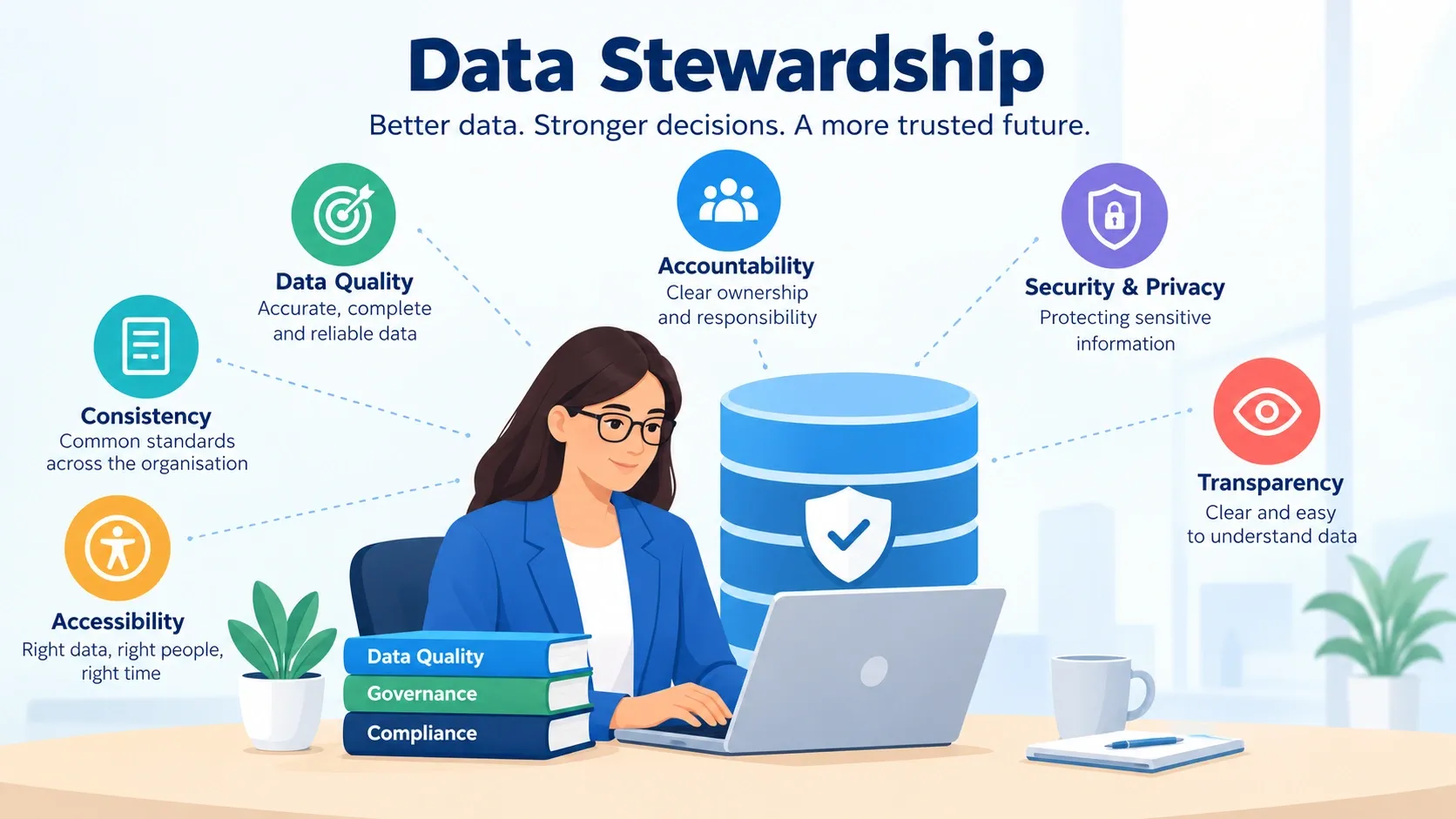











 ROI Calculator