Why Financial Planning and Analysis Matters for Businesses
Key Responsibilities in FP&A
FP&A vs. Accounting: What Is the Difference?
Key Insights
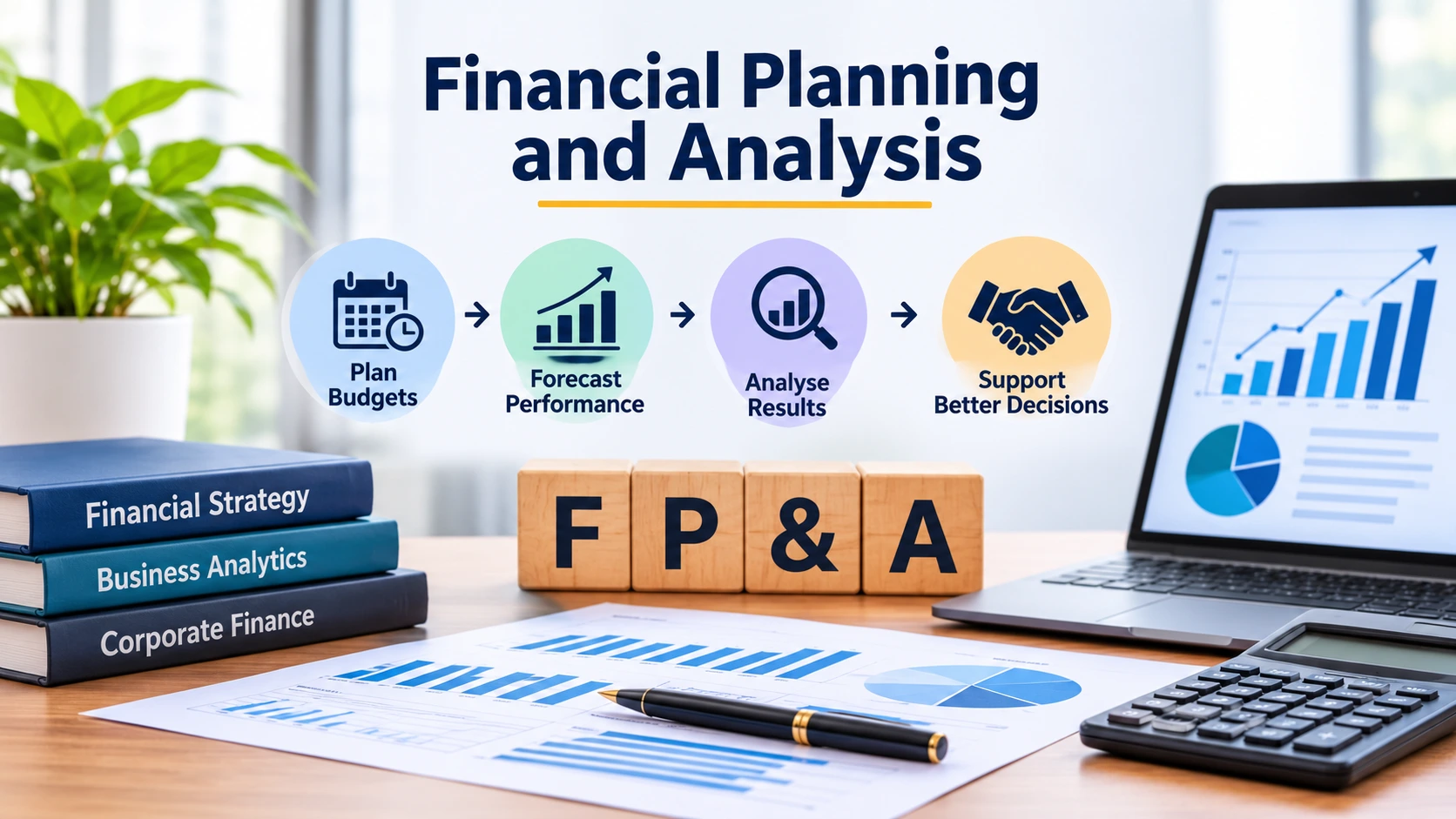
FP&A (Financial Planning and Analysis) helps businesses plan budgets, forecast future performance, analyze financial results, and make informed decisions.
Key FP&A responsibilities include budgeting, forecasting, variance analysis, financial modelling, management reporting, and strategic planning support.
FP&A follows a continuous planning cycle that involves setting goals, gathering data, preparing budgets and forecasts, monitoring performance, analyzing variances, and adjusting plans.
Building a career in FP&A requires technical skills such as advanced Excel, financial modelling, accounting, and data analysis, along with communication, critical thinking, and collaboration skills.
In this blog, you'll learn about the meaning and importance of FP&A, its key responsibilities, the difference between FP&A and accounting, essential skills, career opportunities, emerging trends, and tips to start a career in financial planning and analysis.
Every successful company needs more than accurate bookkeeping. It needs a clear view of where the business is heading, what it can afford, and which decisions will create the most value. This is where FP&A comes in. FP&A has become one of the most important functions in modern finance teams, and it is also one of the most sought-after career paths for finance professionals. The fpna full form is Financial Planning and Analysis (also written as FPNA), and it refers to the finance function that plans budgets, forecasts future performance, and
analyzes actual results to guide business decisions. In this blog, we will explain what FP&A is, how the function works, the skills it requires, and the career opportunities available in this field.
FP&A is the finance function responsible for planning, forecasting, budgeting, and analyzing a company’s financial performance. In simple terms, accountants record what has already happened, while FP&A professionals look at what has happened and use it to guide what should happen next.
A finance team that only reports numbers tells leaders what the results were. A strong FP&A team goes further. It explains why the results look the way they do, what is likely to happen in the coming months, and what actions management should take. For this reason, FP&A is often called the strategic partner of senior leadership.
The function exists in businesses of every size, from startups to large multinational corporations. In a small company, one person may handle all FP&A tasks. In a large organization, there may be a dedicated team with analysts, managers, and a director or vice president who leads the function.
Why Financial Planning and Analysis Matters for Businesses
Companies operate in an uncertain environment. Costs rise, customer demand shifts, and markets change quickly. Financial planning and analysis helps leaders make decisions with data instead of guesswork. Here are some key reasons why it matters.
It supports better decision-making – When management is considering a new product, a hiring plan, or an acquisition, FP&A can show the likely financial impact before money is spent.
It improves cash management – By forecasting cash inflows and outflows, FP&A helps the business avoid shortages and use surplus funds wisely.
It keeps spending under control – Budgets and regular reviews highlight where costs are rising too fast, so corrective steps can be taken early.
It aligns teams with company goals – When each department has a clear budget and target, everyone works toward the same objectives.
It builds confidence with investors and lenders – Reliable forecasts and clear reporting show outside stakeholders that the company is managed responsibly.
Free Courses
Free Finance Courses with Certificate – Finance for All
The daily work of an FP&A team can vary from one company to another, but most teams handle the following core activities.
Budgeting
Budgeting is the process of setting financial targets for a period, usually a year. The FP&A team works with each department to estimate revenue, expenses, and investments. The final budget becomes a roadmap for the entire organization.
Forecasting
While a budget is a fixed plan, a forecast is a flexible estimate of what is likely to happen. Many companies update forecasts every month or quarter, using the latest data. Rolling forecasts, which always look a set number of months ahead, are becoming very common.
Variance Analysis
Variance analysis compares actual results with the budget or forecast. If sales are lower than planned or expenses are higher, the FP&A team investigates the reasons and reports them to management. This step turns raw numbers into useful insight.
Financial Modeling
Financial models are spreadsheets or software tools that show how different assumptions affect results. For example, a model can show how profit would change if prices increase by five percent or if a new factory is opened. Models are widely used for planning and scenario testing.
Management Reporting
FP&A teams prepare regular reports, dashboards, and presentations for senior leaders. These reports usually track key performance indicators such as revenue growth, profit margins, cash flow, and cost per unit.
Business Partnering
Modern FP&A professionals work closely with sales, marketing, operations, and human resources teams. They help these teams understand the financial side of their decisions. This role is often described as business partnering.
Strategic Planning Support
FP&A also supports long-term plans, such as entering a new market, launching a new product line, or making a major investment. The team evaluates the costs, risks, and expected returns.
FP&A vs. Accounting: What Is the Difference?
Many beginners confuse FP&A with accounting, but the two functions are different.
Time focus: Accounting looks at the past and records what has already happened. FP&A looks at the future and uses the past to guide decisions.
Main output: Accounting produces financial statements such as the income statement, balance sheet, and cash flow statement. FP&A produces budgets, forecasts, models, and insights.
Accuracy vs. judgment: Accounting demands exact accuracy and follows strict standards. FP&A relies on assumptions and professional judgment, since the future cannot be known precisely.
Audience: Accounting reports are often used by regulators, auditors, and investors. FP&A reports are mainly used by internal management.
The two teams depend on each other. FP&A uses accurate accounting data as its starting point, and accounting benefits from FP&A’s understanding of the business.
The FP&A Process: How It Works Step by Step
Although every company has its own approach, the typical FP&A cycle looks like this:
Set goals. Leadership defines the company’s targets, such as growth rate, profit margin, or market share.
Gather data. The team collects information from accounting systems, sales records, operations, and market research.
Build the budget and forecast. Using the data and assumptions, the team prepares financial plans for the coming period.
Monitor performance. Actual results are tracked against the plan on a monthly or quarterly basis.
Analyze variances. The team investigates differences between actual and planned results and finds the causes.
Report and recommend. Findings are shared with management along with suggested actions.
Adjust the plan. Based on what was learned, forecasts and strategies are updated.
This cycle repeats throughout the year, making financial planning a continuous activity rather than a one-time task.
Essential Skills for an FP&A Professional
Building a successful career in FP&A requires a balance of technical ability and soft skills.
Technical skills
Financial modeling and Excel: Advanced spreadsheet skills are essential, including formulas, pivot tables, and scenario analysis.
Accounting knowledge: A strong grasp of financial statements helps in understanding how business activity shows up in the numbers.
Forecasting and budgeting methods: Knowing different planning techniques, such as zero-based budgeting and rolling forecasts, is valuable.
Data analysis and visualization: Tools such as Power BI, Tableau, and SQL help in handling large data sets and presenting results clearly.
ERP and planning software: Familiarity with systems like SAP, Oracle, Anaplan, or Adaptive Insights is a strong advantage.
Soft skills
Communication: Numbers are only useful when others understand them. FP&A professionals must explain complex ideas in simple terms.
Critical thinking: The ability to question assumptions and look beyond the obvious is vital.
Business understanding: Knowing how the company makes money and what drives its costs makes the analysis more relevant.
Collaboration: Working smoothly with people from different departments is a daily requirement.
Attention to detail: Even small errors in a model can lead to wrong decisions.
FP&A Jobs: Roles and Career Path
The demand for finance professionals who can combine analysis with business insight continues to grow. Here is a look at common FP&A jobs and how a career in this field usually progresses.
Entry-Level FP&A Jobs
Financial Analyst: Prepares reports, updates models, and supports budgeting and forecasting activities.
Junior FP&A Analyst: Assists with data collection, variance analysis, and routine reporting.
Mid-Level FP&A Jobs
Senior Financial Analyst: Handles complex models, leads parts of the planning cycle, and works closely with business teams.
FP&A Manager: Oversees a small team, owns the budgeting and forecasting process, and presents insights to leadership.
Business Finance Partner: Works inside a specific department, such as sales or operations, and guides its financial decisions.
Senior-Level FP&A Jobs
Director of FP&A: Leads the planning function across the organization and sets reporting standards.
Vice President of Finance: Shapes company-wide financial strategy and works directly with the executive team.
Chief Financial Officer (CFO): Many CFOs have a strong FP&A background, since the role requires strategic thinking and a deep understanding of the business.
Industries Hiring for FP&A Roles
FP&A professionals are needed almost everywhere. Common employers include banks and financial institutions, technology companies, consulting firms, manufacturing businesses, retail and e-commerce companies, healthcare organizations, and startups. Many global companies also run FP&A centers in India, which has increased the number of opportunities for local professionals.
Qualifications for FP&A Jobs
Most employers look for a bachelor’s degree in finance, accounting, commerce, economics, or a related field. Professional qualifications can give a strong boost to your profile. Popular options include:
Master of Business Administration (MBA) with a finance specialization
FP&A-specific certifications, such as the Certified Corporate FP&A Professional (FP&A) credential from the Association for Financial Professionals
Salaries depend on experience, location, industry, and qualifications. Because the figures change often, it is best to check current job portals for up-to-date information.
Trends Shaping FP&A Today
The field is changing quickly, and professionals who stay updated will have an advantage.
Automation and artificial intelligence – Routine tasks such as data collection and report preparation are increasingly automated. This frees analysts to focus on insight and recommendations.
Real-time and rolling forecasts – Companies are moving away from rigid annual budgets and toward continuous planning that adapts quickly to change.
Advanced analytics – Predictive tools help teams anticipate trends and test different scenarios faster.
Stronger business partnering – Finance teams are expected to take part in decisions early, instead of only reporting results afterward.
Focus on sustainability – More companies now include environmental and social goals in their financial plans, which adds a new dimension to analysis.
Tips to Start Your Career in FP&A
Build a strong foundation in accounting and finance. Understanding how financial statements work is the starting point.
Master Excel and financial modeling. Practice building simple models for budgets, forecasts, and what-if scenarios.
Learn data tools. Basic knowledge of SQL, Power BI, or Tableau will make your profile stand out.
Study real companies. Read annual reports and earnings calls to see how businesses plan and explain their results.
Develop communication skills. Practice presenting numbers in a clear and simple way.
Consider further education. A relevant degree or certification can help you move faster into analyst and managerial roles.
Seek internships or entry-level roles. Hands-on experience teaches you things that textbooks cannot.
FP&A sits at the center of business decision-making. By combining careful planning with thoughtful analysis, it helps companies grow with confidence and avoid costly surprises. Now that you know the fpna full form, the key responsibilities, the required skills, and the range of FP&A jobs available, you can decide whether this path suits your interests. For anyone who enjoys working with numbers and wants to influence real business decisions, financial planning and analysis offers a rewarding and future-ready career.
Frequently Asked Questions
The fpna full form is Financial Planning and Analysis. It refers to the finance function that handles budgeting, forecasting, financial modeling, and performance analysis to support business decisions.
Yes. FP&A offers strong growth, exposure to senior management, and opportunities across many industries. It also builds a broad skill set that can lead to roles such as finance manager, director, or CFO.
The most important skills include financial modeling, advanced Excel, accounting knowledge, data analysis, and clear communication. Familiarity with tools such as Power BI, SQL, and planning software is also valuable.
Accounting records and reports past financial transactions, while FP&A uses that data to plan, forecast, and advise management on future decisions. Accounting focuses on accuracy and compliance, whereas FP&A focuses on insight and strategy.
Arif Siddiqui
Head of Accounting and Treasury
Arif Siddiqui is a finance leader specializing in accounting, treasury, and financial strategy. As Head of Finance at Generali Employee Benefits, he brings extensive experience in managing global financial operations. He is known for driving financial efficiency and governance across organizations. His leadership supports sustainable business growth and financial excellence.

 November 10, 2026
 9 min read





 Key Insights
 ChatGPT
 Perplexity
 Claude
 Grok










 ROI Calculator