Tax Consultant Salary in India: Qualification, Pay & Career Scope
J
By Arif Siddiqui
May 26, 20267 min read
Published on May 26, 2026
SHARE THIS ARTICLE
Table Of Content
Tax Consultant Salary Benchmarks: From Entry-Level to Partner
The Qualification Gap: Why Tier-1 Education Changes the Math
Step-by-Step Guide: How to Become a Tax Consultant in India
The Tax Consultant Job Description: Skills That Drive 2026 Salaries
India's tax landscape has fundamentally shifted. Today's tax consultant isn't simply filing returns or ensuring GST compliance—they're sitting across the table from CFOs, shaping financial strategy, and helping organizations navigate an increasingly complex regulatory environment. That evolution has made tax consultant salary figures in India a serious benchmark for finance professionals plotting their career trajectory.
The numbers reflect the moment: According to the ERI Economic Research Institute, the average gross salary for a tax consultant in India stands at approximately ₹10,66,132 per annum, with a projected 30% increase in earning potential over the next five years.
That projected growth isn't accidental. It signals a structural shift in how Indian businesses value tax expertise — not as a back-office cost center, but as a front-line strategic function. Demand is rising fastest among mid-sized firms expanding internationally and corporates managing multi-jurisdictional tax exposure.
Layered on top of that baseline growth is what practitioners increasingly recognize as the 'Prestige Premium' — the measurable salary advantage that comes from working with elite firms, holding advanced credentials, or building specialized expertise. This premium reshapes how compensation scales across experience levels, firm types, and geographies.
Understanding where you sit within that framework starts with knowing the benchmarks.
Tax Consultant Salary Benchmarks: From Entry-Level to Partner
Understanding where you stand on the earnings curve is the first step toward mapping your career trajectory. Whether you’re evaluating your first role or renegotiating as a senior professional, salary data gives your ambitions a concrete foundation.
What Experience Actually Earns You
The gap between entry-level and senior compensation in tax consulting is significant—and worth planning around. According to the ERI Economic Research Institute, entry-level professionals with 1–3 years of experience average ₹7,67,628 annually, while senior-level consultants with 8+ years clock in at ₹12,42,133. That’s roughly a 62% jump — but the ceiling rises much higher depending on the firm type and specialization.
Experience Level
Avg. Annual Salary
Est. Monthly Take-Home
Entry-Level (1–3 yrs)
₹7,67,628
₹47,000–₹52,000
Mid-Level (4–7 yrs)
₹10,00,000–₹12,00,000
₹65,000–₹80,000
Senior-Level (8+ yrs)
₹12,42,133
₹82,000–₹95,000
Partner / Director
₹25,00,000–₹50,00,000+
₹1,80,000+
Note: Monthly take-home estimates account for standard tax deductions and PF contributions.
The Big 4 Premium
Working at a Big 4 firm doesn’t just boost your paycheck — it reshapes your entire compensation trajectory for the decade ahead.
Firms like Deloitte, PwC, EY, and KPMG operate at a different pay tier entirely. According to Lakshya Commerce, Management Consulting, and International Tax tracks at these firms pay ₹12–16 LPA at the entry level, rising to ₹40 LPA for Senior Managers. A typical tax consultant job description at a Big 4 will list strategic advisory responsibilities that justify this premium — these aren’t pure compliance roles.
Independent vs. Corporate, and the City Factor
Independent consultants often trade salary stability for upside — monthly earnings vary widely based on client volume. Corporate consultants benefit from structured increments and benefits packages, though their ceiling is lower at comparable experience levels.
Regional context also shapes numbers. Bengaluru and Hyderabad consistently lead pay scales, driven by the concentration of multinational tech and pharma firms demanding sophisticated cross-border tax expertise. These cities can add 15–25% to base salaries compared to Tier-2 markets.
That earnings gap between good and great — and between standard roles and elite advisory positions — isn’t random. It’s closely tied to education pedigree, a pattern the next section breaks down in detail.
The Qualification Gap: Why Tier-1 Education Changes the Math
Understanding the tax consultant salary in India only tells half the story. The other half is about which tax consultant qualification sits behind that number — and how dramatically it shifts the ceiling.
The gap between a standard CA and a Tier-1 MBA isn’t just noticeable. It’s structural. MBA graduates from institutions like the IIMs earn an average of ₹23.6 LPA, compared to ₹6–8 LPA for fresher Chartered Accountants, according to Glassdoor data via upGrad. That’s not a marginal difference — it’s a multiplier effect built into the hiring process before a candidate walks through the door.
“If a company is unable to afford an MBA from a top B-School, it would rather hire a top CA than look for a management graduate from lower-rung B-schools.” — Nagesh Pinge, former Chief Internal Auditor, Tata Motors (via Economic Times)
This quote cuts to the heart of the matter. Employers aren’t simply buying a degree — they’re buying a signal. And in high-stakes tax advisory, that signal carries real weight.
The 90th Percentile Phenomenon
What happens at the very top of the distribution is even more striking. Elite graduates from Tier-1 programs who land roles in Big Four firms or MNC tax divisions regularly reach ₹46 LPA within a few years of placement. This isn’t luck — it’s the compounding effect of institutional networks, structured mentorship, and the caliber of clients these firms assign to top-tier hires.
On the other hand, a CA without a premium management credential often plateaus at the mid-senior level unless they actively pursue additional qualifications.
The Executive Education Bridge
For working professionals already in the field, the path isn’t closed.Executive MBA programsare specifically designed to let you maintain your career while building the strategic and management credentials that Tier-1 hiring managers look for. Unlike a traditional full-time program, these part-time formats make the bridge accessible without stepping off the career ladder entirely.
The qualification gap is real — but it’s also navigable. The next section maps exactly how to close it.
Step-by-Step Guide: How to Become a Tax Consultant in India
Knowing the salary benchmarks is motivating. Knowing exactly how to reach them is actionable. If you’re mapping out how to become a tax consultant in India, the path has a clear structure — but the shortcuts you take along the way will determine how fast your earnings scale.
Step 1: Build the right educational foundation. A B.Com, LLB, or CA qualification forms the core. CA remains the gold standard for corporate and direct tax roles, while LLB opens doors into tax litigation and advisory.
Step 2: Complete Articleship or structured practical training. This is non-negotiable. Articleship under a registered CA firm exposes you to real compliance cycles, client filings, and audit workflows. Practical technical competence — not just theoretical knowledge — is what firms actually hire for.
Step 3: Choose a specialization early. Generalists plateau faster. Specialists command premium packages, particularly in the niches that Forvis Mazars research consistently flags as top-paying.
Step 4: Use the Executive Pivot to accelerate seniority. PG Diplomas, Executive MBAs, and targeted certifications let mid-career professionals leapfrog into senior advisory roles. Exploring finance-focused advanced programs can compress a 5-year promotion timeline significantly.
Corporate Tax
This specialization covers domestic tax planning, transfer of profits, and compliance under the Income Tax Act. It’s the most common entry point and offers steady demand across industries.
International Tax
Roles here involve cross-border structuring, tax treaties, and regulatory compliance across multiple jurisdictions. According to PayScale data, this remains one of the highest-paying niches in the Indian market.
Transfer Pricing
Transfer Pricing specialists manage intra-group transaction documentation and dispute resolution. The technical complexity commands a significant salary premium over generalist roles.
Once you’ve locked in your specialization and credentials, the next competitive lever is the specific skill set you bring to the table—and that’s where the 2026 job market gets particularly demanding.
Free Courses
Finance for All – Free Finance Certification Course
The Tax Consultant Job Description: Skills That Drive 2026 Salaries
A competitive tax consultant salary per month isn’t handed out for technical competence alone — it’s earned by professionals who combine deep regulatory knowledge with sharp business instincts. As the role evolves, the gap between average and high-earning consultants comes down to a specific, stackable set of skills.
High-Value Skills Employers Are Paying For
GST and Income Tax Act mastery: End-to-end compliance, dispute resolution, and advance rulings remain non-negotiable technical foundations.
International tax and treaty knowledge: Cross-border transaction structuring and transfer pricing expertise command significant premiums in MNCs and Big Four environments.
Negotiation and client advisory: The ability to translate complex tax exposure into boardroom-ready language directly influences client retention and billing rates.
Strategic risk assessment: Identifying compliance vulnerabilities before they become liabilities positions consultants as trusted advisors rather than back-office processors.
Digital literacy: Proficiency in automated compliance platforms, data analytics tools, and AI-assisted audit software is rapidly shifting from “nice to have” to expected.
According to Lakshya Commerce, manager-level salaries in specialized service lines typically range from ₹20–28 LPA — a compensation tier that consistently reflects this blended skill profile.
The field is moving decisively from data entry to data interpretation — and professionals who can interrogate automated outputs, spot anomalies, and advise on strategy are the ones commanding top-bracket compensation.
AI tools now handle routine tax calculations and filing workflows. What they can’t replace is judgment. Consultants who understand how to work alongside these tools — rather than compete with them — are better positioned for 2026 and beyond. Pairing technical expertise with the right advanced business credentials is increasingly how professionals make that leap credible to employers.
Conclusion
To conclude, building a successful career in tax consulting requires a strong combination of technical expertise, strategic thinking, and modern digital skills. Mastery of GST and the Income Tax Act remains essential for handling compliance, dispute resolution, and taxation procedures effectively. Professionals with knowledge of international taxation, transfer pricing, and cross-border regulations are increasingly valued in multinational companies and consulting firms. Additionally, strong negotiation abilities and client advisory skills help consultants communicate complex tax matters clearly to businesses and stakeholders. Strategic risk assessment capabilities allow professionals to identify compliance issues proactively and provide valuable business solutions. Along with these core competencies, digital literacy in automated compliance systems, AI-powered audit tools, and data analytics has become crucial for staying competitive in the evolving tax consulting industry.
Frequently Asked Questions
Tax consultants in India usually charge based on the complexity of services, experience, and business requirements. Fees can range from a few thousand rupees for basic tax filing to higher charges for corporate taxation, GST compliance, and financial advisory services.
A tax consultant in India is a professional who guides taxation, GST, income tax filing, tax planning, compliance, and financial regulations. Chartered Accountants (CAs), tax advisors, and finance professionals commonly work as tax consultants.
To find a good tax consultant, check qualifications, industry experience, client reviews, and expertise in areas like GST, income tax, or corporate taxation. Choosing a consultant with strong communication skills and updated regulatory knowledge is also important.
The cost of a tax advisor depends on the type of tax services required, such as personal tax filing, business compliance, or financial planning. Experienced tax advisors handling complex taxation matters generally charge higher professional fees.
Arif Siddiqui
Head of Accounting and Treasury
Arif Siddiqui is a finance leader specializing in accounting, treasury, and financial strategy. As Head of Finance at Generali Employee Benefits, he brings extensive experience in managing global financial operations. He is known for driving financial efficiency and governance across organizations. His leadership supports sustainable business growth and financial excellence.
 HOME > BLOG > Career Information > Tax Consultant Salary in India: Qualification, Pay & Career Scope
 May 26, 2026
 7 min read





 ChatGPT
 Perplexity
 Claude
 Grok
Grok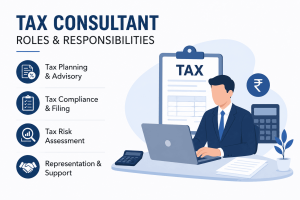









 ROI Calculator