Purchasing Power Parity Meaning: A Simple Explanation
Understanding the Purchasing Power Parity Theory
How Purchasing Power Parity Is Calculated
Purchasing Power Parity by Country: What the Numbers Reveal
Key Insights
Purchasing Power Parity (PPP) compares currencies based on the goods and services they can actually buy, rather than relying only on market exchange rates.
The purchasing power parity theory is based on the law of one price and includes two approaches: Absolute PPP and Relative PPP.
PPP calculations compare the cost of the same basket of goods across countries, while the Big Mac Index offers a simple way to understand currency valuation.
Factors such as transportation costs, tariffs, inflation, government policies, and differences in consumer preferences can limit the accuracy of PPP.
PPP helps governments, businesses, investors, and individuals compare living standards, measure poverty, evaluate currencies, plan salaries, and make economic decisions.
In this blog, you'll learn the meaning and theory of purchasing power parity, its formula, country-wise comparisons, limitations, and real-world applications in business, finance, travel, and economic policy.
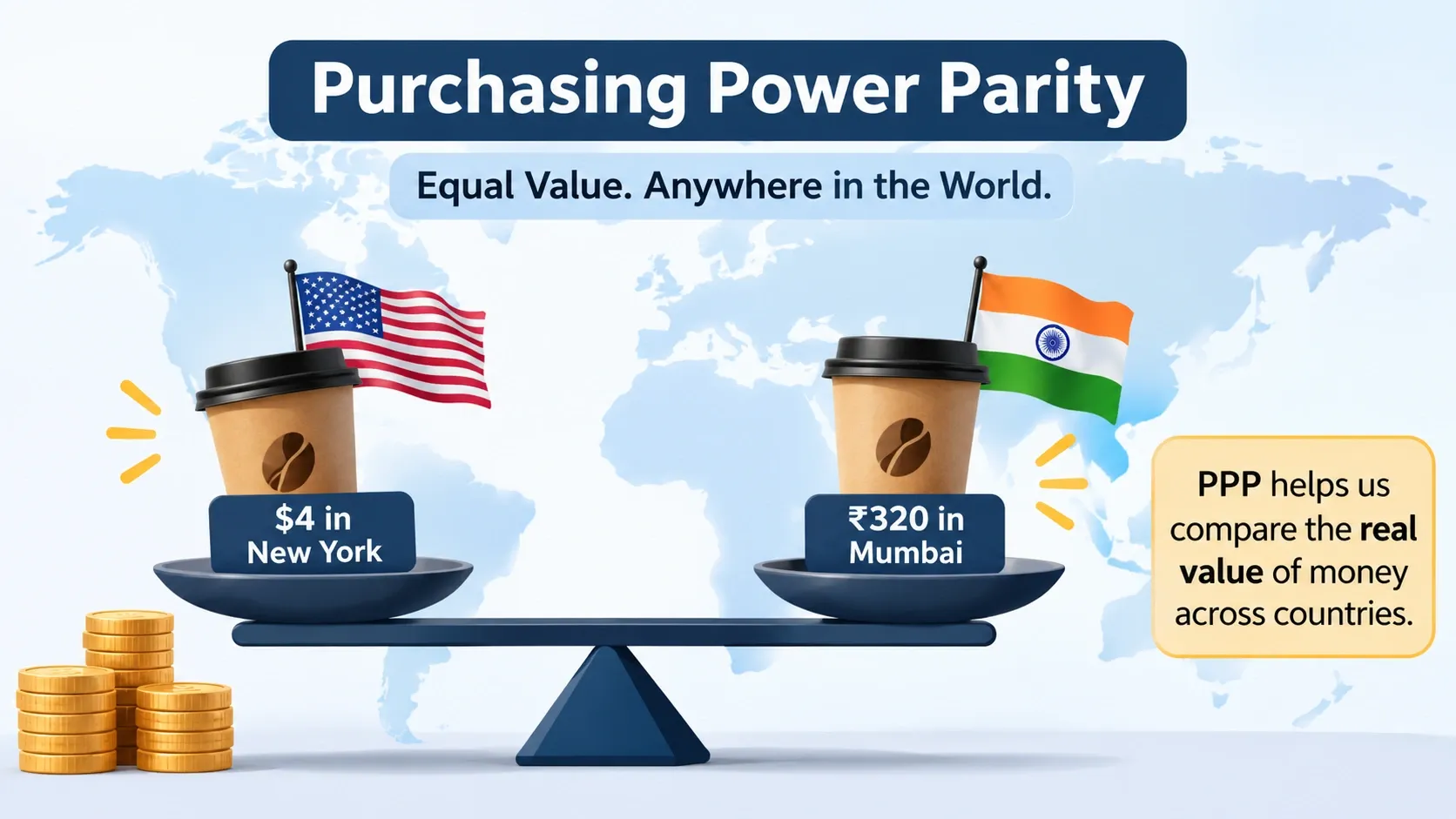
Imagine you buy a cup of coffee in New York for four dollars and the same cup in Mumbai for the equivalent of one dollar. Both cups taste similar, yet the price gap is huge. Now imagine trying to compare the incomes of people in these two cities. Would a salary of $3,000 per month mean the same thing in both places? Clearly not.
This is exactly the kind of puzzle that purchasing power parity helps to solve. Economists, investors, businesses, and policymakers use it to compare living standards and economic strength across countries in a fair way. In this guide, you will learn the purchasing power parity meaning, how the purchasing power parity theoryworks, how it looks across different nations, and why it matters in the real world.
Purchasing Power Parity Meaning: A Simple Explanation
Let us begin with the purchasing power parity meaning. Purchasing power parity, often shortened to PPP, is an economic measure that compares the value of currencies based on what they can actually buy. Instead of looking only at market exchange rates, PPP asks a more practical question: how much money do you need in each country to purchase the same basket of goods and services?
The key word here is “parity,” which means equality. Under PPP, two currencies are at parity when a given amount of each can purchase the same goods and services. If a basket of everyday items costs $100 in the United States and 8,000 rupees in India, then the PPP exchange rate would be 80 rupees per dollar, regardless of what the currency market says on a given day.
This matters because market exchange rates can be misleading. They move daily due to interest rates, investor sentiment, trade flows, and political news. They tell you how currencies trade, but not how far your money will go at the grocery store, the doctor’s office, or the rent office. PPP fills that gap by focusing on real purchasing power.
The purchasing power parity theory is the idea that, over the long run, exchange rates should adjust so that identical goods cost the same in different countries when priced in a common currency. The concept has roots in the early twentieth century and was popularized by the Swedish economist Gustav Cassel after the First World War, although its core idea is much older.
The theory rests on a principle known as the “law of one price.” This law says that, in a perfectly efficient market without transport costs or trade barriers, a single product should sell for the same price everywhere once exchange rates are taken into account. If it did not, traders would buy the product where it is cheap and sell it where it is expensive. This activity, called arbitrage, would push prices back toward equality.
Absolute Purchasing Power Parity
Absolute PPP applies the law of one price to an entire basket of goods. It suggests that the exchange rate between two currencies should equal the ratio of their price levels. For example, if the same basket costs twice as much in one country as in another, the first country’s currency should be worth half as much per unit.
Relative Purchasing Power Parity
Relative PPP is a more flexible version. It does not require prices to be exactly equal. Instead, it says that changes in exchange rates should reflect differences in inflation between two countries. If one country has higher inflation than another, its currency should weaken over time by roughly the difference. This version is used more often in practice because it accounts for real-world frictions.
Limits of the Theory
No theory is perfect, and the purchasing power parity theory has its limits. In the short run, exchange rates often stray far from PPP. In the long run, they tend to move closer, but the process can take years. Several factors explain the gap:
Transportation costs and tariffs prevent prices from fully equalizing.
Non-tradable goods and services, such as haircuts, rent, and local transport, cannot be easily moved across borders.
Differences in quality and consumer taste make some goods hard to compare.
Government policies and taxes change final prices.
Speculation and capital flows can push currencies away from their “fair” value.
Despite these limits, the theory remains a useful benchmark for judging whether a currency looks overvalued or undervalued.
How Purchasing Power Parity Is Calculated
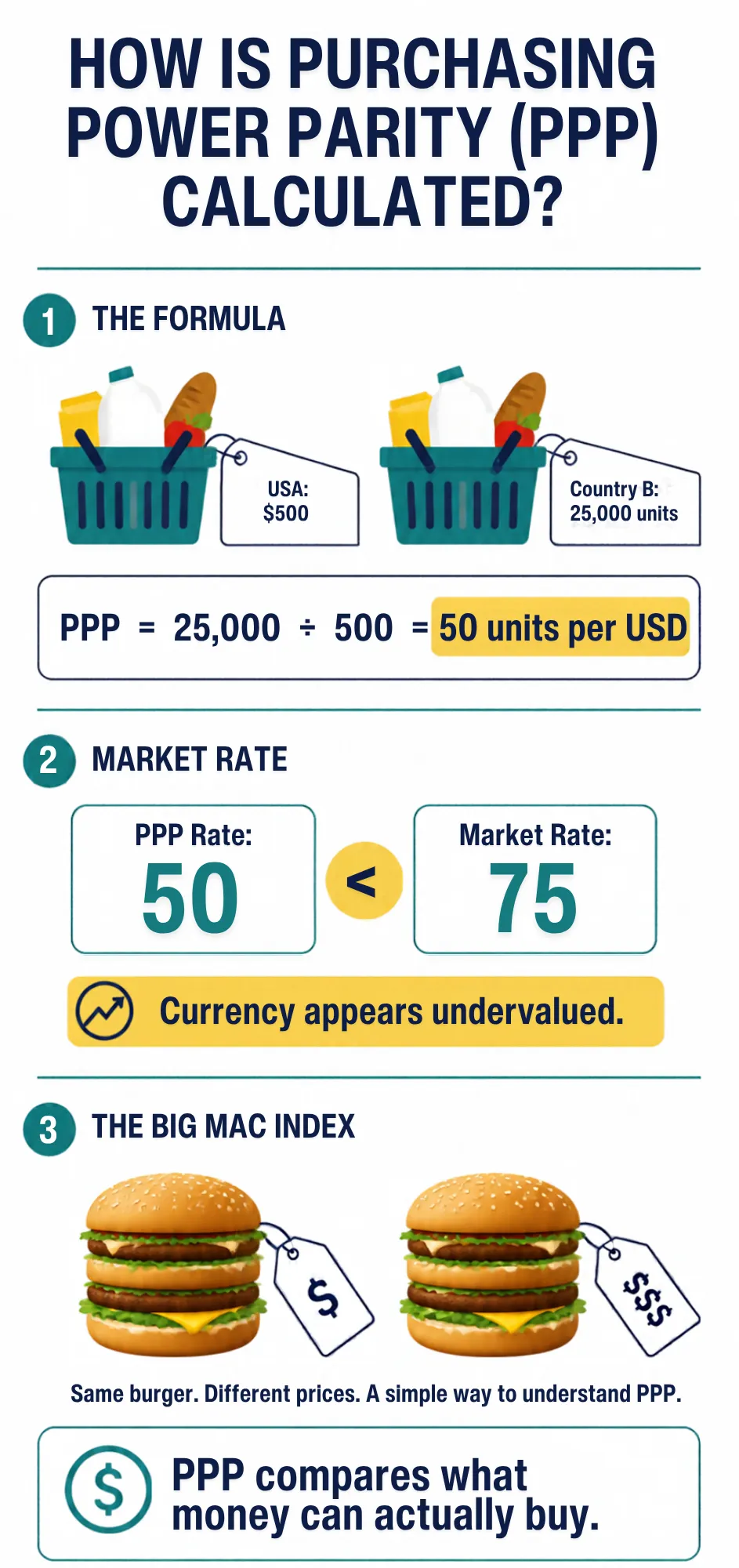
The basic formula is simple. The PPP exchange rate equals the price of a basket of goods in one country divided by the price of the same basket in another country.
For example, suppose a basket of goods costs $500 in the United States and 25,000 units of a foreign currency in another country. The PPP exchange rate would be 50 units of the foreign currencyper dollar. If the actual market rate is 75 units per dollar, the foreign currency would appear undervalued, since your dollar buys more at home prices abroad than the market rate suggests.
In practice, calculating PPP at a national level is a large task. Organizations such as the World Bank, the International Monetary Fund, and the Organisation for Economic Co-operation and Development collect price data on thousands of goods and services, including food, housing, health care, education, and transport. They then build a standard basket and compare costs across economies.
The Big Mac Index
One of the most famous informal examples is the Big Mac Index, created by The Economist in 1986. It compares the price of a Big Mac burger across countries. Because the burger is made with similar ingredients almost everywhere, it offers a lighthearted yet effective way to see whether a currency appears overvalued or undervalued relative to the dollar. It is not a precise scientific tool, but it makes the idea of PPP easy to understand.
Free Courses
Free Finance Courses with Certificate – Finance for All
Purchasing Power Parity by Country: What the Numbers Reveal
Looking at purchasing power parity by country shows why PPP is so valuable. When economists convert national output into dollars using market exchange rates, richer countries with strong currencies tend to look larger. When they use PPP, the picture often changes, because goods and services in lower-income countries are generally cheaper.
Large Emerging Economies
Countries such as China and India look considerably bigger when measured by PPP than by market exchange rates. In recent IMF estimates, China ranks as the largest economy in the world on a PPP basis, and India ranks among the top three. This is because everyday costs, especially for services and housing, are lower in these countries, so each unit of local currency buys more than the market exchange rate implies.
Advanced Economies
Advanced economies such as the United States, Japan, and Germany also remain near the top of PPP rankings, but their relative position can differ from nominal rankings. Because prices in these countries are already high, the PPP adjustment does not boost their figures as much.
High-Cost and Low-Cost Countries
Countries with very high price levels, such as Switzerland and Norway, tend to show that their currencies buy less than the market rate suggests. Meanwhile, countries with lower price levels, including many in South Asia, Africa, and parts of Southeast Asia, often show the opposite. A traveler with dollars or euros may find their money stretches much further there.
A Quick Comparison of GDP Views
Here is a simplified way to think about the difference between the two approaches:
Nominal GDP measures output using market exchange rates. It is useful for comparing global trade, financial markets, and international debt.
PPP-adjusted GDP measures output using price-adjusted rates. It is more useful for comparing living standards, consumption, and the real size of an economy’s production.
Because exact figures change each year with new data and revisions, it is best to check the latest World Bank or IMF tables when you need current numbers for purchasing power parity by country.
Real-World Impact of Purchasing Power Parity
PPP is not just an academic concept. It shapes decisions in many areas of daily life, business, and policy.
Comparing Living Standards
Governments and international organizations use PPP to compare income per person across countries. A person earning the equivalent of $5,000 a year in one country may enjoy a very different standard of living than someone earning the same amount elsewhere, depending on local prices. PPP helps make these comparisons fairer and more meaningful.
Measuring Poverty
The World Bank uses PPP-adjusted figures to define the international poverty line. This allows the poverty threshold to reflect what a dollar can actually buy in different places, rather than relying on raw exchange rates that might hide real hardship or exaggerate it.
Guiding International Business
Companies that operate in several countries use PPP to set prices, plan salaries, and decide where to expand. A firm entering a new market needs to know how much consumers can realistically afford. PPP provides a clearer view of local demand than exchange rates alone.
Supporting Investors and Currency Analysts
Investors use PPP as one input when judging whether a currency is overvalued or undervalued. If a currency trades far above its PPP-implied value, some analysts expect it to weaken over time. Although this is not a preciseforecastingtool, it adds helpful context to long-term investment decisions.
Helping Travelers, Expatriates, and Remote Workers
For individuals, PPP explains why a vacation can feel inexpensive in one country and costly in another. It is also valuable for people considering relocation or remote work abroad. A salary earned in a strong currency can go much further in a lower-cost country, which affects career and lifestyle choices.
Informing Economic Policy
Policymakers look at PPP when evaluating wage levels, inflation, trade competitiveness, and development progress. Institutions such as the IMF also use PPP data to weigh countries’ economic importance in global assessments.
Purchasing power parity offers a simple but powerful way to look beyond headline exchange rates and see what money can really buy. The purchasing power parity meaning is straightforward: it compares currencies by their ability to purchase the same goods and services. The purchasing power parity theory explains why exchange rates should, over time, reflect price differences between countries. And a look at purchasing power parity by country reveals how much our view of global economic strength can change depending on the measure we choose.
Whether you are a student, an investor, a business owner, or simply a curious traveler, understanding PPP can help you make better sense of the global economy. It reminds us that the value of money is not just a number on a currency screen. It is the real-life ability to buy food, pay rent, receive care, and build a better future.
Frequently Asked Questions
Purchasing power parity is a way of comparing the value of different currencies by looking at how much each can buy. If the same basket of goods costs less in one country than another once converted to a common currency, the first country’s money has higher purchasing power.
Market exchange rates change daily and are influenced by investment flows, interest rates, and speculation. They do not always reflect real living costs. PPP adjusts for price differences, so it gives a better picture of living standards and the true size of an economy.
Large emerging economies such as China and India appear significantly larger on a PPP basis than on a nominal basis, because prices for many goods and services in these countries are lower. The exact rankings change as new data is published, so it is best to check the latest World Bank or IMF figures.
PPP is a useful long-term guide, but it is not accurate for short-term predictions. Exchange rates can stay far from PPP levels for years because of trade barriers, capital flows, and market sentiment. Most analysts treat it as one tool among many rather than a precise forecast.
Arif Siddiqui
Head of Accounting and Treasury
Arif Siddiqui is a finance leader specializing in accounting, treasury, and financial strategy. As Head of Finance at Generali Employee Benefits, he brings extensive experience in managing global financial operations. He is known for driving financial efficiency and governance across organizations. His leadership supports sustainable business growth and financial excellence.
Get Free Upskilling Guidance
Fill in the details for a free consultation
Related Courses
Explore our programs
Investment Strategies and Portfolio Management in the Age of AI

 November 19, 2026
 8 min read





 Key Insights
 ChatGPT
 Perplexity
 Claude
 Grok











 ROI Calculator