GDP is the total value of all goods and services produced inside a country's borders in a given period. Real GDP removes the effect of inflation, so it shows whether output actually grew.
India's nominal GDP crossed roughly $4 trillion in 2025. IMF-based projections suggest it could reach around $5 trillion and move into the third spot globally by 2027-28.
GDP can be calculated in three ways: the expenditure approach (GDP = C + I + G + (X − M)), the production approach, and the income approach. In India, the National Statistics Office publishes the estimates every quarter.
The IMF has raised India's FY2026-27 and FY2027-28 growth forecasts to 7%, and the RBI expects 7.1% for FY27. Private consumption, services, infrastructure, reforms, digital public infrastructure, and manufacturing are driving this growth.
Energy prices, global trade uncertainty, job creation, private investment, monsoon risks, and low per capita income remain challenges to watch.
In this blog, you'll learn what GDP is, what the GDP of India is, how to calculate GDP, what drives India's growth toward 2027, and the key challenges ahead.
Every few months, a headline pops up saying India's economy has grown by 7%, or that India has overtaken another country on the world rankings. It sounds impressive, but what does it actually mean for you and me? If you have ever nodded along to those numbers without being fully sure what they represent, this blog is for you.
Let's break down the GDP of India in plain, simple language: what it is, how big it is, how it is calculated, and where it is heading as we move toward 2027.
Let’s start with the basics. GDP stands for Gross Domestic Product. It is the total value of all the goods and services produced inside a country’s borders during a specific period, usually a quarter or a year.
Think of a country as one giant shop. Farmers grow wheat, factories make cars,software engineers build apps, teachers teach, doctors treat patients, and your local tea stall owner sells chai. GDP is the combined value of everything all of these people produce, added together.
A few things are worth noticing in that definition:
“Domestic” means production inside the country. A factory in Gujarat owned by a foreign company counts toward India’s GDP. An Indian company’s factory in Vietnam does not.
“Goods and services” means both physical things (steel, rice, smartphones) and things you cannot touch (banking, tourism, streaming, haircuts).
“Final value” means we only count finished products, so the flour inside a loaf of bread is not counted twice.
Economists use GDP as a report card for the economy. If GDP is rising, businesses are generally producing and earning more, jobs are being created, and incomes tend to go up. If it is shrinking for a long stretch, that is usually a warning sign.
Nominal GDP vs Real GDP
You will often hear these two terms, and they are easy to mix up.
Nominal GDP is measured at current prices. If prices rise because of inflation, nominal GDP rises even if the country did not actually produce more stuff.
Real GDP removes the effect of inflation. It tells you whether the economy truly grew in terms of output. When people say “India grew 7%,” they almost always mean real GDP growth.
There is a third idea too: GDP per capita, which is total GDP divided by population. It shows the average economic output per person, and it is a much better clue about living standards than the headline number.
Now let’s get specific. The GDP of India is the total value of everything produced across all 28 states and 8 Union Territories in a given year. India reports its numbers on a financial year basis, which runs from April 1 to March 31. So “FY27” or “2026-27” means April 2026 to March 2027.
In terms of size, India is one of the biggest economies on the planet. In 2025, its economy crossed the roughly $4 trillion mark in nominal terms, which put it in the club of the world’s top five economies. Most major forecasters expect India to climb further and, according to IMF projections, to move into the third spot globally around 2027-28, with a nominal GDP near the $5 trillion mark. Exact dollar figures shift depending on the source, exchange rates, and revisions, so treat any single number as a close estimate rather than gospel.
Here is a quick snapshot of the Indian economy:
Key fact
What it tells us
World rank (nominal GDP)
Among the top five, aiming for third place
Fiscal year
April to March
Biggest contributor
Services sector (over half of the economy)
Biggest spending driver
Private consumption (more than half of GDP)
Growth status
Among the fastest-growing major economies
One more thing to keep in mind: India is also the world’s most populous country. That is why the total GDP looks huge, while GDP per capita is still modest compared with developed nations. Both stories are true at the same time, and that is the part of the picture that gets missed in cheerful headlines.
Free Courses
Finance for All – Free Finance Certification Course
Global Ranking: As of 2026, India is the world’s 6th-largest economy by nominal GDP, with an estimated GDP of US$4.15 trillion, reflecting its growing economic influence.
Nominal GDP Size: India’s nominal GDP is projected to reach approximately $4.52 trillion in 2027.
Economic Growth: India’s real GDP growth is expected to remain strong, with forecasts ranging from 7% to 7.2% for the 2027 fiscal cycle.
Major Growth Drivers: Domestic consumer demand, manufacturing, public infrastructure spending, and the services sector play important roles in driving economic growth.
Inflation Outlook: Inflation is projected to remain between 4.2% and 4.7%, influencing purchasing power and overall economic activity.
Current Account Deficit: The current account deficit is expected to narrow to around 1.3% of GDP, indicating a potential improvement in the country’s external economic balance.
India’s Year-on-Year GDP Growth
2018: India’s nominal GDP stood at approximately $2.70 trillion, with an annual growth rate of 6.45%.
2019: Nominal GDP increased to $2.83 trillion, while the annual growth rate was 3.87%.
2020: Nominal GDP declined to $2.67 trillion, and the annual growth rate fell to -5.83%.
2021: Nominal GDP rose to $3.15 trillion, with economic growth rebounding to 9.70%.
2022: Nominal GDP reached $3.25 trillion, with an annual growth rate of 6.99%.
2023: Nominal GDP increased to $3.50 trillion, with growth recorded at 7.21%.
2024: Nominal GDP rose to $3.76 trillion, while the annual growth rate stood at 7.10%.
2025: Nominal GDP reached $3.96 trillion, with an annual growth rate of 7.57%.
2026 (Estimated): Nominal GDP is estimated at $4.15 trillion, with an annual growth rate of 6.5%.
2027 (Projected): India’s nominal GDP is expected to reach approximately $4.52 trillion, reflecting continued economic expansion.
2047 (Long-Term Target): Under the Viksit Bharat 2047 vision, India aims to become a developed nation with a nominal GDP of approximately US$30 trillion. Achieving this target will require sustained economic growth, higher investment, improved productivity, and infrastructure development.
How to Calculate GDP
This is the part that sounds scary but is actually quite simple. There are three standard ways to calculate GDP, and in theory they should all arrive at the same answer. Think of them as three different doors into the same room.
1. The Expenditure Approach
This is the most popular method. It adds up everything that is spent in the economy. The formula looks like this:
GDP = C + I + G + (X − M)
Here is what each letter means:
C (Consumption): What households spend on food, clothes, rent, phones, school fees, and so on.
I (Investment): What businesses spend on machinery, factories, and buildings, plus new home construction.
G (Government spending): What the government spends on roads, defence, salaries, and public services.
X − M (Net exports): Exports minus imports. If India sells more abroad than it buys, this adds to GDP. If imports are higher, it reduces it.
A quick example with made-up numbers: if households spend 60, businesses invest 30, the government spends 15, exports are 20, and imports are 25, then GDP = 60 + 30 + 15 + (20 − 25) = 100.
2. The Production (Output) Approach
Here you add up the value created by each sector, such as agriculture, industry, and services. To avoid counting the same thing twice, you measure the value added at each stage. If a farmer sells wheat for 10, a mill turns it into flour worth 15, and a bakery makes bread worth 25, the value added is 10, then 5, then 10, which gives a total of 25 and not 50.
India’s official numbers are often presented in terms of GVA (Gross Value Added). The simple link is: GDP = GVA + taxes on products − subsidies on products.
3. The Income Approach
This one adds up everyone’s earnings: wages and salaries, business profits, rents, and interest, plus certain taxes. Whatever is produced eventually becomes someone’s income, so this method looks at the same economy from the earner’s side.
Who Calculates It in India?
In India, the National Statistics Office (NSO), under the Ministry of Statistics and Programme Implementation, publishes GDP estimates every quarter. It also releases advance estimates for the full year and revises them as better data comes in. That is why you sometimes see numbers change a few months later. It is normal, not a scandal.
Why the GDP of India Matters to You
It is easy to think GDP is just a number for economists, but it quietly touches daily life.
Jobs: When the economy grows, companies expand and hire more people.
Incomes: Steady growth usually means better salary prospects over time.
Prices and interest rates: The RBI looks at growth and inflation together before deciding on loan rates, which affects your home loan EMI.
Government services: Higher growth means higher tax collection, which can fund infrastructure, healthcare, and education.
Investments: Stock markets and businesses often respond to the growth outlook.
In short, a healthy GDP does not guarantee that every individual feels better off, but it makes it much more likely.
India's GDP Growth: Where Are We Now?
India has been on a strong run. The economy grew around 6.5% in 2024-25, and growth in 2025-26 came in notably stronger, with early estimates placing it above 7%. A big reason was healthy domestic demand, supported by tax relief for households, lower inflation for much of the year, and steady services activity.
Now the big question: what about 2027?
As of mid-October 2026, the outlook looks encouraging. In its latest World Economic Outlook, released on October 13, 2026, the IMF raised India’s growth forecast for FY2026-27 to 7%, up from 6.4% earlier. It also pegged growth for FY2027-28 at 7%, up from 6.7% in its July estimate. The Reserve Bank of India has also lifted its own FY27 forecast to 7.1%. The IMF specifically noted that India stands out with upward revisions at a time when many other economies are struggling.
That is a big deal, because the global backdrop is not easy. Higher energy prices linked to the conflict in West Asia, US tariffs, and general trade uncertainty are all weighing on the world economy. India has managed to hold its ground largely because of strong domestic demand rather than relying heavily on exports.
Some other forecasters are a little more cautious, with estimates in the high 6% range for FY27. The honest takeaway is that most expectations cluster between roughly 6.4% and 7.1%, which is still quick by global standards.
So what is powering this momentum? Here are the major engines.
Private consumption. More than half of India’s GDP comes from household spending. A young population, rising incomes, and a growing middle class keep this engine running.
The services sector. IT, finance, telecom, healthcare, and tourism make up the largest slice of the economy. India’s digital services and global capability centres keep expanding.
Infrastructure spending. Roads, railways, ports, airports, and power projects add to demand today and boost productivity tomorrow.
Reforms and policy support. GST simplification, income tax relief, and new trade agreements with countries such as the UK, New Zealand, and Oman are meant to support both domestic demand and exports.
Digital public infrastructure. UPI, Aadhaar, and other digital systems have made payments cheap and fast, drawing millions more people into the formal economy.
Manufacturing push. Schemes to encourage electronics, semiconductors, and other production are slowly building a stronger industrial base.
Challenges to Keep an Eye On
No growth story is perfect, and India’s is no exception. Here are the risks worth watching.
Energy prices: India imports most of its crude oil, so a spike in oil prices can push up inflation and squeeze the economy. The IMF expects consumer inflation to average around 5% in FY27, noticeably higher than last year.
Global trade uncertainty: Tariffs and supply chain shifts can hurt exporters.
Jobs and income gap: Growth needs to create enough quality jobs for millions of young people entering the workforce.
Private investment: A broad, sustained rise in private business investment is still taking time to fully arrive.
Climate and monsoon risks: Agriculture still supports a large share of the population, so weather matters.
Per capita income: India’s total economy is large, but average income per person has plenty of catching up to do.
These challenges do not cancel out the good news, but they are a reminder that forecasts are only forecasts.
Looking Ahead: What to Expect from the GDP of India in 2027
If forecasts hold, India is set to stay among the fastest-growing major economies in 2027. The economy should keep expanding at around 6.5% to 7%, nominal GDP should approach the $5 trillion mark, and India is on track to compete for the number three spot globally behind the US and China.
Beyond the rankings, the real test will be how well this growth translates into better jobs, higher incomes, and improved living standards. India’s long-term ambition of becoming a developed economy by 2047 depends on sustaining high growth for decades, not just a couple of good years.
Final Thoughts
The GDP of India is more than a statistic. It is a snapshot of how millions of people work, spend, build, and earn every single day. Now that you know what GDP is, how it is calculated, and what is driving India’s growth into 2027, those economic headlines should feel a lot less intimidating.
The story so far is a positive one: strong domestic demand, steady reforms, and upgraded forecastsdespite a tricky global environment. Keep an eye on oil prices, jobs, and private investment, and you will understand most of what moves the Indian economy.
Frequently Asked Questions
India’s nominal GDP is expected to be close to $5 trillion around 2027-28, according to IMF-based projections, though exact figures vary by source and exchange rate. Real growth for FY2026-27 and FY2027-28 is forecast at around 7% by the IMF, with other agencies estimating slightly lower.
Most projections suggest India could overtake Germany and move to the third spot by around 2027-28. It depends on exchange rates, growth momentum, and revisions, so the exact timing may shift by a year.
India’s National Statistics Office measures GDP using the production (value added) approach and the expenditure approach, using the formula GDP = C + I + G + (X − M). Figures are released quarterly and revised as more data comes in.
GDP is the total value of everything an economy produces. GDP per capita divides that total by the population, giving the average output per person. India ranks high on total GDP but still sits much lower on per capita GDP because of its large population.
Arif Siddiqui
Head of Accounting and Treasury
Arif Siddiqui is a finance leader specializing in accounting, treasury, and financial strategy. As Head of Finance at Generali Employee Benefits, he brings extensive experience in managing global financial operations. He is known for driving financial efficiency and governance across organizations. His leadership supports sustainable business growth and financial excellence.

 October 16, 2026
 11 min read





 Key Insights
 ChatGPT
 Perplexity
 Claude
 Grok
Grok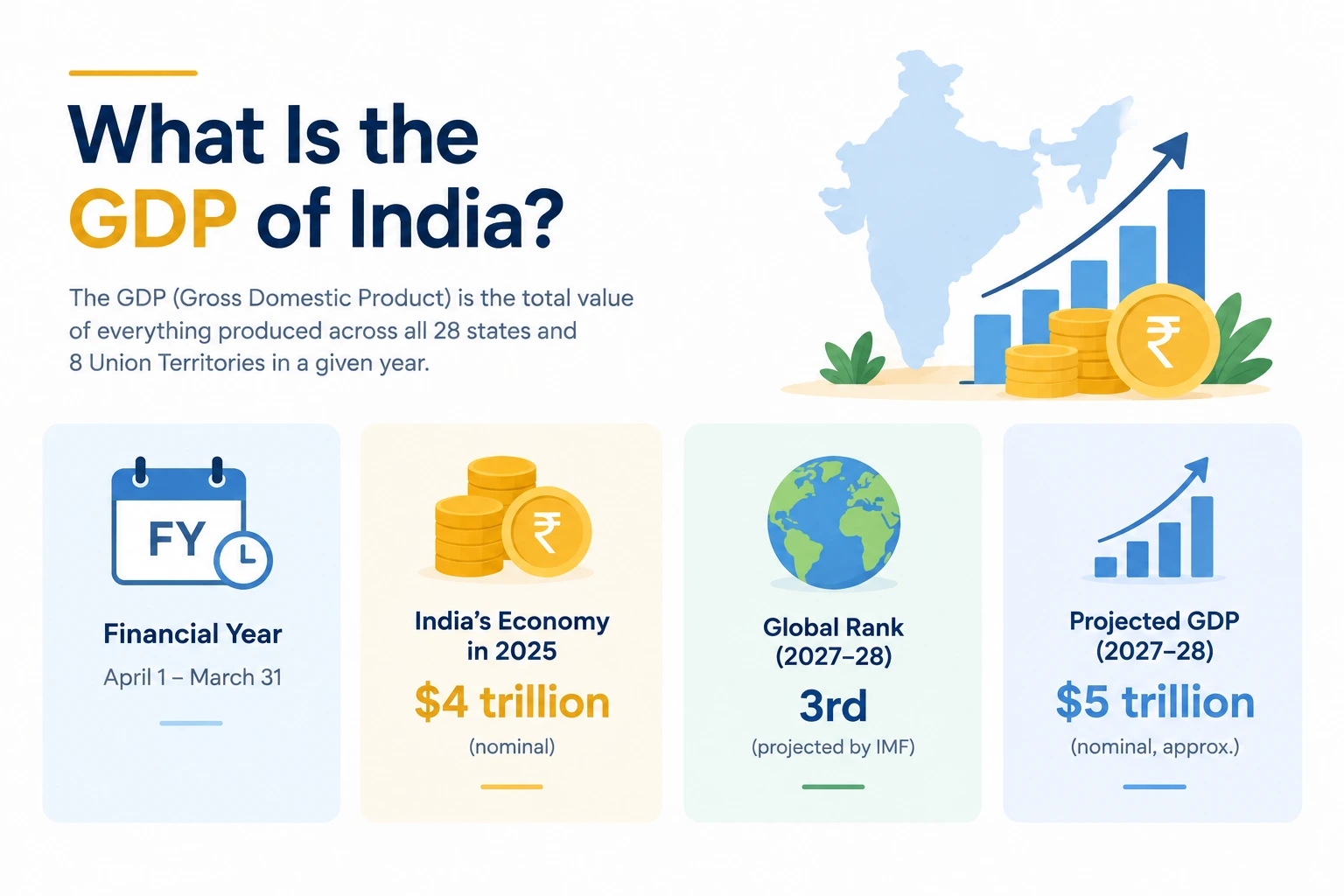











 ROI Calculator



