
How To Become A Procurement Manager (With Salary And Skills)
 June 4, 2026
 7 min read




Table Of Content
- How To Become A Procurement Manager?
- Procurement Manager Salary in India
- Skills Required To Become A Procurement Manager
- How Can Jaro Education Help You Build a Career in Procurement Management?
The procurement manager plays an essential role in deciding how a company can spend, save, negotiate, and make suppliers' relations. From manufacturing and retail to IT, healthcare, logistics, and construction, organisations need professionals who can manage purchasing strategically and commercially. If you are preparing to pursue a career in procurement management, this blog covers all the aspects. Let us get started!
 ChatGPT
 Perplexity
 Claude
 Grok
GrokHow To Become A Procurement Manager?
*spendflo.com
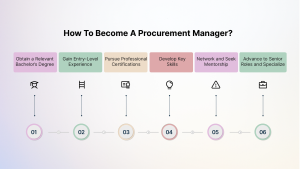
Here, you will understand the step-by-step path to becoming a procurement manager, from choosing the right education to gaining hands-on industry experience. This section also explains how practical skills, certifications, and leadership exposure can help you move into procurement manager jobs with confidence.
1. Start With a Relevant Educational Base
Most companies prefer candidates with a bachelor’s degree. The degree does not always have to say “procurement” or “supply chain” on it, but it should help you understand how businesses work. Common academic backgrounds include:
- Business Administration
- Commerce
- Finance
- Supply Chain Management
- Logistics
- Economics
- Operations Management
- Engineering, especially for technical procurement roles
For example, someone working in construction procurement may need to understand cement grades, steel requirements, machinery, or site timelines. In IT procurement, the discussion may move toward software licences, cloud tools, hardware, and vendor contracts. So, the degree gives you a base. The real learning starts when you begin applying it to actual business purchases.
2. Get Into an Entry-Level Procurement or Supply Chain Role
This is where the job starts making sense. You may begin as a purchase executive, procurement assistant, sourcing associate, vendor management executive, inventory coordinator, or supply chain associate. These roles may look basic at first, but they teach you how procurement actually moves inside a company.
Here is what you usually learn in the early years:
| What You Handle | What It Teaches You |
| Purchase requests | How internal teams raise requirements |
| Vendor quotations | How pricing and supplier comparison work |
| Purchase orders | How buying is documented and approved |
| Delivery follow-ups | How delays affect operations |
| Payment coordination | How finance and procurement connect |
| Supplier communication | How to manage expectations professionally |
Here, you begin to notice which vendors respond quickly, which teams give incomplete requirements, and where delays usually happen. That ground-level exposure matters later.
3. Learn How Strategic Sourcing Works
At some point, procurement stops being only about getting quotes. You start asking better questions, like:
- Is this supplier reliable?
- Can they handle larger volumes?
- Are we depending too much on one vendor?
- Will the cheapest option create quality problems later?
Strategic sourcing is about looking at the full picture before choosing a supplier. Price matters, of course, but it is not the only thing that matters. A low-cost vendor who misses delivery twice a month may end up costing the business more than a slightly expensive but dependable supplier.
Basically, a procurement manager needs to compare:
- Cost
- Quality
- Delivery timelines
- Supplier capacity
- Payment terms
- Compliance requirements
- Long-term reliability
This is where judgement becomes important. You are not just buying for today; you are protecting tomorrow’s operations too.
4. Build Confidence in Vendor and Contract Management
Vendors can make your work easier or very difficult. That is why supplier management becomes a serious part of procurement as you grow. A good procurement professional tracks vendor behaviour over time. Not just the price they offer, but how they actually perform.
Ask simple but useful questions:
- Do they deliver when promised?
- Do they respond when something goes wrong?
- Are their invoices accurate?
- Do quality issues keep coming up?
- Are they flexible during urgent requirements?
Then comes the contract side. Procurement managers often work with pricing clauses, renewal terms, penalties, delivery conditions, service-level agreements, warranties, and payment timelines. You do not need to be from a legal background, but you should know when a contract looks risky. One missed clause can become an expensive problem later.
5. Get Comfortable With Procurement Tools and Data
Modern procurement is not managed only through calls, emails, and spreadsheets anymore. Many companies now use ERP systems, e-procurement platforms, supplier portals, inventory tools, and spend dashboards. Some commonly used tools include:
- SAP
- Oracle
- Coupa
- Microsoft Excel
- Power BI
- Supplier management platforms
- Inventory management systems
But knowing the tool name is not enough. You should know how to read what the data is telling you. For instance, if one supplier’s prices have slowly increased over six months, would you notice? If emergency purchases are happening too often, would you know which department is causing them? If a vendor delivers late every third order, would that show up in your review? This is why data analysis matters. It helps procurement managers catch patterns before they become bigger issues.
6. Get Relevant Certifications
Certifications can help, but they should not be treated like shortcuts. They work best when they add structure to the experience you already have. You can consider certifications in:
- Supply Chain Management
- Procurement Management
- Contract Management
- Project Management
- Business Analytics
- Operations Management
If you are moving from a general business, finance, or operations role into procurement, certifications can help show that you understand the field more formally. If you are already working in procurement, they can support your move into managerial roles.
Still, employers will look for proof of application. Have you handled vendors? Reduced costs? Improved a process? Managed a difficult supplier? Supported contract discussions? That is what makes your profile stronger.
7. Start Thinking Like a Manager Before You Become One
The title may come later, but the mindset has to start earlier. A procurement manager is expected to think beyond individual purchase requests. You need to understand how one buying decision affects budgets, timelines, suppliers, internal teams, and customers. At this stage, try to build habits such as:
- Documenting vendor discussions clearly
- Tracking savings or cost improvements
- Understanding why approvals get delayed
- Learning how finance reviews procurement decisions
- Observing how senior managers negotiate
- Taking ownership of small process improvements
These small habits add up. Over time, they show that you are not just completing tasks; you are thinking about the business impact of procurement. And that is usually when procurement manager jobs start becoming more realistic.
Procurement Manager Salary in India
Here is the salary range of a procurement manager in India based on experience level:
| Category | Expected Salary Range |
| Entry-level procurement roles | ₹3 LPA – ₹6 LPA |
| Assistant/Deputy Procurement Manager | ₹6 LPA – ₹12 LPA |
| Procurement Manager | ₹8 LPA – ₹24 LPA |
| Senior Procurement Manager | ₹17 LPA – ₹35 LPA+ |
Here is how procurement manager salaries may vary across different city tiers in India:
| City Tier | Cities | Salary Outlook |
| Tier 1 | Mumbai, Bengaluru, Delhi NCR, Chennai, Hyderabad, Pune | Higher salary range due to large corporates, global sourcing, IT, manufacturing, and infrastructure demand |
| Tier 2 | Ahmedabad, Jaipur, Indore, Coimbatore, Kochi, Chandigarh | Moderate salary range with growing opportunities in manufacturing, logistics, retail, and regional business hubs |
| Tier 3 | Smaller industrial towns and emerging business locations | Lower starting range, but good growth if the role involves plant procurement, vendor development, or specialised materials |
Professionals with strong negotiation skills, ERP knowledge, vendor management experience, contract understanding, and data-driven sourcing ability usually have better salary growth. In senior roles, salary can increase sharply when the professional manages large budgets, strategic suppliers, multi-location procurement, or international sourcing.
Skills Required To Become A Procurement Manager
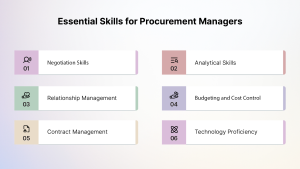
A procurement manager needs a mix of commercial, analytical, and people-facing skills. The role is not only about buying at the lowest price; it is about making smart decisions that protect quality, timelines, and business continuity.
*spendflo.com
Key skills include:
- Negotiation skills to secure better pricing, payment terms, and vendor agreements
- Vendor management to evaluate supplier performance and reliability
- Analytical thinking to study costs, spending patterns, and purchase trends
- Contract awareness to understand clauses, renewals, penalties, and risks
- Communication skills to coordinate with finance, operations, legal, and suppliers
- ERP and procurement tool knowledge to manage data-backed purchasing decisions
- Leadership skills to guide teams and improve procurement processes
How Can Jaro Education Help You Build a Career in Procurement Management?
A strong procurement career is built on sharper decision-making, better negotiation, supply chain awareness, and the confidence to work with multiple stakeholders. Jaro Education helps professionals hone these skills through programmes from top B-schools. These courses support both technical understanding and leadership growth:
- Advanced Certificate Programme in Smart Supply Chain Management & Transformation by IIM Kozhikode: If you want to understand procurement within the larger supply chain ecosystem, this programme can be a highly relevant choice. It connects well with areas such as sourcing strategy, supplier coordination, logistics, cost optimisation, and transformation-led supply chain thinking.
- Advanced Executive Programme in Global Supply Chain Management & Transformation, IIT Bombay: This course provides an extensive outlook on business transformation and global supply operations, making it ideal for experts seeking to manage large-scale systems, intricate networks, or international vendors.
- Executive Programme in Operations Management and Analytics by CEP, IIT Delhi: If your goal is to become stronger at process improvement, analytics, and operational efficiency, this programme can support the analytical side of procurement decision-making.
For those starting and looking for entry-level exposure before committing to a full-fledged management or supply chain programme, at Jaro Education, we also have free courses.
- Stakeholder Communication & Negotiation Skill Sets
- Leadership in Crisis Management
These courses can be a practical first step for learners who want to understand the workplace-facing side of procurement before moving into advanced learning.




Conclusion
It is not enough just to know how to procure goods or bargain for prices when becoming a procurement manager. This job demands business acumen, supplier knowledge, technological savvy, and sound judgment. The right qualifications, experience, credentials, and management abilities will enable you to establish a successful and fulfilling career as a procurement manager.
Frequently Asked Questions

Related Courses
Explore our programs
 Admission Open
 Admission Open
 Admission OpenAdmission Open
Find a Program made just for YOU
We'll help you find the right fit for your solution. Let's get you connected with the perfect solution.
Is Your Upskilling Effort worth it?
 ROI Calculator

Are Your Skills Meeting Job Demands?
Try our Skill Gap tool
Experience Lifelong Learning and Connect with Like-minded Professionals
Explore Jaro Connect
