PCB Career Options After 12th: Courses, Jobs & Career Scope
J
By Manya Tohani
September 21, 20267 min read
Published on September 21, 2026
SHARE THIS ARTICLE
Table Of Content
Why Explore PCB Career Options After 12th?
Career Options After 12th Science PCB
Courses After 12th Science PCB
PCB Student Career Options in Research and Life Sciences
Key Insights
PCB students can explore several career paths beyond medicine, including pharmacy, biotechnology, microbiology, psychology, nutrition, nursing, and physiotherapy.
Courses after 12th science PCB also include agriculture, environmental science, food science, zoology, and botany, depending on eligibility and course requirements.
Students can choose between people focused careers in healthcare and psychology or laboratory and research oriented fields based on their interests and preferred work environment
Communication, analytical thinking, research, digital skills, teamwork, and time management can complement academic knowledge and support career development.
In this blog, you'll learn about PCB career options, courses, job opportunities, research and life science pathways, career scope, and how to choose the right option after Class 12.
Choosing Science with Physics, Chemistry, and Biology (PCB) in Class 12 can open the door to far more careers than just becoming a doctor. Fromhealthcare and pharmacy to biotechnology, nutrition, psychology, environmental science, and research, there are several PCB career options for students with different interests and career goals.
For many students, the biggest question comes after Class 12: What should I do next? While medical courses remain a popular choice, they are not the only path available. The right career can depend on your interests, strengths, entrance exam plans, and the kind of work you see yourself doing in the future.
If you are exploring career options after 12th science PCB, understanding the available courses and their career scope can make this decision easier. Some courses can lead to clinical roles, while others can open opportunities in laboratories, research, healthcare management, food science, or environmental fields.
In this blog, we will explore popular courses after 12th science PCB, job opportunities, career scope, and different PCB student career options to help you understand what you can pursue after Class 12.
The PCB stream builds a foundation in subjects related to life sciences, human health, living organisms, and the natural world. This knowledge can be useful across several industries.
Students who studied PCB can explore undergraduate programs in healthcare, life sciences, pharmacy, biotechnology, agriculture, psychology, nutrition, and other related fields.
The right choice depends on factors such as your interests, academic strengths, preferred work environment, and long-term career plans.
For example, a student who enjoys interacting with people may consider healthcare or psychology, while someone interested in experiments and scientific discovery may prefer biotechnology or research.
Career Options After 12th Science PCB
There are several career options after 12th science PCB beyond the traditional medical route. Here are some popular areas students can explore.
1. Medicine and Healthcare
Medicine remains one of the most widely considered options for PCB students. Students interested in diagnosing illnesses, treating patients, and working in healthcare can explore medical education.
Depending on their interests and eligibility, students may consider programs related to medicine, dentistry, nursing, physiotherapy, and other healthcare fields.
Healthcare also includes many roles beyond doctors. Hospitals, clinics, diagnostic centers, rehabilitation facilities, and healthcare organizations require professionals with different areas of expertise.
2. Pharmacy
Pharmacy can be another option for students interested in medicines, healthcare, and pharmaceutical science.
Students can explore undergraduate pharmacy programs and learn about medicines, drug development, pharmaceutical processes, and related areas.
After completing the required education, professionals can explore opportunities in pharmacies, pharmaceutical companies, hospitals, research organizations, and other healthcare settings.
3. Biotechnology
If you enjoy Biology but are also interested in laboratory work and scientific research, biotechnology can be worth exploring.
Biotechnology combines biological sciences with technology to study and develop applications involving living organisms and biological processes.
Students can explore undergraduate programs in biotechnology and related life science fields. Career opportunities may be available in research laboratories, pharmaceutical companies, biotechnology organizations, food industries, and other scientific fields.
4. Microbiology
Microbiology focuses on microorganisms such as bacteria, viruses, fungi, and other microscopic forms of life.
It can be an interesting option for students who enjoy Biology and laboratory based learning. Students may pursue undergraduate courses in microbiology and later specialize in areas connected with healthcare, research, food science, pharmaceuticals, or environmental studies.
With further education and experience, microbiology graduates can explore roles in laboratories, research organizations, pharmaceutical companies, and other related industries.
5. Psychology
Psychology is another growing area that students from the PCB stream can consider.
The field focuses on human behavior, thoughts, emotions, and mental processes. Students interested in understanding people and human behavior may find psychology interesting.
A bachelor’s degree can provide a foundation for further study in areas such as counseling, organizational psychology, educational psychology, or other specializations. Specific career roles may require postgraduate education and relevant professional qualifications.
6. Nutrition and Dietetics
Students interested in food, health, and wellness can consider nutrition and dietetics.
These fields focus on how food and nutrition influence health and well-being. Students can explore undergraduate programs related to nutrition, dietetics, food science, or related subjects.
Career opportunities may be available in hospitals, wellness organizations, fitness centers, food companies, research organizations, and other health related settings, depending on the qualification and role.
7. Nursing
Nursing is another important healthcare career for PCB students. Nurses play an important role in patient care and work closely with doctors and other healthcare professionals.
Students interested in healthcare and direct patient interaction can explore nursing programs after Class 12.
Career opportunities can exist across hospitals, clinics, community healthcare settings, and other healthcare organizations.
8. Physiotherapy
Physiotherapy can be considered by students who are interested in healthcare, physical movement, rehabilitation, and patient recovery.
Physiotherapists work with people dealing with injuries, physical limitations, and movement related conditions. The career can involve working in hospitals, rehabilitation centers, sports settings, clinics, and other healthcare environments.
Students should check the eligibility requirements of the specific program and institution before applying.
The availability of programs, admission requirements, entrance examinations, and eligibility criteria can vary by university and course. Students should always check the latest requirements before applying.
Free Courses
Stakeholder Communication & Negotiation Skill Sets
PCB Student Career Options in Research and Life Sciences
Not every PCB student wants a patient facing career. If you enjoy experiments, observation, analysis, and scientific discovery, research and life sciences may offer interesting possibilities.
Students can explore areas such as biotechnology, microbiology, zoology, botany, genetics, environmental science, and other life science disciplines.
With higher education and specialization, students can work toward careers in research laboratories, academic institutions, pharmaceutical organizations, biotechnology companies, environmental organizations, and scientific research.
Research based careers often require students to continue their education beyond an undergraduate degree. Therefore, it is useful to understand the education pathway before choosing a specialization.
PCB Student Career Options in Agriculture and Environmental Science
Agriculture is another area that PCB students can explore. Modern agriculture involves science, biology, technology, soil studies, crop management, and environmental understanding.
Students can consider programs related to agriculture, horticulture, food science, or related fields.
Environmental science is another option for students interested in nature, ecosystems, pollution, conservation, and sustainability. Career opportunities may involve environmental organizations, research institutions, consulting, laboratories, and other related areas depending on qualifications.
These fields can be suitable for students who want to connect their interest in Biology with real world environmental and agricultural challenges.
How to Choose the Right PCB Career Option?
With so many choices available, selecting a course can feel confusing. Instead of focusing only on salary or popularity, students should think about what kind of work they actually enjoy.
Start by asking a few simple questions:
What subjects do I enjoy most? If you enjoy human biology and healthcare, medical or allied healthcare fields may interest you. If you enjoy laboratory experiments, biotechnology or microbiology could be worth exploring.
Do I prefer working with people or data and experiments? Healthcare and psychology can involve regular interaction with people, while research and laboratory careers may involve more experimental and analytical work.
Am I comfortable pursuing higher education? Some specialized careers require postgraduate education or additional professional qualifications. Understanding this before choosing a course can help you plan better.
What kind of workplace do I prefer? Think about whether you would prefer hospitals, laboratories, research institutions, companies, schools, outdoor environments, or other professional settings.
Skills That Can Help PCB Students Build Their Careers
Academic knowledge is important, but students can also develop skills that support their future careers.
Communication skills can be useful across healthcare, research, education, and corporate roles. Analytical thinking can help students understand scientific information and solve problems. Research skills can be valuable for laboratory and academic careers.
Students can also work on digital skills, teamwork,time management, presentation skills, and basic data handling. These skills can complement their academic qualifications and help them adapt to different professional environments.
Future Scope of PCB Career Options
The scope of PCB careers extends across healthcare, pharmaceuticals, biotechnology, research, agriculture, food, psychology, nutrition, and environmental science.
The growth of scientific research and healthcare services continues to create opportunities across different areas. At the same time, new technologies are changing how professionals work in fields such as biotechnology, medical research, diagnostics, and life sciences.
This makes it important for students to look beyond a single career title. A degree can provide a foundation, while specialization, practical experience, additional qualifications, and continuous learning can help shape a career over time.
Choosing PCB after Class 12 gives students access to several academic and professional pathways. While medicine is a well known choice, it is not the only direction available.
From pharmacy and nursing to biotechnology, psychology, nutrition, microbiology, agriculture, and environmental science, there are many PCB career options to explore.
The best starting point is to understand your interests, identify the type of work you enjoy, compare relevant courses, and check the eligibility requirements of the programs you are considering.
A thoughtful decision after Class 12 can help you build a career that matches your interests rather than simply following the most common path.
Frequently Asked Questions
Students can explore pharmacy, nursing, physiotherapy, biotechnology, microbiology, psychology, nutrition, agriculture, environmental science, food science, zoology, and botany, depending on their interests and eligibility.
Some options include medicine, pharmacy, biotechnology, microbiology, nursing, physiotherapy, psychology, nutrition, agriculture, environmental science, food science, zoology, and botany.
Yes. PCB student career options also include biotechnology, research, agriculture, environmental science, food science, psychology, zoology, botany, and other life science fields.
Consider your interests, strongest subjects, preferred work environment, willingness to pursue higher education, and the eligibility requirements of the course. Comparing different career paths can help you make a more informed choice.
Manya Tohani
Personal Growth Mentor
Manya Tohani is a Personal Growth Mentor and content strategist, helping individuals build strong personal brands and accelerate career growth. With 8M+ impressions and experience mentoring students, she empowers others through actionable guidance, resilience, and real-world insights.

 September 21, 2026
 7 min read





 Key Insights
 ChatGPT
 Perplexity
 Claude
 Grok
Grok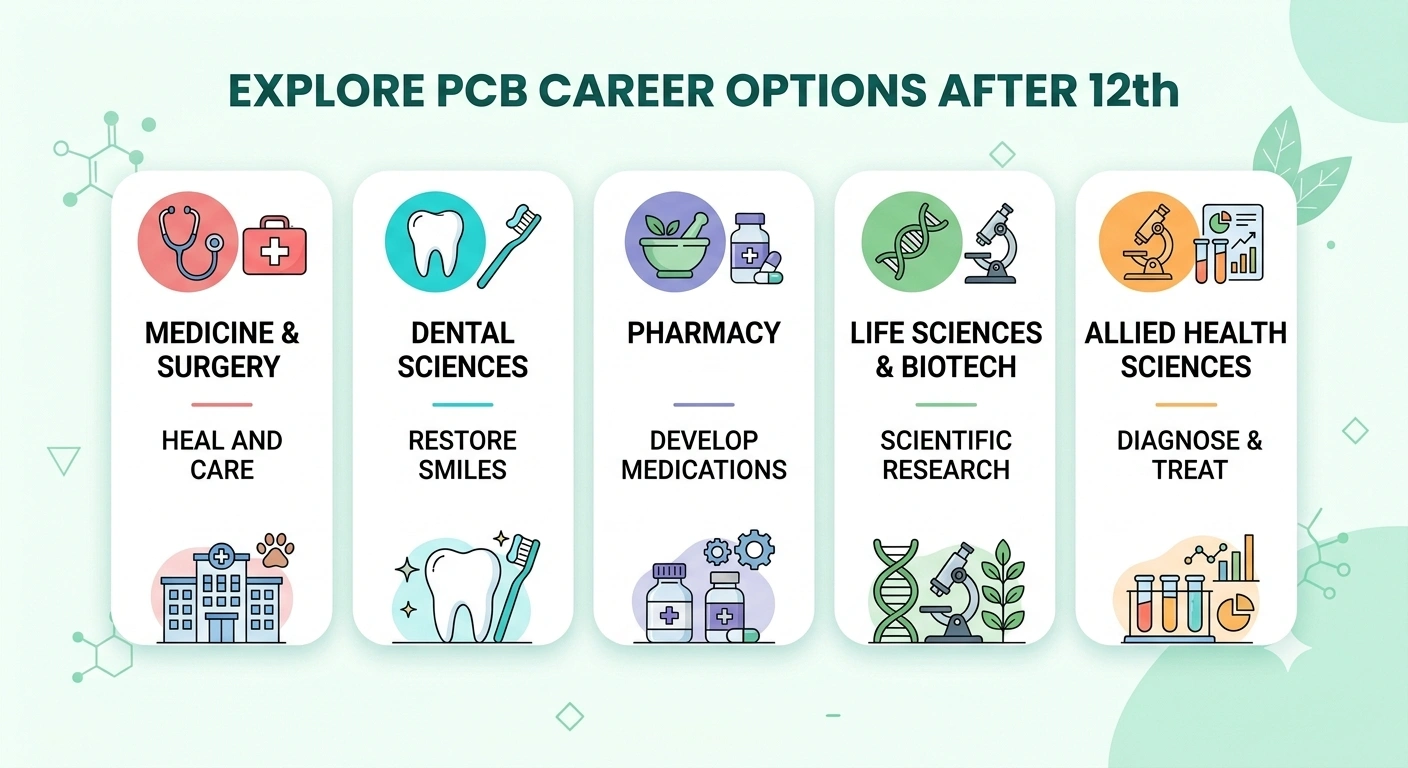







 ROI Calculator