 HOME > BLOG > Career Development > What Is the Best Note-Taking Method for Students? 7 Methods Compared
What Is the Best Note-Taking Method for Students? 7 Methods Compared
 October 21, 2026
 9 min read





Table Of Content
- Why Your Note-Taking Method Matters
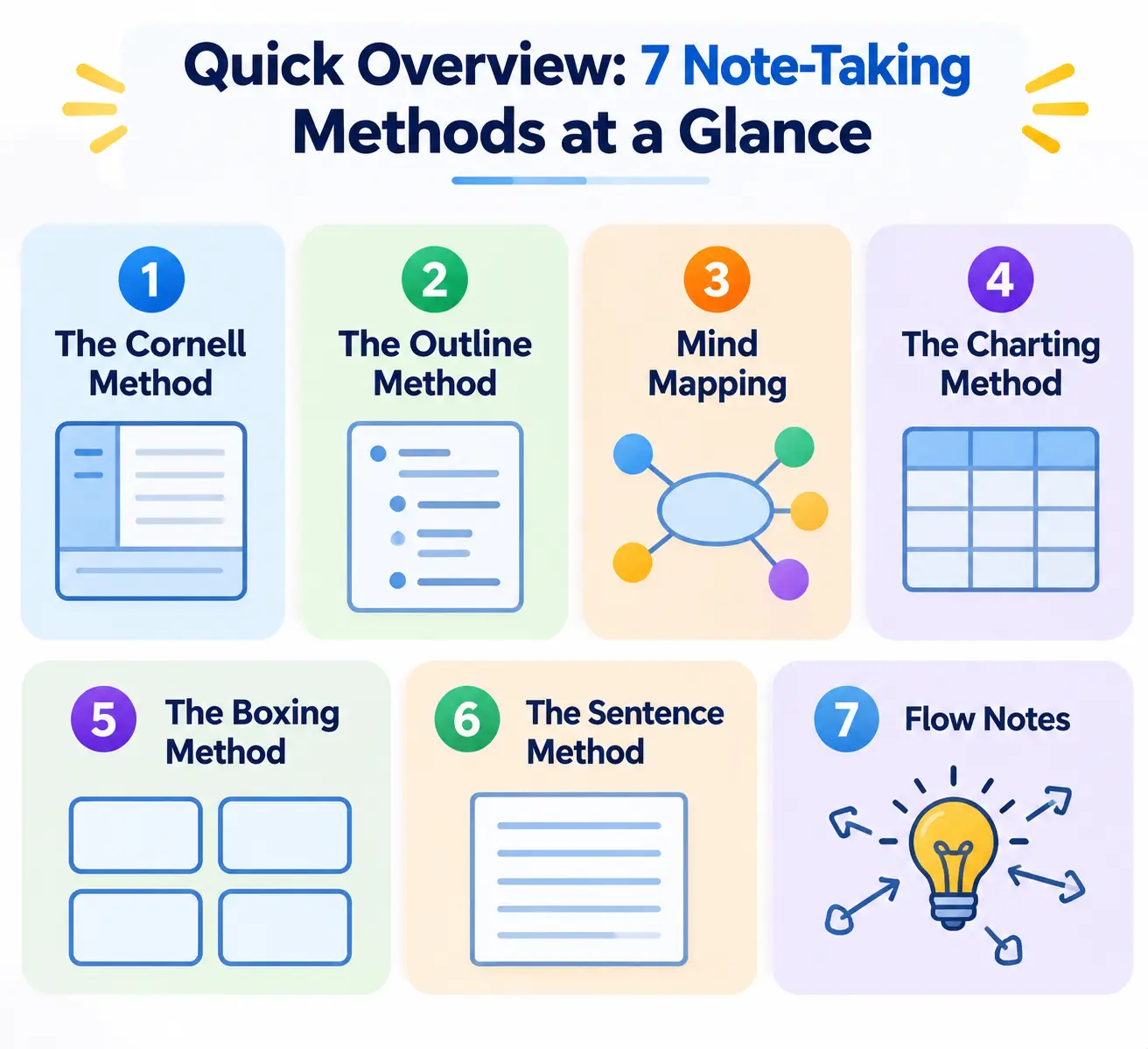
- Quick Overview: 7 Note-Taking Methods at a Glance
- What Is the Best Note-Taking Method?
- Handwriting vs Typing: Does It Matter?
 Key Insights
- The right note-taking method depends on your learning style, subject, and classroom environment. Effective notes help improve understanding, memory, attention, and revision.
- The seven note-taking methods include Cornell, Outline, Mind Mapping, Charting, Boxing, Sentence, and Flow Notes, each with specific benefits and limitations.
- The Cornell method combines main notes, cue questions, and summaries, while mind mapping helps visual learners understand connections between ideas.
- Handwriting encourages summarizing and deeper understanding, while typing offers speed, easy editing, and searchable notes. Reviewing notes within 24 hours and testing yourself can support better retention.
- In this blog, you'll learn how to compare seven note-taking methods, choose the right technique for your learning style and subject, improve your note-taking habits, and find a method that works best for you.
Let's be honest. Most of us have been there: you sit through a lecture, scribble furiously, and then a week later you open your notebook and have no idea what any of it means. The handwriting is a mess, the pages are a wall of text, and somehow you remember the professor's joke better than the formula.
The problem usually is not you. It is the way you are taking notes. Choosing the right note taking methods can completely change how much you remember, how fast you revise, and how stressed you feel before exams.
So, what is the best note taking method for students? The short answer: it depends on you, your subject, and how you like to think. The longer answer is what this blog is all about. We will compare seven popular note taking techniques, show you who each one suits, and help you pick the one that fits your life.
 ChatGPT
 Perplexity
 Claude
 Grok
Why Your Note-Taking Method Matters
Notes are not just a record of what was said. Good notes help you:
- Pay attention in class, because you are actively listening instead of zoning out.
- Understand ideas, since you have to process information to write it down in your own words.
- Remember more, because reviewing organized notes is far more effective than rereading a textbook.
- Revise faster, which is a lifesaver when exams are around the corner.
Studies on learning generally suggest that actively processing information, such as summarizing, questioning, and organizing it, helps memory more than passively copying it down. That is the idea behind most of the methods below. They are different ways of making your brain do a little more work while you write.
Quick Overview: 7 Note-Taking Methods at a Glance
Before we go deep, here is a quick snapshot.
| Method | Best for | Main strength | Main drawback |
| Cornell Method | Lectures, exam prep | Built-in revision system | Needs setup time |
| Outline Method | Structured subjects | Clean and organized | Hard when lectures jump around |
| Mind Mapping | Visual learners, brainstorming | Shows connections | Messy for fast lectures |
| Charting Method | Comparisons, facts, data | Easy to compare | Not for every topic |
| Boxing Method | Textbooks, grouped ideas | Clear sections | Needs planning |
| Sentence Method | Fast-paced classes | Simple and quick | Can be hard to review |
| Flow Notes | Understanding concepts | Encourages thinking | Takes practice |
Now let’s look at each one properly.
1. The Cornell Method
The Cornell method is one of the most recommended note taking techniques for students, and for good reason. It was developed at Cornell University and is designed to help you both take notes and review them.
How it works: Divide your page into three sections.
- Right side (main notes): Write your notes during the lecture.
- Left side (cue column): After class, add keywords, questions, or prompts that match your notes.
- Bottom (summary): Write a short summary of the page in your own words.
Pros:
- Builds revision into the process
- The cue column turns your notes into a self-quiz
- Works for almost any subject
Cons:
- Takes some time to set up
- Requires you to go back and add cues and summaries after class
Best for: Students who want one reliable system for lectures and exam prep. If you want a safe answer to “what is the best note taking method,” Cornell is a strong candidate.
2. The Outline Method
The outline method is the one you probably learned in school without realizing it. You organize information using headings, subheadings, and indented bullet points.
How it works: Start with a main topic. Under it, add subtopics. Under those, add supporting details, each indented a little further. Numbers, letters, or dashes keep things tidy.
Pros:
- Neat and easy to read
- Shows how ideas relate to each other
- Great for subjects like history, law, or biology
Cons:
- Hard to follow if the lecturer jumps between topics
- Does not show relationships between ideas as visually as other methods
Best for: Students who like order and are taking notes in well-organized classes or from textbooks.
3. Mind Mapping
If traditional notes make your eyes glaze over, mind mapping might be your new best friend. It is a visual method where you place the main idea in the center of the page and branch out into related ideas.
How it works: Write your central topic in the middle. Draw branches to major subtopics, then smaller branches for details. Colors, simple doodles, and keywords make it even more memorable.
Pros:
- Shows how ideas connect at a glance
- Fun and creative, which keeps you engaged
- Excellent for brainstorming, planning essays, and revising
Cons:
- Can get crowded and messy
- Hard to use in a fast-moving lecture
- Not ideal for subjects heavy on step-by-step processes
Best for: Visual learners and anyone who wants to see the big picture, especially during revision.
4. The Charting Method
The charting method uses tables to organize information into columns and rows. It is a fantastic option when you have to compare things.
How it works: Decide on categories first, such as event, date, cause, and effect. Make them column headings. Then fill in the details as the lecture goes on.
Pros:
- Makes comparisons easy
- Cuts down on writing because you only note key facts
- Super handy for revision
Cons:
- You need to know the structure in advance
- Does not work well for content that is not fact-based or comparative
Best for: Subjects with lots of facts, dates, definitions, or comparisons, such as history, science, and economics.
5. The Boxing Method
The boxing method is similar to the outline method, but with a visual twist. You group related ideas into boxes, so each box holds one topic.
How it works: As you read or listen, draw a box around each cluster of related information. Give each box a short title. Over time, you end up with neat, separate blocks on the page.
Pros:
- Keeps topics clearly separated
- Easy to spot what belongs where
- Works well with printed handouts and textbooks
Cons:
- Takes planning and good use of space
- You can run out of room if a topic gets bigger than you expected
Best for: Students dealing with lots of separate topics, especially while reading textbooks or studying from slides.
6. The Sentence Method
This is the simplest of all the note taking methods. You write every new thought or fact on its own line, as a short sentence, one under the other.
How it works: No fancy structure, no bullets, no indents. Just a new line for each new idea. You can number them if you like.
Pros:
- Super fast and easy
- Captures a lot of information in a fast-paced class
- No setup needed
Cons:
- Looks plain and can feel overwhelming to review
- Does not show how ideas connect
- Easy to slip into copying everything word for word
Best for: Fast classes where the speaker talks quickly. A good tip is to reorganize these notes later using a more structured method.
7. Flow Notes
Flow notes are less about copying and more about thinking. Instead of writing down everything verbatim, you listen, process, and write down your understanding using arrows, doodles, short phrases, and your own words.
How it works: As you listen, jot down key ideas and link them with arrows and diagrams. You are building a picture of how things connect rather than a transcript.
Pros:
- Encourages real understanding
- Makes you an active listener
- Feels more natural and personal
Cons:
- Takes practice to get comfortable
- May feel uncomfortable if you like very neat notes
- Might miss details if you are not confident in the subject
Best for: Students who want to understand concepts deeply, not just record them.
What Is the Best Note-Taking Method?
Here is the honest truth: there is no single best note taking method that works for everyone. The right choice depends on three things.
- Your learning style. Visual learners tend to enjoy mind maps and flow notes. Students who prefer order and structure usually like outlines and Cornell notes. If you like comparing facts, charts will probably click.
- Your subject. Different subjects ask for different note taking techniques:
- Science and math: Cornell, outline, and charting work well. Add diagrams and worked examples.
- History and social sciences: Outline, Cornell, and charting help with dates, causes, and comparisons.
- Literature and languages: Mind maps and flow notes help with themes, characters, and connections.
- Business and economics: Charting and Cornell are great for frameworks, definitions, and comparisons.
- The class itself. A slow, well-organized lecture suits outlines. A fast, chaotic one suits sentence notes that you tidy up later. A discussion-based class might suit flow notes.
If you want a simple starting recommendation, try the Cornell method for lectures and mind maps for revision. This combo gives you structure for learning and visual connections for memory.





Handwriting vs Typing: Does It Matter?
This is a big debate among students. Some research suggests that handwriting notes can lead to better understanding, partly because writing by hand forces you to summarize instead of copying everything. Typing, on the other hand, is faster and easier to search, edit, and organize.
So which one should you choose?
- Choose handwriting if you want to focus deeply, understand concepts, and avoid distractions.
- Choose typing if you need speed, searchable notes, or easy reorganizing.
- Mix both: Many students handwrite during class and type up a cleaner version afterward, which doubles as a revision session.
If you do type, use a simple notes app, and close your social media tabs. Your future self will thank you.
Tips to Make Any Note-Taking Method Work Better
Even the best method will not help much if the habits around it are shaky. Here are a few tips that work with almost any of the note taking methods above.
Prepare before class. Skim the topic or reading beforehand. You will follow the lecture much more easily.
Use your own words. Paraphrasing forces your brain to process the idea. Copying does not.
Do not write everything. Focus on key ideas, examples, definitions, and anything the teacher stresses. Listen for phrases like “this is important” or “this will be on the test.”
Use abbreviations and symbols. Create your own shorthand, such as “w/” for with, “b/c” for because, and arrows for cause and effect.
Leave some blank space. You will want room to add questions, corrections, or extra details later.
Review within 24 hours. A quick review the same day helps you remember far more than waiting until exam week. Even ten minutes makes a difference.
Test yourself. Cover your notes and try to recall the main points. Turn headings or cue-column prompts into questions.
Add questions and connections. Write down what you do not understand. Ask your teacher, or search for the answer later.
Keep notes organized. Date your pages, label your subjects, and keep everything in one place, whether in a notebook or an app.
How to Find Your Perfect Method: A Simple Experiment
Still unsure? Try this easy plan.
- Pick two methods that sound appealing. For example, Cornell and mind mapping.
- Use each for two weeks in the same class, or one method per class.
- Review your notes at the end of each week. Which ones are easier to understand? Which are quicker to revise from?
- Pay attention to how you feel. Were you more focused? Less stressed? Did you remember more?
- Keep the winner, or combine the best parts of both.
Many students end up with a personal hybrid system, and that is perfectly fine. The goal is not to follow rules perfectly. The goal is to learn better.
Final Thoughts
There is no magic formula, but there is definitely a method out there that fits you. The best note taking method is the one you will actually use, review, and learn from. Try the Cornell method if you want structure, mind maps if you think visually, charts if you love comparisons, and flow notes if you want to dig into understanding.
Start small, stay consistent, and tweak as you go. Great notes are not about perfect handwriting or beautiful layouts. They are about turning a confusing lecture into something your brain can hold on to.
Frequently Asked Questions
Some research suggests handwriting can improve understanding because it encourages summarizing rather than copying. Typing is faster and easier to organize and search. Many students get the best of both by handwriting in class and typing up a cleaner version later.
Use abbreviations and symbols, write short phrases instead of full sentences, and focus on key ideas rather than every word. The sentence method or a simple outline works well for fast lectures. You can also tidy and reorganize your notes after class.
A short review within 24 hours of class is a great habit, followed by regular quick reviews each week. Spacing out your revision, instead of cramming everything the night before, generally helps information stick better.

Related Courses
Explore our programs




Find a Program made just for YOU
We'll help you find the right fit for your solution. Let's get you connected with the perfect solution.
Is Your Upskilling Effort worth it?
 ROI Calculator


Are Your Skills Meeting Job Demands?
Try our Skill Gap tool
Experience Lifelong Learning and Connect with Like-minded Professionals
Explore Jaro Connect
