Why NLP Skills are the Ultimate Differentiator for Top 10 B-Schools in India
10 Beginner NLP Project Ideas to Build Your Foundation
Advanced NLP Project Topics for Final Year Students
Implementation Guide: From Code to MBA Application
Natural Language Processing (NLP) sits at the intersection of human communication and machine intelligence—transforming raw text and speech into actionable business insights. For aspiring leaders targeting top B-schools in India, understanding and applying NLP isn't just a technical skill anymore. It's a strategic differentiator.
Modern MBA curricula have shifted decisively towards data-driven decision-making. Business problems today — from customer churn prediction to supply chain disruption — demand leaders who can interpret, question, and act on data. NLP powers some of the most visible applications in that landscape: sentiment analysis for brand monitoring, automated contract review, and chatbot development that redefines customer experience at scale. These aren't abstract concepts; they're the tools reshaping how companies compete.
A strong NLP project portfolio signals something admissions committees genuinely value: the ability to translate complexity into clarity.
The thesis here is straightforward. Whether you're a beginner writing your first text classifier or a final-year student building a multi-model pipeline,NLP projects demonstrate analytical rigor, business awareness, and technical fluency — all in a single portfolio piece. They show you can work with messy, unstructured data and still surface meaningful conclusions.
This article maps that journey deliberately: starting with accessible beginner projects that build foundational confidence, then scaling towards advanced final-year work that mirrors real-world business challenges. The next section explores exactly why elite institutions are paying close attention to candidates who arrive with this kind of technical edge.
Why NLP Skills are the Ultimate Differentiator for Top 10 B-Schools in India
The previous section established NLP as a core driver of business intelligence — now the question is, how does that translate into a real admissions advantage? The answer is more direct than most applicants realize.
The Tech-MBA Revolution Is Already Here
Elite institutions across the top 10 B-schools in India – from the IIMs at Ahmedabad, Bangalore, and Calcutta to XLRI, FMS Delhi, and ISB Hyderabad — are actively restructuring their curricula around data literacy. IIM Bangalore’s MBA program, for instance, now includes dedicated modules in analytics and machine learning as core, not elective, coursework. NIRF-ranked institutions increasingly view quantitative capability as a baseline expectation, not a bonus credential.
The shift towards “Tech-MBAs” is more than a trend — it’s a structural change in what top programs consider a competitive applicant.
Recruitment data reinforces this. Consulting firms, fintech companies, and FMCG giants recruiting from premier campuses are explicitly prioritizing candidates who can bridge strategic thinking with technical execution. A candidate who can discuss NLP techniques – and has actually deployed them in a project – signals precisely that capability.
What Admissions Committees Actually See
A well-executed NLP project communicates something a GMAT score alone cannot: analytical rigor applied to a real problem. It demonstrates that you can formulate a hypothesis, handle messy real-world data, interpret model outputs, and draw actionable conclusions. That’s the MBA skill set, practiced before the program even begins.
According toProjectPro, hands-on NLP work is among the most valued technical portfolios for students entering business and data roles. Admissions evaluators notice the same pattern.
The Portfolio Advantage
Where most applicants submit comparable GPAs and test scores, an NLP portfolio creates a concrete, memorable differentiator. It answers the implicit admissions question: What do you do with ambiguity?
The good news? You don’t need advanced expertise to start building that portfolio. The next section covers 10 beginner-friendly project ideas that can form exactly that foundation.
10 Beginner NLP Project Ideas to Build Your Foundation
Before diving into the complex architectures that impress admissions panels at top private B-schools in India, you need to walk before you run. These ten basic NLP projects build exactly the foundational fluency — in preprocessing, modeling, and evaluation — that makes advanced work credible. Each one is deployable, portfolio-ready, and teaches a distinct NLP concept.
Text Understanding & Classification
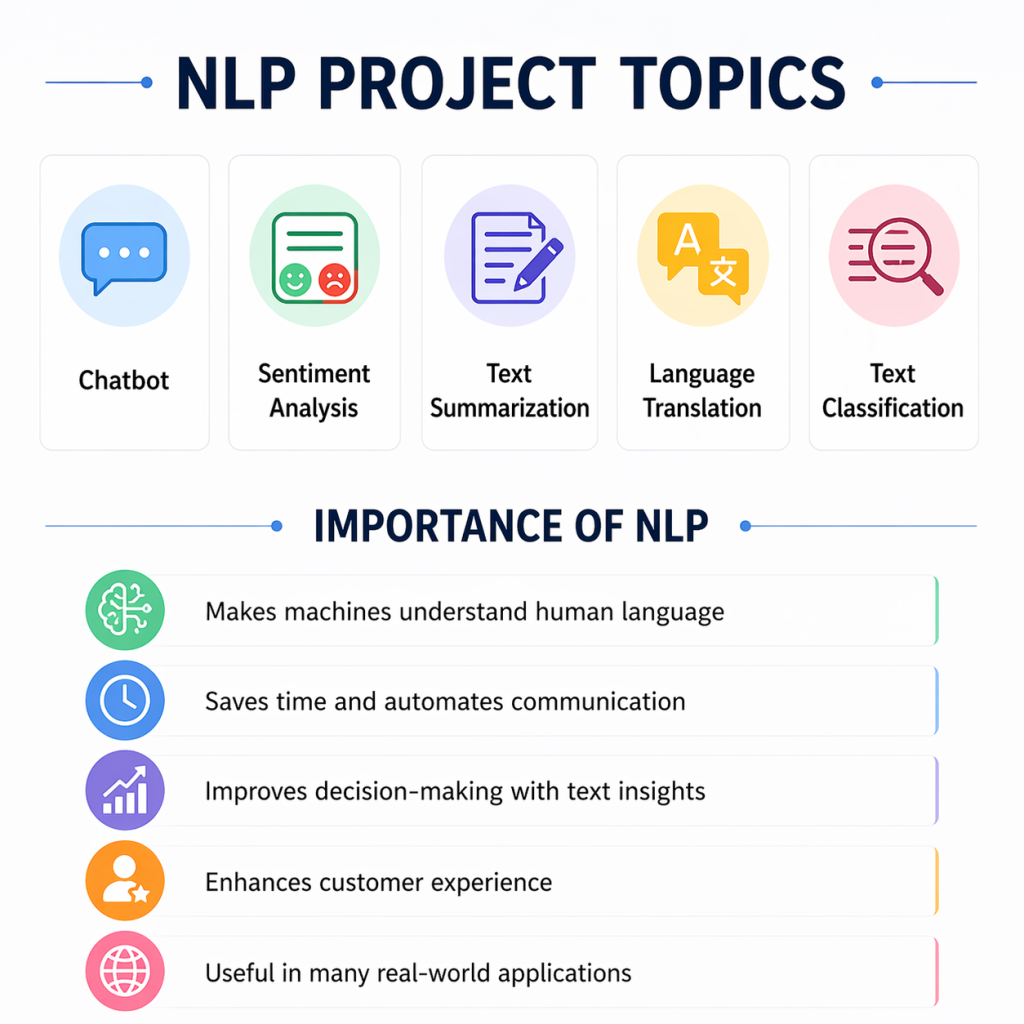
Sentiment Analysis is where most practitioners start, and for good reason. Using libraries like TextBlob or VADER, you can analyzesocial media posts to gauge public opinion on brands, policies, or product launches. It’s immediately relatable to business contexts and produces visual outputs that look compelling in a project portfolio.
Spam SMS Classification introduces the workhorse of probabilistic text modeling: Naive Bayes. Train it on a labeled SMS dataset, and you’ll understand feature extraction, bag-of-words representations, and precision-recall tradeoffs — core concepts every NLP practitioner needs to internalize.
Basic Rule-Based Chatbot using NLTK teaches you pattern matching, tokenization, and intent recognition without the complexity of neural networks. It’s a grounding exercise that clarifies why modern transformer-based chatbots are so powerful by showing you what rule-based systems can’t do.
Language Identification — Detecting whether a text snippet is Hindi, Tamil, Bengali, or English — is a particularly relevant project given India’s multilingual landscape. It introduces N-gram models and probabilistic classifiers in a context that’s directly tied to real-world business needs in emerging markets.
Generation & Transformation
Text Summarization builds a tool that condenses long articles into executive-ready briefs. Extractive summarization using TF-IDF scoring is beginner-accessible and has obvious enterprise value — think compliance teams or investment analysts processing hundreds of documents daily.
Keyword Extraction automates tag generation for blog posts or product listings. Implementing RAKE (Rapid Automatic Keyword Extraction) or simple frequency-based methods teaches you how machines “read” documents for relevance — a concept directly tied to search and recommendation systems.
Poem or Lyrics Generator using Markov Chains is one of the most engaging entry points into probabilistic text generation. It’s creative, shareable, and demonstrates a working understanding of sequence modeling before you encounter LSTMs or transformers.
Utility & Security Applications
Spell Checker built on Levenshtein distance introduces edit-distance algorithms — foundational knowledge for anyone working on search systems, OCR pipelines, or document processing workflows.
Email Header Analysis for phishing detection applies text pattern recognition to a cybersecurity use case. Parsing headers for suspicious sender domains, mismatched reply-to fields, and anomalous language flags teaches practical feature engineering skills.
Readability Scorer using metrics like the Flesch-Kincaid index – It measures text complexity for different audience levels. Legal tech, edtech, and content marketing teams actively use tools like this, making it one of the more immediately employable projects on this list.
A strong beginner NLP portfolio doesn’t just show what you built — it shows you understood why each architectural choice was made.
Each of these projects teaches a transferable concept. Master them, and you’ll have the technical vocabulary to tackle the kind of advanced NLP projects that genuinely differentiate final-year students competing for elite placements.
Advanced NLP Project Topics for Final Year Students
You’ve built your foundation with beginner projects — now it’s time to raise the bar. For students seriously targeting top B-schools in India for an MBA, the admissions committee isn’t just looking for Python fluency. They want evidence that you can solve real, messy, high-stakes business problems. The ten projects below do exactly that. Each one maps directly to an industry challenge that MBA programs spend semesters discussing.
Projects That Signal Business Acumen
Fake News Detection Using LSTMs: Misinformation is a billion-dollar problem for media, finance, and public health. Building a Long Short-Term Memory (LSTM) model that flags unreliable content demonstrates your grasp of sequential data patterns – and shows you understand why truth verification matters at scale. This project speaks directly to risk management and brand reputation, two pillars of the MBA curriculum.
Toxic Comment Classification: Online platforms lose advertising revenue and users when comment sections become hostile. A classifier that identifies harmful language — trained on multi-label categories like threats, insults, and obscenity — positions you at the intersection of AI ethics and community management. It’s technically demanding and socially relevant, a combination that resonates with b-school values.
Resume Parser for HR Automation: Recruiters at large firms screen thousands of applications per cycle. An NLP-powered resume parser that extracts structured fields — skills, education, work history — automates that first-pass review. According toTop NLP Projects for Final Year Students in 2025, this project type consistently ranks among the most practically valued by industry interviewers. The business ROI is immediately legible, which matters in an MBA interview.
Machine Translation for Regional Indian Languages: Building a sequence-to-sequence model that translates between Hindi, Tamil, Bengali, or other regional languages into English addresses a massive underserved market. India has 22 officially recognized languages — the commercial opportunity for localized digital services is enormous. This project signals cultural intelligence alongside technical depth.
Financial Sentiment Analysis: Can news headlines predict stock movements? Financial sentiment analysis extracts market signals from text data, using models trained on earnings calls, analyst reports, and financial news. It’s a project with a quantifiable outcome: prediction accuracy on real market data. As35 NLP Projects with Source Code You’ll Want to Build notes, financial NLP applications are among the most in demand by corporate recruiters.
Projects That Demonstrate Depth of Thinking
Plagiarism Detector Using Semantic Similarity: Traditional plagiarism tools match exact phrases. A semantic similarity-based detector uses sentence embeddings to catch paraphrased content — a significantly harder and more useful problem. This project shows you understand the difference between surface-level patterns and deeper meaning, which is exactly the kind of analytical thinking B-schools cultivate.
Voice-to-Text Meeting Minutes Automation: Corporate productivity tools that convert spoken meetings into structured, searchable notes represent a clear operational efficiency play. Combining automatic speech recognition with NLP summarization, this project bridges two high-demand domains and tells a compelling story about reducing friction in business workflows.
Named Entity Recognition (NER) for Clinical Notes: Healthcare documentation is notoriously unstructured. A custom NER model that extracts patient diagnoses, medications, and procedures from clinical text demonstrates domain-specific NLP expertise and the healthcare management track at many B-schools makes this directly applicable.
Question Answering System for Customer Support: Building a knowledge base QA system that responds to customer queries in natural language — without requiring keyword matches — directly addresses one of the biggest pain points in CRM and customer operations. The business use case practically writes itself.
Sarcasm Detection: Sarcasm is where sentiment analysis breaks down entirely and solving that problem reveals genuine NLP sophistication. Standard sentiment models confidently misclassify sarcastic text. A model that accounts for contextual irony demonstrates advanced understanding of language pragmatics, something that impresses both technical evaluators and b-school interviewers who appreciate nuanced thinking.
Each of these projects carries weight precisely because it’s hard and because it solves something real. But a strong project alone isn’t enough. How you document, present, and frame that work for an admissions panel is equally critical, which is exactly where the next section picks up.
Implementation Guide: From Code to MBA Application
Executing strong NLP project ideas is only half the battle. How you document, present, and position that work determines whether it actually moves the needle on your MBA application.
GitHub Documentation: Your Technical Credibility Signal
Admissions panels at top B-schools increasingly work alongside technical faculty during evaluations. A well-structured GitHub repository — with a clear README, reproducible setup instructions, and commit history — signals intellectual rigor beyond the project itself. In practice, sparse documentation often undercuts even technically impressive work. Include your problem statement, dataset source, methodology, and results in every repository. Screenshots and demo links add further credibility.
Translating Accuracy into Business Value
High accuracy scores in NLP models are impressive, but they don’t always reflect real-world impact. What truly matters is how those models solve business problems—like reducing manual effort, improving customer experience, or speeding up decision-making. Instead of focusing only on metrics like precision or F1-score, translate outcomes into tangible benefits such as time saved, cost reduced, or efficiency gained. This approach makes your NLP projects more relevant, especially for recruiters and business-focused roles.
Connecting Projects to B-School Core Values
Top private B-schools in India consistently emphasize analytical thinking, leadership, and real-world impact. Your project narrative should reflect all three. Explicitly link your work to themes like customer experience, operational efficiency, or data-driven decision-making — language that resonates across domains like healthcare, fintech, and e-commerce.
The 1-Page Project Summary
Create a concise portfolio document covering: problem context, tools used, key results, and business implications. One page forces clarity and prioritization — skills B-schools actively look for. As the next section explores, building this habit now sets you up for a career-long competitive advantage.
One can also make use of GitHub for NLP projects. There is a wide collection of NLP project GitHub repositories that cover tasks like sentiment analysis, text classification, chatbots, and machine translation.
Conclusion: Future-Proofing Your Career with NLP
Natural language processing projects aren’t a one-time resume boost — they’re a career-long asset that compounds in value. As AI continues reshaping business strategy, operations, and decision-making, professionals who understand language models will remain indispensable across every industry.
The best time to start is today. Pick one project. Keep it focused, document it well, and position it around a real-world problem. That single project could become the centerpiece of your MBA application story.
Ultimately, the goal is clear: a seat at one of the top 10 B-schools in India. Admissions committees at elite institutions increasingly reward candidates who demonstrate analytical thinking beyond grades. A well-executed NLP project signals exactly that – curiosity, technical initiative, and business acumen working together.
You already have the roadmap. Now build something worth talking about.
Frequently Asked Questions
Start with approachable builds that deliver visible results. Sentiment analysis projects are consistently recommended as an ideal entry point — they require minimal preprocessing knowledge and produce outputs you can actually explain to a non-technical audience. Other strong starting points include spam email classifiers, chatbots using rule-based logic, and basic text summarizers. Creative beginner-friendly NLP projects provide solid starting templates if you need structured guidance.
They demonstrate analytical thinking, initiative, and real-world problem-solving — qualities every top B-school values. A well-documented project signals that you don’t just consume technology; you build with it.
ISB Hyderabad, SP Jain, XLRI, and MDI Gurgaon consistently attract candidates with strong quantitative and tech backgrounds.
No. Python basics and familiarity with libraries like NLTK or spaCy are sufficient to complete most beginner-level NLP projects worth showcasing.
Priya Sahu
Sales & Digital Marketing Strategist
Sales and Marketing professional with 6+ years of experience in B2B and B2C growth, specializing in business development and digital marketing. Skilled in CRM systems, paid campaigns, and AI-driven strategies to drive revenue, optimize performance, and build lasting client relationships.
 HOME > BLOG > AI and Machine Learning > 20+ NLP Project Ideas for Beginners & Final Year Students (With Topics)
 May 8, 2026
 10 min read




 ChatGPT
 Perplexity
 Claude
 Grok
Grok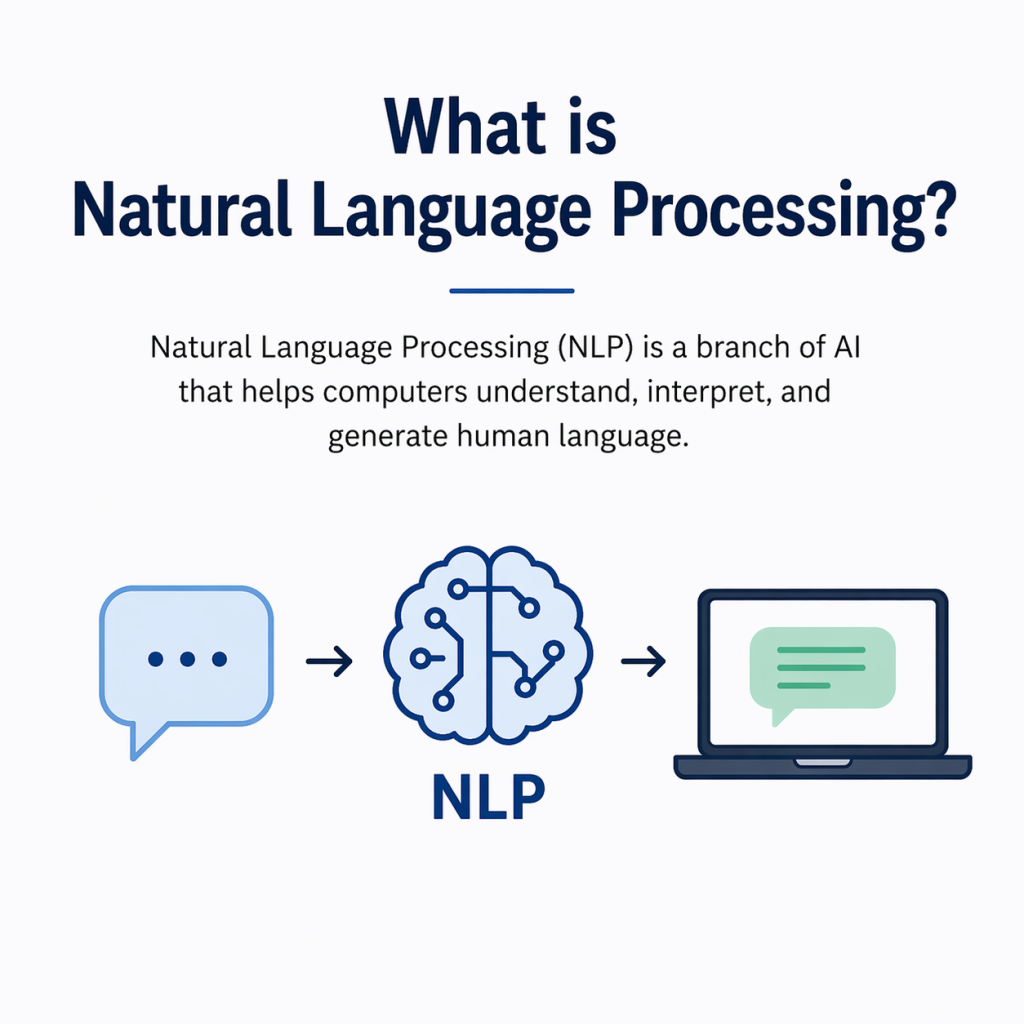




 Admission Open
 Admission Open

 Admission Open
 ROI Calculator