Medical ethics establishes moral values and professional standards that guide healthcare providers in patient care, decision-making, and professional conduct.
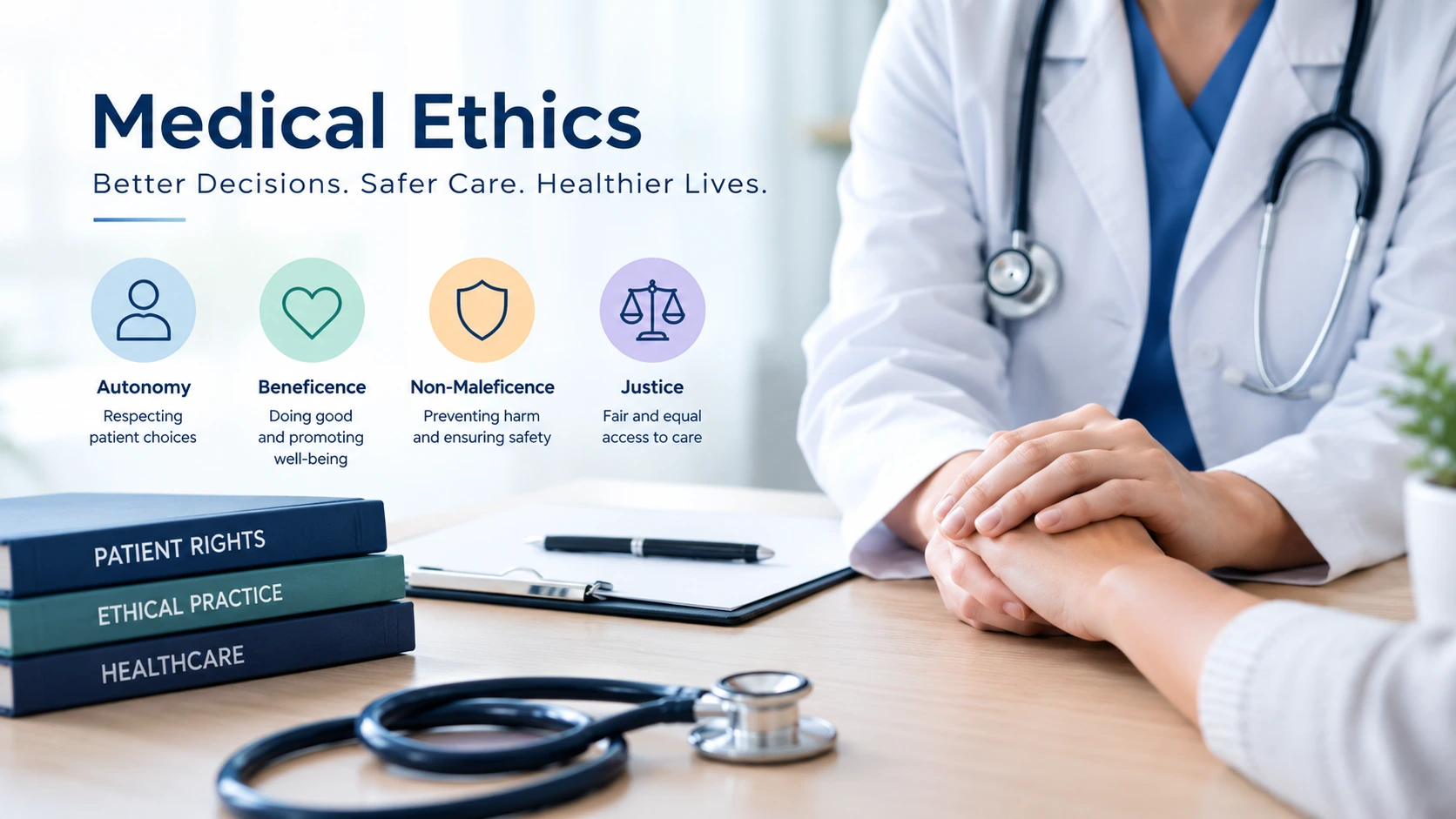
The four core principles of medical ethics are autonomy, beneficence, non-maleficence, and justice, which promote patient choice, well-being, safety, and fairness.
Patient autonomy includes informed consent, voluntary decision-making, the ability to refuse treatment, and respect for patients' healthcare choices.
Common medical ethics dilemmas include end-of-life decisions, patient confidentiality, informed consent, resource allocation, treatment of minors, and data privacy.
In this blog, you'll learn what medical ethics means, its core principles, professional codes, common healthcare dilemmas, patient rights, and how healthcare professionals can apply ethical practices in daily care.
Every day, doctors, nurses, and other healthcare professionals make decisions that affect lives. Some choices are clinical, such as which treatment to recommend. Others are moral, such as how to respect a patient’s wishes when family members disagree. Medical ethics provides the guidance that helps professionals make these decisions with care, honesty, and fairness.
This blog explains medical ethics in simple terms. You will learn how it is defined, the main principles behind it, what professional codes say, the common dilemmas that arise in practice, and the rights every patient should know about.
To define medical ethics in simple words, it is a set of moral values and professional standards that guide how healthcare providers care for patients, make decisions, and behave in their practice. It addresses questions of right and wrong in medicine and helps professionals balance their duties to patients, colleagues, and society.
Medical ethics is closely connected to, but not identical with, the law. The law sets the minimum rules that must be followed, while ethics asks what the best and most respectful action would be. An action can be legal and still raise ethical concerns.
The roots of medical ethics go back thousands of years. The Hippocratic Oath, attributed to ancient Greece, encouraged physicians to help the sick, avoid harm, and protect patient privacy. Over time, events in medical history, including unethical human experiments, led to stronger safeguards such as the Nuremberg Code, the Declaration of Helsinki, and the Belmont Report. Today, medical ethics is a core part of training for every healthcare professional.
Patients often face health problems when they are most vulnerable. They depend on professionals who know more than they do, and that creates an imbalance of knowledge and power. Medical ethics helps protect patients in this situation and supports trust, which is the foundation of the patient-provider relationship.
Strong ethical practice has several benefits:
It protects patients from harm, neglect, and exploitation.
Most discussions of medical ethics principles begin with four widely accepted ideas, introduced by scholars Tom Beauchamp and James Childress. These principles are used in hospitals, medical schools, and ethics committees around the world.
1. Autonomy
Autonomy means respecting a patient’s right to make decisions about their own body and treatment. We explain this principle in more detail in the next section.
2. Beneficence
Beneficence means acting in the best interest of the patient. Healthcare professionals should work to improve health, relieve suffering, and promote well-being. This includes recommending effective treatments, providing preventive care, and considering the patient’s overall quality of life.
3. Non-Maleficence
Non-maleficence is often summed up as “do no harm.” Every treatment has risks, so professionals must weigh potential harm against potential benefit. A treatment that causes more suffering than it relieves is difficult to justify ethically.
4. Justice
Justice means fairness in how care is distributed. Patients should be treated equally, without discrimination based on race, gender, age, religion, income, or social status. Justice also applies to the fair use of limited resources, such as organ donations, hospital beds, and medications.
These medical ethics principles sometimes conflict with one another. For example, respecting a patient’s refusal of treatment (autonomy) may feel at odds with a doctor’s desire to help (beneficence). Ethical reasoning means weighing these values carefully in each situation.
What Is Autonomy in Medical Ethics?
If you are wondering what is autonomy in medical ethics, the idea is simple: competent adults have the right to make informed decisions about their own medical care, even when others disagree with their choices.
In practice, autonomy includes several key elements:
Informed consent: Patients must receive clear information about their diagnosis, treatment options, risks, benefits, and alternatives before agreeing to a procedure.
Voluntary choice: Decisions must be made freely, without pressure or manipulation from providers, family members, or others.
Decision-making capacity: The patient must be able to understand the information, think about the consequences, and communicate a choice.
Right to refuse: Patients may decline treatment, including treatments that could save their lives.
For example, an adult patient may refuse a blood transfusion for personal or religious reasons. A respectful provider will explain the risks, answer questions, and then honor the decision if the patient is competent and fully informed.
Autonomy becomes more complex when patients are children, have cognitive impairments, or are unconscious. In these cases, a legal guardian, a health care proxy, or advance directives (written instructions about care) help guide decisions while still respecting the patient’s values as much as possible.
What Does the Code of Medical Ethics State?
Many people ask what does the code of medical ethics state. The answer depends on the country and professional organization, but most codes share similar themes. In the United States, the American Medical Association (AMA) publishes the AMA Code of Medical Ethics, which has guided physicians since 1847. It includes the Principles of Medical Ethics, a short set of core standards, along with detailed opinions on specific topics.
In general, the AMA Principles of Medical Ethics state that a physician should:
Provide competent medical care with compassion and respect for human dignity and rights.
Uphold professional standards and deal honestly with patients and colleagues.
Respect the law while working to change requirements that are contrary to the best interests of patients.
Respect the rights of patients, colleagues, and other health professionals, and protect patient confidences within the limits of the law.
Keep up with scientific knowledge, continue to study, and share relevant information with patients and the public.
Use free choice in deciding whom to serve, except in emergencies, and provide appropriate care in the setting in which they practice.
Recognize a responsibility to participate in activities that improve the community and public health.
Put the patient’s welfare first when caring for a patient.
Support access to medical care for all people.
Other important documents include the World Medical Association’s Declaration of Geneva, which is a modern version of the physician’s pledge, and the International Code of Medical Ethics. Nurses, pharmacists, and other health professionals have their own codes with similar values, such as respect, honesty, confidentiality, and accountability.
Because codes are updated over time, it is a good idea to review the latest version from the relevant medical association or licensing board.
Common Medical Ethics Dilemmas
Ethical dilemmas arise when two or more values conflict and no option feels completely right. Here are some of the most common situations in modern healthcare.
End-of-Life Decisions
Decisions about life support, do-not-resuscitate orders, and palliative care can be emotionally difficult. Providers and families must balance a patient’s wishes, comfort, and medical prognosis. Advance directives and open conversations early in an illness can make these moments less painful.
Confidentiality vs. Duty to Warn
Patient information is private, but there are rare exceptions. If a patient poses a serious threat to another person or has a contagious condition that endangers public health, a provider may need to share limited information. These situations require careful judgment and knowledge of the law.
Informed Consent and Limited Understanding
Sometimes patients may not fully understand complex information because of language barriers, stress, or limited health literacy. Providers must take extra steps, such as using plain language, interpreters, and teach-back methods, to ensure consent is truly informed.
Allocation of Scarce Resources
When there are not enough organs, intensive care beds, or medications for everyone, difficult decisions about priority must be made. Ethical frameworks emphasize fairness, medical need, and transparent criteria rather than personal bias.
Treatment of Minors
Parents or guardians usually make decisions for children, but disagreements may arise when parents refuse recommended care. Ethics teams often help balance the child’s best interest with family values.
New Technology and Data Privacy
Artificial intelligence, genetic testing, and digital health records create new questions. Who owns health data? How should algorithms be tested for bias? How can patients stay in control of sensitive information? Medical ethics continues to adapt as technology advances.
Patient Rights Under Medical Ethics
Ethical principles are closely linked to patient rights. While specific legal rights vary by country and state, the following are widely recognized:
The right to informed consent: Patients can understand and agree to or decline treatment.
The right to privacy and confidentiality: Personal health information should be protected. In the United States, laws such as HIPAA set rules for how it can be used and shared.
The right to respectful, non-discriminatory care: Every patient deserves dignity, regardless of background or condition.
The right to access medical records: Patients can generally review and request copies of their records.
The right to a second opinion: Patients may consult another provider before deciding on treatment.
The right to clear information: Providers should explain diagnoses, costs, and options in a way that patients can understand.
The right to make complaints: Patients can raise concerns or file grievances without fear of punishment.
Knowing these rights helps patients take an active role in their care and encourages providers to maintain high standards.
How Healthcare Professionals Can Apply Medical Ethics Daily
Ethics is not only for dramatic cases. It shows up in routine interactions as well. Professionals can strengthen ethical practice by:
Listening carefully and giving patients enough time to ask questions.
Explaining treatment options honestly, including uncertainty.
Protecting privacy in conversations, charts, and electronic systems.
Recognizing personal bias and working to treat all patients fairly.
Seeking advice from ethics committees or colleagues when a case is unclear.
Continuing to learn about changes in laws, technology, and professional guidelines.
Hospitals also support ethical practice through ethics committees, training programs, and clear policies. When a team faces a difficult decision, structured discussion often leads to better and more compassionate outcomes.
Conclusion
Medical ethics is the moral compass of healthcare. By respecting autonomy, promoting benefit, avoiding harm, and ensuring fairness, professionals can support patients through some of the most challenging moments of their lives. Codes of ethics, patient rights, and open communication all work together to protect trust.
As medicine continues to change with new technology and new social challenges, the core values stay the same: honesty, compassion, respect, and responsibility. Whether you are a student, a healthcare worker, or a patient, understanding medical ethics helps you take part in care that is safe, fair, and humane.
Frequently Asked Questions
The four main principles are autonomy (respecting patient choices), beneficence (acting in the patient’s best interest), non-maleficence (avoiding harm), and justice (ensuring fairness in care and resource distribution).
Autonomy is the right of competent patients to make informed decisions about their own treatment. It is important because it respects human dignity, builds trust, and ensures that care reflects the patient’s values and preferences.
In most cases, no. Providers are expected to protect patient confidentiality. However, limited exceptions exist, such as when the law requires reporting certain diseases or when there is a serious risk to others. The rules vary by location.
Medical law consists of rules enforced by the legal system, while medical ethics refers to moral standards and professional values. Laws set the minimum requirements, while ethics often encourages a higher standard of care and respect.
Nuthana Reddy
Nuthana Reddy is a Senior Manager at Procter & Gamble, specializing in operations, digitization, and cross-functional leadership. She has driven multimillion-dollar impact through innovation, process optimization, and strategic execution across global markets.
Get Free Upskilling Guidance
Fill in the details for a free consultation
Related Courses
Explore our programs
Post Graduate Certificate Programme in Digital Healthcare & AI Strategy
 HOME > BLOG > Healthcare Management > Medical Ethics: Understanding Principles, Dilemmas & Patient Rights
 November 2, 2026
 8 min read





 Key Insights
 ChatGPT
 Perplexity
 Claude
 Grok












 ROI Calculator