Career Gap Meaning: What Does It Actually Include?
Why a Career Gap Is Less of a Problem Than You Think
Common Career Gap Reasons Employers Understand
How to Justify a Career Gap in Your Resume: Step-by-Step
Key Insights
A career gap is not necessarily a setback or a sign of failure. Employers primarily look for honesty, updated skills, and readiness to return to work.
Common career gap reasons include layoffs, family responsibilities, health concerns, further education, relocation, travel, and career changes.
Choose the right resume format, preferably a combination or hybrid format, to highlight your skills and experience while addressing employment gaps.
Explain your career break honestly and briefly. Highlight relevant certifications, freelance projects, volunteering, or personal achievements during the break.
Prepare a confident, positive explanation for your cover letter and interview by stating the reason, sharing what you gained, and focusing on your future goals.
In this blog, you'll learn the meaning of a career gap, common career gap reasons, practical steps to justify employment gaps in your resume, sample explanations, and tips to rebuild confidence before returning to work.
If you have taken a break from work, you are not alone. Millions of professionals step away from their jobs at some point, whether by choice or by circumstance. Still, the moment you sit down to update your resume, a career gap can feel like a red flag that hiring managerswill notice right away.
The good news is that a career gap is far more common and far more acceptable than most people believe. What matters is not that the gap exists, but how you present it. In this guide, you will learn what a career gap really means, the most common career gap reasons, and exactly how to justify a career gap on your resume, in your cover letter, and during interviews.
Career Gap Meaning: What Does It Actually Include?
Before you can explain a gap, it helps to understand the career gap meaning. A career gap is a period of time when you were not formally employed. It appears on a resume as a visible stretch between the end date of one job and the start date of the next.
There is no official rule on how long a break must be to count as a gap. In general, recruiters begin to notice when the break lasts longer than three to six months. A gap of a year or more usually invites questions, and gaps of several years require a clear explanation.
It is also important to know what a career gap is not. It is not a sign of failure, and it does not automatically mean you were idle. Many people spend this time caring for family,learning new skills, recovering from illness, or planning a change in direction. Seen this way, a career gap is simply a chapter in your professional story that happened to take place outside a traditional office.
Why a Career Gap Is Less of a Problem Than You Think
Hiring practices have changed significantly over the past several years. Layoffs, economic shifts, remote work, and the global pandemic have made employment breaks a normal part of working life. Many employers now openly state that they welcome applicants returning from a career break, and some companies even run structured return-to-work programs.
Recruiters today care mostly about three things: whether you are honest, whether your skills are current, and whether you are ready to work. If you can show all three, a gap on your resume will rarely stand in the way of an offer.
That said, silence can hurt you. When a hiring manager sees an unexplained break, they may fill in the blanks with their own assumptions, and those assumptions are rarely generous. A short, confident explanation removes the guesswork and keeps the conversation focused on your strengths.
Common Career Gap Reasons Employers Understand
Knowing the common career gap reasons can help you see that your situation is likely more normal than you fear. Here are the reasons employers encounter most often.
Layoffs and company closures – Job loss due to restructuring, budget cuts, or a business shutting down is one of the most widely accepted reasons for a break. It reflects a business decision, not your performance.
Caring for a child or family member – Many people leave work to raise children or look after an aging parent, a spouse, or a relative with a medical condition. Employers increasingly respect this responsibility.
Health and recovery – Personal illness, surgery, injury, or mental health challenges are valid reasons to step away. You do not need to share medical details. A simple statement that you took time to recover and are now fully ready to return is enough.
Further education or training – Returning to school, completing a certification, or attending a bootcampis a productive use of time and shows initiative.
Relocation – Moving to a new city or country, or relocating for a spouse’s job, can interrupt a career for several months.
Travel or a sabbatical – Some professionals take planned time off to travel, rest, or reflect on their goals. When explained well, this can show maturity and self-awareness.
Career change or job search – A long job search in a competitive market, or time spent exploring a new field, is also a common reason for a break.
Freelancing, volunteering, or starting a business – If you worked independently or gave your time to a cause, you were not truly out of work. This experience can and should appear on your resume.
Whichever of these career gap reasons applies to you, remember that you do not need to apologize for it. You only need to explain it clearly and then redirect attention to what you bring to the role.
How to Justify a Career Gap in Your Resume: Step-by-Step
Now let us get to the heart of the matter. Here is a practical process you can follow to justify a career gap in your resume.
Step 1: Be Honest About the Dates
Honesty is the foundation of any good explanation. Do not stretch job dates or invent employment to hide a break. Background checks, reference calls, and employment verification often reveal the truth, and being caught in a lie can cost you the job, even after you have been hired.
That does not mean you must list every detail. You can choose a format that presents your history accurately without drawing unnecessary attention to the gap.
Step 2: Choose the Right Resume Format
The format of your resume can make a career gap easier to manage.
Chronological format lists jobs from most recent to oldest. It is the most common format, but it makes gaps easy to see.
Functional format focuses on skills rather than dates. Some recruiters view it with suspicion, so use it carefully.
Combination (hybrid) format opens with a strong summary and skills section, followed by a brief work history. This is often the best choice if you have a gap, because it highlights your abilities first.
If your gap is short, you can also list only years rather than months, such as “2021–2023.” This is acceptable as long as you are prepared to give exact dates when asked.
Step 3: Add the Gap to Your Resume as an Entry
Instead of leaving a blank space, consider adding a brief line that explains the break. For example:
Sabbatical – Relocation and Skill Development (2021–2022)
A one-line entry shows transparency. It tells the reader that you have nothing to hide, and it often answers the question before it is asked.
Step 4: Highlight What You Did During the Break
Think carefully about how you spent your time. Even if you were not employed, you may have developed useful skills or gained relevant experience. Consider including:
Personal projects, such as building a website or writing a blog
Managing a household, budgeting, or coordinating care, which builds organization and problem-solving skills
Use action words and, where possible, measurable results. For instance, “Completed a six-month data analytics course and built three dashboard projects” is far stronger than “Learned data analysis.”
Step 5: Strengthen Your Skills Section and Summary
Your professional summary is the first thing a recruiter reads. Use it to focus on your strengths and your readiness to return. A strong summary might read: “Marketing professional with seven years of experience in digital campaigns, recently certified in advanced analytics and eager to return to a growth-focused team.”
Pair this with an updated skills section that reflects current tools, software, and industry terms. This reassures employers that your knowledge has not gone out of date.
Step 6: Keep the Explanation Short and Positive
Your resume is not the place for a long story. Keep the explanation to a single line or phrase. Avoid negative language, blame, or emotional detail. State the reason, mention any relevant activity, and move on.
Free Courses
Free Microsoft Excel course: : Beginner to Advanced
How to Explain a Career Gap in Your Cover Letter and Interview
Your resume opens the door, but your cover letter and interview often decide the outcome. Here is how to handle each stage.
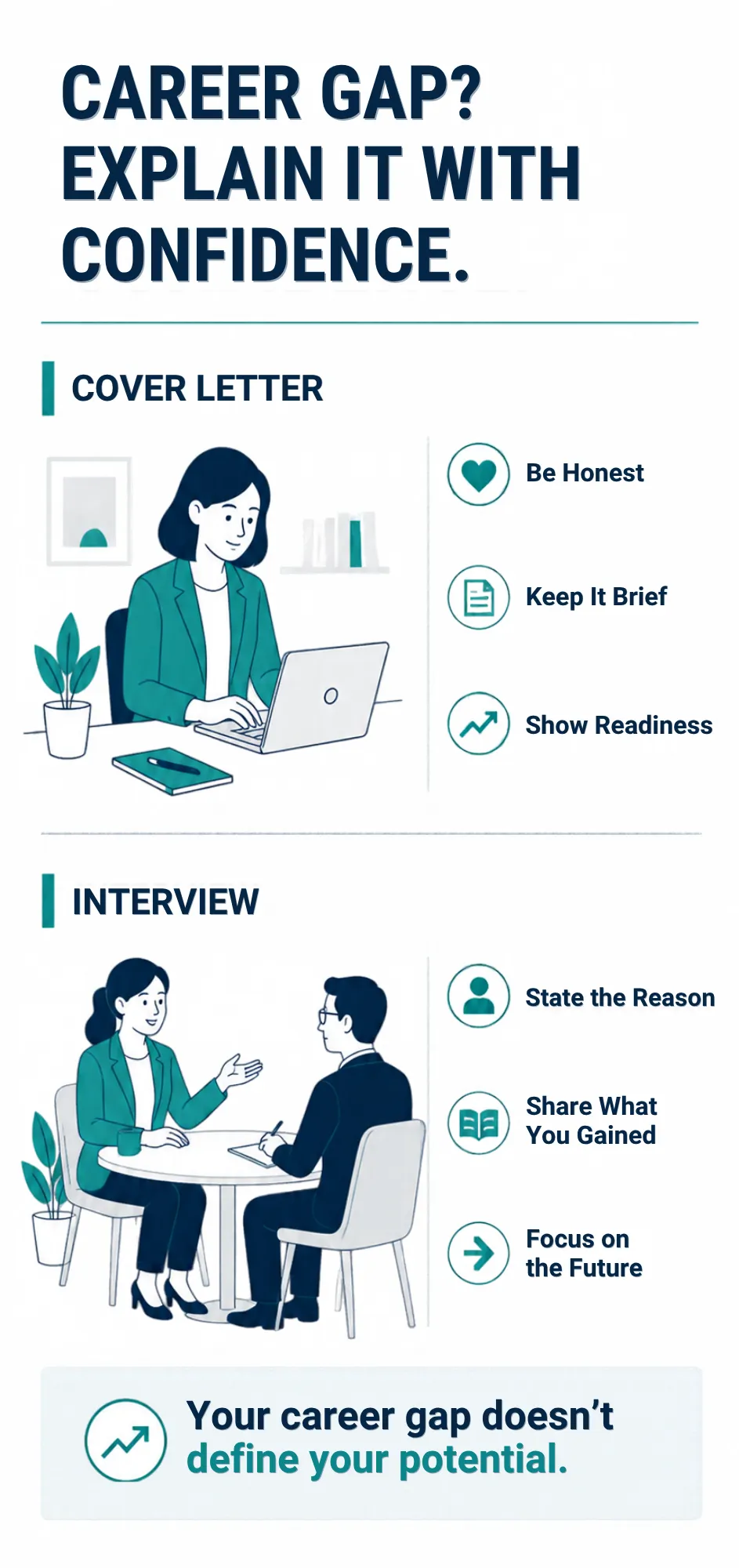
In the Cover Letter
A cover letter gives you room to add context. You do not have to dedicate a full paragraph to the gap, but one or two sentences can be helpful. Mention the reason briefly, then connect it to your readiness for the role. For example: “After taking two years away from work to care for a family member, I am excited to return to the industry with renewed energy and updated skills.”
In the Interview
If the interviewer asks about your gap, stay calm. They are not trying to trap you. They simply want to understand your story. Use this simple three-part structure:
State the reason plainly. Say what happened in one or two sentences.
Show what you gained or did. Mention skills, learning, or experience from that period.
Pivot to the future. Explain why you are ready and excited for this role.
Practice your answer aloud beforehand. A confident, steady tone matters just as much as the words you choose.
Sample Career Gap Explanations You Can Adapt
The following examples show how to put these ideas into practice. Adjust them to fit your own situation.
Layoff: “My previous company went through a major restructuring, and my role was eliminated. I used the time to complete a certification in project management and am now looking for a position where I can apply those skills.”
Caregiving: “I stepped away from my career to care for a family member. That responsibility has now been resolved, and I am fully prepared to return to work. During that time, I also kept my skills current through online courses.”
Health: “I took time off to focus on my health. I have fully recovered and am eager to get back to work in a role where I can contribute right away.”
Relocation: “I relocated to a new city for family reasons, and I took some time to settle in and plan my next move. I am now ready to commit fully to a new opportunity.”
Career change: “I took a deliberate break to explore a different path and strengthen my skills in digital marketing. That experience confirmed my interest in this field, and I am excited to build my career here.”
Notice that every example is brief, honest, and forward-looking. None of them over-explain or sound defensive.
Tips to Rebuild Confidence After a Career Gap
Explaining a gap is easier when you feel ready for what comes next. A few simple actions can help.
Refresh your skills. Take a short course or earn a certification that is relevant to your target role.
Reconnect with your network. Reach out to former colleagues, managers, and mentors. Many jobs are filled through referrals.
Update your online profile. Make sure your LinkedIn page matches your resume and presents a clear, positive summary.
Consider contract or part-time work. Short-term roles can bridge the gap and give you fresh, recent experience to list.
Look for returnship programs. Several companies offer paid programs designed for professionals coming back after a break.
Final Thoughts
A career gap does not define your worth or your potential. Whether your career gap reasons involve family, health, education, or a layoff, what employers want to see is honesty, relevant skills, and a clear desire to move forward.
To justify a career gap in your resume, be truthful about your dates, choose a format that highlights your strengths, add a short explanation, and show what you learned or accomplished during your time away. Then carry that same confident, positive tone into your cover letter and interviews.
With the right approach, your break can become part of a thoughtful, credible career story rather than a barrier to your next opportunity.
Frequently Asked Questions
There is no fixed limit. Gaps of less than six months are usually overlooked. Gaps of one to two years are common and easy to explain with a clear reason. Longer gaps may raise more questions, but they can still be handled well if you show current skills, recent activity, and a strong reason for your return.
If the gap is under three to six months, you generally do not need to explain it. Listing employment years instead of months can also make a short break less noticeable. Just be ready to share exact dates if someone asks.
Yes, as long as the work was real. Freelance projects, consulting, volunteering, and self-employment are legitimate experience. List them with clear titles, dates, and achievements, just as you would any other role.
Absolutely. Many employers now recognize the importance of well-being. You are not required to share private details. A short, professional statement such as “I took time away for personal reasons and am now ready to return” is perfectly acceptable.
Bhargavi R
HR Professional
Bhargavi Reddy is an HR professional with over 6 years of experience in IT recruitment and talent acquisition. She specializes in hiring across technologies like Java, DevOps, Python, and Data Engineering. With strong expertise in full-cycle recruitment and stakeholder management, she focuses on building high-performing teams. Currently, she works as an HR Manager driving strategic hiring initiatives.

 November 18, 2026
 9 min read




 Key Insights
 ChatGPT
 Perplexity
 Claude
 Grok












 ROI Calculator