7 Habits of Highly Effective People: Key Lessons for Success
J
By Bhargavi R
October 10, 20268 min read
Published on October 10, 2026
SHARE THIS ARTICLE
Table Of Content
What Are the 7 Habits of Highly Effective People?
The 7 Effective Habits Book: A Quick Background
Highly Effective Habits for Personal Growth (Private Victory)
7 Habits of Highly Effective People for Better Relationships (Public Victory)
Key Insights
The 7 Habits of Highly Effective People focus on building strong character, improving relationships, and achieving lasting success through small, consistent actions.
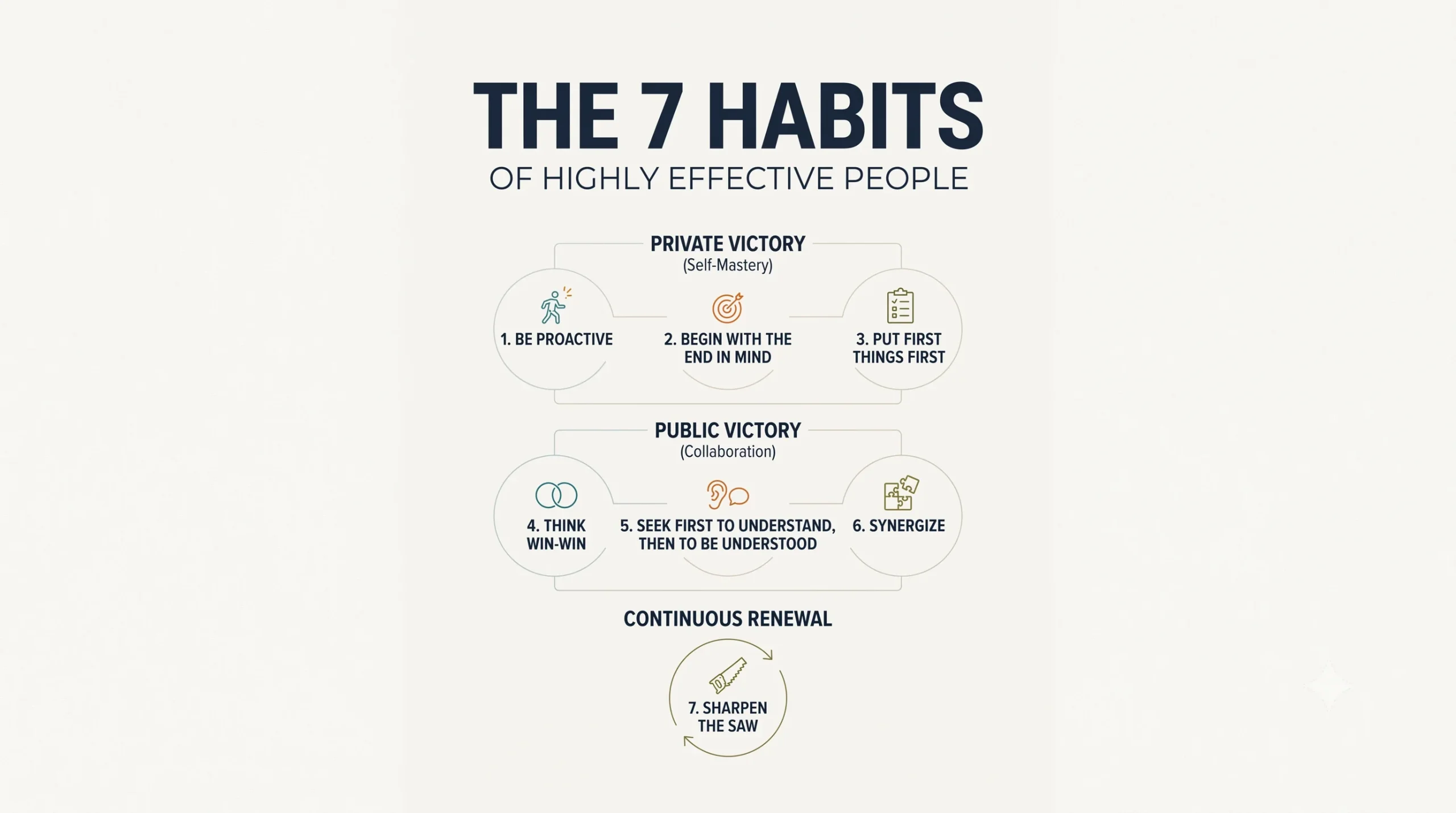
- The seven habits are divided into three stages: Private Victory for self-mastery, Public Victory for teamwork and relationships, and Renewal for continuous personal growth.
Effective time management involves prioritizing important tasks, setting clear goals, and focusing on activities that contribute to long-term success rather than reacting to every urgent demand.
- Strong relationships grow through mutual respect, empathetic listening, win-win thinking, and collaboration. Regularly renewing physical, mental, social, emotional, and spiritual well-being also helps maintain balance.
In this blog, you'll learn about all seven habits, their practical applications in daily life, ways to develop them consistently, and common mistakes to avoid on the path to personal and professional success.
Have you ever ended a long day feeling tired but not sure what you actually achieved? Most of us have been there. We stay busy, answer messages, attend meetings, and still feel like we are running in circles. That is exactly the problem Stephen R. Covey set out to solve more than 30 years ago.
The 7 habits of highly effective people is not a quick-fix trick or a motivational pep talk. It is a simple, practical way of thinking about how you live, work, and treat others. In this blog, we will walk through each habit in plain language, share easy examples, and show you how to use these ideas in your own life, starting today.
The 7 habits of highly effective people are a set of principles that help you build better character, stronger relationships, and steady success. Instead of focusing on tricks or shortcuts, they focus on who you are and how you act every day.
Covey believed that success is not about one big moment. It comes from small, repeated actions. If you change your habits, you slowly change your results. That idea is simple, but it is powerful.
Public Victory (Habits 4, 5, 6): Working well with others.
Renewal (Habit 7): Taking care of yourself so you can keep growing.
Think of it as a journey. First you learn to depend on yourself, then you learn to work with others, and finally you keep yourself strong for the long run.
The 7 effective habits book, titled The 7 Habits of Highly Effective People, was first published in 1989. Stephen R. Covey, an educator and author, wrote it after studying decades of writing on success. He noticed that older advice talked about character, honesty, and fairness, while newer advice talked about image, tricks, and quick wins. Covey felt the older approach was the one that truly lasts.
The book went on to sell tens of millions of copies worldwide and has been translated into dozens of languages. Students, managers, entrepreneurs, parents, and even sports teams have used its ideas. The reason is simple: the lessons are not tied to any one job or country. They work wherever people live, work, and deal with each other.
Highly Effective Habits for Personal Growth (Private Victory)
The first three habits are all about you. Covey says you cannot build good relationships with others until you get your own house in order.
Habit 1: Be Proactive
Proactive people take responsibility for their choices. They do not blame traffic, the boss, the weather, or their past. Instead, they ask, “What can I do about this?”
Covey explains this with two circles. The circle of concern holds everything you worry about, like the economy or other people’s opinions. The circle of influence holds the things you can actually change, like your effort, your attitude, and your skills. Proactive people spend their energy on the second circle, and over time that circle grows.
Try this: The next time something goes wrong, pause for ten seconds and ask yourself what part of it you can control. Then act on only that part.
Habit 2: Begin with the End in Mind
This habit asks a big question: where are you heading? If you do not know your destination, any road will do, and you may end up somewhere you never wanted to be.
Covey suggests picturing your own future in detail. Imagine how you want to be remembered by your family, friends, and colleagues. Then work backwards. Write a personal mission statement, even a short one, that describes your values and goals. It becomes your compass when life gets confusing.
Try this: Write three sentences about the person you want to be in five years. Keep them somewhere you can see them.
Habit 3: Put First Things First
This is the habit of action. Once you know your goals, you need to make time for what matters most. Covey uses a simple time matrix with four boxes: urgent and important, important but not urgent, urgent but not important, and neither.
Most people spend their day in the urgent boxes, answering calls and putting out fires. Highly effective people spend more time on the important but not urgent box. That includes planning, learning new skills, exercising, and building relationships. These tasks do not scream for attention, but they shape your future.
Try this: Each Sunday, pick two or three big priorities for the week and block time for them in your calendar before anything else.
7 Habits of Highly Effective People for Better Relationships (Public Victory)
Once you are steady on your own, you are ready to work with others. Habits 4, 5, and 6 are about teamwork, trust, and communication.
Habit 4: Think Win-Win
Many of us see life as a contest where someone must lose for someone else to win. Covey says this is a limited way of thinking. Win-win means looking for solutions where everyone benefits.
This mindset comes from an abundance attitude, which is the belief that there is enough success, credit, and opportunity to go around. Imagine two colleagues who both want the same project. A win-lose person fights for it. A win-win person sits down, talks about what each person needs, and finds a way to share the work or split the credit.
Covey also talks about the emotional bank account. Every kind word, promise kept, or act of respect is a deposit. Every broken promise or harsh word is a withdrawal. Strong relationships have a healthy balance.
Try this: Before your next discussion or negotiation, ask yourself, “What outcome would make this good for both of us?”
Habit 5: Seek First to Understand, Then to Be Understood
This is the habit most people find hardest, and it might be the most useful. Most of us listen with the plan to reply. We are already forming our answer while the other person is still speaking.
Covey asks us to listen with real empathy, which means trying to see the situation through the other person’s eyes. When people feel heard, they relax, open up, and become more willing to listen to you in return. Many arguments at home and at work could be solved if both sides did this one thing.
Try this: In your next conversation, repeat back what the other person said in your own words before you share your view. Notice how the mood changes.
Habit 6: Synergize
Synergy simply means that the whole is greater than the sum of its parts. When people with different strengths and different ideas work together with respect, they can create results nobody could reach alone.
The key is to value differences instead of fearing them. A team full of people who think alike may feel comfortable, but it also gets stuck. A team that welcomes different views finds new solutions. This applies to family decisions, group projects, and business teams alike.
Try this: The next time someone disagrees with you, treat it as a chance to learn something new rather than a threat.
7 Highly Effective Habits for Renewal: Habit 7
Habit 7: Sharpen the Saw
Imagine a woodcutter who is so busy sawing that he never stops to sharpen the blade. His work gets slower and harder every day. Covey uses this picture to show why we must take care of ourselves.
Sharpening the saw means regularly renewing four parts of life:
Physical: Exercise, sleep, and healthy food.
Mental: Reading, learning, and challenging your mind.
Social and emotional: Building good relationships and staying calm under pressure.
Spiritual: Spending time on what gives your life meaning, such as prayer, meditation, nature, or service.
This habit keeps all the others alive. Without energy and balance, even the best plans fall apart.
Try this: Choose one small action for each of the four areas, like a 20-minute walk, ten pages of reading, a call to a friend, and five minutes of quiet reflection.
How to Apply the 7 Habits of Highly Effective People in Daily Life
Reading about habits is easy. Living them is the real challenge. Here are a few simple ways to begin without feeling overwhelmed.
Start with one habit. Do not try to change everything at once. Pick the habit that feels most useful right now.
Make it small. Instead of a huge goal, choose a tiny action you can repeat daily, such as a two-minute morning plan.
Track your progress. Use a notebook or phone app to note how often you practice the habit.
Find a partner. Share your goals with a friend or colleague and check in weekly.
Review every week. Ask what worked, what did not, and what you will adjust next week.
Be kind to yourself. You will miss days. That is normal. Just return to the habit the next day.
If you are a student, you can use Habit 3 to plan study time. If you are a manager, Habit 5 can improve how you handle your team. If you are a parent, Habit 4 can help you solve family conflicts calmly. The 7 effective habits are flexible, so you can shape them to fit your life.
Common Mistakes to Avoid with the 7 Effective Habits
People often get excited about these ideas and then lose steam. Watch out for these traps:
Treating it like a checklist. These are not boxes to tick. They are ways of thinking that grow with practice.
Skipping the first three habits. Many people jump to teamwork andcommunication, but the strength to work with others starts with self-discipline.
Expecting quick results. Habits take weeks and months to settle. Be patient.
Ignoring renewal. If you burn out, nothing else matters. Rest is part of success.
The 7 habits of highly effective people are not about becoming perfect. They are about becoming a little more thoughtful, a little more focused, and a lot more connected with the people around you. Start by owning your choices, decide where you want to go, spend your time on what truly matters, and treat others with respect and understanding. Keep renewing yourself along the way. Pick one habit today, practice it for a few weeks, and watch how small changes begin to shape bigger results.
Frequently Asked Questions
The seven habits are: be proactive, begin with the end in mind, put first things first, think win-win, seek first to understand then to be understood, synergize, and sharpen the saw. Together they cover self-mastery, teamwork, and continuous renewal.
Yes. Even though it was written in 1989, its lessons on responsibility, priorities, and communication are just as useful in today’s busy, digital world. Many people find that the ideas matter even more now, when distractions are everywhere.
Almost anyone can benefit from it. Students, working professionals, business owners, team leaders, and parents all find something practical in it. If you want to manage time better, build stronger relationships, or become more focused, it is a good place to start.
There is no fixed timeline. Research on habit formation suggests that it can take anywhere from a few weeks to a few months, depending on the person and the habit. Focus on steady practice instead of speed, and start with one habit at a time.
Bhargavi R
HR Professional
Bhargavi Reddy is an HR professional with over 6 years of experience in IT recruitment and talent acquisition. She specializes in hiring across technologies like Java, DevOps, Python, and Data Engineering. With strong expertise in full-cycle recruitment and stakeholder management, she focuses on building high-performing teams. Currently, she works as an HR Manager driving strategic hiring initiatives.

 October 10, 2026
 8 min read





 Key Insights
 ChatGPT
 Perplexity
 Claude
 Grok
Grok










 ROI Calculator