Formal Letter Writing: Format, Examples, and How to Write in English
J
By Prerna Singh
March 19, 20269 min read
Published on March 19, 2026
SHARE THIS ARTICLE
Table Of Content
What is Formal Letter Writing?
Importance of Formal Letter Writing
Formal Letter Writing Format
How to Write a Formal Letter: Step-by-Step Guide
For any sort of professional and academic communication, writing in a clear and respectful manner is crucial. Formal letter writing is one of the most important forms of professional communication. Whether you are writing an application for a job, making a request to an institution or company, or simply communicating with a company or individual, formal letter writing is crucial to convey your message in a clear and effective manner.
Although today’s world is dominated by emails and electronic communication, formal letter writing is still an important aspect of business, education, and official communication. Writing formal letters is a reflection of your professionalism, clear communication skills, and respectful attitude towards the recipient.
However, many students and professionals face difficulties in understanding how to write a formal letter and the correct tone to be used while communicating formally. Writing a formal letter is crucial to ensure that your message is communicated in a clear and respectful manner.
With this guide on formal letter writing, you will be able to:
Know what formal letter writing is
Know the correct formal letter writing format
Know how to write a formal letter
Know about different types of formal letters
Know examples to follow for writing a formal letter
At the end of this blog, you will be able to confidently understand formal letter writing in English and write effective formal letters for various situations in academics and professions.
Formal letter writing is a structured form of written communication used for professional purposes or official communication. Unlike informal communication, formal letters are not written to friends or family members. Formal communication is structured and uses formal language to communicate with the recipient.
Formal communication is used in various situations, such as:
A formal letter must be structured with various components such as sender’s address, date, recipient’s address, subject line, salutation, body, and closing.
Formal letter writing is an important skill for students and working professionals to learn. Formal letter writing is quite important in communication for various purposes.
1. Professional Communication
Formal letters are commonly used in business organizations to communicate with various clients and organizations.
2. Academic Requirements
Students are required to write formal letters for various purposes such as applications, requests to institutions, and examination purposes.
3. Legal and Official Documentation
Formal letters can be used as documented communication for official purposes such as complaints, requests, or confirmations.
4. Building Professional Image
Writing formal letters is an important skill to showcase professionalism and clarity in communication.
Formal Letter Writing Format
The formal letter writing format is quite structured to ensure that the communication is formal and easy to comprehend. Each component has its own significance in formal communication.
The following is the formal letter writing format commonly used in various professional and academic institutions.
1. Sender’s Address
The sender’s address is placed at the top of the formal letter. This is to ensure that the recipient is aware of the source of communication and knows where to reply.
Example: Ritu Pradip Sharma Mumbai, Maharashtra India
2. Date
The date is mentioned below the sender’s address. The date indicates when the letter was written.
Example: 10th March 2026
3. Receiver’s Address
The receiver’s details include their name, designation, organization, and address.
Example: The HR Manager ABC Solutions Pvt. Ltd. Bandra East Mumbai, Maharashtra
4. Subject Line
The subject line indicates the purpose of the letter. The subject line is a single line that describes the purpose of the letter.
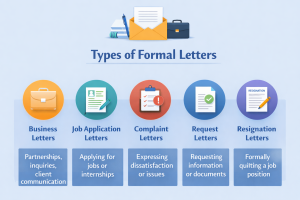
Formal letters are used for various purposes. The following are some of the common types of formal letters used in different situations.
1. Business Letters
These are used for communication between business organizations or between two or more business people.
Examples are:
Sending a proposal for a business partnership
Sending business inquiries
Communicating with clients
2. Job Application Letters
These are used to apply for a job or internship vacancy.
These letters are used to introduce oneself and describe oneself to the reader.
3. Complaint Letters
These are used to express dissatisfaction or complaint about something or some service provided by a company or business organization.
Example: Complaint to a company about defective products.
4. Request Letters
These are used to request something from someone or some information from a person or business organization.
Example: Requesting a bonafide certificate from a college or university.
5. Resignation Letters
These are used by an employee to quit a particular job or work.
Formal Letter Writing in English: Language and Tone
While writing formal letters in English, it is very important that the language used is polite, clear, and professional.
Key Language Rules
Avoid using slang and informal words.
Be polite.
Keep your sentences clear and concise.
Maintain a respectful tone.
Useful Formal Phrases
Introduction
I am writing to inform you that…
I would like to request…
I am writing regarding…
Conclusion
Thank you for your time and consideration.
I look forward to your response.
Kindly take the necessary action.
Example of Formal Letter Writing
The following is a simple example of formal letter writing.
Ritu Pradip Sharma Mumbai, Maharashtra India
10 March 2026
The HR Manager XYZ Digital Solutions Mumbai, Maharashtra
Subject: Request for Internship Opportunity
Dear Sir/Madam,
I am writing to express my interest in applying for an internship position at your esteemed organization. I am currently pursuing a degree in Business Administration and am eager to gain practical industry experience.
During my academic studies, I have developed strong analytical and communication skills. I believe that an internship at your company would provide valuable exposure to real-world business operations.
I would appreciate the opportunity to contribute to your team and enhance my professional skills. Kindly consider my application.
The Key Elements That Make A Formal Letter Effective
Formal letter writing is not just about learning the format of the letter. It is also about writing an effective letter that conveys your message clearly and professionally. A well-written formal letter is effective in conveying the message and leaves an impact on the reader. Here are the key elements that make an effective formal letter.
Clarity of Purpose
The most important aspect of formal letter writing in English is the clarity of purpose. To write an effective formal letter, it is important that the writer is clear about the purpose of writing the letter. The purpose of writing the letter should be stated clearly in the opening paragraph of the letter. The purpose of writing the letter could be to make a request, to apply for a job, or to raise a complaint.
Professional Tone
For example: Instead of using a phrase like: “Can I have a request?”
A professional phrase should be used: “Can I request something?”
Or: “Can I request something?” Instead of using a phrase like: “I am angry because…” A professional phrase should be used: “Thank you for considering…”
Proper Structure and Organization
For example: The proper format of a formal letter should be: Introduction – It should clearly mention the purpose of writing the letter. Body – It should clearly mention the necessary details. Conclusion – It should clearly mention the purpose of writing the letter. The paragraphs should be short and well-organized.
Concise and Relevant Content
When it comes to formal letter writing, it is always important that the letter is written in a concise manner. While practicing formal letter writing in English, it is very important that you avoid including any irrelevant information in your letter, as it might confuse the reader.
Each sentence in your letter should be relevant and contribute towards the overall purpose of your letter. This will not only save time, but it will also show your professionalism.
For example, instead of including lengthy explanations in your letter, you can simply state your requirement in a straightforward manner. This will not only make your letter more effective, but it will also be easy to comprehend.
Correct Grammar and Language
When it comes to formal letter writing, grammar is an essential aspect. Any mistakes in grammar, vocabulary, or punctuation can affect the professionalism in your letter.
Before you send or submit your letter, it is always important that you review it carefully. This will not only ensure that your letter includes relevant and accurate information, but it will also show your professionalism.
Appropriate Closing
The closing is as important as the opening in a formal letter. As one learns how to write a formal letter, it is important to note that the letter should be closed in a respectful manner. Some of the common closings used are as follows:
Yours sincerely
Yours faithfully
Respectfully
After using these closings, the writer should include his or her name to add authenticity to the formal letter writing format.
Common Mistakes to Avoid in Formal Letter Writing
There are various mistakes that people generally make while writing formal letters. Here are some common mistakes that need to be avoided while writing formal letters. This will definitely enhance the quality of your writing.
1. Using Informal Language
Avoid using the following phrases while writing formal letters:
Hey
What’s up
Thanks a lot
2. Ignoring Proper Format
Proper format is essential while writing formal letters. A well-structured format will definitely enhance the quality of your writing.
3. Writing Long Paragraphs
Try to keep paragraphs short and simple while writing formal letters.
4. Not Including a Subject Line
While writing formal letters, it is always better to include a subject line. This will definitely enhance the quality of your writing.
5. Skipping Proofreading
Grammar mistakes should always be avoided while writing formal letters.
Conclusion
Formal letter writing is an important communication skill that is used in various academic and business situations. Whether you are writing to apply for a job or to make a request or raise an official concern, a well-written formal letter is sure to convey your message in a clear and professional manner.
Knowing how to write a formal letter in the correct format is sure to help you convey your thoughts and ideas in a clear and effective manner. By following a correct format that includes address, date, recipient’s details, subject, salutation, body, and closure, you are sure to write clear and effective formal letters.
Knowing how to write formal letters in English is sure to help you master this skill with ease and confidence. With the evolution of technologyin communication, formal letter writing is sure to be an important skill that depicts professionalism and courtesy in every communication.
Frequently Asked Questions
To begin writing a formal letter, it is important to ensure that it starts with the sender’s address, date, receiver’s address, and a subject line. The use of a formal letter writing format is important as it helps to maintain a clear and professional tone in your letter.
The best formal letter writing format is one that includes the sender’s address, date, receiver’s address, subject line, salutations, body paragraphs, closing paragraphs, and signature. The use of this format is important as it helps to ensure that your formal letter writing in English is clear and professional.
Formal letter writing is important to consider while writing a letter. The purpose of a formal letter is to be clear and concise while using a proper tone. While writing a formal letter, it is important to consider guidelines for formal letter writing in English.
The five different types of letters that are used in formal letter writing are business letters, job application letters, complaint letters, request letters, and resignation letters.
Prerna Singh
Talent Acquisition Manager - India
Prerna Singh is a results-driven Talent Acquisition Manager with expertise in end-to-end HR management. She has a strong background in recruitment, employee engagement, and HR operations across IT domains. Skilled in ATS/HRIS platforms and vendor management, she is passionate about building productive workplaces. She is committed to aligning talent strategies with business growth.
 HOME > BLOG > Career Development > Formal Letter Writing: Format, Examples, and How to Write in English
 March 19, 2026
 9 min read





 ChatGPT
 Perplexity
 Claude
 Grok
Grok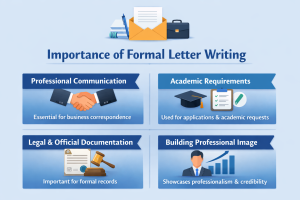




 Admission Open

 Admission Open
 Admission Open

 ROI Calculator