 HOME > BLOG > Investment Banking > What Is an Equity Research Analyst? Role, Skills, Career Path & Salary
What Is an Equity Research Analyst? Role, Skills, Career Path & Salary
 August 30, 2026
 9 min read





Table Of Content
- What Is Equity Research?
- Who Is an Equity Research Analyst?
- What Does an Equity Research Analyst Do?
- Research Analyst Responsibilities
 Key Insights
- An equity research analyst analyzes companies, financial statements, industries, and market trends to assess business performance, valuation, and investment potential.
- Key research analyst responsibilities include financial analysis, financial modeling, company valuation, industry research, preparing reports, monitoring company performance, and communicating investment insights.
- A successful career requires financial analysis, Excel, financial modeling, valuation, research, analytical thinking, attention to detail, communication skills, and industry knowledge.
- To understand how to become an equity research analyst, candidates should build a strong finance foundation, develop technical skills, gain practical experience, build a research portfolio, and develop sector expertise.
- In this blog, you'll learn what is equity research, the role and responsibilities of an equity research analyst, required skills, career path, salary factors, and opportunities in the field.
The financial markets generate an enormous amount of information every day, from company earnings and economic indicators to industry developments and stock price movements. Making sense of this information requires more than simply following market news. This is where an equity research analyst plays an important role.
An equity research analyst studies companies, industries, financial statements, market trends, and other relevant information to evaluate the potential performance of stocks. Their analysis can help investors and financial institutions make informed investment decisions.
For individuals who enjoy finance, data analysis, business research, and understanding how companies create value, equity research can be an attractive career option. The field also offers opportunities to develop specialized industry knowledge and progress into senior research, portfolio management, or other investment roles.
This guide explains what is equity research, the role and research analyst responsibilities, essential skills, career progression, salary expectations, and how to become an equity research analyst.
 ChatGPT
 Perplexity
 Claude
 Grok
GrokWhat Is Equity Research?
Equity research refers to the process of analyzing publicly traded companies and their stocks to assess their financial performance, business prospects, valuation, and investment potential.
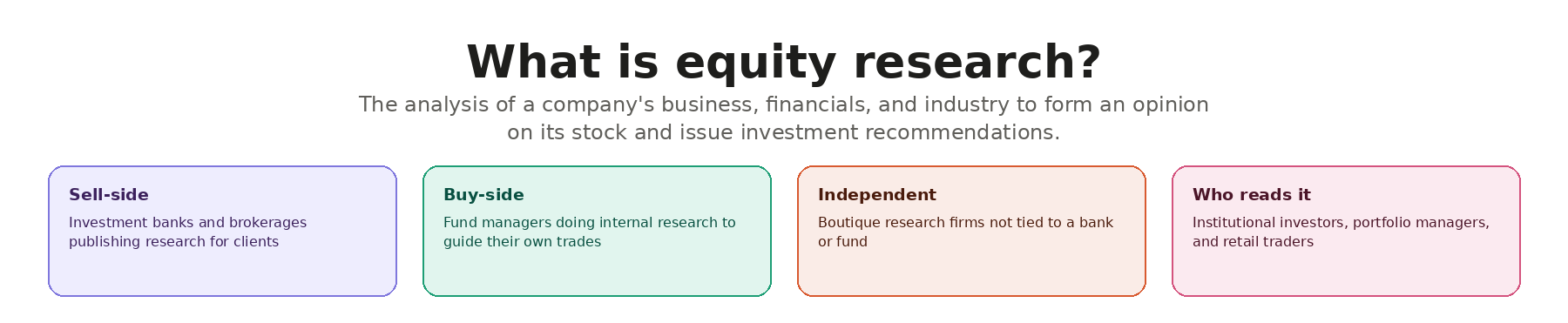
Equity research professionals typically study a company’s financial statements, revenue growth, profitability, competitive position, management, industry conditions, and future prospects. They then use this information to develop financial models, valuation estimates, and investment views.
Equity research can broadly be divided into two areas:
Sell-side equity research: Analysts working for investment banks, brokerage firms, and research organizations prepare reports and analysis that may be used by institutional clients and investors.
Buy-side equity research: Analysts working for asset management companies, mutual funds, hedge funds, and other investment organizations conduct research primarily to support their organization’s investment decisions.
Although the working environment differs, both types of analysts rely heavily on financial analysis, valuation, industry research, and critical thinking.
Who Is an Equity Research Analyst?
An equity research analyst is a finance professional who researches companies and securities to develop investment insights.
Rather than looking only at stock prices, analysts try to understand the business behind the stock. They examine questions such as:
- Is the company’s revenue growing?
- How profitable is the business?
- What are its major risks?
- How competitive is its industry?
- Is the company financially stable?
- What could influence its future growth?
- Does the current valuation appear reasonable?
The answers to these questions help analysts develop an investment thesis and communicate their views through research reports, financial models, presentations, and discussions with relevant stakeholders.
What Does an Equity Research Analyst Do?
The day-to-day work of an equity research analyst can vary based on the organization, industry, and level of experience. However, the role generally combines financial analysis, research, modeling, writing, and communication.
1. Analyze Financial Statements
Analysts review income statements, balance sheets, cash flow statements, annual reports, quarterly results, and other company disclosures. They use these documents to understand financial health and identify important trends.
2. Conduct Company Research
An analyst researches a company’s business model, products, customers, competitors, management, growth strategy, and industry position. The goal is to understand what drives the company’s performance.
3. Build Financial Models
Financial modeling is an important part of equity research. Analysts may create models to estimate future revenue, expenses, earnings, cash flows, and other financial metrics.
4. Perform Valuation
Analysts use different valuation approaches to estimate what a company or stock could be worth. Depending on the company and sector, methods may include discounted cash flow analysis, comparable company analysis, and other valuation techniques.
5. Track Industry Trends
An analyst does not study a company in isolation. Changes in regulations, consumer behavior, technology, competition, interest rates, and industry conditions can affect business performance.
6. Prepare Research Reports
Research findings are converted into reports, investment notes, earnings updates, presentations, and other forms of communication. Clear writing is therefore an important part of the job.
7. Monitor Company Performance
Analysts continuously track the companies they cover. New earnings, management announcements, acquisitions, product launches, and industry developments can require analysts to update their models and investment views.
8. Communicate Investment Insights
Depending on the organization, analysts may communicate their findings to portfolio managers, institutional investors, clients, senior professionals, or internal teams. Strong communication skills help them explain complex financial information clearly.
Research Analyst Responsibilities
The key research analyst responsibilities generally include:
- Conducting company and industry research
- Analyzing financial statements
- Building and updating financial models
- Performing company valuations
- Tracking earnings and business developments
- Preparing research reports and presentations
- Monitoring industry and market trends
- Developing investment opinions based on research
- Communicating findings to stakeholders
- Maintaining accurate and updated financial data
The balance between these responsibilities can change as an analyst gains experience. Junior professionals often spend more time collecting data, updating models, and supporting senior analysts, while experienced professionals typically take greater ownership of company coverage and investment opinions.
Skills Required to Become an Equity Research Analyst
A successful career in equity research requires a combination of technical knowledge and soft skills.
Financial Analysis
A strong understanding of financial statements, accounting concepts, ratios, profitability, cash flow, and financial performance is essential.
Financial Modeling
Analysts should be comfortable working with spreadsheets and developing financial models. The ability to translate business assumptions into financial projections is particularly valuable.
Valuation Skills
Understanding how companies are valued is a core requirement. Analysts should be familiar with concepts such as discounted cash flow analysis and comparable-company valuation.
Excel Skills
Excel remains an important tool for financial analysis and modeling. Analysts often use spreadsheets to organize data, perform calculations, create projections, and analyze scenarios.
Research Skills
Equity research involves extensive information gathering. Analysts need to identify relevant information, evaluate its importance, and separate meaningful insights from unnecessary data.
Analytical Thinking
The role requires the ability to connect different pieces of information and understand what they mean for a company’s future performance.
Attention to Detail
A small error in a financial model or research report can affect the quality of an analysis. Strong attention to detail is therefore essential.
Communication Skills
Analysts must explain financial information in a way that is understandable to their audience. Writing concise reports and presenting investment ideas clearly are important aspects of the job.
Industry Knowledge
Developing expertise in a particular sector can help analysts understand companies more deeply and identify industry-specific opportunities and risks.





How to Become an Equity Research Analyst?
If you are wondering how to become an equity research analyst, there is no single route. However, building a strong foundation in finance and gaining practical experience can significantly improve your prospects.
Step 1: Earn a Relevant Degree
A bachelor’s degree in finance, economics, accounting, business, or a related field can provide a useful foundation.
Students from other academic backgrounds can also move into equity research by developing strong financial and analytical knowledge.
Step 2: Learn Financial Analysis
Develop a solid understanding of accounting, financial statements, corporate finance, financial ratios, and investment concepts.
Step 3: Master Excel and Financial Modeling
Practical spreadsheet skills can make a major difference when applying for entry-level finance roles. Practice building income statement projections, cash flow models, valuation models, and financial analysis templates.
Step 4: Learn Company Valuation
Understand how investors evaluate companies. Learn the logic behind valuation techniques rather than simply memorizing formulas.
Step 5: Gain Practical Experience
Internships and entry-level positions can provide valuable exposure to financial research. Roles such as research associate, financial analyst, investment research intern, or related finance positions can help build relevant experience.
Step 6: Consider Professional Certifications
Professional finance certifications can strengthen your technical knowledge and demonstrate commitment to the field. The right certification depends on your career goals, educational background, and target role.
Step 7: Build a Research Portfolio
Aspiring analysts can practice researching publicly listed companies and preparing sample reports. This can demonstrate their ability to analyze financial information, develop an investment thesis, and communicate their findings.
Step 8: Develop Sector Expertise
Choose sectors that interest you and follow them consistently. Over time, studying the same industry can help you understand business models, competitors, financial drivers, and industry trends more deeply.
Equity Research Analyst Career Path
The career path in equity research typically progresses from junior research positions to increasingly senior analytical and leadership roles.
A common progression may look like:
Research Intern → Research Associate/Junior Analyst → Equity Research Analyst → Senior Analyst → Research Manager/Director → Head of Research
At the beginning of their careers, professionals may support senior analysts by collecting information, updating financial models, analyzing company results, and preparing research materials.
As they gain experience, they may take responsibility for covering specific companies or sectors, developing independent investment views, interacting with clients or stakeholders, and mentoring junior professionals.
Experienced professionals may also explore related career paths, including portfolio management, asset management, investment strategy, or other senior investment roles.
Equity Research Analyst Salary
The equity research analyst salary can vary significantly depending on experience, qualifications, location, employer, sector specialization, and performance.
Entry-level professionals generally earn less than experienced analysts, while professionals working with major financial institutions or specialized investment teams may have higher compensation potential.
A broad career-stage view is:
| Experience Level | Indicative Salary Range in India |
| Entry Level | ₹4–8 LPA |
| Early Career | ₹8–15 LPA |
| Mid-Level | ₹12–25 LPA |
| Senior Analyst | ₹20–40+ LPA |
| Leadership Roles | Can be significantly higher |
These figures should be treated as indicative rather than fixed salary bands. Compensation can differ considerably between boutique firms, domestic financial institutions, global firms, and buy-side organizations. Bonuses and performance-based compensation can also influence total earnings.
For professionals who develop strong financial modeling, valuation, research, communication, and sector expertise, compensation can increase substantially with experience.
Factors That Influence Equity Research Analyst Salary
Several factors can influence earning potential in equity research.
Experience: Professionals generally take on greater responsibility and can command higher compensation as they progress.
Employer: Compensation structures differ between investment banks, brokerages, asset management firms, independent research firms, and other organizations.
Location: Financial centers can have stronger demand for specialized finance professionals, although opportunities vary by firm and market.
Technical Skills: Strong financial modeling, valuation, accounting, and analytical capabilities can improve career prospects.
Sector Expertise: Analysts who develop deep knowledge of a specific industry can become valuable specialists.
Performance: The quality of research, accuracy of analysis, ability to communicate ideas, and contribution to investment decisions can influence career progression.
Is Equity Research a Good Career?
Equity research can be a good career choice for people who genuinely enjoy analyzing businesses and financial information.
The profession offers opportunities to develop expertise in companies and industries while working closely with financial markets. It can also provide a strong foundation for careers in investment management and related areas.
However, the role can be demanding. Analysts may need to work under tight deadlines, especially around earnings announcements and major company developments. The profession also requires continuous learning because companies, industries, regulations, and market conditions change over time.
Therefore, equity research is particularly suitable for individuals who enjoy numbers, research, business analysis, financial markets, and forming evidence-based opinions.
Equity Research Analyst vs Financial Analyst
Although the titles may sound similar, the roles can have different areas of focus.
An equity research analyst primarily studies publicly traded companies and stocks, often with a focus on investment analysis and valuation.
A financial analyst can work across a much broader range of responsibilities, including corporate budgeting, forecasting, financial planning, business performance analysis, and internal decision-making.
Both careers require analytical ability and financial knowledge, but the work environment and objectives can differ significantly.
Conclusion
An equity research analyst combines financial analysis, company research, valuation, financial modeling, and communication to develop informed views about businesses and their stocks. The role requires more than understanding numbers; analysts must also understand industries, business models, competitive dynamics, and the factors that can influence future performance.
For aspiring professionals, the journey begins with a strong foundation in finance and accounting, followed by practical experience, technical skill development, and continuous research. Learning Excel, financial modeling, valuation, and industry analysis can help candidates become better prepared for the profession.
If you are exploring how to become an equity research analyst, focus on building practical skills rather than relying only on academic qualifications. With experience and specialization, the career can progress toward senior research positions and related investment roles.
Frequently Asked Questions
An equity research analyst studies publicly traded companies, financial statements, industries, and market developments. They build financial models, perform valuations, prepare research reports, and develop investment insights.
A bachelor’s degree in finance, economics, accounting, business, or a related field can provide a strong foundation. Practical knowledge of financial analysis, Excel, financial modeling, valuation, and investment research is also important.
Equity research can offer competitive compensation, particularly as professionals gain experience and develop strong technical and sector-specific expertise. Salary varies based on experience, employer, location, role, and performance.
Yes. With relevant experience and strong investment analysis skills, equity research professionals can explore career opportunities in portfolio management, asset management, investment strategy, and other investment-related roles.





Find a Program made just for YOU
We'll help you find the right fit for your solution. Let's get you connected with the perfect solution.
Is Your Upskilling Effort worth it?
 ROI Calculator

Are Your Skills Meeting Job Demands?
Try our Skill Gap tool
Experience Lifelong Learning and Connect with Like-minded Professionals
Explore Jaro Connect
