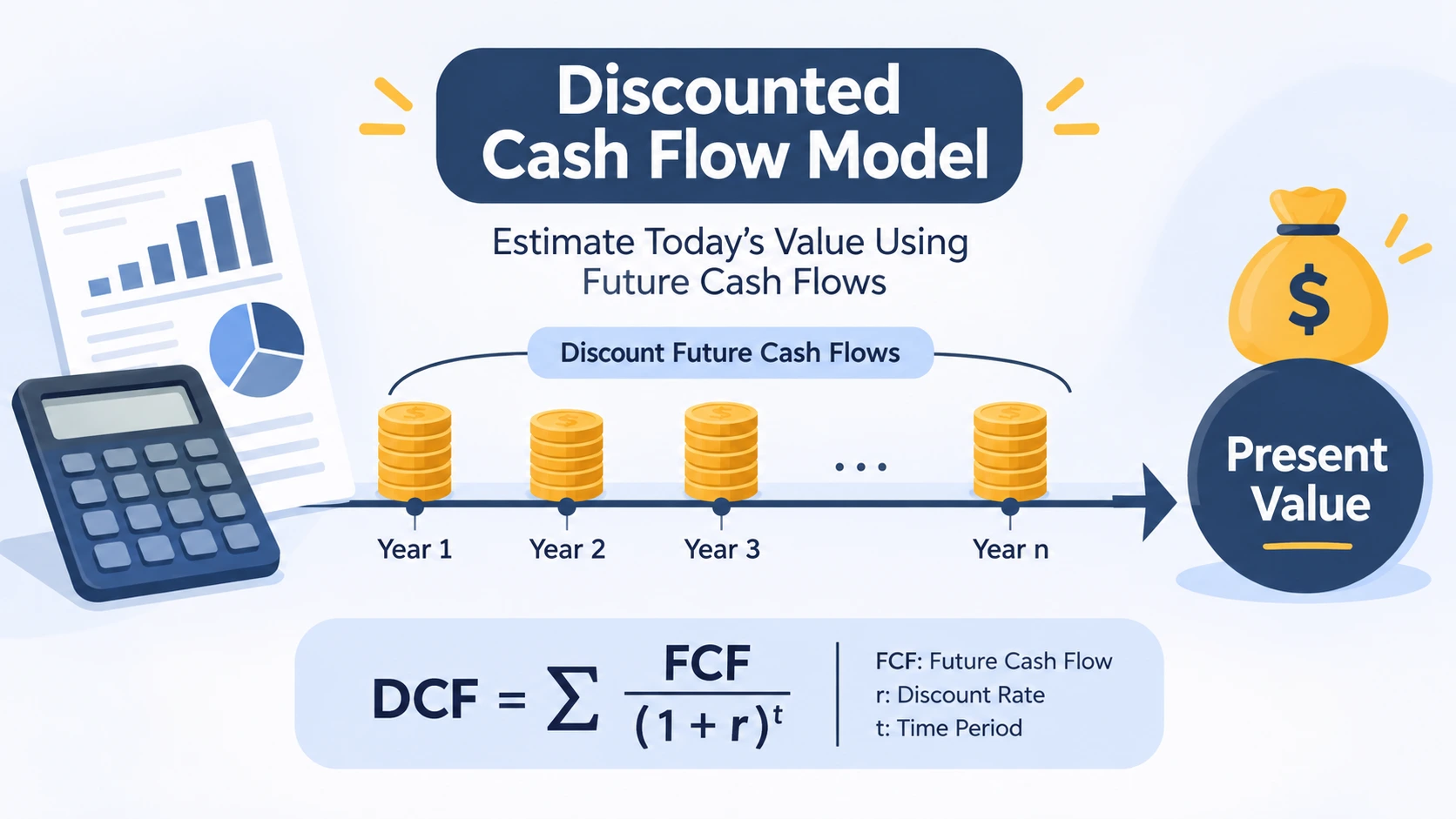
A discounted cash flow (DCF) model estimates a business's intrinsic value by forecasting future free cash flows and converting them into present value using an appropriate discount rate.
The key components of a DCF model include free cash flow, forecast period, Weighted Average Cost of Capital (WACC), and terminal value.
A DCF calculation involves forecasting cash flows, determining the discount rate, calculating terminal value, discounting future cash flows, and moving from enterprise value to equity value.
DCF valuation offers benefits such as fundamental analysis, flexibility, transparency, and scenario analysis. However, its accuracy depends on realistic assumptions and reliable cash flow forecasts.
In this blog, you'll learn what a discounted cash flow model is, its key components, step-by-step calculation, practical example, advantages, limitations, best practices, and the role of technology in modern DCF valuation.
Every investment decision begins with one question: what is this business really worth? Analysts, investors, and corporate financeteams answer it with a time-tested method known as discounted cash flow analysis. Whether you are a student, a working professional, or someone planning a move into finance, understanding this method is a core skill. Learners who want to build such capabilities in a structured way can also explore programs like the Financial Technologies (FinTech) course by IIM Nagpur, which connects financial concepts with modern technology. In this guide, we explain the discounted cash flow model in plain language, walk through each step of the process, and show how it is used in real-world DCF valuation.
A discounted cash flow (DCF) model is a valuation method that estimates the present value of an investment based on the cash it is expected to generate in the future. The central idea is the time value of money: a dollar received today is worth more than a dollar received a year from now. This is because today’s dollar can be invested, earn a return, and grow.
In practice, a DCF model forecasts a company’s future free cash flows, then “discounts” them back to today’s value using a rate that reflects the risk of those cash flows. The sum of these discounted values gives an estimate of the company’s intrinsic value. If that value is higher than the current market price, the stock may be undervalued. If it is lower, the stock may be overvalued.
Because the discounted cash flow approach focuses on cash generation rather than accounting profit or market sentiment, many professionals consider it one of the most rigorous ways to value a business.
DCF valuation is widely used across the financial industry. Investment bankers rely on it for mergers and acquisitions. Equity research analysts use it to set target prices. Private equity firms use it to decide how much to pay for a company. Corporate managers also apply it to evaluate new projects and capital expenditures.
The main reasons for its popularity include:
Intrinsic focus: It values a business based on its own fundamentals, not on how similar companies are priced by the market.
Flexibility: It can be applied to a startup, a mature manufacturer, a real estate project, or a single product line.
Transparency: Every assumption is visible, so users can test how changes in growth or risk affect the final value.
Long-term perspective: It encouragesdecision-makers to think about sustained cash generation instead of short-term earnings.
Free Courses
Free Finance Courses with Certificate – Finance for All
Before performing any DCF calculation, it helps to understand the building blocks of the model.
Free Cash Flow (FCF)
Free cash flow is the cash a business generates after paying its operating expenses, taxes, and the capital expenditures needed to maintain or grow its asset base. A common formula for unlevered free cash flow is:
FCF = EBIT × (1 − Tax Rate) + Depreciation & Amortization − Capital Expenditures − Increase in Net Working Capital
This figure represents cash available to all capital providers, including both lenders and shareholders.
Forecast Period
Most analysts project cash flows for five to ten years. A shorter period is more reliable, while a longer one suits companies with high growth that will take time to stabilize. Discount Rate (WACC)
The discount rate converts future cash flows into present value. For a DCF model that values the whole firm, the Weighted Average Cost of Capital (WACC) is the standard choice. WACC blends the cost of equity and the after-tax cost of debt, weighted by how much of each the company uses. A riskier business carries a higher WACC, which lowers the present value of its cash flows.
The discount rate converts future cash flows into present value. For a DCF model that values the whole firm, the Weighted Average Cost of Capital (WACC) is the standard choice. WACC blends the cost of equity and the after-tax cost of debt, weighted by how much of each the company uses. A riskier business carries a higher WACC, which lowers the present value of its cash flows.
Terminal Value
A company is expected to operate beyond the forecast period, so analystsestimate its value at the end of that period. This is called the terminal value. It is commonly calculated in two ways: the perpetuity growth method and the exit multiple method. Terminal value often makes up more than half of the total value, so it deserves careful attention.
Step-by-Step DCF Calculation
Here is a simple, structured approach to the DCF calculation.
Step 1: Forecast Free Cash Flows
Start with the company’s historicalfinancial statements. Study revenue growth, margins, tax rates, capital spending, and working capital needs. Based on this analysis and your view of the industry, project revenues and costs for each year of the forecast period, and then derive free cash flow for each year.
Step 2: Determine the Discount Rate
Calculate WACC using the following formula:
WACC = (E/V × Re) + (D/V × Rd × (1 − Tax Rate))
Here, E is the market value of equity, D is the market value of debt, V is the sum of both, Re is the cost of equity, and Rd is the cost of debt. The cost of equity is often estimated with the Capital Asset Pricing Model (CAPM), which uses the risk-free rate, the stock’s beta, and the equity risk premium.
Step 3: Calculate the Terminal Value
Under the perpetuity growth method, terminal value is:
Terminal Value = FCF in final year × (1 + g) ÷ (WACC − g)
In this formula, g is the long-term growth rate, which should be modest and typically in line with long-run inflation or economic growth. Under the exit multiple method, you apply a market multiple, such as EV/EBITDA, to the final-year metric.
Step 4: Discount All Cash Flows to Present Value
Each year’s cash flow, along with the terminal value, is discounted using this formula:
Present Value = Cash Flow ÷ (1 + WACC)^n
Here, n is the number of years from today. Add all the present values together to get the enterprise value.
Step 5: Move From Enterprise Value to Equity Value
Subtract net debt (total debt minus cash) from the enterprise value to arrive at equity value. Divide this by the number of diluted shares outstanding to get the intrinsic value per share.
DCF Calculation Example
Let us apply a simple DCF valuation to a hypothetical company. Assume the following:
Projected free cash flows for the next five years: $100 million, $110 million, $121 million, $133.1 million, and $146.4 million
WACC: 10%
Long-term growth rate: 3%
Net debt: $200 million
Diluted shares outstanding: 100 million
Step A: Present value of forecast cash flows. Each cash flow, discounted at 10%, comes to roughly $90.9 million. Across five years, the total is about $454.5 million.
Step B: Terminal value. The final-year cash flow of $146.4 million is grown by 3% and divided by (10% − 3%). This gives a terminal value of about $2,154 million.
Step C: Present value of terminal value. Discounting $2,154 million back five years at 10% gives about $1,338 million.
Step D: Enterprise value. Add $454.5 million and $1,338 million for a total of about $1,792 million.
Step E: Equity value. Subtract net debt of $200 million to get an equity value of about $1,592 million.
Step F: Value per share. Dividing by 100 million shares gives an intrinsic value of roughly $15.92 per share.
If the stock trades at $12, the DCF model suggests it may be undervalued. If it trades at $20, it may be overvalued. Notice also that the terminal value contributes about three-quarters of the enterprise value in this example, which shows why the long-term assumptions matter so much.
Advantages of the DCF Model
The discounted cash flow method offers several benefits:
It is based on fundamentals, which makes it less vulnerable to temporary market swings.
It forces analysts to understand the drivers of the business, such as growth, margins, and reinvestment needs.
It works for companies that have no close peers, since it does not depend on comparable companies.
It allows scenario analysis, so you can see how the valuation changes under optimistic, base, and pessimistic cases.
Limitations of DCF Valuation
No method is perfect, and DCF valuation has its own weaknesses.
Sensitivity to assumptions: A small change in the discount rate or terminal growth rate can change the result significantly. For example, lowering WACC by one percentage point can raise the valuation by a large margin.
Forecasting difficulty: Predicting cash flows several years ahead is uncertain, particularly for young or cyclical businesses.
Dependence on terminal value: Because a large share of value sits in the terminal period, errors there can distort the entire result.
Limited use for cash-negative companies: Early-stage firms with negative or unpredictable cash flows are harder to model reliably.
To reduce these risks, analysts often run sensitivity tables, test several scenarios, and compare the DCF output with valuation multiples such as price-to-earnings or EV/EBITDA.
Following a few sound practices can improve the quality of your DCF calculation:
Use realistic assumptions. Tie growth rates and margins to historical performance and industry trends rather than optimism.
Keep the terminal growth rate conservative. It should rarely exceed the long-term growth rate of the economy.
Be consistent. Use unlevered free cash flow with WACC, and levered free cash flow with the cost of equity.
Run sensitivity analysis. Show how value changes across a range of WACC and growth values.
Cross-check the output. Compare your result with market multiples and recent transactions to confirm that it is reasonable.
Document everything. Clear notes on every assumption make the model easier to review, update, and defend.
The Role of Technology in Modern DCF Valuation
Spreadsheets remain the standard tool for building a DCF model, but technology is changing how analysts work. Automated data feeds, cloud-based platforms, and analytics tools now help gather financial data, run simulations, and update forecasts faster than before. Professionals who combine strong valuation knowledge with technical skills are in high demand, since they can build more dynamic and data-driven models.
Conclusion
The discounted cash flow model remains one of the most trusted tools in finance. By projecting future free cash flows and discounting them at an appropriate rate, it estimates what a business is truly worth today. A careful DCF calculation requires sound forecasts, a well-reasoned discount rate, and a thoughtful terminal value. While the method is sensitive to assumptions, it rewards disciplined analysis and encourages a deeper understanding of how a company creates value.
Used alongside other valuation techniques, DCF valuation can support better investment, lending, and corporate decisions. With regular practice and attention to detail, anyone can learn to build and interpret a reliable DCF model.
Frequently Asked Questions
A discounted cash flow model estimates what a business or investment is worth today by forecasting the cash it will produce in the future and converting those future amounts into today’s value using a discount rate.
For valuing an entire company, analysts typically use the Weighted Average Cost of Capital (WACC). It reflects the blended cost of debt and equity financing. When valuing only the equity portion using levered cash flows, the cost of equity is used instead.
A DCF calculation is only as accurate as its assumptions. Since it relies on forecasts of growth, margins, and risk, the result is best seen as a reasonable range of values rather than an exact figure. Sensitivity analysis helps show that range.
t can, but with caution. Startups often have negative or highly uncertain cash flows, which makes forecasting difficult. Analysts typically use multiple scenarios and probability-weighted outcomes, and they often combine DCF with other methods, such as venture capital valuation or comparable transactions.
Arif Siddiqui
Head of Accounting and Treasury
Arif Siddiqui is a finance leader specializing in accounting, treasury, and financial strategy. As Head of Finance at Generali Employee Benefits, he brings extensive experience in managing global financial operations. He is known for driving financial efficiency and governance across organizations. His leadership supports sustainable business growth and financial excellence.
Get Free Upskilling Guidance
Fill in the details for a free consultation
Related Courses
Explore our programs
Post Graduate Certificate Programme in FinTech, AI in Finance, and Risk Management

 November 10, 2026
 8 min read





 Key Insights
 ChatGPT
 Perplexity
 Claude
 Grok









 ROI Calculator