From unlocking your phone with your face to getting instant movie recommendations, deep learning quietly powers many of the tools we use every day. Behind these smart features are deep learning models, systems that learn patterns from large amounts of data and improve with experience. As businesses across healthcare, finance, retail, and manufacturing adopt artificial intelligence, professionals who understand these models are in high demand. If you are thinking about building such skills through a structured, hands-on curriculum, programs like theApplied Data Science and AI Certificate from IIT Roorkee can help you move from basic concepts to real-world applications. In this guide, we explain what deep learning models are, the main types, and where they are used, all in simple language.
Deep learning models are a branch of machine learning built onartificial neural networkswith many layers. The word “deep” refers to these multiple layers, each of which learns something slightly more complex than the one before it.
Consider how a model learns to recognize a cat in a photo. The first layers detect simple features such as edges and colors. The middle layers combine them into shapes like ears and eyes. The final layers put everything together and decide, “This is a cat.” Nobody writes rules for each of these steps. The model discovers them by studying thousands or millions of examples.
Traditional machine learning often needs people to hand-pick the important features from data. Deep learning models skip much of that effort. They learn features automatically, which is why they perform so well on complex data such as images, speech, video, and natural language.
To understand neural networks and deep learning, it helps to look at the basic building blocks. A neural network is made of connected units called neurons, arranged in layers:
Input layer: Receives raw data, such as pixels of an image or words in a sentence.
Hidden layers: Perform calculations and extract patterns. A network with many hidden layers is called a deep neural network.
Output layer: Produces the final result, such as a category, a number, or a piece of text.
Each connection between neurons carries a weight, which controls how strongly one neuron influences another. During training, the model makes a prediction, compares it with the correct answer, and measures the error using a loss function. It then adjusts its weights through a process called backpropagation, usually guided by an optimizer such as gradient descent. This cycle repeats thousands of times until the errors become small.
Activation functions add another important ingredient. They allow the network to capture complex, non-linear relationships. Without them, even a very large network would behave like a simple straight-line model.
Thanks to powerful GPUs, cloud computing, and the availability of massive datasets, training such networks has become practical. That is the main reason deep learning neural networks have advanced so quickly in the past decade.
Types of Deep Learning Models
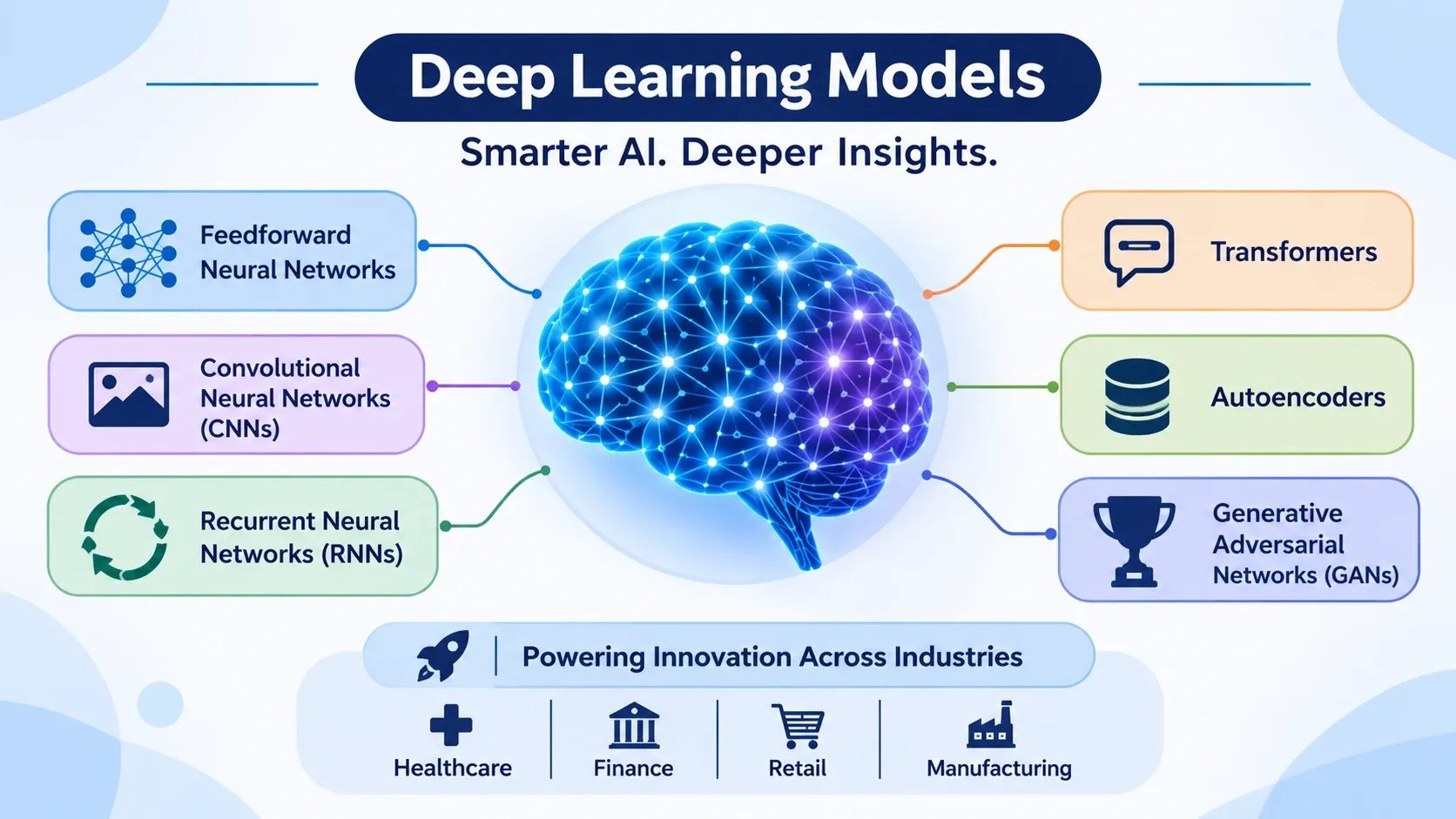
There is no single model that fits every problem. Different deep learning models are designed for different kinds of data and tasks. Let us explore the most important ones.
Feedforward Neural Networks: The Basic Deep Neural Network
A feedforward neural network, also called a multilayer perceptron, is the simplest type of deep neural network. Data flows in one direction, from input to output, without looping back. Each layer passes its results to the next.
These models work well with structured, tabular data. Common uses include credit scoring, customer churn prediction, and sales forecasting. They are also the foundation for understanding more advanced architectures.
Convolutional Neural Networks (CNNs)
CNNs are specialized for visual data. They use filters that slide across an image to detect features such as edges, textures, and shapes. Because the same filter is reused across the image, CNNs need far fewer parameters than a standard network, which makes them efficient.
Popular applications include face recognition, medical image analysis, self-driving car vision, quality inspection in factories, and photo tagging. Well-known architectures include ResNet, VGG, and EfficientNet.
Recurrent Neural Networks (RNNs) and LSTMs
RNNs are built for sequential data, where order matters. They keep a form of memory, passing information from one step to the next. This makes them useful for text, speech, and time series.
Basic RNNs struggle to remember information over long sequences. Long Short-Term Memory (LSTM) networks and Gated Recurrent Units (GRUs) solve this problem with special gates that control what to remember and what to forget. They are used in speech recognition, stock price prediction, and weather forecasting.
Transformers
Transformers have changed the field of artificial intelligence. Instead of reading data step by step, they use a mechanism called self-attention to look at all parts of an input at once and decide which parts matter most. This allows faster training and a better grasp of context.
Transformers power modern language models, chatbots, translation tools, and text summarizers. They are also now used for images, audio, and even protein structure prediction. Models such as BERT and GPT belong to this family.
Autoencoders
Autoencoders learn to compress data into a smaller representation and then rebuild it. The compressed form captures the most important information. They are commonly used for noise removal, dimensionality reduction, and anomaly detection, such as spotting unusual transactions in banking or faulty parts on a production line.
Generative Adversarial Networks (GANs)
GANs consist of two networks that compete with each other. A generator creates fake data, while a discriminator tries to tell real from fake. Through this contest, the generator becomes remarkably good at producing realistic images, audio, and video.
GANs are used for image enhancement, synthetic data creation, design prototyping, and art generation. They also raise important ethical questions, particularly around deepfakes.
Deep Reinforcement Learning Models
These models learn by trial and error. An agent takes actions in an environment, receives rewards or penalties, and gradually learns the best strategy. Deep reinforcement learning has been used to master complex games, control robots, and optimize energy usage in data centers.
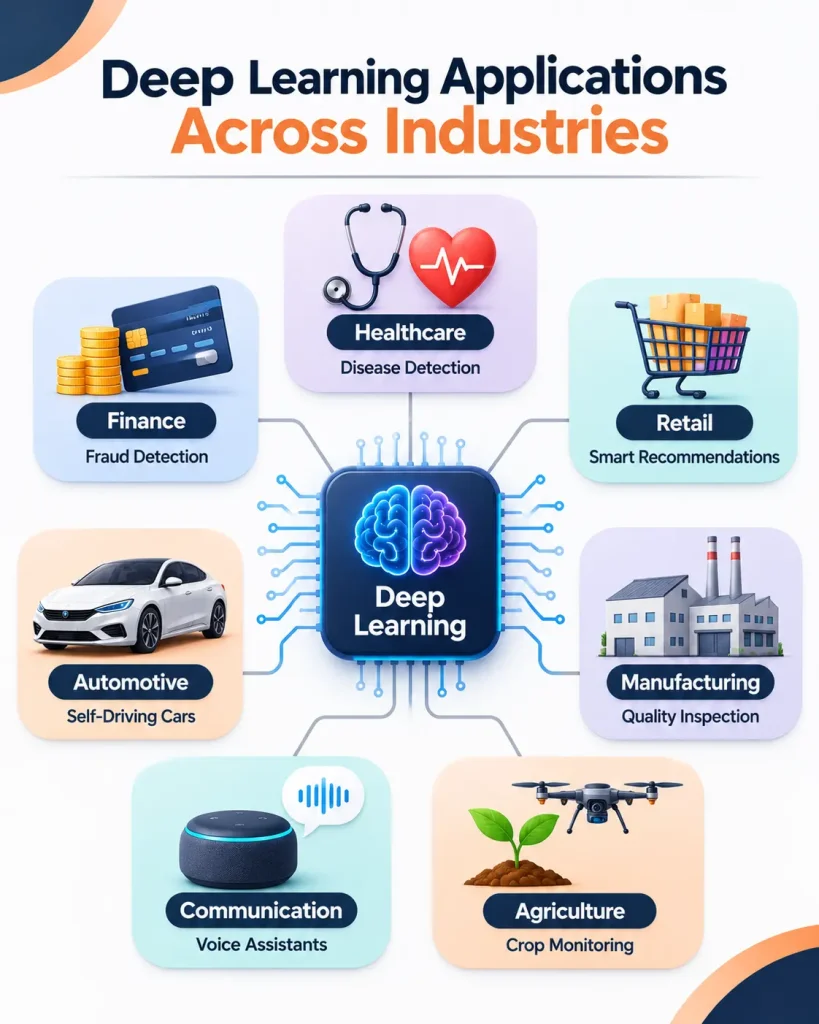
The real value of neural networks and deep learning becomes clear when we see them in action.
Healthcare: Deep learning models help doctors detect diseases such as cancer, diabetic eye disease, and lung conditions from scans, often at an early stage. They also assist in drug discovery and personalized treatment planning.
Finance: Banks use deep neural network systems to detect fraud in real time, assess credit risk, and automate document processing. Investment firms apply them to market analysis and risk modeling.
Retail and E-commerce: Recommendation engines, demand forecasting, visual search, and customer support chatbots all rely on deep learning neural networks to improve the shopping experience.
Automotive: Self-driving and driver-assist systems use CNNs and other models to recognize pedestrians, lane markings, and traffic signs.
Manufacturing: Cameras combined with deep learning inspect products for defects, while predictive maintenance models warn engineers before a machine fails.
Language and Communication: Translation apps, voice assistants, grammar checkers, and automated captioning all depend on RNNs and transformers.
Agriculture and Environment: Drones and satellite images, analyzed by deep models, help monitor crop health, predict yields, and track deforestation or climate patterns.
Benefits and Challenges of Deep Learning Neural Networks
Deep learning offers clear advantages. It handles unstructured data very well, learns features automatically, and often achieves higher accuracy than traditional methods when enough data is available. It also keeps improving as more data is added.
However, it comes with challenges that learners and organizations should understand:
Data hunger: These models usually need large, high-quality datasets.
Computing cost: Training deep neural network architectures requires powerful hardware and considerable energy.
Limited interpretability: It can be difficult to explain exactly why a model made a certain decision, which matters in areas like healthcare and finance.
Bias risk: If the training data is biased, the model can produce unfair results.
Overfitting: A model may memorize training data instead of learning general patterns, which hurts performance on new data.
Techniques such as dropout, regularization, data augmentation, and transfer learning help reduce several of these issues.
How to Choose the Right Deep Learning Model
Choosing a model begins with the data and the goal. For tabular data, a feedforward network is a sensible start. For images, CNNs are usually the best choice. For text and language tasks, transformers are the current standard. For sequences such as sensor readings, LSTMs or transformers work well. For generating new content, consider GANs or transformer-based generative models, and for decision-making in changing environments, look at reinforcement learning.
It is also wise to begin with a simple model, measure its performance, and increase complexity only when needed. Pre-trained models can save time and cost, since they have already learned general patterns from massive datasets.
Deep learning models have moved from research labs into everyday life. By understanding how neural networks and deep learning work, and by knowing the strengths of each architecture, you can better judge which tool suits which problem. Feedforward networks handle structured data, CNNs see, RNNs and LSTMs follow sequences, transformers understand language, autoencoders detect the unusual, GANs create, and reinforcement learning agents make decisions. For anyone planning a career in data science or artificial intelligence, learning these foundations and practicing on real projects is a smart and rewarding step.
Frequently Asked Questions
Deep learning models are artificial neural networks with multiple layers that learn patterns directly from data. They are used for tasks such as image recognition, speech processing, language translation, and prediction.
A basic neural network may have just one or two hidden layers. A deep neural network has many hidden layers, which allows it to learn more complex patterns from large datasets.
Convolutional neural networks are typically the preferred choice for images, while transformers are the leading choice for text and language tasks. The best option still depends on your data, goals, and resources.
Basic knowledge of Python, statistics, and linear algebra is very helpful. Libraries such as TensorFlow and PyTorch make it easier to build models, and beginners can learn step by step through guided courses and practical projects.
Dr. Sanjay Kulkarni
Data & AI Transformation Leader
Dr. Sanjay Kulkarni is a Data & AI Transformation Leader with over 25 years of industry experience. He helps organizations adopt data-driven and responsible AI practices through strategic guidance and education. With experience across startups and global enterprises, he bridges the gap between theory and real-world application. His work empowers teams to innovate and thrive in AI-driven environments.
Get Free Upskilling Guidance
Fill in the details for a free consultation
Related Courses
Explore our programs
Post Graduate Certificate Programme in Applied Data Science & AI

 November 21, 2026
 7 min read




 ChatGPT
 Perplexity
 Claude
 Grok











 ROI Calculator