List of Courses After 12th Commerce With High Salary Potential
Which Courses After 12th Commerce Are Best Without Maths?
How to Select the Right Course After 12th Commerce
Conclusion
Key Insights
Commerce after class 12 can lead to careers in finance, management, law, marketing, analytics, and entrepreneurship.
CA, CS, and CMA are professional routes for students looking for specialised careers in finance and corporate functions.
Economics, Statistics, and finance-focused programmes can suit students with strong analytical and numerical skills.
Mass Media, Law, and Design-related fields allow Commerce students to move beyond traditional accounting careers.
The right course should be selected by considering career goals, eligibility, skills, course structure, and long-term growth rather than salary alone.
Choosing courses after 12th commerce can feel like a big decision, especially when there are so many degrees and professional courses available. While accounting and finance remain popular, today's courses after 12th commerce also cover management, law, economics, marketing, analytics, and other growing fields. The best choice depends on your interests, academic strengths, and the kind of career you want to build.
This guide explores the major commerce courses with strong salary potential, what each one focuses on, and the career directions they can open up. It also covers options for students without mathematics and some of the best courses after 12th commerce for girls.
List of Courses After 12th Commerce With High Salary Potential
There is no single commerce course that guarantees a high salary. Earning potential usually depends on the qualification, skills, experience, specialisation, organisation, and location. With that in mind, these are some of the most relevant options to consider.
1. B.Com (Bachelor of Commerce)
B.Com is a broad undergraduate programme covering accounting, finance, taxation, economics, business law, and commercial practices. It gives students a foundation that can be used for careers in finance and businessor further professional studies.
Duration: 3 years
Career Opportunities: Accountant, Financial Analyst, Tax Associate
Higher Study Options: CA, CMA, CFA, MBA, M.Com
2. BBA (Bachelor of Business Administration)
BBA focuses on how businesses are managed and operated, with subjects generally covering marketing, finance, human resources, operations, entrepreneurship, and business strategy. It is suited to students looking for a management-oriented undergraduate degree.
Duration: 3 years
Career Opportunities: Business Development Executive, Marketing Executive, HR Executive
Further Study: MBA, PGDM, specialised management programmes
3. Chartered Accountancy (CA)
CA is a professional qualification focused on accounting, auditing, taxation, financial reporting, and business laws. Unlike a conventional undergraduate degree, it involves a structured professional qualification process and practical training.
Qualification Body: Institute of Chartered Accountants of India (ICAI)
The Company Secretary programme centres on company law, corporate governance, compliance, and regulatory requirements. It offers a different professional route within Commerce for students interested in the legal and regulatory side of businesses.
Qualification Body: Institute of Company Secretaries of India (ICSI)
Career Opportunities: Company Secretary, Compliance Officer, Corporate Governance Professional
Workplaces: Corporates, listed companies, consulting firms, professional practices
5. Cost and Management Accountancy (CMA)
CMA focuses on cost management, budgeting,financial planning, performance evaluation, and business decision-making. The qualification helps professionals understand how financial information can be used to improve efficiency and profitability.
Qualification Body: Institute of Cost Accountants of India (ICMAI)
Career Opportunities: Cost Accountant, Management Accountant, Financial Analyst
A Bachelor’s degree in Economics examines markets, economic policies, consumer behaviour, business cycles, and economic decision-making. It combines conceptual understanding with analytical and quantitative methods.
Duration: 3 years
Career Opportunities: Economic Analyst, Research Analyst, Policy Analyst
Workplaces: Banks, research institutions, consulting firms, government and policy organisations
7. Bachelor of Management Studies (BMS)
BMS provides an undergraduate foundation in management, marketing, finance, human resources, operations, and organisational practices. It is closely aligned with business management and can lead to roles across different functions.
Duration: 3 years
Career Opportunities: Management Trainee, Business Analyst, Marketing Executive
Further Study: MBA, PGDM, specialised management programmes
8. Integrated Law: BA LLB or BBA LLB
Integrated law programmescombine undergraduate education with professional legal studies over five years. BA LLB combines arts and law, while BBA LLB brings business and legal education together, making the latter particularly relevant to Commerce students.
Duration: 5 years
Career Opportunities: Corporate Lawyer, Legal Consultant, Compliance Professional
Areas of Practice: Corporate law, contracts, taxation, commercial law
9. Bachelor of Statistics
Bachelor of Statistics develops expertise in probability, statistical methods, data interpretation, research, and quantitative analysis. It can be a strong option for Commerce students who are comfortable with Mathematics and interested in data-driven careers.
Duration: 3 years
Career Opportunities: Statistician,Data Analyst, Research Analyst
Workplaces: Finance, research, consulting, analytics and government organisations
10. Bachelor of Mass Media and Communication
Mass Media and Communication covers the wider media and communication industry, including journalism, advertising, public relations, digital media, content creation, broadcasting, film, and animation. The field offers both creative and communication-focused career paths.
Duration: Usually 3 years
Career Opportunities: Journalist, Content Creator, PR Executive, Media Professional
Workplaces: Media houses, advertising agencies, digital platforms, production companies
11. Bachelor of Hotel Management
Hotel Management prepares students for the business and operational side of hospitality, accommodation, food and beverage, tourism, events, and customer service. The course combines practical training with knowledge of hospitality operations.
Duration: Usually 3–4 years
Career Opportunities: Hotel Manager, Food & Beverage Executive, Event Professional
Workplaces: Hotels, resorts, restaurants, airlines, cruise lines and event companies
12. Bachelor of Design (B.Des)
B.Des is a broad creative degree where specialisations can include graphic design, animation, visual communication, fashion, product design, UX, and other design disciplines. The specific subjects and career pathways depend on the chosen specialisation and institution.
Duration: Usually 4 years
Career Opportunities: Graphic Designer, UX Designer, Animator, Visual Designer
Workplaces: Design studios, media companies, advertising agencies, technology and creative firms
Which Courses After 12th Commerce Are Best Without Maths?
Students who did not have mathematics in class 12 still have a broad selection of career paths. The exact eligibility depends on the university, so it is important to check admission requirements before applying.
Reference:collegeknowledge.in
Some commonly considered courses after 12th commerce options include:
Traditional & Management Courses
B.Com / B.Com (Hons): Covers accounting, finance, taxation, and business law.
BBA / BMS: Focuses on management, marketing, HR, and business strategy.
BA Economics: Covers economic theory, markets, policies, and trends.
Professional Courses
CA: Builds expertise in accounting, auditing, taxation, and financial reporting.
CS: Focuses on company law, governance, and regulatory compliance.
How to Select the Right Course After 12th Commerce
A high salary can be a useful consideration, but it should not be the only one. A course that fits your strengths is more likely to keep you engaged and help you build expertise over time.
Start With the Career, Not the Course: Think about the type of work you would like to do first. If you want to become a finance professional, your shortlist will look different from someone interested in marketing or corporate law.
Check the Eligibility: Some programmes have subject-specific requirements or entrance examinations. This is especially important for specialised programmes involving Mathematics, Economics, or professional qualifications.
Compare the Learning Approach: Look at what you will actually study. A BBA, for example, will involve management and business subjects, whereas B.Com may provide wider exposure to accounting, taxation, finance, and commerce.
Consider What Comes Next: Ask yourself what you can do after graduation. Can you enter the workforce directly? Would a professional certification improve your prospects? Would an MBA or another postgraduate qualification be useful?
Look at Practical Exposure: Internships, live projects, industry interactions, competitions, and placement assistance can make a significant difference when moving from college to the workplace.
Commerce can take you in many directions after Class 12, from accounting and finance to business management, law, economics, marketing, and analytics. So, instead of choosing a course only because it appears on a list of high-paying options, think about the kind of work you see yourself doing and the expertise you want to develop over the years.
At Jaro Education, we bring together undergraduate and career-focused programmes from reputed universities, covering areas such as Commerce, management, and finance. Students can explore options such as B.Com, BBA, and specialised Commerce and finance programmes and understand what each programme offers before making their choice.
So, what could your next step look like? Explore Jaro Education’s programmesand discover courses that match your interests and aspirations.
Frequently Asked Questions
Popular options include B.Com, BBA, Bachelor of Economics, CA, CS, CMA, and specialised courses in finance, accounting, digital marketing, and business management.
B.Com, B.Com in Banking and Finance, CA, CMA, and finance-focused degree programmes are suitable for students interested in accounting, investment, taxation, and financial management.
Professional qualifications such as CA, CMA, and CS can offer strong earning potential, while degrees such as BBA, B.Com, Economics, and other specialised programmes can also lead to well-paying careers with the right skills and experience.
Yes. Several options are available to students who did not have Mathematics in Class 12, including B.Com, BBA, BMS, CS, integrated Law, Mass Media, and Hotel Management. However, eligibility varies by institution.
To choose courses after 12th Commerce, start by identifying the subjects and career areas that interest you. Then compare the course curriculum, eligibility, duration, career opportunities, practical exposure, and scope for further education before making a decision.
Manya Tohani
Personal Growth Mentor
Manya Tohani is a Personal Growth Mentor and content strategist, helping individuals build strong personal brands and accelerate career growth. With 8M+ impressions and experience mentoring students, she empowers others through actionable guidance, resilience, and real-world insights.

 April 28, 2025
 6 min read





 Key Insights
 ChatGPT
 Perplexity
 Claude
 Grok
Grok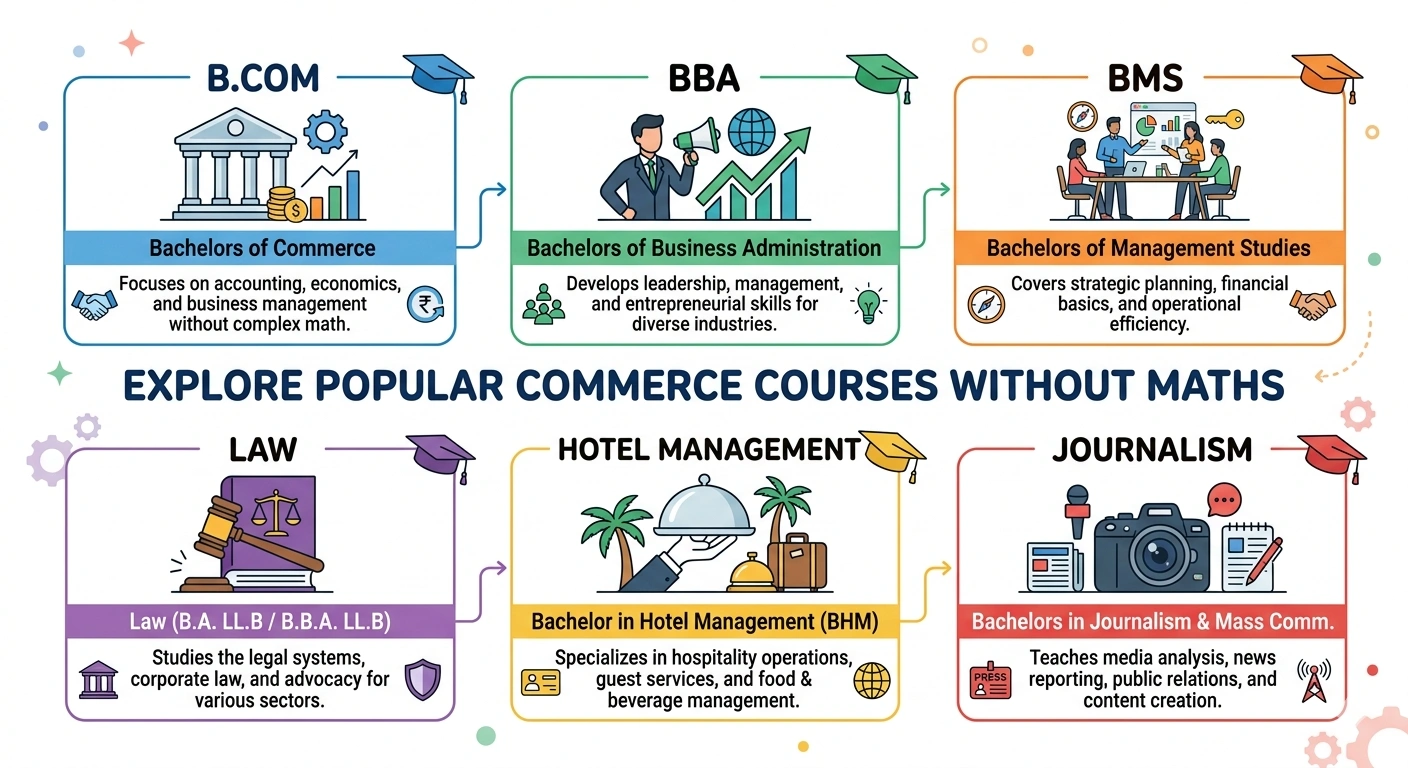







 ROI Calculator



