
CAT Exam Syllabus, Pattern and Preparation Guide
 April 30, 2025
 6 min read





Table Of Content
- What Is CAT Exam?
- CAT Exam Eligibility — Can You Appear?
- CAT Exam 2026 Overview
- CAT Exam Syllabus 2026
The Common Admission Test is one of the toughest exams that a candidate has to face. To prepare for this exam, a candidate needs to have a strong grasp on the patterns, trends that have been identified for 2026, and other relevant factors that are required to achieve excellence in this exam.
In this blog, we will discuss the various components of the CAT exam syllabus in an exciting way that will help you go through all the intricacies involved.
 ChatGPT
 Perplexity
 Claude
 Grok
GrokWhat Is CAT Exam?
*careerchoice360.in
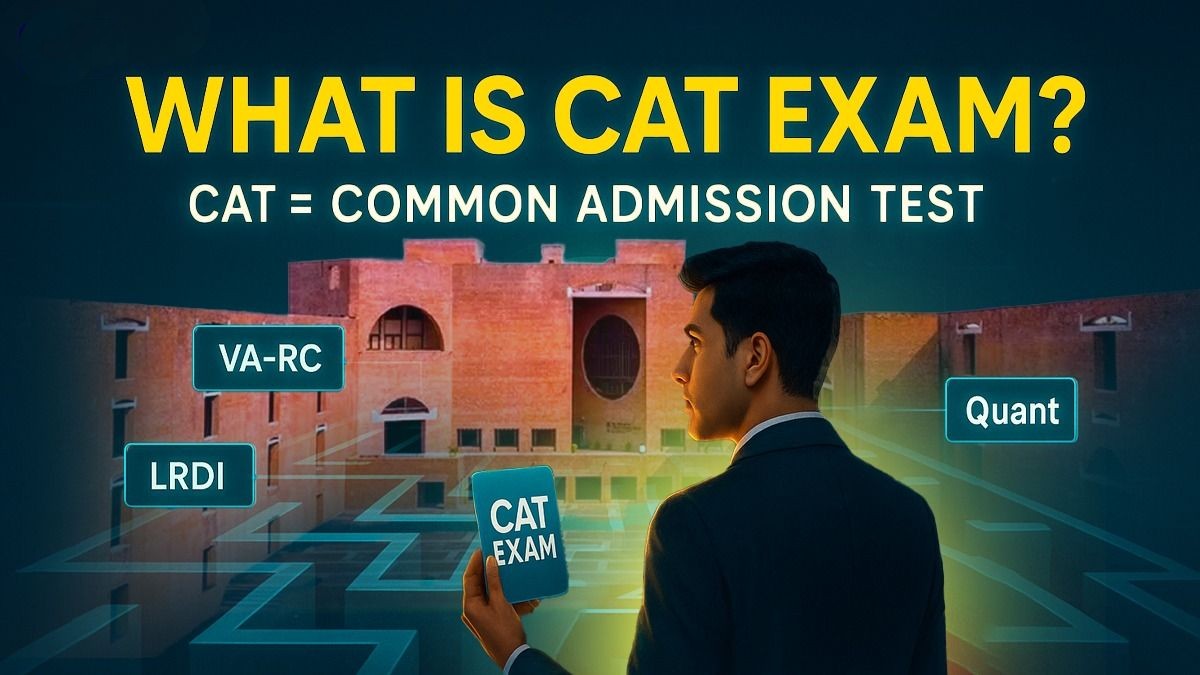
The CAT entrance exam is for MBA courses conducted by the IIMS on a rotational basis every year in November. This is the entrance exam to the IIMS and hundreds of other top business schools in India. Think IIT Bombay, MDI, SP Jain, FMS Delhi, and so on.
What makes CAT special is not how difficult it is, but what kind of difficult it is. It’s not about memorizing facts. It’s about how you think, how you adapt to situations, and how well you process information. That’s why it’s not just about being aware of the syllabus. You also have to understand the logic behind the exam.
A quick note: There is no official CAT Syllabus ever released by the IIMS. Whatever you read, including this one, is based on the question papers of previous years.
CAT Exam Eligibility — Can You Appear?
First, let’s quickly touch base on who can actually take the exam because there is a lot of confusion in this regard.
- Education: You must be a graduate from a recognized university with at least 50% marks (45% in case of SC/ST/PWD candidates). If you’re in the final year of your undergraduate course, you can provisionally appear, but you must submit evidence of completion later on.
- Age limit: There is no restriction on age in CAT.
- Attempts Limit: You can attempt the exam as many times as you wish, as long as you meet the eligibility criteria.
CAT Exam 2026 Overview
First, it is important to understand the CAT exam pattern. These are the primary parameters on which you can base your preparation.
Key Highlights
- Total Questions: 68
- Total Duration: 120 minutes
- Total Marks: 204
- Time per Section: 40 minutes (fixed)
- Exam Slots: 3
- Negative Marking: −1 (MCQs only)
Exam Structure & Marking Scheme
| Detail | Information |
| Mode | Computer-Based Test (CBT) |
| Sections | VARC → DILR → QA (fixed order) |
| Question Types | MCQs + TITA (Type In The Answer) |
| MCQ Marking | +3 correct, −1 incorrect, 0 unattempted |
| TITA Marking | +3 correct, no negative marking |
| Section Switching | Not allowed |
| PwD Duration | ~50+ minutes per section |
Strategic Implication
This pattern follows a section-wise time constraint and is non-flexible in nature.
You cannot switch between the two sections. This means that you have to treat both 40-minute periods as two separate tests.
What this means to you:
- Time management is not a choice; it’s a necessity
- Question selection is just as important as getting the correct answer
- Practicing under time constraints is a must
CAT Exam Syllabus 2026
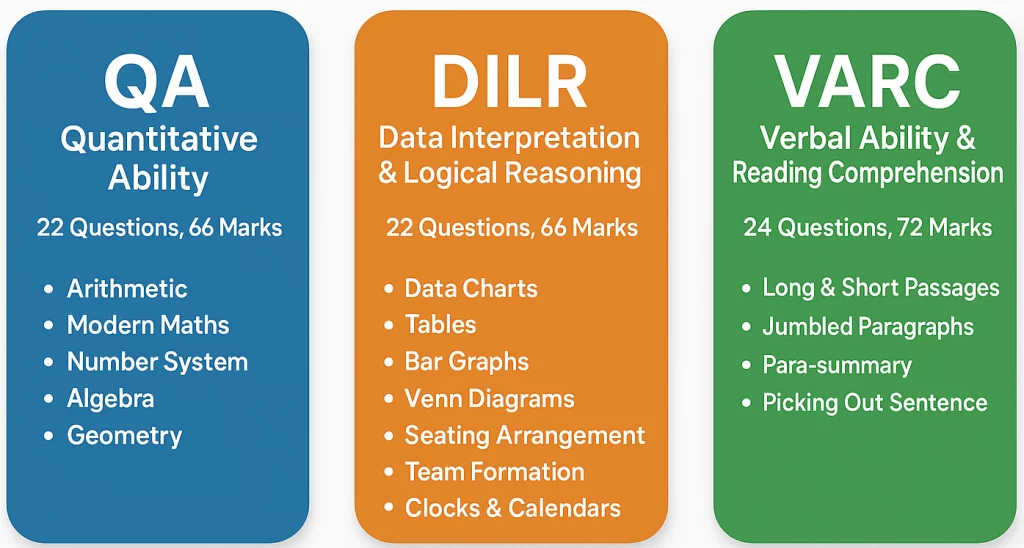
The CAT 2026 Syllabus is divided into three main sections:
- VARC: Verbal Ability & Reading Comprehension
- DILR: Data Interpretation & Logical Reasoning
- Quantitative Aptitude (QA)
Further, the exam includes MCQ and TITA (Type In The Answer) types. In TITA type, the student has to type the answer instead of selecting it. The CAT 2026 Syllabus has been divided into different sections to evaluate different skill sets in the student. This makes CAT an aptitude test rather than a knowledge test.
1. VARC (Verbal Ability & Reading Comprehension)
24 Questions | ~72 Marks
Key Areas:
- Reading Comprehension (4 passages, ~16 questions)
- Para Summary
- Para Completion
- Odd Sentence Out
Weightage Insight:
- RC dominates the section (~65–70%)
- VA is smaller but scoring if practiced well
Difficulty Trend:
- Increasing focus on inference and meaning-based questions
- Less reliance on direct grammar rules
2. DILR (Data Interpretation & Logical Reasoning)
22 Questions | ~66 Marks
Key Areas:
- Data Interpretation (Tables, Graphs, Caselets)
- Logical Reasoning (Seating, Puzzles, Networks, Games)
Structure Insight:
- 5 sets (mix of 4 & 5 questions)
- Selection of the right sets is critical
Difficulty Trend:
- Highly unpredictable
- Focus shifting toward hybrid sets (DI + LR combined)
3. QA (Quantitative Aptitude)
22 Questions | ~66 Marks
Key Areas:
- Arithmetic (highest weightage)
- Algebra
- Geometry
- Modern Maths
- Number System
Weightage Insight:
- Arithmetic + Algebra ≈ 70% of the section
Difficulty Trend:
- Conceptually simple but application-heavy
- Questions increasingly test logic + speed, not formulas
Key Trends Observed (CAT 2023–2025)
- DILR expanded and stabilized at 22 questions, making it a decisive section
- VARC continues to be RC-dominated, while VA question types remain unpredictable
- QA maintains similar topics but has become more application-driven and calculation-intensive
- The exam increasingly rewards smart decision-making and time management over brute attempts
- Total paper structure stabilized at 68 questions, but difficulty varies yearly
CAT Exam Preparation Tips
Now that you clearly understand:
- What is the CAT exam
- The exam pattern
- The actual syllabus structure
- The latest trends
It’s important to translate this knowledge into a practical preparation strategy. Because in CAT, knowing the syllabus is only step one, execution is what determines your percentile.
Your CAT exam preparation roadmap should look like:
- Start with diagnosis, not content. Take a free mock CAT first, even if your scores are bad. This will give you your real scores over all sections. Blind preparation without diagnosis of your weaknesses is pointless.
- Topic-by-topic practice for QA and DILR. These sections will benefit from topic-by-topic practice. Practice each topic for 6-8 weeks without jumping between topics. Complete arithmetic before moving to algebra. Get it done once rather than skimming all of it twice.
- For VARC, read more than you practice. RC is a long game. Read The Economist, Aeon, Mint, or any other serious long-form publication every day. 20 minutes a day for 6 months will do more for your RC skills than 100 RC passage exercises done in the last month.
- Mocks are a necessity. You should be doing at least 2 full mocks per month from month 3 onwards. And at least one or two mocks per week in the last two months. But the mocks are not the practice. The practice comes after the mocks. Every incorrect answer should have a written explanation of why you got it wrong.
- TITA questions in DILR and QA. Since there’s no negative marking in TITA, you should attempt these questions at all costs. Many students leave these questions blank. Do not become one of these students.
- Review your own error log weekly. Keep a notebook, physical or digital, containing all the concepts you got wrong. Re-attempt these exact same problems 2 weeks later. This is the best way to learn. Nothing beats this.
Section-wise Time: How to Split Your Study Hours
| Section | If You’re an Engineer | If You’re from Humanities/Commerce |
| VARC | 35–40% of total time | 20–25% of total time |
| DILR | 25–30% of total time | 35% of total time |
| QA | 30–35% of total time | 40–45% of total time |
How Jaro Education Can Support Your MBA Journey
While cracking the CAT exam is a major milestone, choosing the right program and platform for your MBA is equally critical. At Jaro Education, we offer industry-relevant online postgraduate programs designed for professionals who want to upskill without putting their careers on hold.
Through our collaborations with leading institutions, you can explore programs such as:
- Online MBA – Amrita Vishwa Vidyapeetham
- Online MBA (ESG) – Amrita Vishwa Vidyapeetham
- Online MBA (FinTech) – Amrita Vishwa Vidyapeetham
- Online MBA (Business Analytics) – Amrita Vishwa Vidyapeetham
- Online MBA Degree Programme – Symbiosis School for Online and Digital Learning (SSODL)
These programs are designed to bridge the gap between academic knowledge and real-world business application, helping you build skills in areas like analytics, finance, sustainability, and technology.
If you’re planning your next step after CAT or exploring flexible MBA options, Jaro Education can help you make a well-informed, career-focused decision. Get in touch now!





Conclusion
The CAT exam is not just about understanding the syllabus, it’s about how effectively you translate that understanding into performance under pressure. By now, you have a clear view of the exam pattern, section-wise syllabus, and recent trends shaping CAT 2026.
The real differentiator lies in execution. Candidates who succeed are not the ones who study everything, but those who focus on high-weightage areas, practice consistently, and make data-driven improvements through mocks and analysis.
With the right mindset and a structured plan, cracking the CAT exam is not just possible, it’s achievable. All the very best!
Frequently Asked Questions
The minimum time to start taking the CAT seriously would be 6 months. This is assuming you’re starting from scratch. If you’re already good in math and/or verbal, 4 months would be sufficient. But to get to the 99th percentile, toppers usually end up taking 8-12 months with 4-6 hours a day.

Related Courses
Explore our programs




Find a Program made just for YOU
We'll help you find the right fit for your solution. Let's get you connected with the perfect solution.

Is Your Upskilling Effort worth it?
 ROI Calculator

Are Your Skills Meeting Job Demands?
Try our Skill Gap tool
Experience Lifelong Learning and Connect with Like-minded Professionals
Explore Jaro Connect
