
Executive Certificate Programme in Applied AI for Business Managers & Leaders
Desai Sethi School of Entrepreneurship, IIT Bombay

- Batch
01
- Duration
6 Months
- Mode
Hybrid
(Live Online with Campus Immersions) - Commencement Date
12th July 2026
- Admission Closure Date
Closing Soon
- Session Timings
Saturday,
10:00 AM to 1:00 PM
Programme Overview
Generative AI is rapidly transforming the technology landscape, fundamentally altering how businesses approach innovation, competition, and value creation. This 6-month, practice-oriented programme is specifically designed for leaders and managers ready to strategically implement Gen AI across various business functions.
Moving beyond foundational theory, the programme emphasises real-world applications of Gen AI in core areas like operations, marketing, finance, HR, supply chain, and strategy. Participants will gain a comprehensive understanding of Gen AI fundamentals, build the confidence to integrate this transformative technology, and learn to drive efficiency, innovation, and informed decision-making within their organizations for tangible impact.
Admission Criteria

Eligibility Criteria
- Educational Qualification: Bachelor’s degree (10+2+3) or Diploma (10+2+3) in any discipline
- Work Experience: 5-15 years of professional experience in managerial or decision-making roles
- Industry Background: Open to professionals from all sectors, including technology, BFSI, manufacturing, healthcare, retail, consulting, e-commerce, telecommunications, and more
Attendance Criteria:
- Minimum 80% attendance is mandatory.
Who Should Attend?
This programme is ideal for:
- Functional Managers in operations, marketing, sales, finance, HR, supply chain, and product management seeking to leverage GenAI for functional excellence.
- Mid-to-Senior Level Managers (5-15 years experience) responsible for driving innovation, efficiency, and digital transformation within their teams or business units.
- Strategy & Business Development Professionals looking to incorporate AI into strategic planning, competitive positioning, and growth initiatives.
- Project & Program Managers leading cross-functional initiatives who need to understand AI capabilities for effective project scoping and execution.
- Entrepreneurs & Business Owners aiming to build AI-augmented business models and sustainable competitive advantages.
- Consultants & Advisors who guide organizations through technology adoption and require deep GenAI expertise to serve clients effectively.
- Professionals transitioning into AI-enabled roles who want to future-proof their careers by building leadership capabilities in the AI domain.
About The Desai Sethi School of Entrepreneurship (DSSE),
IIT Bombay
The Desai Sethi School of Entrepreneurship (DSSE) at IIT Bombay is a leading institution dedicated to fostering entrepreneurship through education, research, and practical engagement. Established initially as the Centre for Entrepreneurship in 2014, it was upgraded to a full-fledged school in 2020, underscoring IIT Bombay’s strong commitment to cultivating entrepreneurial talent and supporting an innovation-driven ecosystem in India.
DSSE’s core mission is to empower students, researchers, and aspiring entrepreneurs with the mindset, skills, and practical experience needed to transform innovative ideas into impactful ventures. The school offers a blend of rigorous academic programs, hands-on experiential learning, and dedicated mentoring. Through these initiatives, DSSE has established itself as a national leader in entrepreneurship education and a key driver of innovation at IIT Bombay.
Pedagogical Methodology
Learning Outcomes
Provide a solid foundation in Generative AI concepts, technologies, and their business implications.
Explore the practical applications of GenAI across various business functions and industries.
Develop strategic thinking skills to integrate GenAI into business processes and decision-making.
Equip participants with hands-on experience using GenAI tools and platforms.
Cultivate the ability to strategically plan for and manage GenAI adoption, including organizational change and cross-functional collaboration.
Prepare participants to lead GenAI initiatives within their organizations.
Admission Process
- 1
Eligibility of Applicant
- 2
Application Submission
- 3
Screening & Shortlisting
- 4
Admission & Fee Payment
- 5
Book your Seat
Unleash the benefits that await you with Jaro Value adds.
%
higher employee retention rate
%
increase in employee productivity
%
higher incomes per employee
%
businesses achieved measurable growth
Companies that already trust us!



















- What Generative AI (is and is not): understanding capabilities, limits, and common misconceptions
- How GenAI works at a high level: models, data, training, inference
- Introduction to GenAI tech stack, infrastructure, and ecosystem, including foundation models, copilots, agents, and enterprise tools
- Where GenAI creates business value: efficiency, productivity, cost savings, augmentation, automation, and innovation
- Identifying AI-ready tasks vs human-critical decisions in managerial work
- Examples and case studies of GenAI adoption across enterprises (successes and failures)
- Prompting structure involving role, task, context, examples, and output format
- Advanced prompting techniques using system-level instructions, style, tone, and constraints
- Designing reusable prompts for common managerial workflows (emails, reports, analysis, planning)
- Overview of leading GenAI tools for business (text, data, presentations, research, analysis)
- Using AI for thinking support: ideation, synthesis, decision framing, and scenario exploration
- Managing quality, bias, and hallucinations in AI-generated outputs
- The GenAI tech stack, including LLMs, prompting, and multimodality
- Differences between open-source and proprietary implementation models
- Understanding Retrieval-Augmented Generation (RAG) and AI wrappers
- Underlying AI infrastructure, ecosystems, and implementation options for the enterprise
- Introductory overviews of technical tools like N8N, Hugging Face, and low-code/no-code tools
- Introduction to agentic AI and its evolving role in business automation
- Mapping GenAI use cases across functions: HR, marketing, operations, finance, etc.
- Data-driven decision-making and strategy using AI to extract insights from data
- Domain-agnostic tasks like meeting transcription, document creation, and language translation
- Function-specific case studies (e.g., recruitment screening, demand forecasting, content ops)
- Measuring impact: productivity gains, cost savings, speed, quality, and employee experience
- AI data and task audit for identifying repetitive tasks to automate in daily workflows and available data
- Identifying and prioritising AI use cases based on feasibility and potential impact
- Defining business problems clearly before applying AI
- Structuring AI initiatives: pilots, proofs of concept, and scaled deployment
- Identifying quick wins vs long-term transformation opportunities
- Translating functional needs into AI requirements (without technical depth)
- Managing timelines, expectations, and change resistance
- Evaluating outcomes and deciding when to scale, pivot, or stop AI projects
- Cloud vs on-premises vs hybrid AI deployment options
- Build vs buy vs partner strategies for functional AI tools
- Integration with existing enterprise systems (ERP, CRM, HRIS, analytics tools)
- Cost structures, scalability considerations, and vendor lock-in risks
- Managerial questions to ask IT, vendors, and leadership before approving AI investments
- Leadership and change management strategies for AI adoption and people management
- Managing human-AI collaboration: trust, delegation, and accountability
- Leading AI-augmented teams without deskilling or demotivating employees
- Redesigning KPIs, incentives, and performance reviews in AI-enabled environments
- Developing AI literacy and confidence across diverse teams
- Preparing for AI agents and semi-autonomous workflows in the workplace
- How to stay updated on AI for business
- Responsible AI principles translated into managerial decision-making
- Key risks of GenAI: data leakage, IP issues, misinformation, over-automation, lack of transparency of tools, models and decision-making
- Understanding bias
- Regulatory landscape overview and relevance
- Ethical pitfalls to keep in mind for business operations
- Crisis scenarios: what to do when AI goes wrong
- Understanding guardrails, human-in-the-loop processes, and escalation mechanisms
- Identify a real functional or operational challenge from the participant’s organisation
- Map current workflows and redesign them using GenAI augmentation
- Select appropriate tools, prompts, and governance mechanisms
- Define success metrics and implementation roadmap
- Present a business-ready AI integration proposal to a review panel
- Reflect on leadership, change management, and ethical considerations
Programme Fee Details

Application Fee
(Non-refundable)
(To be made part of the Programme Fee)
Programme Fee
(Per Participant)
Certification
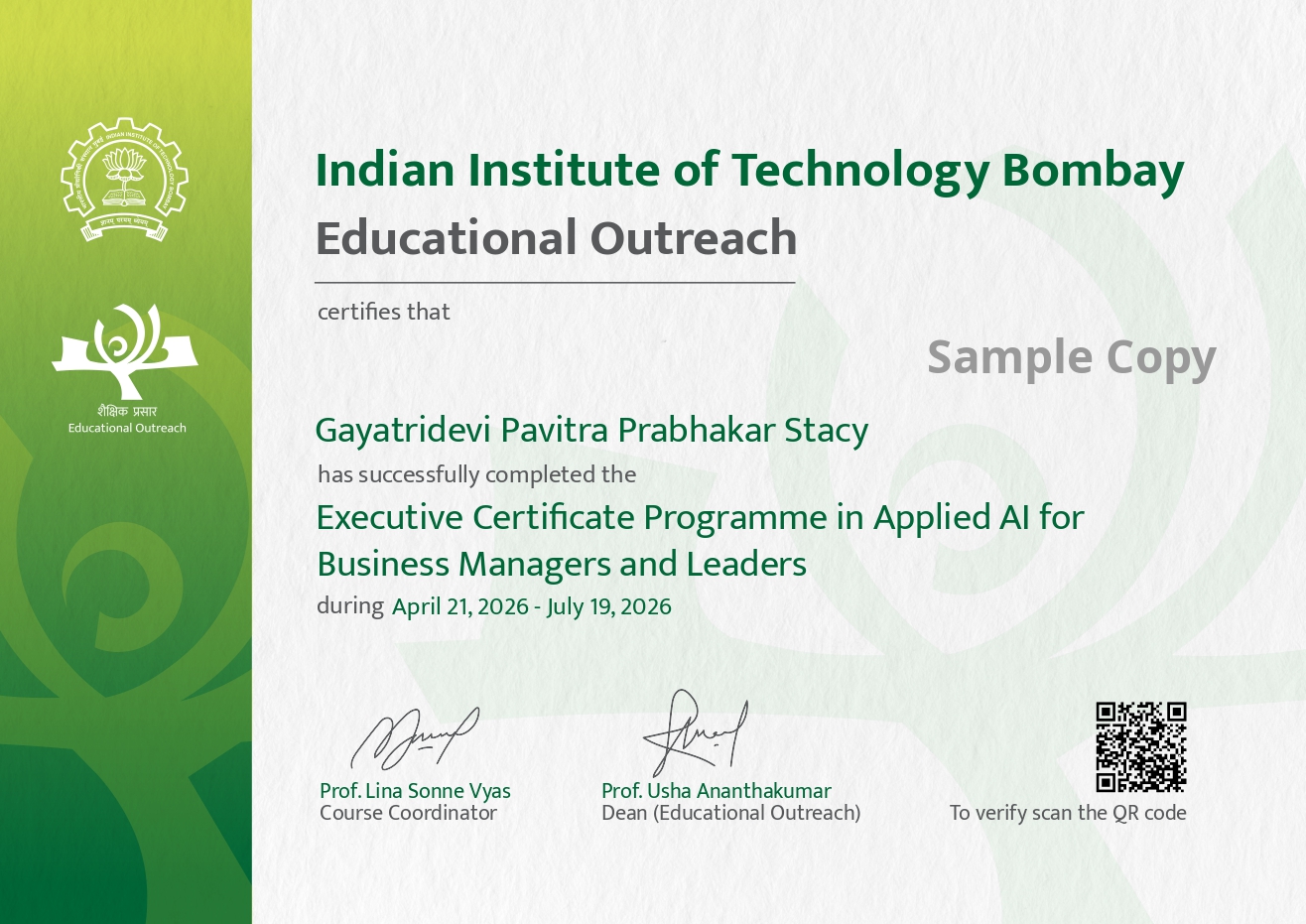
Certificate of Completion/Participation from Educational Outreach, IIT Bombay.
Programme Coordinator

The Jaro Advantage

Personalized Learning Support
- Career Acceleration: Get unmatched career guidance, resume-building workshops, and 1:1 mentorship to fast-track your professional growth.
- 24/7 Student Support: Dedicated assistance at every step—from enrollment to graduation.
- Future-Ready Learning: Engage in immersive, industry-aligned programs designed for lifelong career relevance.

Expert-Led Doubt Resolution
- Learn from the Best: Access mentorship from top-tier faculty and industry leaders.
- Collaborative Learning: Join dynamic discussion forums and peer-to-peer networks for deeper insights.
- Real-World Problem Solving: Apply knowledge through case studies and interactive sessions.

Powerful Global Networking
- Elite Alumni Community: Connect with 350,000+ professionals worldwide for career opportunities and collaborations.
- Exclusive Events: Attend global webinars, networking meetups, and industry talks.
- Lifelong Access: Stay updated with cutting-edge trends and alumni benefits long after graduation.
Unlock Your Path to Success
Unsure about which course to choose? We understand—selecting the right programme can feel overwhelming. That’s why our intuitive Course Finder is here to help you discover the perfect match based on your skills, goals, and interests. Let us guide you toward your next career milestone with confidence.
Find My Ideal Course Find My Ideal Course

Refer & Earn – Amazing Rewards Await!
Share the gift of education—refer your friends and colleagues now! Earn fantastic rewards for every successful referral and empower others to advance their careers while you benefit.
Start Referring Today! Start Referring Today!Frequently Asked Questions
The programme is designed for 6 months, combining live online sessions with immersive on-campus learning.
- Industry-relevant curriculum tailored for business leaders
- Functional AI use cases + Capstone Project
- Exposure to enterprise AI architecture and implementation
- Leadership and responsible AI focus
- Learning from faculty at IIT Bombay
This programme is best suited for:
- Functional Managers (Operations, Marketing, Finance, HR, Supply Chain, Product)
- Mid-to-Senior Level Managers (5–15 years of experience)
- Strategy & Business Development Professionals
- Project & Program Managers
- Entrepreneurs & Business Owners
- Consultants & Advisors
- Professionals transitioning into AI-enabled leadership roles
Participants will:
- Build a strong foundation in Generative AI concepts
- Apply AI use cases across HR, marketing, finance, operations, and strategy
- Master AI tools and prompt engineering
- Lead AI-driven transformation initiatives
- Manage AI risks, ethics, and governance
- Execute AI projects from pilot to scale
