Why Is Everyone Talking About the Union Budget 2026?
There were no headline-grabbing tax cuts, no dramatic giveaways, and no policy shocks. Yet among working professionals, middle-class families, and even employers, the reaction has been unusually reflective. That’s because this Budget quietly acknowledges a truth many Indians are already living with: career stability is no longer guaranteed by degrees, tenure, or loyalty alone.
Why does this Budget feel different?
Most budgets try to reassure people. Budget 2026 assumes reassurance is no longer enough.
Instead of saying “we’ll protect you”, it says:
“The world is changing — let’s prepare you for it.”
It shifts focus from safety nets to skill nets.
Why does it matter beyond numbers and allocations?
Because the real impact of Budget 2026 lies in what it expects from citizens.
This Budget:
Treats education as an economic necessity, not a social add-on
Treats skills as the new form of job security
Treats career ownership as an individual responsibility
These ideas influence how companies hire, how institutions design programmes, and how professionals plan the next 20 years of their careers.
Why should the middle class and working professionals care?
Because this Budget is designed around people already in the workforce, people juggling EMIs, upskilling costs, and the fear of becoming outdated.
If you’re working today and planning to keep working tomorrow, Budget 2026 is talking directly to you.
In Simple Terms, What Is Union Budget 2026 Trying to Do?
In simple terms, Union Budget 2026 is trying to make India’s workforce more capable, adaptable, and globally competitive — rather than financially dependent.
That single idea explains almost every major choice.
What is the government’s core economic philosophy in 2026?
The philosophy rests on three assumptions:
Low-cost labour is no longer India’s biggest advantage
Productivity matters more than population size
Skills and education are central to long-term growth
This is why the Budget prioritises:
Skill development over blanket subsidies
Education outcomes over enrolment numbers
Productivity over protection
How is the focus shifting from relief to readiness?
Earlier budgets were shaped by recovery — pandemics, slowdowns, inflation. Budget 2026 assumes that phase has largely passed.
Now the focus is readiness:
Are workers ready for changing roles?
Are industries ready for global competition?
Are education systems aligned with real jobs?
Instead of cash relief, the Budget invests in systems: skilling platforms, digital infrastructure, and industry-linked education.
What does “from protection to productivity” actually mean?
It means the government is no longer trying to protect specific jobs. It’s trying to make people employable across jobs.
In plain English:
Your income growth is expected to come from your skillset, not your place of work.
How Is Budget 2026 Different From Previous Budgets?
Union Budget 2026 doesn’t reject earlier priorities — it reframes them.
Focus Area
Budgets 2023–2025
Union Budget 2026
Overall mindset
Recovery & stability
Readiness & competitiveness
Middle-class approach
Relief & exemptions
Stability + skill enablement
Education focus
Access & expansion
Employability & outcomes
Skilling strategy
Broad schemes
Targeted, tech-enabled
Job creation
Capex-led
Industry + skills-linked
Learning model
One-time degrees
Lifelong learning
What has clearly changed?
Education is now judged by outcomes, not intake
Careers are assumed to be non-linear
Learning is assumed to be continuous
What has stayed the same?
Fiscal discipline still matters
Infrastructure and manufacturing remain priorities
Digital transformation continues
The difference is that all of these now depend on human capability, not just spending.
What Does Union Budget 2026 Mean for the Indian Middle Class?
For the middle class, Budget 2026 is about earning power — not instant comfort.
That’s why reactions feel mixed.
Why is there no big tax relief?
Because the government appears to believe:
Predictability beats giveaways
Structural growth beats temporary relief
Income growth should come from productivity
So instead of sweeteners, the Budget offers stability, and expects households to build growth on top of it.
*BJP’s Facebook Profile
Stability vs comfort: what’s the difference?
Here’s the clear difference:
Comfort lowers expenses temporarily
Stability improves your ability to earn consistently
Budget 2026 chooses stability.
What does the government implicitly expect from the middle class?
Reading between the lines, the expectation is clear:
Keep learning
Stay adaptable
Take ownership of career growth
The state builds the ecosystem. The individual uses it.
Why Does the Middle Class Feel More Financially Pressured Despite Economic Growth?
Because the cost of staying relevant is rising faster than incomes. The pressure is not only financial; it is tied closely to shifting career stability.
Why does career insecurity feel constant?
Because experience drives relevance, but the pace of change demands constant growth.
Automation reshapes roles
AI compresses job functions
Skills age faster than before
Even well-employed professionals feel one upgrade behind.
Why does education feel more expensive?
Education becomes a continuous journey and a series of milestones.
Middle-class spending now includes:
Certifications every few years
Online and executive education
Skill upgrades to avoid stagnation
This spending is usually mid-career, self-funded, and unavoidable.
Why is EMI-based learning becoming normal?
Because learning has become career insurance.
Budget 2026 indirectly legitimises this reality by supporting flexible, digital, and modular education pathways.
Is Education the Real Winner in Union Budget 2026?
The Budget’s focus on digital systems, skilling, and workforce readiness naturally aligns with online and blended learning.
Why does flexibility matter for professionals?
Most professionals cannot:
Quit jobs to study
Pause income to reskill
Online and executive formats allow:
Learning without career breaks
Immediate workplace application
Readers exploring this shift can start with a free course in management consulting to understand expectations before committing to long-term programmes.
Why do industry-aligned credentials matter?
Because credibility now depends on recognition, not just certificates.
Why Are Working Professionals the Silent Focus of Budget 2026?
India’s next phase of growth is being shaped by people who are already at work. Professionals who bring experience, judgment, and the ability to adapt are becoming the strongest drivers of progress.
Fresh graduates play an important role. They bring new ideas and energy into the system. But real impact builds over time. Productivity increases with exposure, and leadership grows from experience. This is why much of today’s output comes from professionals who have spent years learning on the job.
What’s changing now is how careers evolve.
More professionals are exploring new industries. Many are stepping into leadership roles after years of technical work. Others are upgrading their skills to stay aligned with fast-moving sectors. These shifts are not disruptions. They are signs of confidence and ambition in the workforce.
Budget 2026 recognises this momentum. Education is being seen as a continuous partner in a professional’s journey, supporting growth at every stage rather than only at the beginning.
India’s growth story is not about starting over.
It is about building forward with the experience we already have.
They help translate policy intent into real career outcomes. Jaro Education has transformed 3,50,000+ careers and offers 230+ professional programmes as a testament to what online education can do for anyone who wants to upskill while working.
Here’s what Jaro Education’s CEO, Ms. Ranjita Raman has to say about the Union Budget 2026:
“This Budget makes a strong and timely push towards building a workforce that is ready for the future and aligned with India’s Viksit Bharat 2047 goals. By placing skill development and industry-linked education at the core of its agenda, the government has clearly acknowledged the need to bridge the gap between learning and employability. The proposal to develop university townships near industrial corridors and to set up an Education to Employment and Enterprise Standing Committee reflects a practical, outcome-focused approach, especially for strengthening the services sector.
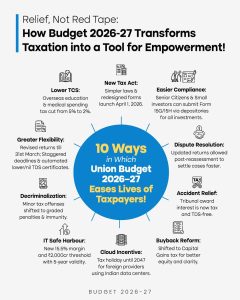
The continued emphasis on research, innovation, and digital learning will play an important role in scaling up skilling and reskilling efforts across the country. Equally important is the reduction in TCS from 5% to 2% on education and medical expenses, which will ease financial pressure on learners and working professionals and encourage greater participation in higher education and career progression.”
What Should the Middle Class Actually Do After Budget 2026?
Step 1: Audit skills honestly
Step 2: Align learning with career direction
Step 3: Build a phased learning strategy
Step 4: Treat learning as risk management
A free foundation course in Python for Data Analysis can help identify gaps before investing heavily.
Is Union Budget 2026 Good or Bad for the Middle Class in the Long Run?
It depends on how you respond.
The upside
Stable policy
Education-led growth
Better long-term employability
The trade-offs
Less immediate relief
More personal responsibility
Those who adapt benefit most.
*NewsMobile’s Facebook Profile
What Does Union Budget 2026 Tell Us About the Future of Work in India?
Here’s what Union Budget 2026 tells us:
Lifelong learning is normal
Career paths are fluid
Reskilling is continuous
Work is no longer something you “settle into”.
Final Takeaway: How Should Individuals Respond to Budget 2026?
Budget 2026 rewards preparedness, not dependency.
Learning becomes insurance
Careers require ownership
Skills decide stability
Those who evolve will thrive.
Frequently Asked Questions
Yes, for those who invest in skills and adaptability. It favours long-term earning power over short-term relief.
Strongly. Its focus on digital infrastructure and skilling legitimises online and executive learning.
Yes, especially in outcome-aligned, industry-recognised programmes.
It makes continuous learning essential for progression and relevance.
It significantly supports skill-based education as the critical factor for employability.
Shubham Lal
Lead Software Developer
Shubham Lal joined Microsoft in 2017 and brings 8 years of experience across Windows, Office 365, and Teams. He has mentored 5,000+ students, supported 15+ ed-techs, delivered 60+ keynotes including TEDx, and founded AI Linc, transforming learning in colleges and companies.
Get Free Upskilling Guidance
Fill in the details for a free consultation
Related Courses
Explore our programs
Admission Open
Post Graduate Certificate in Senior Management Programme

 February 3, 2026
 8 min read




 ChatGPT
 Perplexity
 Claude
 Grok
Grok





 Admission Open
 Admission Open
 Admission Closed
 Admission Open
 ROI Calculator