
7 Types Of Data Analysis Methods & Models
 May 5, 2023
 6 min read




Table Of Content
- Importance of Data Analysis
- Benefits of Data Analysis Methods
- Data Analysis Techniques
- Learn Data Analysis in Depth With the ePost Graduate Diploma in Advanced Business Analytics (ePGD-ABA), Offered by IIM Ahmedabad
In today’s data-driven world, businesses and researchers rely on robust data analysis methods to uncover insights and make informed decisions. Whether it is identifying customer trends, improving operation efficiency, or predicting future results, effective data analysis techniques play a major role in turning raw information into actionable intelligence. Among many approaches, the 7 types of data analysis methods, from descriptive to prescriptive, each have their very own purpose in understanding and interpreting data. One of the most common techniques is statistical analysis, where mathematical models are applied to identify patterns, correlations, and relationships within datasets. By combining these approaches to analytics, organizations can gain deeper insights, minimize risks, and drive smarter strategies with measurable results. In this blog, we will learn about the importance of data analysis, its benefits and various types of data analysis methods.
Importance of Data Analysis
The importance of data analysis methods is their ability to turn large amounts of raw information into useful insights that support decision-making. In today’s competitive environment, organizations produce data from various sources, including sales, marketing, operations, and customer interactions. Without effective data analysis techniques, this data remains scattered and unused. Statistical analysis helps reveal trends, patterns, and relationships that show the real story behind the numbers. By interpreting data accurately, businesses can make informed decisions, reduce uncertainty, and connect strategies with measurable outcomes.
*Sprinkle Data
Benefits of Data Analysis Methods
Data Analysis Techniques
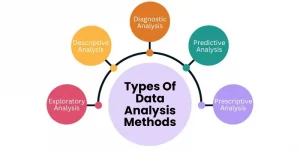
Data analysis techniques are essential for organizations to make informed, evidence-based decisions. These methods turn raw data into meaningful insights, allowing businesses to identify trends, solve problems, and predict outcomes. Each of the seven types of data analysis given below relies on specific analytical methods and tools to derive value from data.
Text analysis is a process of examining or extracting information from text data. It can come in many forms, such as web pages, news sources, emails, tweets, or reviews. There are many different methods and models that can be used for text analysis, such as topic modelling, sentiment analysis, text classification, and text clustering.
– Topic modelling is a method of identifying the main topics or themes in a collection of text data. This can be done using a technique called Latent Dirichlet Allocation (LDA).
– Sentiment analysis determines the emotional tone of a piece of text. This can be done using a technique called lexical analysis.
– Text classification comprises assigning labels or categories to texts. This can be done using a technique called support vector machines (SVM), which is a subset of machine learning.
– Text clustering is a method of grouping together similar texts. This can be done using a technique called ‘k-means clustering’, wherein different data points are assigned to a particular group, which automatically creates a cluster, as data points are clubbed together based on similar characteristics.
Learn Data Analysis in Depth With the ePost Graduate Diploma in Advanced Business Analytics (ePGD-ABA), Offered by IIM Ahmedabad
Conclusion
Frequently Asked Questions
The four main data analysis methods are descriptive, diagnostic, predictive, and prescriptive analysis. Each of these data analysis techniques interprets data in different ways, helping to understand past trends and forecast future outcomes.
Although data analysis requires technical skills such as coding and database management, it goes beyond traditional IT roles. Professionals from various fields use data analysis techniques and statistical analysis to make decisions based on evidence.
Data analysis refers to collecting, organizing, and interpreting information to find meaningful insights. By using data analysis methods and statistical analysis, organizations can make informed decisions based on data.

Find a Program made just for YOU
We'll help you find the right fit for your solution. Let's get you connected with the perfect solution.

Is Your Upskilling Effort worth it?
 ROI Calculator

Are Your Skills Meeting Job Demands?
Try our Skill Gap tool
Experience Lifelong Learning and Connect with Like-minded Professionals
Explore Jaro Connect

