 HOME > BLOG > Data Science and BI Analytics > Understand the Value of Text Mining for Unstructured Data
Understand the Value of Text Mining for Unstructured Data
 April 12, 2023
 6 min read





Table Of Content
- Text Mining Process
- How Text Mining Supports Businesses?
- Text Mining Tools
 ChatGPT
 Perplexity
 Claude
 Grok
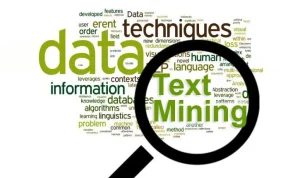
GrokText mining has become increasingly significant in today’s data-driven world, where a vast amount of data is generated daily. Businesses need to extract insights and knowledge from this data to make informed decisions.
As discussed before, the significance of text mining lies in its ability to convert unstructured data into structured data, which can be analyzed using statistical and machine-learning techniques. According to industry estimates, up to 80% of business data includes unstructured information like text. By applying text mining techniques to such data, businesses can uncover hidden patterns, relationships, and insights that were previously hidden. This can help improve decision-making, gain a competitive advantage, and identify new business opportunities.
One of the most significant applications of text mining is in the field of sentiment analysis. Sentiment analysis involves analyzing customer feedback, social media posts, and reviews to determine whether the sentiment expressed is positive, negative, or neutral. Businesses can use this information to improve their products and services. Plus, it helps to identify potential issues before they escalate.
Text mining is also used in various other applications, including fraud detection, topic modeling, recommendation systems, and more. For example, banks and financial institutions use text mining to identify potentially fraudulent transactions by assessing unstructured data from emails, chat logs, and other sources. Similarly, e-commerce platforms use text mining to analyze product reviews and recommend products to customers based on their preferences and behavior.
*MBA Knowledge Base
Text Mining Process
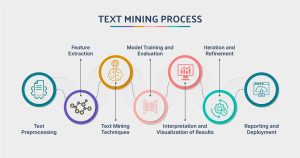
The text mining software uses NLP, which involves preprocessing with combinations of some of these text mining processes.
1. Data Collection:
The first text mining process is to collect data from various sources, such as social media platforms, news articles, customer feedback, and more. The data collected may be in various formats like text, PDFs, and HTML.
2. Cleaning:
The data collected needs to be cleaned to remove any irrelevant or unnecessary information, such as stop words, special characters, and punctuation. Cleaning ensures a standard format of the data.
3. Tokenizing:
TThe text data is divided into small units called tokens. A token can be a word or phrase.Tokenization is a critical step in text mining, as it helps to break the text into smaller units that can be analyzed.
4. Stemming:
Stemming is a text mining process that involves reducing words to their root form. This is done to reduce unique words in the data. It also ensures that words with the same root are treated as the same word.
5. Parts of Speech Tagging:
This text mining process involves labeling each word in the text data with its corresponding part of speech, such as noun, verb, adjective, and adverb. This information is used to understand the grammatical structure of the text data.
*Shiksha
Parsing Syntax:
This text mining process involves analyzing the structure of the text data. It identifies phrases and clauses and their relationships with each other. This information is used to understand the context and meaning of the text data. After going through all these or a few of these steps, data is ready to be a part of machine learning models.
How Text Mining Supports Businesses?
Text mining is a treasure for thousands of businesses, as it has numerous benefits. It helps ventures to manage various operations in a limited span. The vital fields where text mining effectively supports businesses are listed below. The text mining software uses NLP, which involves preprocessing with combinations of some of these steps.
1. Customer Relationship Management:
Text mining can help businesses analyze customer feedback, social media posts, and product reviews to understand customer sentiment, preferences, and behavior. This information can help improve customer satisfaction, identify potential issues, and develop new products and services.
2. Email Filtering:
Filtering emails is a great attribute of text mining. It filters emails by assessing the content of emails and categorizing them based on their content. This can help businesses prioritize important emails and reduce the time spent on reading irrelevant emails.
3. Human Resources:
The recruitment process can be made hassle-free with text mining. It analyses resumes and job descriptions to identify the most qualified candidates. One can scrutinize employee feedback and sentiment to improve employee satisfaction and engagement.
4. Product Development:
Identifying new product opportunities by analyzing customer feedback, social media posts, and reviews is now made easy with text mining. It can also be used to analyze competitor products and customer feedback to identify areas for improvement.
5. Competitive Marketing Analysis:
Text mining can be used to analyze competitor marketing strategies and customer feedback to identify opportunities to improve marketing campaigns and gain a competitive advantage.





Text Mining Tools
Text mining tools are important for analyzing and extracting useful insights from large amounts of unstructured text data, like emails, social media posts, reviews, or reports. These tools help organizations identify trends, sentiments, and hidden patterns in text, which supports better decision-making and communication strategies. By using techniques such as natural language processing (NLP), sentiment analysis, and keyword extraction, text mining tools turn raw text into structured, actionable information. Here are some of the most commonly used tools in this area:
- RapidMiner offers integrated text mining extensions for sentiment analysis, keyword extraction, and text classification.
- KNIME provides text processing nodes that let users clean documents, tokenize text, and efficiently model topics.
- SAS Text Miner is a strong enterprise solution for text analytics, allowing organizations to find key topics and relationships in large text collections.
- MonkeyLearn is a no-code platform that helps businesses analyze customer feedback, categorize text, and visualize results using machine learning.
- NVivo is popular in academic and qualitative research. It supports coding, analyzing, and visualizing textual and multimedia data.
- Lexalytics (Semantria) employs NLP and machine learning for sentiment analysis and entity recognition in large-scale text data.
Python (NLTK & spaCy) features programming libraries like NLTK and spaCy, which provide customizable text mining methods for tokenization, sentiment analysis, and named entity recognition.
In today’s data-driven environment, text mining tools empower businesses and researchers to understand audience behavior, automate content analysis, and improve overall data mining productivity through smarter insights.
Conclusion
Text mining is a powerful tool that can help businesses gain insights and knowledge from unstructured textual data. This empowers businesses to enhance customer satisfaction, reduce costs, and gain a competitive advantage by identifying new product opportunities and improving marketing strategies.
To learn data mining and advanced analytics, IIM Kozhikode is offering a one-year-long Professional Certificate Programme In Advanced Analytics and Business Intelligence. It is a great opportunity to gear up in Advanced analytics and achieve success in your career. Register now with Jaro Education and prepare yourself to make a difference in the world of advanced analytics and business intelligence.
Frequently Asked Questions
Text mining is the process of extracting useful information from unstructured text data through analytical and statistical techniques. Examples include sentiment analysis of customer reviews and topic detection in social media posts.
Text mining NLP (Natural Language Processing) involves using AI-powered language models to understand and process human language. It helps identify keywords, classify documents, and analyze sentiments in large text datasets.
Yes, text mining is a subset of Artificial Intelligence applied using machine learning and NLP for the interpretation of textual data. It allows computers to read and analyze human language efficiently, extracting meaning from it.





Find a Program made just for YOU
We'll help you find the right fit for your solution. Let's get you connected with the perfect solution.
Is Your Upskilling Effort worth it?
 ROI Calculator

Are Your Skills Meeting Job Demands?
Try our Skill Gap tool
Experience Lifelong Learning and Connect with Like-minded Professionals
Explore Jaro Connect

