IQ Test Questions and Answers: Number and Pattern Series
IQ Test Practice Questions for Verbal Reasoning
Key Insights
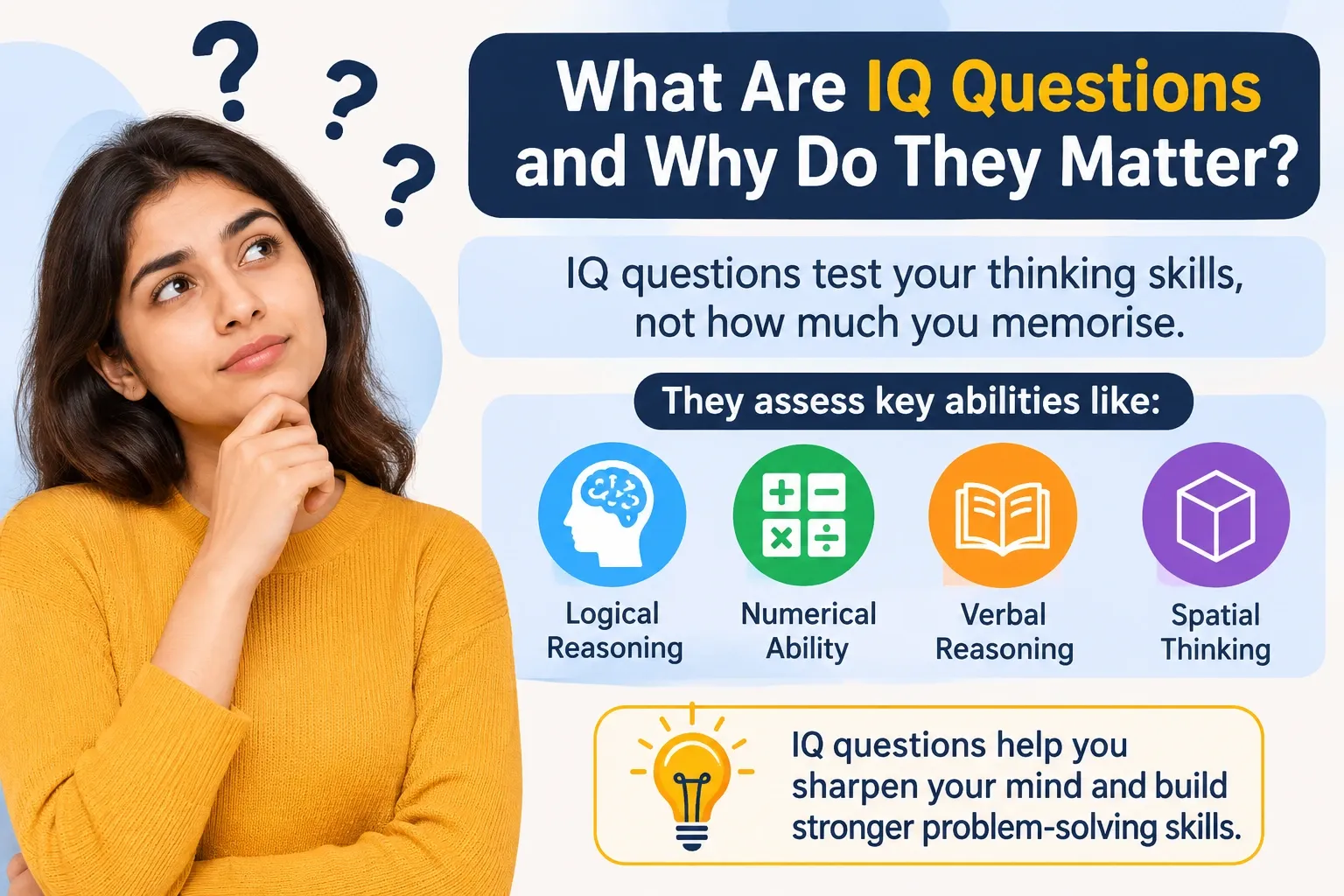
IQ questions test core thinking abilities, including logical reasoning, numerical ability, verbal reasoning, and spatial thinking.
IQ tests often progress from easier to more difficult questions and may include multiple-choice formats with time limits.
Practising number series, word relationships, mathematical puzzles, and logical deduction helps improve familiarity with different question types.
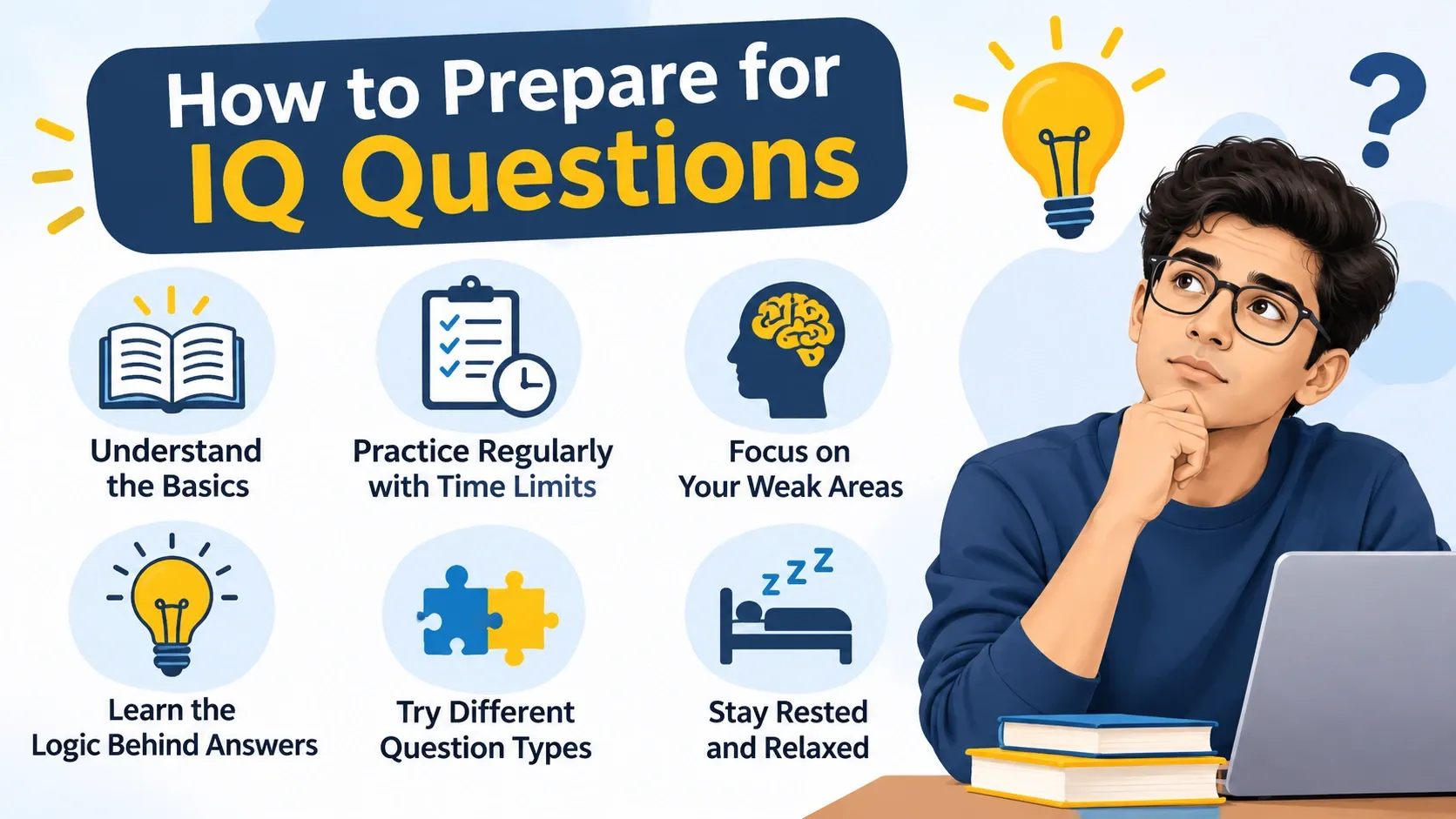
Effective preparation involves understanding solutions, practising under time limits, focusing on weaker areas, and reviewing questions regularly.
In this blog, you'll learn 20 IQ test questions and answers covering number patterns, verbal reasoning, maths, logical thinking, spatial reasoning, and lateral thinking, along with practical tips to improve your test performance.
Most people are curious about how sharp their thinking really is. Whether you are a student preparing for an aptitude exam, a job seeker facing a screening test, or simply someone who enjoys a good mental workout, practicing with well-designed IQ questions is a smart place to start. They train you to spot patterns, reason logically, and stay calm while solving unfamiliar problems. In this blog, we share 20 carefully selected IQ test questions and answers, grouped by skill type, with clear explanations so you can understand not only the solution but also the thinking behind it.
IQ stands for intelligence quotient, a score that attempts to measure reasoning ability compared with others of the same age group. IQ questions are not designed to test how much you have memorized. Instead, they examine how well you think when you meet something new.
Most tests assess a few core abilities:
Logical reasoning: finding rules and relationships between ideas.
Numerical ability: working with numbers, sequences, and basic calculations.
Verbal reasoning: understanding words, analogies, and meaning.
Spatial thinking: visualizing shapes, directions, and objects in space.
It is worth remembering that an IQ score is only one measure of ability. Creativity, emotional intelligence, and persistence matter just as much in school and at work. Think of these puzzles as a friendly way to exercise your mind, not as a final judgment on your intelligence.
Modern IQ testing questions typically begin with easy items and become more difficult as the test continues. Many are multiple choice, and most carry a time limit. A reliable approach is to read each question carefully, eliminate answers that clearly do not fit, and move on if you are stuck. Spending too long on one puzzle can cost you several easier ones later.
Now let us look at the questions themselves. Try to solve each one before reading the answer.
IQ Test Questions and Answers: Number and Pattern Series
Number series are among the most common IQ test practice questions. The goal is to find the rule that links one number to the next.
What comes next? 2, 6, 12, 20, 30, ?
Answer: 42. The differences between the numbers are 4, 6, 8, and 10, so the next difference is 12. Adding 12 to 30 gives 42.
What comes next? 3, 6, 12, 24, 48, ?
Answer: 96. Each number is double the one before it, so 48 multiplied by 2 equals 96.
What comes next? 1, 1, 2, 3, 5, 8, ?
Answer: 13. This is theFibonacci sequence, where each number is the sum of the two before it. Adding 5 and 8 gives 13.
What comes next? 2, 3, 5, 7, 11, ?
Answer: 13. These are consecutive prime numbers, meaning numbers divisible only by 1 and themselves. The next prime after 11 is 13.
What comes next? 1, 4, 9, 16, 25, ?
Answer: 36. These are perfect squares: 1², 2², 3², 4², and 5². The next is 6², which equals 36.
IQ Test Practice Questions for Verbal Reasoning
Verbal questions check your vocabulary, comprehension, and ability to see relationships between words.
Book is to reading as fork is to what?
Answer: Eating. A book is used for reading, and a fork is used for eating. The relationship is object to its main purpose.
Which one is the odd one out: apple, banana, carrot, mango?
Answer: Carrot. Apple, banana, and mango are fruits, while a carrot is a vegetable.
What is the opposite of the word “scarce”?
Answer: Abundant. Scarce means rare or in short supply, so its opposite is plentiful, or abundant.
Rearrange the letters L-E-P-A-P to form a common word.
Answer: Apple. Anagram questions test flexible thinking. Try swapping letters and looking for familiar word patterns.
All roses are flowers. Some flowers fade quickly. Can we conclude that some roses fade quickly?
Answer: No. The quickly fading flowers might not include any roses. The statements do not guarantee that conclusion, which is a classic test of logical deduction.
Free Courses
Free Business Statistics Course Online with Certificate
These puzzles often have a tempting but incorrect first answer. Slow down and check your work.
A bat and a ball cost $1.10 in total. The bat costs $1.00 more than the ball. How much does the ball cost?
Answer: 5 cents. If the ball costs 5 cents, the bat costs $1.05, and together they make $1.10. Many people say 10 cents, but then the bat would cost $1.10 and the total would be $1.20.
If 5 machines take 5 minutes to make 5 widgets, how long will 100 machines take to make 100 widgets?
Answer: 5 minutes. Each machine makes one widget in 5 minutes. So 100 machines make 100 widgets in the same 5 minutes.
A patch of lily pads doubles in size every day. It covers a whole lake in 48 days. On which day was the lake half covered?
Answer: Day 47. Because the patch doubles daily, it must have been half the size one day before covering the full lake.
A train travels 60 miles in 1.5 hours. What is its average speed?
Answer: 40 miles per hour. Speed equals distance divided by time, so 60 divided by 1.5 equals 40.
What is 15 percent of 240?
Answer: 36. Ten percent of 240 is 24, and five percent is 12. Adding them gives 36.
IQ Test Questions and Answers for Spatial and Lateral Thinking
The final group tests visualization and creative problem solving. These are often the most enjoyable IQ questions to work through.
A large cube is painted on the outside and then cut into 27 equal small cubes (3 x 3 x 3). How many small cubes have exactly two painted faces?
Answer: 12. Only the cubes on the edges, excluding the corners, have two painted faces. A cube has 12 edges, and each edge has one such middle cube.
You are facing north. You turn 90 degrees right, then 180 degrees, then 90 degrees left. Which direction are you facing now?
Answer: South. Turning right from north takes you east. A 180-degree turn points you west. Turning left from west leaves you facing south.
Triangle, square, pentagon, hexagon, ? What shape comes next?
Answer: Heptagon. Each shape has one more side than the last: 3, 4, 5, 6, and then 7 sides.
Mary’s father has five daughters named Nana, Nene, Nini, and Nono. What is the name of the fifth daughter?
Answer: Mary. The question already tells you that Mary’s father has the daughters, so Mary is the fifth. This is a good reminder to read each question carefully.
What has keys but no locks, space but no room, and allows you to enter but not go inside?
Answer: A keyboard. Lateral thinking riddles like this one reward you for looking at ordinary words in a new way.
How to Use IQ Test Practice Questions Effectively
Solving puzzles is helpful, but how you practice matters just as much. Keep these points in mind:
Understand the method, not just the answer. When you miss a question, study the explanation until the logic feels natural.
Practice under time limits. Set a timer so you become comfortable working at a steady pace.
Work on your weak areas. If number series feel difficult, spend extra time there instead of repeating what you already do well.
Stay rested and relaxed. Good sleep, a healthy meal, and a calm mind improve concentration far more than last-minute cramming.
Read every question twice. As questions 11 and 19 showed, small details often change the answer completely.
Review regularly. Short, consistent sessions work better than one long study day.
With regular practice, you will notice patterns appearing more quickly, and that growing confidence often leads to better performance on real tests.
The 20 puzzles above cover the main types of IQ testing questions you are likely to meet: number series, verbal reasoning, math and logic, and spatial thinking. Use them as a starting point, and keep exploring new IQ test questions and answers to keep your mind active. Remember that an IQ score is only a snapshot of certain reasoning skills, and your abilities can grow with curiosity and steady effort. Enjoy the challenge, learn from every mistake, and keep your thinking sharp.
Frequently Asked Questions
Most standardized tests set the average score at 100. Scores between 90 and 110 are considered average, while scores above 120 are generally seen as high. Keep in mind that scores vary slightly depending on the test used.
Practicing IQ test questions can improve your speed, familiarity with question types, and confidence, which may raise your test performance. However, experts debate how much underlying intelligence changes. Regular learning, reading, and problem-solving are still excellent habits for brain health.
Many free online tests are meant for fun and are not scientifically validated. Official assessments are administered and scored by qualified psychologists under controlled conditions. Treat online results as entertainment or practice rather than a true measure.
IQ tests can be taken at different ages, with versions designed for children, teenagers, and adults. For children, they are usually given by a licensed professional when there is a specific educational or developmental reason. Adults often take them for academic programs, job screening, or personal interest.
Bhargavi R
HR Professional
Bhargavi Reddy is an HR professional with over 6 years of experience in IT recruitment and talent acquisition. She specializes in hiring across technologies like Java, DevOps, Python, and Data Engineering. With strong expertise in full-cycle recruitment and stakeholder management, she focuses on building high-performing teams. Currently, she works as an HR Manager driving strategic hiring initiatives.
Get Free Upskilling Guidance
Fill in the details for a free consultation
Related Courses
Explore our programs
Post Graduate Certificate Programme in General Management (PGCPGM)

 November 24, 2026
 6 min read




 Key Insights
 ChatGPT
 Perplexity
 Claude
 Grok











 ROI Calculator